Understanding Uterus Involution

Updated: 3 days ago
Medically reviewed by Dr. Baraa Alnahhal, MD · Last reviewed: October 2026
Uterus involution is the natural process in which the uterus returns to its prepregnancy size and weight after childbirth [1]. It begins as soon as the placenta is delivered and takes about six weeks to complete [1]. Muscular contractions reduce bleeding and shed extra tissue, and breastfeeding triggers the release of oxytocin, a hormone that makes the uterus contract [1].
Quick Answer: What is uterus involution?
Uterus involution is the postpartum process in which the uterus shrinks from its expanded pregnancy size back to its nonpregnant size. Starting with delivery of the placenta, regular contractions reduce blood flow to the placental site and shed lochia [1]. Over about six weeks, the uterus descends back into the pelvis, shrinking from roughly grapefruit size to pear size [1].
What the research says
The uterus shrinks fastest in the first weeks. In 50 women with uncomplicated deliveries followed with three-dimensional ultrasound, median uterine body volume fell from 756 cm³ on day 1 to 440 cm³ on day 7, 253 cm³ on day 14, 125 cm³ on day 28 and 68 cm³ on day 56 (Belachew et al., Acta Obstetricia et Gynecologica Scandinavica, 2012) [2].
Evidence on breastfeeding and involution is mixed. In an ultrasound study of 91 women, breastfeeding (p = 0.04) and higher birth weight (p ≤ 0.01) were significantly related to uterine involution (Kristoschek et al., Revista Brasileira de Ginecologia e Obstetrícia, 2017) [3], whereas a study that followed 71 women for seven weeks found that breastfeeding and parity did not affect involution (Wataganara et al., Journal of Maternal-Fetal & Neonatal Medicine, 2015) [4].
Active management of the third stage of labor may reduce heavy bleeding, but the evidence is limited. A Cochrane review of 8 trials (8,892 women) found that giving a preventive uterotonic, clamping the cord early and using controlled cord traction lowered the average risk of blood loss over 1,000 mL (RR 0.34, 95% CI 0.14-0.87; 3 trials, 4,636 women), but the evidence was very low quality and the approach may increase afterpains (Begley et al., Cochrane Database of Systematic Reviews, 2019) [5].
The Timeline of Involution
Following childbirth, the uterus changes quickly in both weight and position. Healthcare providers track this progress to make sure recovery is proceeding safely.
Time After Delivery | Average Uterine Weight | Position of the Top of the Uterus (Fundal Height) |
Right after delivery | About 1,000 grams (2 pounds) [1] | Around the belly button (about 1 hour after birth) [1] |
1 week | About 500 grams [1] | About halfway between the belly button and the pubic bone [1] |
2 weeks | About 300 grams [1] | Back within the pelvic cavity (by 10 to 14 days) [1] |
4 weeks | About 100 grams [1] | Within the pelvis, approaching prepregnancy size |
8 weeks | About 60 grams (2 ounces) [1] | Roughly the nonpregnant size and weight |
After the first hour, the fundus should steadily get lower in the abdomen, by about 1 centimeter every 24 hours [1]. How big your uterus was before pregnancy depends on factors such as whether you have given birth before (most women have a slightly larger uterus after a previous birth), whether you had multiples, and how far along you were when you delivered [1].

The Role of Contractions and Oxytocin
Involution is driven by muscular contractions that begin as soon as the placenta is delivered. These contractions decrease blood flow to the area where the placenta was attached, which is the body's way of minimizing bleeding and preventing excessive bleeding (postpartum hemorrhage) [1]. They also help the uterus shrink and shed extra tissue (lochia) [1]. During the first 12 hours after birth, the contractions are regular and strong [1].
As this happens, you may feel cramps called afterpains. They are typically noticeable only for a few days after birth, and you will likely feel them most when you breastfeed or pump. Afterpains also tend to be more painful if you have given birth before [1].
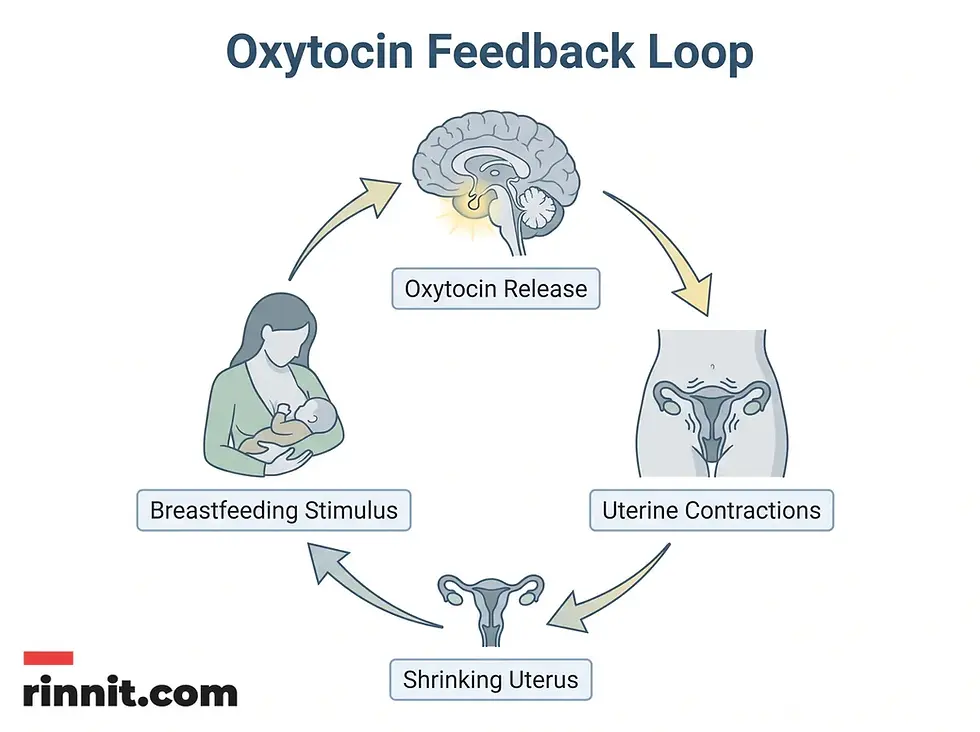
Breastfeeding plays a role in this process. When your newborn suckles, or when you pump, your body makes oxytocin, a hormone that causes the uterus to contract. For this reason, the uterus generally shrinks more rapidly if you breastfeed [1].
How Providers Check Involution
During your recovery in the hospital, a healthcare provider will check the progress of involution. They will press on your belly to check your fundal height and to see whether the fundus feels firm, and they will check your lochia [1].
If your uterus is not involuting as expected or feels soft, you are at increased risk for postpartum hemorrhage [1]. Your provider will likely do a fundal massage to help the uterus contract, and may give you manufactured oxytocin (Pitocin) to help stimulate contractions [1].
Potential Complications
Involution is a natural process, but certain conditions can interfere with it. The two main issues are subinvolution and postpartum hemorrhage.
Subinvolution
Subinvolution means the uterus is not decreasing in size as it should. Your provider may suspect it after a fundal exam. Having lochia rubra (red, bloody discharge) for more than one week after delivery is also a sign, and your provider may recommend an ultrasound to see what is happening [1]. Causes include:
Uterine infections, such as endometritis
Remaining debris in the uterus, such as fragments of the placenta
Prolonged labor, or prolonged exposure to oxytocin (Pitocin) to help the uterus contract
Cesarean (C-section) delivery
General anesthesia, such as for an emergency C-section [1]
Postpartum Hemorrhage
Postpartum hemorrhage (PPH) is excessive uterine bleeding after childbirth and can be life-threatening. About 80% of cases happen because uterine contractions are not strong enough after birth [1]. PPH usually occurs within 24 hours of childbirth, but it can happen up to 12 weeks after delivery [1]. While you recover in the hospital, your healthcare team will check your bleeding often and act quickly if you hemorrhage. If you have excessive bleeding at home, get to the nearest emergency room as soon as possible [1].
Managing Recovery at Home
During the postpartum period, it is important to rest and take care of yourself, not just your baby. Lean on loved ones to help with the baby so you have time for self-care.
Afterpains can be intense, especially during breastfeeding. You may feel strong cramping that lasts about five minutes and then gradually eases [1]. Ways to manage afterpains include:
Breathing and relaxation exercises, like the ones that help with labor pains
Lying on your stomach with a pillow under your lower belly
An over-the-counter pain reliever that your healthcare provider recommends (ibuprofen may work better than acetaminophen) [1]
Walking

When to Get Medical Help
Contact your healthcare provider, or go to the nearest emergency room for heavy bleeding, if you notice:
Excessive bleeding, such as soaking through a pad in an hour or passing large clots
Red, bloody discharge (lochia rubra) that lasts longer than one week [1]
Foul-smelling vaginal discharge
A fever above 100.4°F (38°C), especially with chills or feeling unwell
Conclusion
Uterus involution is a remarkable example of the body's ability to heal and adapt after pregnancy. By understanding the timeline and the role of contractions and oxytocin, new parents can better navigate the postpartum period. While most recoveries proceed naturally, the frequent check-ins after birth matter because they help catch complications such as subinvolution and postpartum hemorrhage early, so that any needed medical support can be provided promptly.
Frequently Asked Questions
What is uterus involution?
Uterus involution is the natural process of the uterus returning to its prepregnancy size and weight after childbirth.
How long does uterus involution take?
The process takes about six weeks to complete. By around eight weeks the uterus weighs about 60 grams, close to its nonpregnant weight.
What are afterpains?
Afterpains are postpartum cramps caused by the uterus contracting as it shrinks. They are typically noticeable for a few days after birth and are felt most during breastfeeding or pumping.
Does breastfeeding help the uterus shrink?
In general, yes. When your newborn suckles, your body releases oxytocin, which makes the uterus contract, so it tends to shrink more rapidly. Research findings on the size of this effect are mixed.
What is fundal height?
Fundal height is the position of the top of the uterus (the fundus), checked by pressing on the belly. It sits around the belly button soon after birth and lowers by about 1 centimeter a day, so that by about two weeks it usually can no longer be felt above the pubic bone.
What is subinvolution?
Subinvolution is when the uterus does not decrease in size as expected. Red, bloody discharge (lochia rubra) lasting more than a week can be a sign, and a provider may recommend an ultrasound.
What causes postpartum hemorrhage?
About 80% of cases happen because uterine contractions are not strong enough after birth. It usually occurs within 24 hours of childbirth but can happen up to 12 weeks after delivery.
How can I manage postpartum cramps?
Options include breathing and relaxation exercises, lying on your stomach with a pillow under your lower belly, walking, and an over-the-counter pain reliever your provider recommends (ibuprofen may work better than acetaminophen).
When should I worry about postpartum bleeding?
Get medical help right away for excessive bleeding, such as soaking through a pad in an hour or passing large clots. Also contact your provider for foul-smelling discharge or a fever.
What is lochia?
Lochia is the normal vaginal bleeding and discharge after childbirth, made up of blood, mucus and uterine tissue shed as the uterus involutes.
Related Reading
Understanding Lochia: Your Guide to Postpartum Recovery explains normal bleeding and discharge after giving birth.
Uterine Atony: Understanding Postpartum Muscle Tone and Recovery covers a uterus that does not contract well after birth.
Retained Products of Conception (RPOC): Symptoms, Causes, and Treatment explains leftover pregnancy tissue that can slow uterine recovery.
Understanding the Uterus describes the anatomy and function of the uterus.
References
Cleveland Clinic. Uterus Involution. Cleveland Clinic. Last updated May 7, 2025. https://my.clevelandclinic.org/health/body/22655-uterus-involution
Belachew J, Axelsson O, Mulic-Lutvica A, et al. Longitudinal study of the uterine body and cavity with three-dimensional ultrasonography in the puerperium. Acta Obstetricia et Gynecologica Scandinavica. 2012;91(10):1184-1190. PMID 22497320. https://doi.org/10.1111/j.1600-0412.2012.01418.x
Kristoschek JH, Moreira de Sá RA, Silva FCD, et al. Ultrasonographic Evaluation of Uterine Involution in the Early Puerperium. Revista Brasileira de Ginecologia e Obstetrícia. 2017;39(4):149-154. PMID 28371959. https://doi.org/10.1055/s-0037-1601418
Wataganara T, Phithakwatchara N, Komoltri C, et al. Functional three-dimensional sonographic study of the postpartum uterus. The Journal of Maternal-Fetal & Neonatal Medicine. 2015;28(18):2221-2227. PMID 25363015. https://doi.org/10.3109/14767058.2014.983063
Begley CM, Gyte GM, Devane D, et al. Active versus expectant management for women in the third stage of labour. Cochrane Database of Systematic Reviews. 2019;2(2):CD007412. PMID 30754073. https://doi.org/10.1002/14651858.CD007412.pub5
Medical disclaimer
The information provided in this article is for educational purposes only and should not be used as a substitute for professional medical advice, diagnosis, or treatment. Always seek the advice of your physician or other qualified health provider with any questions you may have regarding a medical condition.



Comments