Understanding the Navel: Anatomy, Function, and Care of the Belly Button

Updated: 2 days ago
Medically reviewed by Dr. Baraa Alnahhal, MD · Last reviewed: October 2026
The navel, commonly known as the belly button, is a permanent scar marking the site where the umbilical cord was attached during fetal development [1]. While it performs no active physiological function in adults, it serves as a critical anatomical landmark for medical examinations and a potential access point for minimally invasive surgeries [1]. The navel can also be an indicator of underlying health issues, such as hernias or infections [1]. Proper hygiene, including regular cleaning and drying, is essential to prevent the buildup of debris and the development of unpleasant odors or infections.
Quick Answer: What is the navel?
The navel, or belly button, is a pushed-in scar on the abdomen that forms after the umbilical cord falls off after birth [1]. It serves as a landmark for dividing the abdomen during exams and as a surgical access point [1]. Navels are innies or outies [1]. Gentle cleaning with soap and water prevents infections, yeast buildup and belly button stones.
What the research says
Most children's umbilical hernias can be watched. A systematic review of 787 manuscripts (28 met inclusion criteria) found that expectant management of asymptomatic umbilical hernias until age 4-5 years, regardless of the size of the defect, is safe and is standard practice at many pediatric hospitals (Zens et al., Journal of Pediatric Surgery, 2017) [2].
Cord care protects newborns from navel infection. In a Cochrane review of 12 trials, pooled data from three community trials showed that chlorhexidine cord cleansing, compared with dry cord care, reduced neonatal mortality (risk ratio 0.81; 95% CI 0.71-0.92) and omphalitis or infection (risk ratio 0.48; 95% CI 0.40-0.57) (Sinha et al., Cochrane Database of Systematic Reviews, 2015) [3].
Single-port surgery through the navel has trade-offs. A meta-analysis of 48 randomized trials (2,838 single-incision and 2,956 conventional multiport gallbladder operations) found a higher incisional hernia risk with the single-incision approach (relative risk 2.51; 95% CI 1.23-5.12) and a longer operation (mean difference 15.27 minutes; 95% CI 9.67-20.87), with no significant difference in pain scores or overall complication rate (Lyu et al., Surgical Endoscopy, 2019) [4].
Anatomical Significance and Classification
The navel is situated at the exact center of the abdomen, serving as the junction where the four abdominal quadrants meet [1]. This central positioning makes it an invaluable reference point for healthcare providers when diagnosing conditions that affect specific areas of the belly, such as appendicitis in the lower right quadrant [1]. Beyond its location, the navel's appearance is unique to each individual, primarily categorized into two informal types: the "innie" (an indention) and the "outie" (protruding skin) [1].
Medical professionals use the SHAPE classification system to describe the navel in detail, which is particularly important for reconstructive surgeries [1]. This system evaluates several factors to determine the navel's structural characteristics.
SHAPE Criteria | Description |
Shape | Whether the navel is round, T-shaped, or a vertical/horizontal oval [1]. |
Hood | The presence and extent of an overhanging flap of skin [1]. |
Adiposity | Whether and how fat under the skin affects the navel's appearance [1]. |
Protrusion | Whether the internal skin of the navel sticks out [1]. |
Position | The degree to which the navel is perfectly centered [1]. |
Ptosis | The amount of drooping present in the navel opening [1]. |
External piercing | Whether the navel has any piercings [1]. |

Medical Roles and Access Point
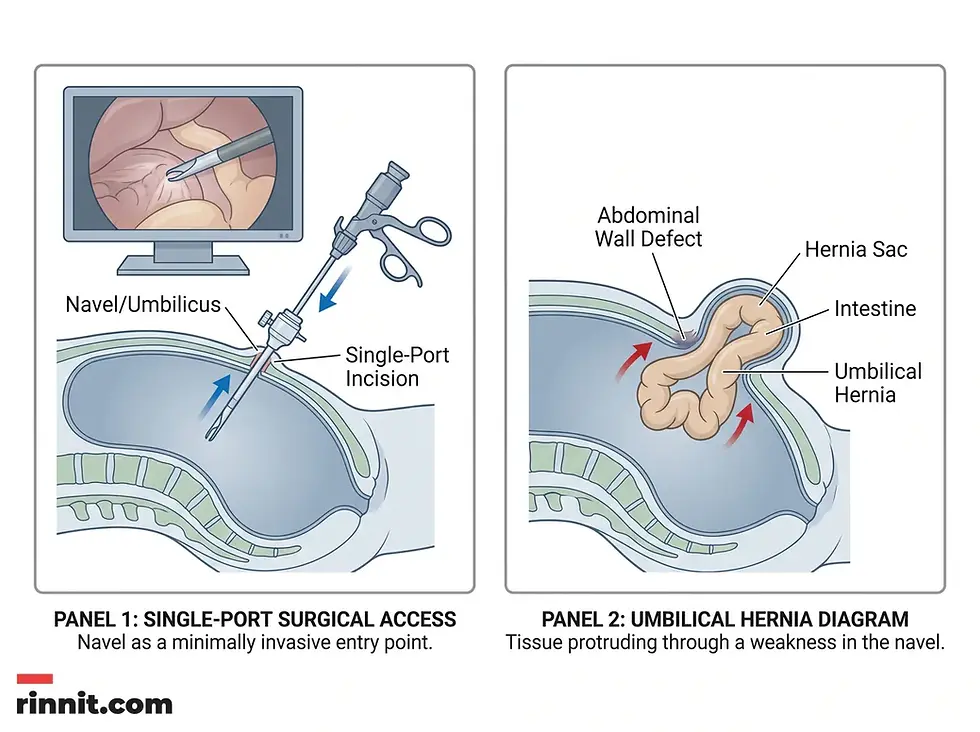
Although the navel does not perform metabolic or mechanical tasks, it remains medically significant throughout life. In newborns, the umbilical vein and arteries in the cord stump provide a vital access point for catheters (IV lines) [1]. For adults, the navel has become a preferred site for single-port surgery, a technique that allows surgeons to perform internal procedures through the navel to minimize visible external scarring [1].
Furthermore, the navel can provide visual clues about internal health. Certain conditions, such as portal hypertension, can cause the veins around the navel to swell, a sign known as caput medusae. It can also be the site of umbilical hernias, where internal tissue bulges through a weak point in the abdominal wall. A hernia that becomes painful, firm, discolored or cannot be pushed back in, especially with vomiting, needs emergency care.
Hygiene, Odor, and Care
The deep creases of the navel can trap lint, hair, sweat, and dead skin cells [1]. If not cleaned regularly, these materials can accumulate and lead to unpleasant odors or the formation of omphaloliths, also known as belly button stones [1]. These hardened clumps of debris can cause irritation and increase the risk of yeast or bacterial infections [1].
Proper care is straightforward and can be incorporated into a regular bathing routine. Using a fingertip with soap and water is usually sufficient to clean the area [1]. It is equally important to rinse the navel thoroughly and dry it completely, as trapped moisture can encourage the growth of germs [1].

Conclusion
The navel is far more than a remnant of birth; it is a functional landmark and a window into abdominal health. By understanding its anatomy and maintaining consistent hygiene, individuals can prevent common issues like infections and stones. Recognizing changes in the navel's appearance or comfort level is a key part of monitoring overall wellness.
Take Action for Navel Health
Clean Regularly: Use gentle soap and water during your daily shower to clear away lint and skin oils [1].
Dry Thoroughly: Always use a towel to remove excess moisture from the navel after bathing to prevent yeast growth.
Watch for Changes: Consult a provider if you notice new pain, unusual odors, redness, or discharge from your belly button.
Frequently Asked Questions
What is the navel?
The navel is a scar left behind after the umbilical cord falls off after birth.
What is an 'innie' vs. an 'outie'?
An innie is a pushed-in indention, while an outie has skin that protrudes slightly.
Why does my belly button smell?
Odors are usually caused by trapped lint, sweat, oils, and dead skin cells.
What are belly button stones?
Also called omphaloliths, these are hardened clumps of debris that accumulate in the navel.
How should I clean my belly button?
Gently use soap, water, and your fingertip, then rinse and dry thoroughly.
Can the navel indicate health problems?
Yes, changes can signal hernias, infections, or even internal issues like liver disease.
What is an umbilical hernia?
An umbilical hernia is a condition where internal tissue bulges through a weak spot near the navel.
Why is the navel used in surgery?
The navel's natural indention makes it an ideal spot for 'hidden' surgical incisions.
Is a navel piercing safe?
While common, piercings require strict hygiene to avoid infections and keloid scarring.
When should I see a doctor for navel pain?
Seek help if pain is persistent, worsening, or accompanied by redness and discharge.
Related Reading
Umbilical Hernia in Babies and Adults: When It Closes on Its Own and When Surgery Is Needed explains belly button hernias in babies and adults and their repair.
What Is a Belly Button Yeast Infection? Symptoms, Causes, and Treatment covers belly button yeast infections and how to treat them.
Omphalitis Guide: Understanding and Treating Umbilical Cord Infections in Newborns explains umbilical stump infection in newborns and urgent warning signs.
What is an Umbilical Granuloma? describes the small moist growth that can form after cord loss.
References
Cleveland Clinic. Navel (Belly Button). Cleveland Clinic. Last updated June 25, 2025. https://my.clevelandclinic.org/health/body/navel-belly-button
Zens T, Nichol PF, Cartmill R, et al. Management of asymptomatic pediatric umbilical hernias: a systematic review. Journal of Pediatric Surgery. 2017;52(11):1723-1731. PMID 28778691. https://doi.org/10.1016/j.jpedsurg.2017.07.016
Sinha A, Sazawal S, Pradhan A, et al. Chlorhexidine skin or cord care for prevention of mortality and infections in neonates. Cochrane Database of Systematic Reviews. 2015;(3):CD007835. PMID 25739381. https://doi.org/10.1002/14651858.CD007835.pub2
Lyu Y, Cheng Y, Wang B, et al. Single-incision versus conventional multiport laparoscopic cholecystectomy: a current meta-analysis of randomized controlled trials. Surgical Endoscopy. 2019;34(10):4315-4329. PMID 31620914. https://doi.org/10.1007/s00464-019-07198-8
Medical disclaimer
The information provided in this article is for educational purposes only and should not be used as a substitute for professional medical advice, diagnosis, or treatment. Always seek the advice of your physician or other qualified health provider with any questions you may have regarding a medical condition.



Comments