Omphalitis Guide: Understanding and Treating Umbilical Cord Infections in Newborns

Updated: 2 days ago
Medically reviewed by Dr. Baraa Alnahhal, MD · Last reviewed: October 2026
Quick Answer: Omphalitis at a Glance
Omphalitis is a bacterial infection of the umbilical stump and nearby tissue in newborns, most often caused by Staphylococcus aureus. [1] Signs include redness, hardened skin, discharge and tenderness at the navel, usually within the first week or two. [1] Treatment is usually IV antibiotics [1], and keeping the stump clean and dry helps prevent it. [1] [2]
Feature | Details |
Definition | Bacterial infection of the umbilical stump and nearby soft tissue. [1] |
Common signs | Redness or discoloration, thick or hard skin, yellowish and sometimes foul-smelling discharge, and tenderness at the navel. [1] |
Primary cause | Bacteria, most often Staphylococcus aureus. [1] |
How common | Less than 1% of babies in high-income countries; up to 6% in low- and middle-income countries. [1] |
Typical timing | Signs usually appear within the first week or two after birth. [1] |
Treatment | Antibiotics, usually IV, with a short hospital stay for most babies. [1] |
Prevention | Keep the stump clean and dry until it falls off on its own. [2] |
What the research says
Omphalitis is usually a mild, localized infection. A study across 28 pediatric emergency departments looked at 566 infants aged 90 days or younger with omphalitis (median age 16 days). Of these, 95% looked well and 11% had a fever. Blood, urine and spinal fluid cultures grew a germ in only about 1% of the infants tested, while cultures from the infected site grew bacteria in 85%, most often methicillin-sensitive Staphylococcus aureus (62%). Most infants (88%) were hospitalized, 2.1% developed sepsis or shock, and there was 1 death. Serious complications occurred only in infants younger than 28 days. (Kaplan et al., Pediatrics, 2022) [3]
Cord antiseptics help in community settings, but not clearly in hospitals. A Cochrane review of 34 trials covering 69,338 babies found that, in three large community trials in developing countries (54,624 babies), applying chlorhexidine to the cord lowered all-cause newborn deaths by 23% (risk ratio 0.77, 95% CI 0.63 to 0.94) and reduced omphalitis by 27% to 56%, depending on severity. In hospital settings, no antiseptic lowered omphalitis more than dry cord care. (Imdad et al., Cochrane Database Syst Rev, 2013) [4]
What Is Omphalitis?
Omphalitis is an infection of the soft tissues of a newborn's umbilical cord stump and the area around it. [1] The stump is the short piece of cord that remains after a healthcare provider cuts the cord following delivery. [1] Normally it dries up, shrinks, changes color from yellowish-green to brown to black, and falls off painlessly by the time the baby is about three weeks old, leaving the belly button. [1] [2]
Rarely, bacteria infect the stump before it falls off. [1] This is serious, because infections in newborns can progress quickly and lead to complications without prompt treatment. [1] Experts estimate that omphalitis affects less than 1% of babies in high-income countries like the U.S., but up to 6% of babies in low- and middle-income countries. [1]
What are the symptoms of omphalitis in newborns?
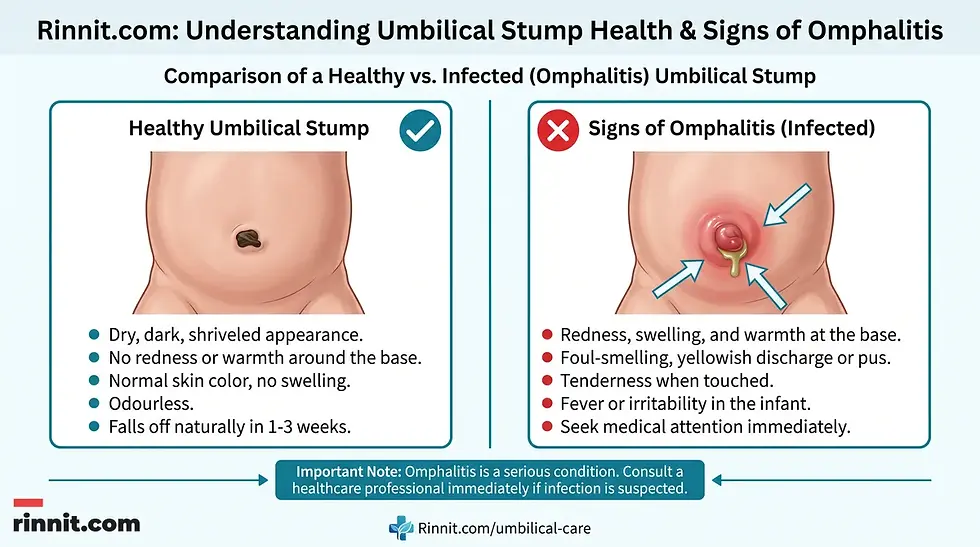
Check your baby's navel area every day during the first weeks of life. Signs of omphalitis usually appear around the base of the stump within the first week or two after birth. [1]
Localized Signs of Infection
The most common signs show up right at the base of the stump:
Systemic Warning Signs
If the infection spreads, your baby may show signs of illness in the whole body:
Call your pediatrician right away if your newborn has any of these signs. Because omphalitis and other newborn infections can progress quickly, your baby may be sent directly to the emergency room or hospital for urgent evaluation and treatment. [1]

Normal vs. Infected Umbilical Stump
What causes omphalitis, and which newborns are at risk?
Omphalitis is a bacterial infection, and Staphylococcus aureus (staph) is the most common culprit. [1] Several factors can raise a baby's risk.
Delivery and Hygiene Factors
Medical and Biological Risks

How is omphalitis diagnosed and treated?
Providers diagnose omphalitis with a thorough physical exam. [1] They check your baby's vital signs and breathing and look closely at the stump for signs of infection and other conditions. [1]
Diagnostic Testing
Depending on what the exam shows, your baby's provider may take a sample of any drainage from the stump for a bacteria culture. [1] Blood and urine tests may show whether the infection has spread or point to other causes of illness. [1] Some babies also need an ultrasound to identify or rule out urachal abnormalities, which are problems affecting the area between the stump and the bladder. [1]
The Treatment Process
Antibiotics can effectively treat omphalitis. [1] Most babies need a short hospital stay to receive intravenous (IV) antibiotics so the infection is treated quickly. [1] Your baby's provider will explain which antibiotics they recommend and for how long. [1] A small number of babies need a minor surgical procedure to clean out damaged and infected tissue when complications develop. [1]
What are the complications and outlook of omphalitis?
Omphalitis complications are rare in the U.S. but can quickly become an emergency [1], although most babies recover well with antibiotics and have no long-term problems. [1] They include:
In general, babies in the U.S. recover well from omphalitis. [1] It is usually an uncomplicated infection that clears with antibiotics, and most babies have no long-term health problems. [1]
How should you care for the umbilical cord stump at home?
Healthcare providers use strict cleanliness during delivery and sterilized scissors to cut the cord, and they show parents how to care for the stump at home. [1] At home:
Keep it clean and dry. The American Academy of Pediatrics says there is no need to use alcohol on the stump. [2]
Fold the diaper below the stump so urine does not soak it. [2]
Wash your hands before handling your baby and the stump.
Expect a few drops of blood around the time the stump falls off. [2] Call your baby's doctor right away if it actively bleeds. [2]
Call your pediatrician if your baby has any sign of omphalitis, has a fever over 100.4°F (38°C), still has the stump three weeks after birth, or has continued bleeding or oozing from the stump. [1]
What is the bottom line on omphalitis?
Omphalitis is a serious but highly treatable infection. Keeping the umbilical stump clean and dry, and acting fast on redness, discharge, tenderness, or fever, gives your baby the best chance of a quick and full recovery. When in doubt, call your pediatrician. There is no question too small when it comes to a newborn.
Want more newborn and child health guides? Explore more plain-language health information at Rinnit.com.
Frequently Asked Questions
Is omphalitis common?
No. It affects less than 1% of babies in high-income countries like the U.S. [1], though it affects up to 6% of babies in low- and middle-income countries. [1]
How do I know if the umbilical stump is just healing or infected?
A healing stump dries up, shrinks, and darkens from yellowish-green to brown to black, with normal-colored skin around it. [1] An infected stump has redness or discoloration around its base and may leak yellowish, foul-smelling fluid. [1] [2]
What is the most common cause of omphalitis?
It is most often caused by the bacteria Staphylococcus aureus. [1]
Does my baby need to stay in the hospital for omphalitis?
Usually, yes. Most babies need a short hospital stay to receive IV antibiotics so the infection is treated quickly. [1] Your baby's provider will explain what is needed.
Can I prevent omphalitis at home?
You can lower the risk by keeping the stump clean and dry, folding the diaper below it [2], and washing your hands before handling your baby. Follow your provider's guidance on stump care and call early if anything looks off.
Is a foul smell always a sign of infection?
A foul-smelling discharge is a warning sign. [1] [2] Call your pediatrician if you notice it, especially together with redness or tenderness, rather than trying to decide at home.
What happens if the stump doesn't fall off after three weeks?
Call your pediatrician. A stump that still looks normal but has not fallen off by about three weeks should be checked. [1] [2]
Can omphalitis happen after the stump falls off?
Omphalitis is an infection of the stump and nearby tissue, so it is mostly seen in the first week or two, before the stump falls off. [1] Keep an eye on the navel until it has healed, and call your pediatrician if you see redness, discharge, or bleeding or oozing that continues.
Is omphalitis contagious?
Omphalitis is a local infection of the baby's stump, not a respiratory illness like the flu. Staph bacteria can still spread through contact, so washing your hands before handling your baby and the stump is important.
What is a lotus birth and why is it a risk?
In a lotus birth, the umbilical cord is not cut and stays attached to the placenta until it separates on its own. [1] Cleveland Clinic lists it as a risk factor for omphalitis. [1]
Does omphalitis cause long-term problems?
Usually not. Most babies who are treated promptly recover well and have no long-term health issues. [1]
Can breastfeeding help prevent omphalitis?
Breastfeeding supports a newborn's overall health, but it does not replace good cord care. The main ways to lower risk are clean delivery practices, keeping the stump clean and dry, and getting prompt care for any warning signs.
What should I do if my baby has a fever but the navel looks fine?
Call your pediatrician right away. A temperature over 100.4°F (38°C) in a newborn needs prompt medical attention even if the navel looks normal. [1]
Are there different types of omphalitis?
It ranges from a mild, localized infection of the skin around the stump to a more serious infection that spreads to the bloodstream or deeper tissues. [3]
Can I use alcohol to clean the umbilical stump?
The American Academy of Pediatrics says there is no need to use alcohol on the stump. [2] Just keep it clean and dry, and keep the diaper folded below it. [2]
Related Reading
The Umbilical Cord: Function, Anatomy, and Newborn Care explains the umbilical cord and how to care for the stump.
What is an Umbilical Granuloma? explains a common moist lump at the belly button after the cord falls off.
Sepsis: Complete Guide to Symptoms, Causes, Risks, and Treatment explains sepsis, a serious complication of untreated infection.
Cellulitis: Symptoms, Causes, Diagnosis and Treatment — What You Need to Know explains skin infections that cause spreading redness and swelling.
References
Cleveland Clinic. Omphalitis. Cleveland Clinic. Updated April 4, 2024. https://my.clevelandclinic.org/health/diseases/omphalitis
American Academy of Pediatrics. Umbilical Cord Care in Newborns. HealthyChildren.org. Updated July 6, 2025. https://www.healthychildren.org/English/ages-stages/baby/bathing-skin-care/Pages/Umbilical-Cord-Care.aspx
Kaplan RL, et al. Omphalitis and Concurrent Serious Bacterial Infection. Pediatrics. 2022;149(5):e2021054189. PMID 35441224. https://doi.org/10.1542/peds.2021-054189
Imdad A, et al. Umbilical cord antiseptics for preventing sepsis and death among newborns. Cochrane Database Syst Rev. 2013;2013(5):CD008635. PMID 23728678. https://doi.org/10.1002/14651858.CD008635.pub2
Medical disclaimer
This article is for general informational purposes only and does not constitute medical advice. Always consult a qualified healthcare professional for diagnosis and treatment decisions. A fever of 100.4°F (38°C) or higher in a newborn, or redness, discharge, or swelling around the umbilical stump, needs urgent medical care.



Comments