Understanding the Human Airway: Anatomy, Function, and Health

Updated: 2 days ago
Medically reviewed by Dr. Baraa Alnahhal, MD | Last reviewed: October 7, 2026
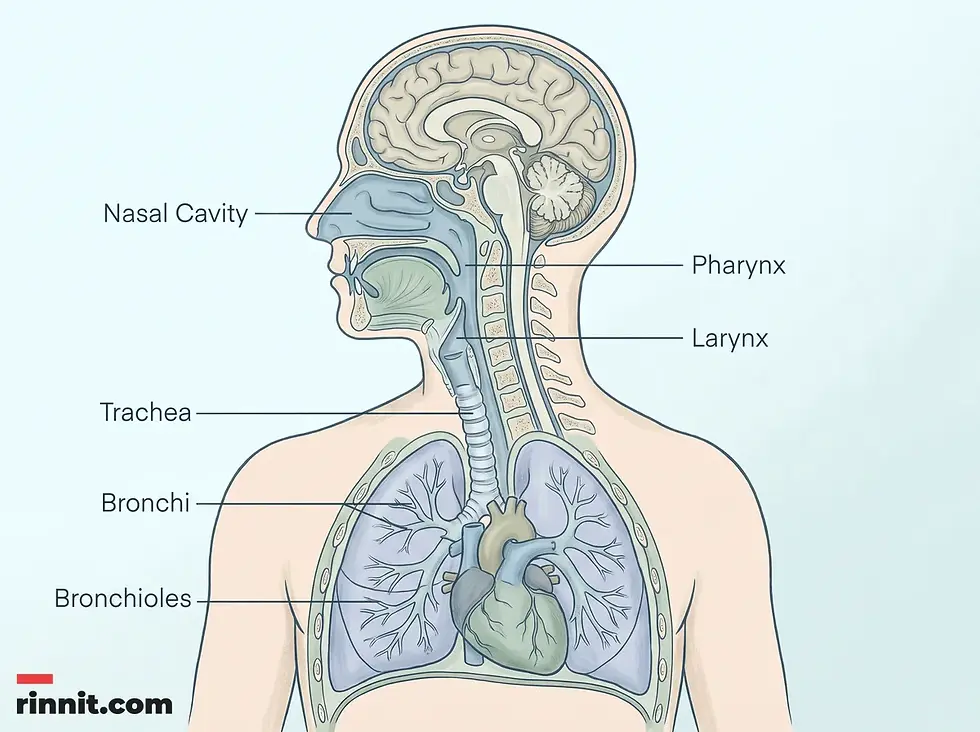
Quick Answer: What is the human airway?
The human airway is the series of passages that move air into and out of the lungs, divided into the upper airway, including the nose, sinuses, pharynx and larynx, and the lower airway, including the trachea, bronchi and bronchioles. [1] It also warms and moistens air, traps irritants and enables speech. [1] Common problems include infections, asthma and COPD. [1]
What the research says
COPD, a common chronic airway disease, affects roughly one in ten adults aged 30–79 worldwide, and smoking multiplies the risk. A systematic review and modelling analysis of 162 articles (260 sites in 65 countries) estimated a 2019 global COPD prevalence of 10.3% (95% CI 8.2–12.8), or 391.9 million people, among adults aged 30–79 using the GOLD definition. Current smokers had 3.2 times the odds of COPD (95% CI 2.5–4.0) and ever smokers 2.3 times (95% CI 2.0–2.5) (Adeloye et al., The Lancet Respiratory Medicine, 2022) [2].
E-cigarette use is linked to a higher likelihood of COPD, even in people who do not smoke cigarettes. A meta-analysis of 7 observational studies (3,552,424 participants, including 138,698 people with COPD) found that e-cigarette use among people who did not use cigarettes was associated with a 1.50-times higher likelihood of COPD (95% CI 1.27–1.73) (Song et al., Respiratory Medicine, 2025) [3].
Hand washing probably modestly reduces respiratory infections, but it has not been shown to prevent confirmed influenza. A Cochrane review of 78 randomized trials found that hand hygiene was associated with a 14% relative reduction in acute respiratory infections (RR 0.86, 95% CI 0.81–0.90; 9 trials, 52,105 participants; moderate-certainty evidence), but made little or no difference to influenza-like illness or laboratory-confirmed influenza (Jefferson et al., Cochrane Database of Systematic Reviews, 2023) [4].
What path does air take through the human airway?
The human airway serves as the primary structural conduit for the respiratory system, acting as a dedicated runway for oxygen to enter the body and carbon dioxide to exit. This network begins at the nose and mouth, extending deep into the chest where it terminates at the microscopic air sacs known as alveoli. [1] By providing a clear and regulated path, the airway ensures that the body maintains the gas exchange necessary for survival.
Upper vs. Lower Airway Anatomy
The respiratory passages are categorized into two primary sections based on their location and function. The upper airway is situated within the face, head, and neck, serving as the entry point for air. In contrast, the lower airway resides in the neck and chest, directly feeding into the lung tissue. [1]
Section | Key Structures | Primary Location |
Upper Airway | Nasal cavity, Sinuses, Pharynx (throat), Larynx (voice box) | Face, Head, and Neck |
Lower Airway | Trachea (windpipe), Bronchi, Bronchioles | Neck and Chest |
What does the airway do besides moving air?
While the movement of air is the most visible role of the airway, these passages perform several critical “behind-the-scenes” tasks. They act as a sophisticated climate control and filtration system for the body. As air enters, the airway regulates both temperature and humidity, warming and moistening the air to match internal body conditions before it reaches the sensitive tissues of the lungs. [1]
Protection is another vital function facilitated by the mucociliary escalator. The airways are lined with tiny, hair-like structures called cilia and a layer of mucus. This combination traps dust, germs, and other irritants. The cilia move in a wave-like motion to push these trapped particles upward, where they can be expelled through coughing or sneezing. [1] Additionally, the airway enables the senses and communication; air passing the olfactory nerve allows for smell, while air vibrating the vocal cords in the larynx produces speech. [1]
What are common airway conditions and disorders?
The health of the respiratory passages can be compromised by a variety of factors, ranging from genetic predispositions to environmental triggers. These issues generally fall into three categories: chronic conditions, acute inflammation, and physical blockages. [1]
Category | Common Examples | Impact on Breathing |
Chronic Conditions | Asthma, COPD, Cystic Fibrosis, Bronchiectasis | Long-term narrowing or damage to the passages. |
Inflammation | Bronchitis, Sinusitis, Allergies, Viral Infections | Temporary swelling and increased mucus production. |
Blockages | Foreign objects, Tumors, Stenosis, Sleep Apnea | Physical obstruction of airflow. |
Symptoms of these conditions often include a persistent runny or stuffy nose, wheezing, stridor (high-pitched breathing sounds), and shortness of breath. [1] In cases of obstructive sleep apnea, the airway may become blocked specifically during sleep, leading to significant daytime exhaustion.

How are airway problems diagnosed and treated?
Healthcare providers utilize a range of tools to assess airway health. Visual inspections are often performed using endoscopy or bronchoscopy, where a thin scope is inserted to view the internal structures. [1] Functional tests, such as pulmonary function tests (PFTs) and pulse oximetry, measure breathing capacity and blood oxygen levels, respectively. [1] Imaging like X-rays and CT scans provides a clear picture of the structural integrity of the passages. [1]
Treatment is tailored to the specific cause of the airway issue. Medications such as corticosteroids and bronchodilators are frequently used to reduce swelling and open the passages. [1] For infections, providers may prescribe antibiotics or antivirals. [1] In more severe cases involving physical blockages or respiratory failure, procedures such as intubation or a tracheostomy may be required to establish a secure path for air. [1]
How can you maintain a healthy airway?
Proactive care is the most effective way to protect the respiratory system from long-term damage. Avoiding tobacco products and vaping is paramount [1], as these substances directly damage the delicate lining of the airways. Furthermore, staying hydrated helps keep the protective mucus layer thin and easier for the body to clear. [1]
Daily Habits for Respiratory Health
Minimize Pollutant Exposure: Avoid secondhand smoke, harsh chemicals, and radon. Use protective masks when working in dusty or fume-heavy environments. [1]
Infection Prevention: Practice regular hand washing [4] and stay up to date with vaccinations to reduce the risk of inflammatory illnesses. [1]
Clearance Techniques: For those with chronic conditions, practicing airway clearance exercises like the “huff cough” can assist in removing excess mucus. [1]

Conclusion
The human airway is far more than a simple tube for breathing; it is a dynamic system that filters, conditions, and protects the body with every breath. By understanding its anatomy and the factors that influence its health, individuals can take meaningful steps to ensure their respiratory system remains clear and functional throughout their lives.
Call to Action
If you experience persistent wheezing, chronic shortness of breath, or significant daytime sleepiness, consult a healthcare professional for a comprehensive airway evaluation. Early diagnosis of respiratory conditions can significantly improve long-term outcomes and quality of life.
Frequently Asked Questions
What are the two main sections of the airway?
The airway is divided into the upper airway (nasal cavity, sinuses, pharynx, and larynx) and the lower airway (trachea, bronchi, and bronchioles).
How does the airway protect the lungs?
The airway uses a combination of mucus to trap particles and tiny hairs called cilia to push those particles out of the body through coughing or sneezing.
What is the “mucociliary escalator”?
The mucociliary escalator is the process where cilia move in a wave-like motion to push mucus and trapped irritants upward and out of the respiratory tract.
How do the airways help with speech?
Air moving through the larynx vibrates the vocal cords, which produces the sounds needed for speaking.
What is the difference between the pharynx and the larynx?
The pharynx is the throat, while the larynx is the voice box located just below the pharynx.
Can the airway regulate air temperature?
Yes, the passages warm and moisten incoming air so that it matches the body’s internal temperature and humidity levels.
What are common chronic airway conditions?
Asthma, chronic obstructive pulmonary disease (COPD), cystic fibrosis, and bronchiectasis are common long-term conditions.
What causes airway inflammation?
Inflammation is typically caused by infections (like the flu or COVID-19), allergies, or environmental irritants.
What is airway stenosis?
Stenosis refers to the abnormal narrowing of the airway passages, which can make breathing difficult.
How is obstructive sleep apnea related to the airway?
Obstructive sleep apnea occurs when the airway becomes physically blocked or collapses during sleep, interrupting normal breathing.
What is a bronchoscopy?
A bronchoscopy is a diagnostic procedure where a provider uses a thin, lighted scope to look inside the lower airways.
When is a tracheostomy necessary?
A tracheostomy is performed to create an opening in the neck to provide an alternative airway when the normal path is blocked or compromised.
How does smoking affect the airways?
Smoking causes direct damage to the cilia and lining of the airways, leading to inflammation and an increased risk of chronic disease.
Why is hydration important for airway health?
Staying hydrated keeps the mucus in the airways thin, making it easier for the body to clear out dust and germs.
What are airway clearance exercises?
Airway clearance exercises are specific techniques, like the huff cough, designed to help people with chronic conditions clear mucus from their lungs more effectively.
Related Reading
Understanding the Bronchi: The Airways of Your Lungs explains the main branching airways inside the lungs and their conditions.
The Larynx: Anatomy, Function, and Common Disorders covers the voice box, how it protects the airway and common problems.
The Human Lungs: Anatomy, Function, and Respiratory Health describes how the lungs exchange oxygen and carbon dioxide.
Asthma: Symptoms, Causes, Triggers, Diagnosis & Treatment — Complete Guide explains how asthma narrows the airways and how it is treated.
Sources
Cleveland Clinic. Airways. Cleveland Clinic. Last updated April 2, 2024. https://my.clevelandclinic.org/health/body/airway
Adeloye D, Song P, Zhu Y, et al. Global, regional, and national prevalence of, and risk factors for, chronic obstructive pulmonary disease (COPD) in 2019: a systematic review and modelling analysis. Lancet Respir Med. 2022;10(5):447-458. PMID 35279265. https://doi.org/10.1016/S2213-2600(21)00511-7
Song C, Hao X, Critselis E, et al. The impact of electronic cigarette use on chronic obstructive pulmonary disease: A systematic review and meta-analysis. Respir Med. 2025;239:107985. PMID 39921069. https://doi.org/10.1016/j.rmed.2025.107985
Jefferson T, Dooley L, Ferroni E, et al. Physical interventions to interrupt or reduce the spread of respiratory viruses. Cochrane Database Syst Rev. 2023;1(1):CD006207. PMID 36715243. https://doi.org/10.1002/14651858.CD006207.pub6
Medical disclaimer
This content is for informational purposes only and does not constitute medical advice. Always seek the advice of a qualified healthcare provider with any questions regarding a medical condition.



Comments