Understanding the Great Vessels of the Heart: Anatomy and Function

Updated: 2 days ago
Medically reviewed by Dr. Baraa Alnahhal, MD · Last reviewed: October 2026
The great vessels are the major arteries and veins that connect directly to your heart [1]. They act as the primary highways for blood circulation, transporting oxygen-rich and oxygen-poor blood between the heart, lungs, and the rest of your body [1].
Quick Answer: What are the great vessels?
The great vessels are five major blood vessels that connect directly to the heart: the aorta, pulmonary trunk, pulmonary veins, superior vena cava and inferior vena cava [1]. They manage blood flow between the heart, lungs and body [1]. Wider than other vessels, they handle large blood volumes and withstand high pressure [1] for efficient oxygen delivery and waste removal.
What the research says
Lowering blood pressure sharply reduces cardiovascular events. A systematic review and meta-analysis of 123 randomized trials with 613,815 participants found that every 10 mm Hg reduction in systolic blood pressure lowered the risk of major cardiovascular events by 20% (RR 0.80; 95% CI 0.77 to 0.83), stroke by 27% (RR 0.73; 95% CI 0.68 to 0.77), heart failure by 28% (RR 0.72; 95% CI 0.67 to 0.78) and all-cause mortality by 13% (RR 0.87; 95% CI 0.84 to 0.91) (Ettehad et al., The Lancet, 2016) [2].
Strain on the right side of the heart predicts worse outcomes in pulmonary arterial hypertension. In a meta-analysis of 22 studies with 1,938 patients, every 1% decrease in right ventricular ejection fraction on cardiac MRI was associated with a 4.9% higher risk of clinical worsening over 22 months and a 2.1% higher risk of death over 54 months (Alabed et al., JACC: Cardiovascular Imaging, 2021) [3].
What are the great vessels of the heart?
The great vessels are the largest blood vessels in the human body, serving as the immediate conduits for blood entering or exiting the heart. Because they handle the highest volume of blood flow and the most intense pressure from cardiac contractions, their structure is specialized for durability and efficiency.
These vessels facilitate two primary circuits: the pulmonary circuit, which moves blood between the heart and lungs, and the systemic circuit, which services the rest of the body [1]. Without these major pathways, the heart would be unable to distribute oxygen or collect metabolic waste products.
What are the main functions and circuits of the great vessels?
The great vessels are divided by their role in either carrying blood away from the heart (arteries) or returning it to the heart (veins) [1].
The Pulmonary Circuit
The pulmonary circuit focuses on gas exchange within the lungs. The main pulmonary artery, or pulmonary trunk, carries oxygen-poor blood from the right ventricle into the lungs [1]. After the blood is refreshed with oxygen, the pulmonary veins carry it back to the left atrium [1]. This is a unique exception where arteries carry deoxygenated blood and veins carry oxygenated blood [1].
The Systemic Circuit
The systemic circuit is responsible for nourishing the entire body. The aorta is the primary artery in this circuit, carrying oxygen-rich blood from the left ventricle [1] to various branches that reach every organ. The superior vena cava and inferior vena cava act as the return highways, bringing oxygen-poor blood from the upper and lower body back to the right atrium [1].
How are the great vessels of the heart structured?
Each great vessel is composed of three distinct layers of tissue that provide strength, elasticity, and a smooth surface for blood flow [1].
Layer Name | Description | Key Components |
Tunica Intima | The innermost layer in direct contact with blood [1]. | Endothelial cells for smooth flow. |
Tunica Media | The middle layer responsible for vessel movement. | Elastic fibers and muscle for contraction. |
Tunica Adventitia | The outermost layer providing structural support [1]. | Connective tissue for vessel integrity. |
The “lumen” refers to the opening through which blood travels [1]. The great vessels have significantly wider lumens than peripheral vessels to accommodate the heavy volume of blood required for systemic health [1].

What conditions and disorders affect the great vessels of the heart?
Because the great vessels are under constant pressure, they are susceptible to various medical conditions. These can be present at birth or develop over time due to lifestyle factors or aging [1].
Aortic and Pulmonary Conditions
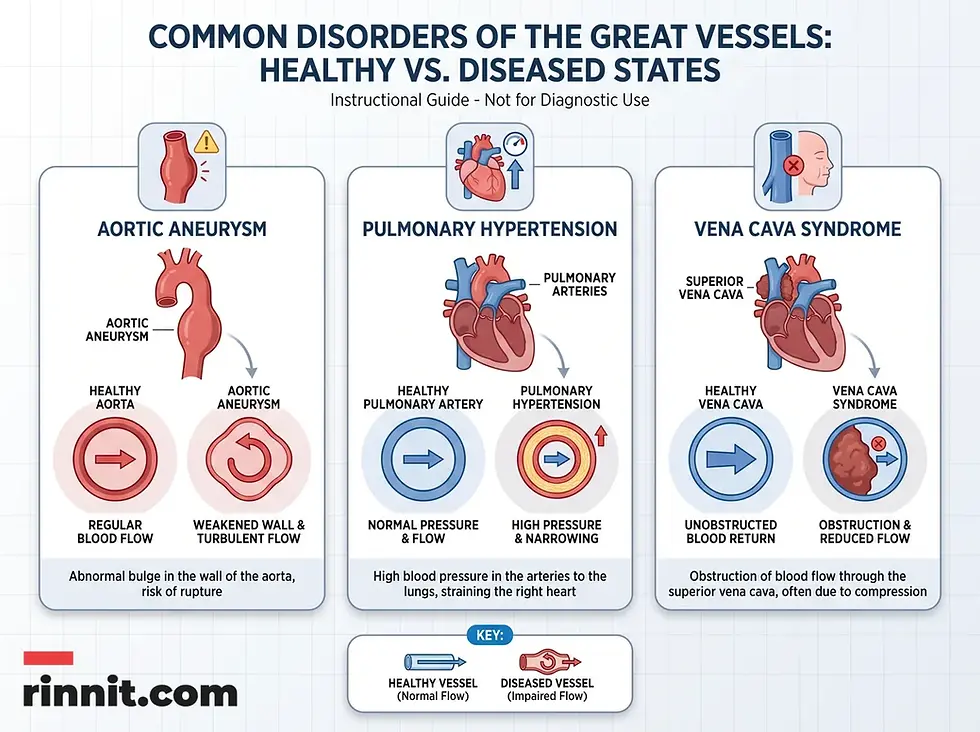
The aorta can be affected by aneurysms, which are bulges in the vessel wall, or dissections, where a tear occurs in the inner layer. Sudden, severe chest, back or belly pain, especially if it feels like tearing, can signal a dissection or rupture; call 911 right away. Atherosclerosis, or the buildup of plaque, can also narrow the aorta. The pulmonary artery may experience hypertension (high blood pressure) or embolism, where a blockage restricts flow to the lungs.
Vena Cava and Venous Issues
The vena cava can be impacted by syndromes that cause compression, such as superior vena cava syndrome, or by the development of blood clots [1]. In some cases, medical devices like filters are placed in the inferior vena cava to prevent clots from reaching the lungs.
How are great vessel problems diagnosed and cared for?
Healthcare providers use various imaging techniques to monitor the health of the great vessels. Common tests include echocardiograms, CT scans, and MRIs, which allow for detailed visualization of vessel diameter and blood flow patterns.
Maintaining vascular health involves managing blood pressure and cholesterol levels and avoiding tobacco use [1]. Regular physical activity and a balanced diet also support overall blood vessel health [1].

Conclusion
The great vessels are the fundamental infrastructure of the circulatory system. By connecting the heart to the lungs and the body, they ensure that every cell receives the oxygen it needs to function. Understanding their anatomy and the conditions that affect them is vital for long-term cardiovascular wellness.
Next step: If you have concerns about your heart health or vascular system, consult with a healthcare professional. Early detection of vessel issues through routine screening can significantly improve outcomes and prevent serious complications.
Frequently Asked Questions
What are the five great vessels of the heart?
The five great vessels are the aorta, pulmonary trunk, pulmonary veins, superior vena cava, and inferior vena cava.
Which vessel carries oxygen-rich blood to the body?
The aorta is responsible for carrying oxygen-rich blood from the heart’s left ventricle to the rest of the body.
How many pulmonary veins do most people have?
Most people have four pulmonary veins that carry oxygenated blood from the lungs back to the heart.
What is the difference between the superior and inferior vena cava?
The superior vena cava brings blood from the upper body, while the inferior vena cava brings blood from the lower body.
What are the three layers of a blood vessel?
The three layers are the tunica intima (inner), tunica media (middle), and tunica adventitia (outer).
Why are the great vessels wider than other vessels?
The great vessels are wider to accommodate the large volume of blood that must pass through them with every heartbeat.
Do all arteries carry oxygen-rich blood?
No, the pulmonary artery is an exception; it carries oxygen-poor blood from the heart to the lungs.
What is an aortic aneurysm?
An aortic aneurysm is a bulge or weak spot in the wall of the aorta that can potentially rupture if left untreated.
How do doctors check the health of these vessels?
Providers use imaging tests like echocardiograms, CT scans, and MRIs to evaluate the structure and function of the vessels.
What is pulmonary hypertension?
Pulmonary hypertension is high blood pressure that specifically affects the arteries in your lungs and the right side of your heart.
Related Reading
Pulmonary Arteries: Anatomy, Function, Conditions and Care explains how the pulmonary arteries carry blood to the lungs.
Aortic Dissection: Emergency Warning Signs, Types, Diagnosis & Treatment covers tears in the aorta wall and why they are an emergency.
Aortic Aneurysm: Types, Causes, Dissection Risk & Complete Guide explains aortic bulges, their risks and how they are treated.
Pulmonary Veins: Anatomy, Function, Variations and Care describes the veins that return oxygen-rich blood to the heart.
References
Cleveland Clinic. Great Vessels of the Heart. Cleveland Clinic. Last updated October 11, 2022. https://my.clevelandclinic.org/health/body/17057-your-heart--blood-vessels
Ettehad D, Emdin CA, Kiran A, et al. Blood pressure lowering for prevention of cardiovascular disease and death: a systematic review and meta-analysis. The Lancet. 2016;387(10022):957-967. PMID 26724178. https://doi.org/10.1016/S0140-6736(15)01225-8
Alabed S, Shahin Y, Garg P, et al. Cardiac-MRI predicts clinical worsening and mortality in pulmonary arterial hypertension: a systematic review and meta-analysis. JACC: Cardiovascular Imaging. 2021;14(5):931-942. PMID 33008758. https://doi.org/10.1016/j.jcmg.2020.08.013
Medical disclaimer
The information provided in this article is for educational purposes only and should not be used as a substitute for professional medical advice, diagnosis, or treatment. Always seek the advice of your physician or other qualified health provider with any questions you may have regarding a medical condition.



Comments