Understanding the Foreskin: Anatomy, Function, and Care

Updated: 3 days ago
Medically reviewed by Dr. Baraa Alnahhal, MD · Last reviewed: October 2026
The foreskin, or prepuce, is a moveable layer of skin that covers the head of the penis [1]. It serves to protect the glans and aids in sexual pleasure [1]. While tight in infancy, the foreskin gradually becomes retractable during childhood, though for some boys this does not happen until the teen years [1]. Proper hygiene—including regular cleaning after the skin has separated—is essential to prevent infections [1] like balanitis or posthitis. Decisions regarding circumcision are often based on cultural, religious, or medical factors [1].
Quick Answer: What is the foreskin?
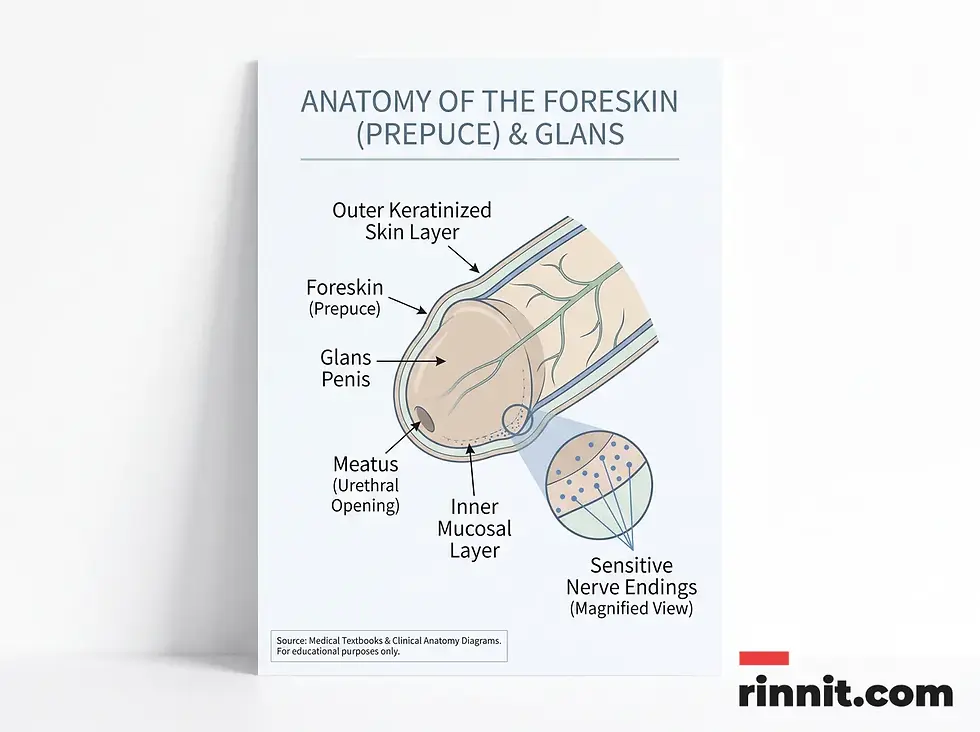
The foreskin, or prepuce, is an outer layer of skin that protects the head of the penis and the urethral opening [1], made of sensitive mucosal tissue and keratinized skin [1]. In infants it is naturally tight and non-retractable but usually loosens with growth [1]. Gentle cleaning once retractable and safe sex practices help reduce the risk of infections [1].
What the research says
Topical steroids work for a tight foreskin in children. A meta-analysis of 11 studies (1,669 children with phimosis) found topical steroid treatment more effective than placebo or manual retraction alone (pooled odds ratio 7.46; 95% CI 4.42-12.58) (Liu et al., International Urology and Nephrology, 2016) [2].
Foreskin separation is gradual. In a cross-sectional study in Taiwan, none of 59 newborn boys had a fully retractable foreskin; among 1,145 school-age boys, the proportion with a fully retractable foreskin was 71.7% at age 7, 72.4% at age 10 and 84.1% at age 13 (Ko et al., Journal of the Formosan Medical Association, 2007) [3].
Circumcision lowers HIV acquisition in heterosexual men. A Cochrane review of three randomized trials in South Africa, Uganda and Kenya (3,274, 4,996 and 2,784 HIV-negative men) found a 54% relative reduction in HIV acquisition at 21 to 24 months (incidence risk ratio 0.46; 95% CI 0.34-0.62), with a low rate of adverse events (Siegfried et al., Cochrane Database of Systematic Reviews, 2009) [4].
What is the anatomy of the foreskin and how does it develop?
The foreskin is a complex anatomical structure with specialized tissues that serve both protective and sensory roles.
Structure and Composition
Mucosal Tissue: The inner layer of the foreskin is composed of mucosa, which contains numerous sensitive nerve endings that contribute to sexual pleasure [1].
Keratinized Skin: The outer layer is standard skin reinforced with keratin [1], a protein that provides strength and protects the underlying tissue from water and friction.
Appearance: When flaccid, the foreskin appears as a loose fold of skin; it typically retracts during an erection to reveal the glans [1].
Color and Size: It is often slightly darker than the surrounding skin, with an average length of approximately 2.5 inches [1].
Developmental Stages
In newborns and young children, the foreskin is fused to the glans and cannot be pulled back. Forcing retraction in a young child can cause trauma and scarring [1]. Separation happens gradually: many boys can retract the foreskin by age five, but for some it does not happen until the teen years, and this is normal [1].
What is the purpose and function of the foreskin?
The primary roles of the foreskin involve physical protection and biological utility.
Physical Protection: It shields the sensitive glans and meatus from friction and environmental irritation.
Sensory Function: The high density of nerve endings in the mucosal layer aids in sexual sensation [1].
Reproductive Support: Some researchers believe the increased pleasure provided by the foreskin may facilitate successful reproduction [1].
Moisture Maintenance: The covering helps keep the glans moist and sensitive.

What are common foreskin conditions and disorders?
Foreskin conditions range from minor irritations to surgical emergencies, and signs such as discharge, pus or being unable to move the foreskin need a provider's attention.
Condition | Description | Symptoms |
Balanitis | Inflammation of the head of the penis [1]. | Swelling, pain, and redness. |
Phimosis | The foreskin is too tight to be pulled back [1]. | Difficulty retracting, pain during erection. |
Paraphimosis | Foreskin is stuck behind the glans (Emergency). | Swelling, cut-off circulation, severe pain. |
Posthitis | Infection caused by bacterial or smegma buildup [1]. | Discharge, pus, and irritation. |
Balanoposthitis | Inflammation affecting both the glans and foreskin [1]. | Combined symptoms of balanitis and posthitis. |
Signs to Watch For
Consult a healthcare provider if you notice discharge, pus, persistent itching, inability to move the foreskin, or unusual rashes and swelling [1].
How should you care for and clean the foreskin?
Maintaining the health of the foreskin requires consistent but gentle care once it has become retractable.
Regular Cleaning: Gently pull back the skin and wash underneath with mild soap and clean water [1].
Drying: Always pat the area dry before returning the foreskin to its natural position [1].
Urination Habits: Pulling the skin back during urination prevents urine from becoming trapped, which can cause irritation [1].
Safe Sex: Consistent condom use is vital for reducing the transmission of sexually transmitted infections (STIs) [1].

Conclusion
The foreskin is a natural part of male anatomy that provides protection and sensory benefits. While it requires specific care once it becomes retractable, most conditions associated with it are preventable through good hygiene and safe practices. Whether one chooses to remain uncircumcised or undergoes the procedure for medical or personal reasons, understanding the anatomy and care of this tissue is essential for long-term health.
Next step: If you are experiencing pain, swelling, or difficulty retracting your foreskin, schedule an appointment with a healthcare professional for an evaluation.
Frequently Asked Questions
What is the foreskin?
The foreskin is a moveable layer of skin that covers the head of the penis and the urethral opening.
What is another name for the foreskin?
The medical term for the foreskin is the prepuce.
Why is the foreskin tight in infants?
The foreskin is naturally fused to the glans at birth for protection; it separates gradually, often by age five but sometimes not until the teen years.
What is smegma?
Smegma is a buildup of dead skin cells and oils that can accumulate under the foreskin if it is not cleaned regularly.
What is phimosis?
Phimosis is a condition where the foreskin is too tight to be pulled back over the head of the penis.
Is paraphimosis a medical emergency?
Yes, paraphimosis occurs when the foreskin is stuck behind the glans and can cut off circulation, requiring immediate medical attention.
How should I clean my foreskin?
Gently retract the skin and wash the area with mild soap and warm water, then pat it dry.
What are the symptoms of a foreskin infection?
Symptoms include redness, swelling, pain, itching, and unusual discharge or pus.
What is circumcision?
Circumcision is the surgical removal of the foreskin, often performed for religious, cultural, or medical reasons.
Does having a foreskin increase the risk of STIs?
Some studies suggest that uncircumcised individuals may have a higher risk of certain STIs, though safe sex practices like condom use significantly mitigate this risk.
Related Reading
Circumcision: Procedure, Methods, Recovery and Risks explains the foreskin removal procedure, its benefits, risks and recovery.
What Is Balanitis? Symptoms, Causes, and Treatment covers inflammation of the head of the penis and how it is treated.
Understanding the Male Reproductive System: Anatomy and Function explains how the male reproductive organs work together.
Circumcision Revision: Why It's Done, Surgery, Recovery and Risks explains when and how a previous circumcision is surgically corrected.
References
Cleveland Clinic. Foreskin. Cleveland Clinic. Last updated August 4, 2025. https://my.clevelandclinic.org/health/body/23175-foreskin
Liu J, Yang J, Chen Y, et al. Is steroids therapy effective in treating phimosis? A meta-analysis. International Urology and Nephrology. 2016;48(3):335-342. PMID 26725071. https://doi.org/10.1007/s11255-015-1184-9
Ko MC, Liu CK, Lee WK, et al. Age-specific prevalence rates of phimosis and circumcision in Taiwanese boys. Journal of the Formosan Medical Association. 2007;106(4):302-307. PMID 17475607. https://doi.org/10.1016/S0929-6646(09)60256-4
Siegfried N, Muller M, Deeks JJ, et al. Male circumcision for prevention of heterosexual acquisition of HIV in men. Cochrane Database of Systematic Reviews. 2009;(2):CD003362. PMID 19370585. https://doi.org/10.1002/14651858.CD003362.pub2
Medical disclaimer
The information provided in this article is for educational purposes only and should not be used as a substitute for professional medical advice, diagnosis, or treatment. Always seek the advice of your physician or other qualified health provider with any questions you may have regarding a medical condition.



Comments