Understanding the Epiglottis: Your Body's Natural Airway Protector

Updated: 2 days ago
Medically reviewed by Dr. Baraa Alnahhal, MD · Last reviewed: October 2026
The epiglottis is a small, leaf-shaped sheet of elastic cartilage located behind the tongue that acts as a vital valve for the respiratory system [1]. Its primary function is to cover the opening of the larynx during swallowing, ensuring that food and liquids are directed into the esophagus rather than the windpipe [1]. Inflammation of this structure, known as epiglottitis, is a serious medical emergency that can block the airway [1]. Maintaining good hygiene and avoiding smoking are key to protecting this essential organ [1].
Quick Answer: What is the epiglottis?
The epiglottis is a cartilage flap in the throat that prevents food and fluids from entering the larynx and trachea during swallowing [1]. By flipping backward to seal the airway, it routes everything you consume safely to the esophagus, hundreds of times daily [1]. When it becomes inflamed or floppy, it can cause life-threatening airway obstruction and infections like pneumonia [1].
What the research says
Airway emergencies are now less common. A systematic review and meta-analysis of 30 studies (10,148 adults) found that the rate of airway intervention in adult epiglottitis fell from 18.8% before to 10.9% after Haemophilus influenzae vaccine introduction (P = 0.01); stridor (relative risk 7.15), an epiglottic abscess (RR 2.45) and a history of diabetes (RR 2.15) were linked to needing one (Sideris et al., Laryngoscope, 2020) [2].
Securing the airway is still high-stakes. A systematic review and meta-analysis of 56 studies (10,630 adults) estimated that about 15.6% (95% CI 12.9-18.8%) needed an airway intervention overall, and that tracheal intubation failed in 4.2% (95% CI 1.4-8.0%), roughly 1 in 25 (Booth et al., BJA Open, 2024) [3].
Kidney failure may raise the risk. In a nationwide matched cohort study in Taiwan of 87,908 people with end-stage renal disease on dialysis, epiglottitis requiring hospitalisation occurred at 10.3 versus 5.3 cases per 100,000 person-years compared with matched controls (adjusted hazard ratio 1.89; 95% CI 1.23-2.91) (Tsai et al., BMJ Open, 2020) [4].
What does the epiglottis do?
The epiglottis serves as a biological "trashcan lid" for the respiratory system, swinging into action every time you swallow to prevent foreign objects from entering the lungs [1].
The Swallowing Mechanism
Most people swallow between 500 and 700 times per day [1]. During each swallow, several physiological changes occur to move the epiglottis into place:
Upward Movement: The larynx and hyoid bone move up and forward, causing the back of the tongue to press against the epiglottis [1].
Pressure Reaction: Muscles and ligaments pull the epiglottis backward as food or liquid approaches [1].
Sealing the Airway: The free end of the epiglottis flips down to cover the larynx, directing traffic toward the esophagus [1].
Preventing Aspiration
When the epiglottis fails to seal properly, food or liquid can enter the larynx, causing coughing or choking [1]. If these substances reach the lungs, it is known as aspiration, which can lead to serious medical conditions such as pneumonia [1].
What is the anatomy and location of the epiglottis?
The epiglottis is positioned just behind the tongue and in front of the larynx [1]. It is anchored at its base and sides by a combination of muscles, ligaments, and mucous membranes, while its top remains loose to allow for free movement [1].

What conditions affect the epiglottis?
The most common and dangerous condition involving this organ is epiglottitis, which is the sudden swelling and inflammation of the epiglottis [1].
Epiglottitis Symptoms and Causes
Epiglottitis is often caused by an infection and is a medical emergency because the swelling can block the airway; call 911 right away for trouble breathing, noisy breathing, drooling or bluish skin [1].
Floppy Epiglottis
In some individuals, the epiglottis can become "floppy" or collapse over the glottis [1]. This condition can interfere with normal breathing and is believed by some healthcare providers to contribute to obstructive sleep apnea syndrome [1].

How can you protect your epiglottis?
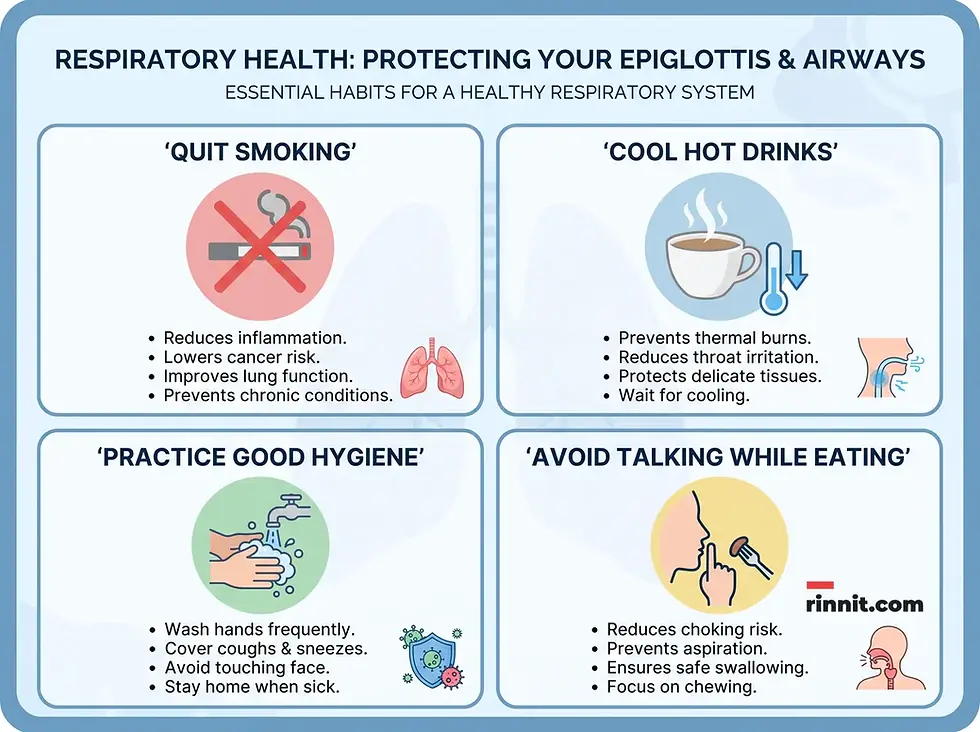
You can lower the risk of epiglottis problems by quitting smoking, avoiding very hot drinks, practicing good hand hygiene, staying up to date on vaccines and not talking while eating [1].
Preventive Strategies
Quit Smoking: Smoking is a known contributor to epiglottitis [1] and other laryngeal issues.
Monitor Drink Temperature: Very hot liquids can cause thermal damage to the delicate tissue of the epiglottis [1].
Infection Control: Practicing good hand hygiene and staying up to date on vaccinations can prevent the infections that lead to swelling [1].
Table Manners: Avoiding talking while eating reduces the risk that the epiglottis will be out of position when food is present, preventing choking [1].
Conclusion
The epiglottis is a small but mighty protector of our respiratory health. By acting as a precise valve, it ensures that our basic needs for nourishment and oxygen do not conflict. Understanding its role and the signs of potential dysfunction is essential for maintaining long-term airway safety and preventing serious respiratory complications.
Next step: If you experience a sudden, severe sore throat or difficulty swallowing, seek immediate medical attention, as these could be signs of a serious epiglottis condition.
Frequently Asked Questions
What is the epiglottis?
The epiglottis is a leaf-shaped piece of cartilage that covers the windpipe during swallowing to prevent food from entering the lungs.
Where is the epiglottis located?
The epiglottis is located in the throat, just behind the tongue and above the larynx (voice box).
What happens when you swallow?
The epiglottis flips backward to cover the opening of the larynx, directing food into the esophagus.
What is epiglottitis?
Epiglottitis is the inflammation and swelling of the epiglottis, often caused by an infection.
Is epiglottitis a medical emergency?
Yes, if the epiglottis swells enough to block the airway and prevent oxygen from reaching the body.
What causes the epiglottis to swell?
Common causes include infections, smoking, chemical burns, neck trauma, and drinking very hot liquids.
What is a "floppy" epiglottis?
A floppy epiglottis occurs when the epiglottis collapses over the glottis, potentially interfering with breathing and sleep.
How can I protect my epiglottis?
You can protect it by quitting smoking, cooling hot drinks, and practicing good hygiene to prevent infections.
Why shouldn't you talk while eating?
Talking while eating increases the chance that the epiglottis will not cover the airway properly, leading to choking.
What is aspiration?
Aspiration is when food or liquid enters the lungs, which can cause serious issues like pneumonia.
Related Reading
Epiglottitis: Symptoms, Causes, and Treatment explains a dangerous swelling of the epiglottis that needs emergency care.
Dysphagia (Trouble Swallowing): Symptoms, Causes, Diagnosis & Treatment — Complete Guide covers swallowing problems, their causes and how they are treated.
The Larynx: Anatomy, Function, and Common Disorders describes the voice box that the epiglottis covers during swallowing.
Pharynx (Throat): Anatomy, Function, Symptoms and Care explains the throat passage shared by food and air.
References
Cleveland Clinic. Epiglottis. Cleveland Clinic. Last updated September 6, 2022. https://my.clevelandclinic.org/health/body/24278-epiglottis
Sideris A, Holmes TR, Cumming B, et al. A systematic review and meta-analysis of predictors of airway intervention in adult epiglottitis. Laryngoscope. 2020;130(2):465-473. PMID 31173373. https://doi.org/10.1002/lary.28076
Booth AWG, Pungsornruk K, Llewellyn S, et al. Airway management of adult epiglottitis: a systematic review and meta-analysis. BJA Open. 2024;9:100250. PMID 38230383. https://doi.org/10.1016/j.bjao.2023.100250
Tsai YT, Tsai MS, Hsu CM, et al. End-stage renal disease as a risk factor for epiglottitis: a population-based cohort study in Taiwan. BMJ Open. 2020;10(11):e038683. PMID 33148739. https://doi.org/10.1136/bmjopen-2020-038683
Medical disclaimer
The information provided in this article is for educational purposes only and should not be used as a substitute for professional medical advice, diagnosis, or treatment. Always seek the advice of your physician or other qualified health provider with any questions you may have regarding a medical condition.



Comments