Understanding the Axillary Nerve: Anatomy, Function, and Injury Recovery

Updated: 2 days ago
Medically reviewed by Dr. Baraa Alnahhal, MD · Last reviewed: October 2026
TL;DR: The axillary nerve, also called the circumflex nerve, is a peripheral nerve that branches from the brachial plexus (C5–C6 nerve roots) and powers the shoulder. [1] It moves the deltoid and teres minor muscles to lift and rotate the arm and carries sensation from the outer shoulder. [1] It is most often injured by shoulder dislocations and fractures of the upper arm bone. Many injuries recover over months with physical therapy, while severe ones may need nerve surgery. [1]
Medical emergency: After a fall or accident, get emergency care right away if your shoulder looks out of place, you cannot move your arm, or your arm or hand becomes pale, cold, or numb. A dislocated shoulder needs to be put back in place promptly, because delays raise the risk of nerve injury.
Quick Answer: What is the axillary nerve?
The axillary nerve, also called the circumflex nerve, is one of the five main peripheral nerves of the arm, branching from the brachial plexus to the shoulder. [1] [2] It moves the deltoid and teres minor muscles and carries sensation from the outer shoulder. [1] Injury causes arm-lifting weakness and numbness; most improve with rest and physical therapy, though severe cases need surgery. [1]
What the research says
Many injuries from shoulder dislocation recover without surgery. A review of axillary nerve injury after glenohumeral dislocation describes it as often a low-grade injury that progresses to full recovery without intervention, with a small number of high-grade injuries that are unlikely to recover well without surgical exploration and reconstruction (Avis and Power, EFORT Open Rev, 2018) [4].
Nerve transfer restores shoulder lifting in most patients who need surgery. In a systematic review of 80 patients, 66 (82.5%) improved after nerve transfer, and results were better when surgery took place within the first 7 months of injury (Wells et al., Plast Reconstr Surg Glob Open, 2020) [5].
Nerve grafts and nerve transfers give similar results. In a systematic review of 66 patients with isolated axillary nerve injuries, 100% of the 20 graft patients and 87% of the 46 transfer patients regained useful shoulder abduction (grade M3 or better), and 85% versus 73.9% reached grade M4 or better, differences that were not statistically significant (Koshy et al., Plast Reconstr Surg, 2017) [6].
Key takeaways
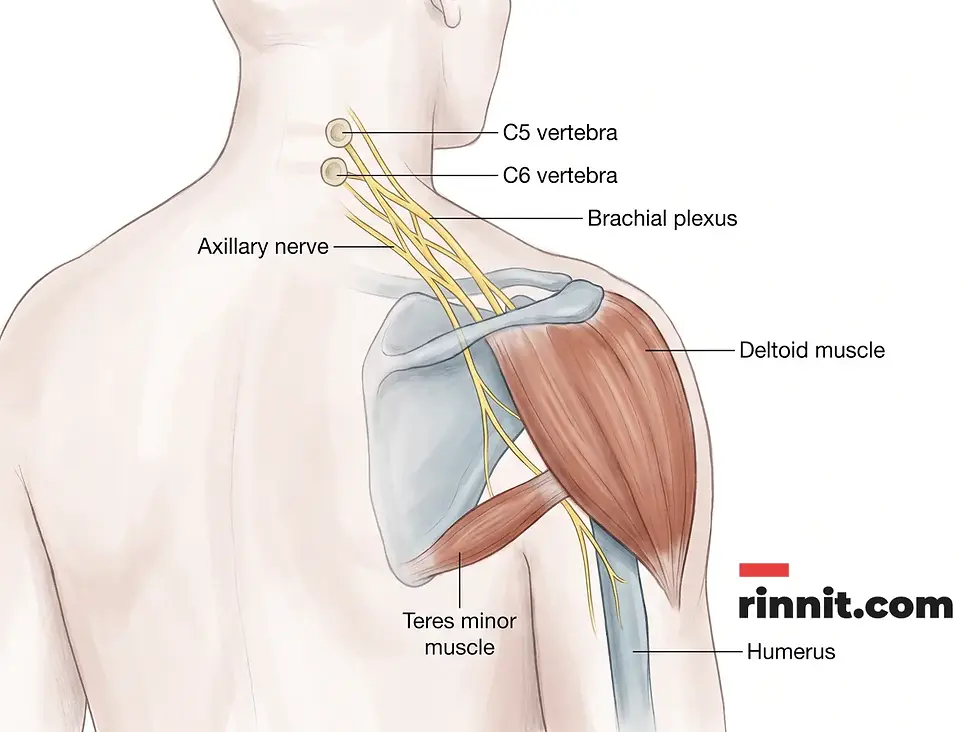
The axillary nerve comes from the C5 and C6 nerve roots through the posterior cord of the brachial plexus. [2]
It passes through the quadrangular space behind the upper arm bone and divides into anterior, posterior, and articular branches. [1] [2]
It controls the deltoid and teres minor and supplies skin sensation over the outer shoulder. [1] [2]
Shoulder dislocations and fractures of the surgical neck of the humerus are the leading causes of injury.
Most low-grade injuries recover over several months, and electrical nerve testing (EMG) guides whether surgery is needed.
See a provider for numbness, weakness lifting the arm, or shoulder pain that does not settle.
What is the axillary nerve?
The axillary nerve links the central nervous system to the shoulder. It starts in the brachial plexus and is one of the plexus's five terminal branches, along with the median, ulnar, radial, and musculocutaneous nerves. [2] Because it supplies the muscle that gives the shoulder its rounded shape and most of its lifting power, damage to it is noticeable in daily life, from reaching a shelf to throwing a ball.
What are the main functions of the axillary nerve?
The axillary nerve carries both motor signals (for movement) and sensory signals (for feeling).
Function | Description |
Motor | Powers the deltoid, which lifts the arm out to the side (abduction), and the teres minor, which rotates the arm outward and helps keep the shoulder joint stable [2] |
Sensory | Carries pain, touch, temperature, and position sense from the skin over the outer shoulder, an area sometimes called the regimental badge area [2] |
Joint support | A small articular branch supplies the shoulder (glenohumeral) joint [1] |
The axillary nerve does not power the triceps. The radial nerve supplies that muscle. Some older sources describe a branch to the long head of the triceps, but a cadaver study found no axillary nerve supply to the triceps, as reported in a StatPearls review.
What is the detailed anatomy of the axillary nerve?
The axillary nerve begins at the C5 and C6 spinal nerve roots in the neck. These roots join the brachial plexus, and the axillary nerve leaves the plexus as a branch of its posterior cord. [2] It runs behind the axillary artery and in front of the subscapularis muscle, then leaves the armpit region through the quadrangular space together with the posterior circumflex humeral artery and vein. [2] This gap is bordered by the teres minor above, the teres major below, the long head of the triceps on the inner side, and the surgical neck of the humerus on the outer side. [2]
After it passes through the quadrangular space, the nerve wraps around the back of the surgical neck of the humerus, the narrow part just below the rounded top of the bone. [2] This is also where it is most exposed to injury.
Branches of the axillary nerve
Anterior (upper) branch: wraps around the surgical neck of the humerus and supplies the front and middle parts of the deltoid.
Posterior (lower) branch: supplies the back part of the deltoid and the teres minor, and ends as the upper lateral cutaneous nerve of the arm, which supplies skin over the outer shoulder. [1] [2]
Articular branch: a small branch to the shoulder joint capsule. [1]

What conditions and injuries affect the axillary nerve?
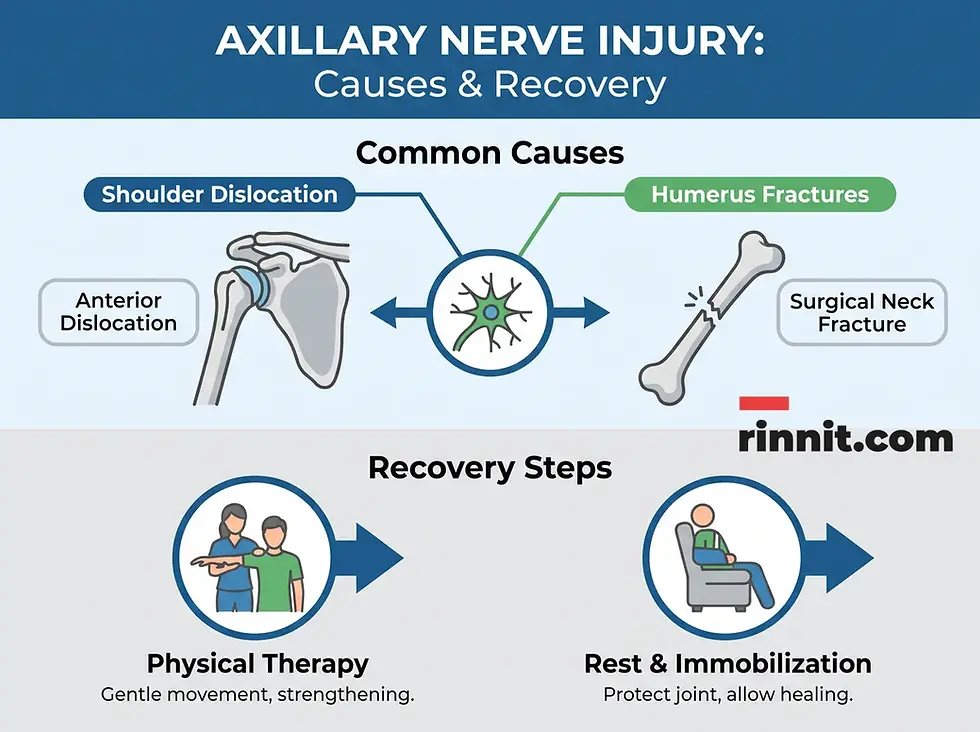
The axillary nerve is the nerve most often damaged in shoulder dislocations. Axillary nerve mononeuropathy on its own is uncommon and accounts for about 0.3% to 6% of all brachial plexus injuries, and the risk after a dislocation rises with age. In one review, about 65% of patients over 40 who dislocated a shoulder had an axillary nerve lesion on EMG testing.
Cause | How it injures the nerve |
Shoulder dislocation | An anterior (forward) dislocation can stretch or compress the nerve [1] |
Humerus fracture | A break at the surgical neck of the humerus can bruise or tear the nerve where it wraps around the bone [2] |
Traction injury | A sudden pull, such as the head and shoulder being forced in opposite directions in a fall or crash [1] |
Compression | Crutches or other devices that press on the nerve in the armpit area [1] |
Surgery | Injury during shoulder operations, such as arthroscopy or approaches through the outer shoulder [1] |
Inflammation or entrapment | Parsonage-Turner syndrome (brachial neuritis), quadrilateral space syndrome, or herpes zoster [1] |
Birth injury | Stretching of the shoulder during delivery can injure the nerve in newborns [1] |
Contact sports raise the risk of direct injury to the nerve. Related conditions that can look similar include a pinched nerve in the neck (see our guide to pinched nerve and radiculopathy) and Parsonage-Turner syndrome.
What are the symptoms and warning signs of axillary nerve injury?
Axillary nerve injury can cause weakness lifting or rotating the arm, numbness over the outer shoulder, shoulder pain and, over time, visible muscle wasting.
After a dislocation or fracture, pain can hide weakness and numbness at first, so these signs may only show up once the injury settles.
How is an axillary nerve injury diagnosed?
An axillary nerve injury is diagnosed by asking how it happened, testing deltoid and teres minor strength, and using tests such as nerve conduction studies, electromyography, X-rays or MRI. Tests may include:
A neurologic exam of the shoulder and arm [1]
Nerve conduction studies and electromyography (NCS/EMG), which is the standard way to confirm nerve injury and to track recovery
X-rays to look for a fracture or dislocation [1]
MRI, which shows the nerve, muscles, and deeper shoulder structures [1]
Neuromuscular ultrasound, which more clinics are using to examine nerves
How is an axillary nerve injury treated, and what is recovery like?
Most axillary nerve injuries are treated without surgery. After a dislocation, the shoulder is put back in place and rested in a sling, then physical therapy restores motion and strength. Nerve recovery is slow, because nerves regrow about as fast as a fingernail, so progress is measured in months.
Type of nerve injury | What to expect |
Neuropraxia (bruised nerve) | Strength usually returns on its own over about 6 to 12 months |
Axonotmesis (stretched nerve fibers) | Recovery in about 70% to 80% of cases, over many months; repeat EMG tests track regrowth |
Neurotmesis (torn nerve) | Does not recover without surgery |
Surgery can be considered if EMG shows no improvement after about 3 months in a closed injury, or if there is no sign of recovery by 6 to 9 months. Fresh, open injuries need quicker surgical care. Options include nerve repair, nerve grafting, nerve transfer (often using a branch of the radial nerve), and muscle transfer in long-standing cases. Earlier surgery tends to give better results. [5]
How can you prevent axillary nerve injuries in the shoulder?
Axillary nerve injuries can be prevented by wearing seat belts and safety gear, using ladders and crutches carefully, and choosing an experienced surgeon for shoulder surgery.
Wear a seat belt and use safety equipment to lower the risk of crashes and falls. [1]
Be careful on ladders, and ask someone to steady the ladder or hand you items. [1]
Learn to use crutches correctly so they do not press on the nerve. [1]
Choose an experienced orthopedic or upper-limb surgeon if you need shoulder surgery. [1]
When should you see a healthcare provider about your axillary nerve?
See a provider about axillary nerve problems if you have lasting shoulder numbness or tingling, trouble lifting or rotating your arm, pain that worsens with activity, or visible shoulder weakness.
Numbness or tingling in the shoulder or upper arm that does not go away
Difficulty lifting or rotating your arm
Pain that gets worse with activity
Visible weakness or thinning of the shoulder muscle
Seek emergency care after trauma if the shoulder looks deformed or the arm turns pale, cold, or numb.
Conclusion
The axillary nerve is a small nerve with a big job. It lets you raise and rotate your arm and feel the skin of your outer shoulder. Because it wraps closely around the upper arm bone, it is easily hurt in dislocations and fractures, but most low-grade injuries recover with time and therapy. Getting the shoulder checked early, and having nerve function tested when weakness persists, gives the best chance of a full recovery.
Related reading
Frequently Asked Questions
What is the axillary nerve?
The axillary nerve is a peripheral nerve that branches from the brachial plexus and controls shoulder movement and sensation.
What is another name for the axillary nerve?
The axillary nerve is also called the circumflex nerve.
Where does the axillary nerve start?
The axillary nerve comes from the C5 and C6 nerve roots in the neck and leaves the posterior cord of the brachial plexus.
What muscles does the axillary nerve control?
The deltoid and the teres minor.
How does the axillary nerve help with arm movement?
The axillary nerve lets you lift your arm out to the side and rotate it outward.
Does the axillary nerve control the triceps?
No. The radial nerve supplies the triceps. Some older sources describe an axillary branch to the long head of the triceps, but a cadaver study did not find one.
What are the sensory roles of the axillary nerve?
The axillary nerve carries pain, touch, and temperature from the skin over the outer shoulder.
What is the most common cause of axillary nerve injury?
Shoulder dislocations and fractures of the upper humerus are the leading causes.
Can crutches cause nerve damage?
Yes. Crutches that press into the armpit area can compress the nerve, so it is important to learn how to use them correctly.
Does childbirth affect this nerve?
Childbirth can. A newborn's shoulder can be stretched during delivery, which may injure the nerve.
What is quadrilateral space syndrome?
Quadrilateral space syndrome is a condition in which structures in the quadrangular space press on the axillary nerve and the artery that travels with it.
How is an axillary nerve injury diagnosed?
Providers use a neurologic exam, NCS/EMG, X-rays, MRI, and sometimes neuromuscular ultrasound.
Do axillary nerve injuries heal on their own?
Many mild and moderate injuries do, with rest and physical therapy. Severe injuries may need surgery.
How long does recovery take?
Recovery takes months. A bruised nerve usually recovers in about 6 to 12 months, and surgery is considered if there is no improvement after about 3 to 9 months.
How can I prevent shoulder nerve injuries?
Use seat belts, prevent falls, learn to use crutches correctly, and choose an experienced surgeon for shoulder procedures.
Sources
Cleveland Clinic. Axillary Nerve. Cleveland Clinic. Last updated January 16, 2022. https://my.clevelandclinic.org/health/body/22264-axillary-nerve
Okwumabua E, Thompson JH. Anatomy, Shoulder and Upper Limb, Axillary Nerve. StatPearls. Treasure Island (FL): StatPearls Publishing; updated 2023 Jul 24. PMID 29630264. https://www.ncbi.nlm.nih.gov/books/NBK493212/
Tessler J, Talati R. Axillary Nerve Injury. StatPearls. Treasure Island (FL): StatPearls Publishing; updated 2023 Aug 14. PMID 30969717. https://www.ncbi.nlm.nih.gov/books/NBK539895/
Avis D, Power D. Axillary nerve injury associated with glenohumeral dislocation: a review and algorithm for management. EFORT Open Rev. 2018;3(3):70-77. PMID 29657847. https://doi.org/10.1302/2058-5241.3.170003
Wells ME, Gonzalez GA, Childs BR, et al. Radial to axillary nerve transfer outcomes in shoulder abduction: a systematic review. Plast Reconstr Surg Glob Open. 2020;8(9):e3096. PMID 33133948. https://doi.org/10.1097/GOX.0000000000003096
Koshy JC, Agrawal NA, Seruya M. Nerve transfer versus interpositional nerve graft reconstruction for posttraumatic, isolated axillary nerve injuries: a systematic review. Plast Reconstr Surg. 2017;140(5):953-960. PMID 29068931. https://doi.org/10.1097/PRS.0000000000003749
Medical disclaimer
The information in this article is for educational purposes only and is not a substitute for professional medical advice, diagnosis, or treatment. Always seek the advice of your physician or another qualified health provider with any questions you may have about a medical condition. Never disregard professional medical advice or delay seeking it because of something you have read here. If you think you may have a medical emergency, call your doctor or your local emergency number immediately.



Comments