Understanding Ring Avulsion: Prevention, Severity, and Treatment

Updated: 3 days ago
Medically reviewed by Dr. Baraa Alnahhal, MD · Last reviewed: October 2026
Ring avulsion is a rare but catastrophic finger injury caused by a sudden, forceful tug on a ring. [1] These injuries often involve extensive damage to nerves, blood vessels, and bones, frequently leading to amputation. [1] Prevention through the removal of jewelry during high-risk activities is the most effective strategy for maintaining hand safety.
Quick Answer
A ring avulsion is a severe finger injury that occurs when a ring catches on an object and is pulled with significant force. [1] Injuries range from minor circulation problems to complete finger loss, with intense pain and visible tissue damage. Treatment almost always requires emergency surgery, and many cases end in permanent amputation. [1] Recovery can take over a year. [1]
What the research says
Most reported ring avulsions are severe, but outcomes are better for lower classes. A systematic review of 20 studies covering 572 patients found 54 with Urbaniak class I injuries, 204 with class II and 314 with class III, and concluded that outcomes are superior for class I and II injuries while select class III injuries can be treated with replantation, with shared decision making needed to decide whether replantation is appropriate (Bamba et al., Hand, 2018) [2].
Finger motion after repair declines as the injury class rises. In the same review, the average total arc of motion was 201.25 for class I injuries (40 patients), 187.0 for class II injuries treated with microsurgical revascularization (114 patients), and 168.2 for class III injuries treated with microsurgical revascularization (170 patients) (Bamba et al., Hand, 2018) [2].
How does a ring avulsion injury happen?
Ring avulsion is a traumatic event that occurs when the force of a pull is concentrated on a small area—the ring itself—rather than the entire hand. This concentration of force can cause the ring to act like a snare, stripping away skin, fat, and muscle from the underlying bone in a process known as degloving. While these injuries represent only about 5% of hand-related emergency room visits annually [1], they are among the most severe due to the complexity of the tissues involved.
The injury can damage every structural component of the finger, including blood vessels, nerves, tendons, and bones. [1] In many instances, the sudden tug also causes secondary injuries like blood clots or fractures. [1] Because the blood supply to the finger is often compromised, ring avulsion is considered a surgical emergency where time is a critical factor in saving the digit.
Injury Component | Potential Damage | Long-Term Impact |
Soft Tissue | Degloving (skin and fat stripped away). | Requires extensive skin grafts; high scarring risk. |
Blood Vessels | Tearing or complete severance; blood clots. | Loss of circulation; potential for tissue death. |
Nerves | Stretching or severing of digital nerves. | Permanent numbness or loss of fine motor control. |
Bones & Tendons | Fractures; tendon ruptures or avulsions. | Chronic stiffness and reduced range of motion. |
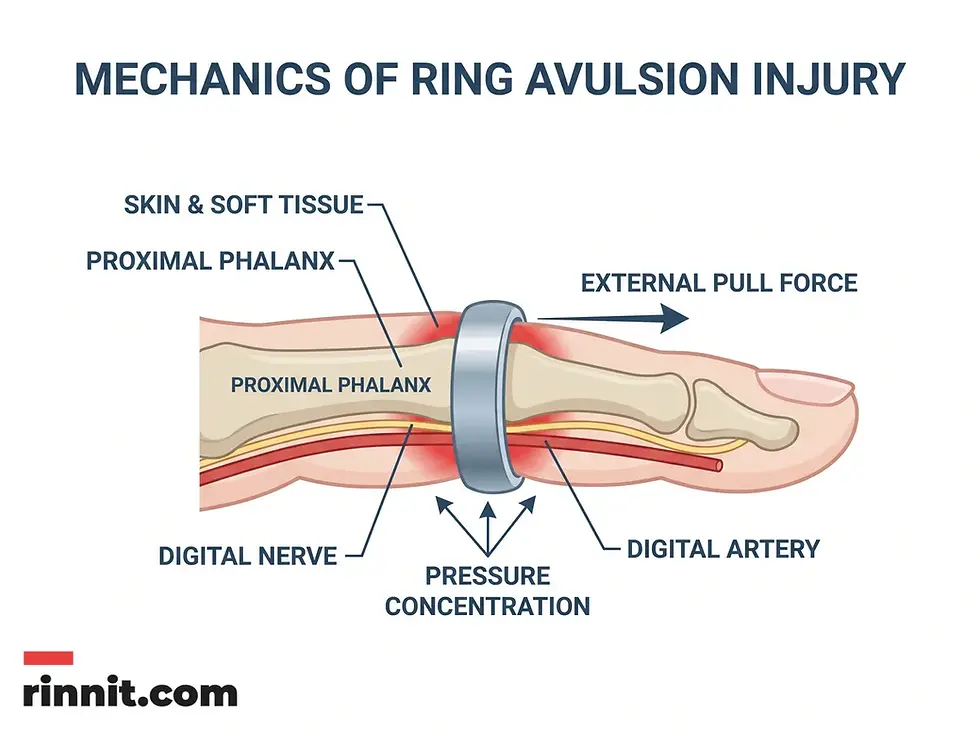
How is ring avulsion severity classified on the Urbaniak scale?
Medical professionals use the Urbaniak classification system to define the severity of a ring avulsion and determine the necessary course of treatment. This scale focuses primarily on the state of blood circulation and the physical integrity of the finger.
Class 1 (Least Severe): The finger still has adequate blood circulation. [1] While there may be significant soft tissue damage, the finger remains attached and functional.
Class 2 (Moderate): Circulation is inadequate, and the patient has difficulty moving the finger. [1] This stage requires urgent vascular repair to restore blood flow.
Class 3 (Complete Avulsion): The most severe form, where circulation is entirely absent or the finger has been completely pulled off the hand. [1] These cases often necessitate amputation. [1]
What causes ring avulsion and who is at risk?
Ring avulsions are most frequently linked to activities where the hands are in close proximity to moving parts or stationary objects that can snag jewelry. Workplace accidents, particularly those involving heavy machinery or power tools, are leading causes. However, everyday incidents can also lead to trauma.
Common scenarios include:
Athletes and manual laborers are at the highest risk, but anyone wearing a ring is susceptible if the right amount of force is applied.

How is ring avulsion treated in an emergency and with surgery?
If a ring avulsion occurs, immediate medical attention is vital. In cases of complete avulsion, the amputated finger should be preserved correctly for the best chance of reattachment. The finger should be wrapped in clean, damp gauze, placed in a sealed plastic bag, and then placed on ice. It is critical not to put the finger directly on ice [1], as this can damage the delicate tissues beyond repair. Bring the finger with you to the emergency room. [1]
Treatment typically involves complex microsurgery. Surgeons work to reattach severed blood vessels and nerves, repair fractured bones, and mend torn tendons. In cases of degloving, skin grafts may be required [1] to cover exposed bone and muscle. Despite advanced surgical techniques, Class 3 injuries frequently result in permanent amputation [1] because the damage to the blood vessels is too extensive to restore viable circulation.
What is recovery and the long-term outlook after a ring avulsion?
Recovery from a ring avulsion is a long and challenging process. Depending on the severity, patients may undergo multiple surgeries and months of physical therapy to regain even partial function. The healing timeline can range from several weeks to over a year. [1]
Even with successful reattachment, many individuals experience permanent changes, such as chronic stiffness, loss of sensation, or reduced grip strength. The psychological impact of a traumatic hand injury is also significant, as it can affect one's ability to work or perform daily tasks.

How can you protect your hands and prevent ring avulsion?
The most effective way to manage ring avulsion is to prevent it entirely. Simple safety measures can significantly reduce the risk of a life-altering injury.
Remove Jewelry: Always take off rings and other jewelry before working with tools, machinery, or participating in sports. [1]
Proper Fit: Ensure that rings are not loose; a loose ring is more likely to snag on an external object. [1]
Silicone Alternatives: Many people in high-risk professions now use silicone wedding bands. These are designed to break or tear more easily than metal rings [1], which may protect the finger from injury, although experts are still studying how well they work. [1]
Frequently Asked Questions
What exactly is a ring avulsion?
A ring avulsion is a severe finger injury caused by a ring being pulled with extreme force, often resulting in the skin and tissues being stripped away or the finger being completely removed.
How common are these injuries?
Ring avulsion injuries are rare, representing approximately 5% of arm and hand injuries seen in emergency rooms each year.
Can a ring avulsion be treated without surgery?
Almost never. Due to the severity of tissue, nerve, and vascular damage, almost all ring avulsions require emergency surgical intervention.
What is degloving?
Degloving is a specific type of avulsion where the skin and soft tissues are pulled off the underlying bone, much like removing a glove.
Is reattachment always possible?
No. Reattachment depends on the condition of the amputated part and the extent of the damage to the remaining blood vessels. Many Class 3 injuries result in permanent amputation.
Are silicone rings safer?
Silicone rings are designed to break or tear under high tension, which may prevent the force from being transferred to the finger tissues. There is some evidence that they help prevent ring avulsions, but experts are still studying this.
What should I do if a finger is pulled off?
Wrap the finger in clean gauze, put it in a bag, and place that bag on ice. Go to the emergency room immediately. Do not put the finger directly on ice.
How long does recovery take?
Recovery can take anywhere from a few weeks for minor cases to over a year for complex reattachments and grafts.
Can I wear my ring while exercising?
It is safer to remove all rings before exercising, especially during weightlifting or contact sports, to avoid snagging.
Is a ring avulsion an emergency?
Yes. Any ring injury that leaves the finger pale, cold, numb or badly torn needs emergency care right away, because fast treatment improves the chance of saving the finger.
Related Reading
Microsurgery: What It Is, What It Treats, Risks and Recovery explains the surgery used to repair tiny vessels and nerves in the finger.
Amputation Surgery: Understanding Procedures, Causes, and Long-Term Recovery covers amputation, healing and long-term recovery.
Skin Graft: Types, Surgery and Recovery describes how skin is moved to cover areas where it was torn away.
Finger Splint: Support and Protection for Hand Injuries explains how splints protect injured fingers while they heal.
References
Cleveland Clinic. Ring Avulsion. Cleveland Clinic. January 31, 2022. https://my.clevelandclinic.org/health/diseases/22368-ring-avulsion
Bamba R, Malhotra G, Bueno RA, et al. Ring avulsion injuries: a systematic review. Hand (New York, N.Y.). 2018;13(1):15-22. PMID 28720047. https://doi.org/10.1177/1558944717692094
Medical disclaimer
The information provided in this article is for educational purposes only and should not be used as a substitute for professional medical advice, diagnosis, or treatment. Always seek the advice of your physician or other qualified health provider with any questions you may have regarding a medical condition.



Comments