Understanding Reversible Cerebral Vasoconstriction Syndrome (RCVS)

Updated: 2 days ago
Medically reviewed by Dr. Baraa Alnahhal, MD · Last reviewed: October 2026
Reversible Cerebral Vasoconstriction Syndrome (RCVS) is a critical neurological condition characterized by sudden, intense "thunderclap" headaches caused by temporary spasms in the brain's blood vessels. [1] While often reversible, it carries risks of stroke or brain bleeds, requiring immediate emergency evaluation and diagnostic imaging to differentiate it from other life-threatening conditions. [1]
Quick Answer
Reversible cerebral vasoconstriction syndrome (RCVS) is a condition in which blood vessels in the brain suddenly narrow. [1] Its hallmark is a thunderclap headache that peaks almost instantly. [1] Often triggered by pregnancy, certain medications or stimulants, it needs urgent medical attention because it mimics strokes and brain bleeds. [1] Most cases resolve within weeks, but specialized imaging is essential. [1]
What the research says
Most people recover well, but serious complications do occur. In a retrospective analysis of 139 patients with RCVS from two academic centers (mean age 42.5 years, 81% women), 85% presented with a thunderclap headache, 43% developed neurological deficits, and although the admission CT or MRI was normal in 55%, 81% ultimately developed brain lesions (including infarcts in 39% and convexity subarachnoid hemorrhage in 34%); nearly 90% had a good clinical outcome, 9% developed severe deficits, 2% died, and angiographic abnormalities typically normalized within 2 months (Singhal et al., Archives of Neurology, 2011 [2]).
Drugs and pregnancy are leading triggers, and some features predict lasting deficits. A systematic review of 191 published cases found that vasoactive substances were the most common trigger (41.4%), followed by pregnancy or the postpartum period (20.9%) and sexual intercourse (10.5%); calcium channel blockers were the most commonly used treatment (44.5%), and aphasia, neglect or apraxia in the acute phase (hazard ratio 3.83, 95% CI 1.33 to 11.05) and a trauma, surgery or procedure trigger (hazard ratio 3.29, 95% CI 1.21 to 8.88) were independent risk factors for residual neurological deficit (Song et al., European Review for Medical and Pharmacological Sciences, 2021 [3]).
Fatal cases have been reported, mostly after childbirth, and not every patient has a thunderclap headache. A systematic review of published fatal RCVS cases (9 publications describing 12 adults) found that all had a headache at presentation but only 42% had a thunderclap headache, most of the female cases occurred postpartum, and the time to death ranged from 4 to 14 days (Valencia-Mendoza et al., Journal of Clinical Neuroscience, 2019 [4]).
What is reversible cerebral vasoconstriction syndrome (RCVS)?
Reversible Cerebral Vasoconstriction Syndrome (RCVS) is a condition defined by the sudden constriction and relaxation of blood vessels within the brain. This phenomenon, known as vasospasm, disrupts normal blood circulation and can lead to severe neurological symptoms. [1] Historically referred to as Call-Fleming syndrome after the physicians who identified it in 1988, the condition is now primarily recognized by its descriptive clinical name. [1]
The mechanism of RCVS involves the smooth muscle lining of the cerebral arteries. [1] When these muscles spasm, the vessels narrow significantly, similar to crimping a straw and restricting the fluid moving through it. [1] Because the brain requires a constant and high-volume supply of oxygenated blood, even temporary narrowing can cause profound dysfunction or damage to brain tissue.
Feature | Reversible Cerebral Vasoconstriction Syndrome (RCVS) |
|---|---|
Primary Mechanism | Sudden tightening (vasospasm) of brain blood vessels |
Hallmark Symptom | Sudden, severe "thunderclap" headache |
Common Triggers | Postpartum period, SSRIs, stimulants, migraines |
Emergency Status | High (mimics stroke and brain bleeds) |
Typical Outcome | Often reversible, but carries stroke risk |

What are the symptoms and warning signs of RCVS?
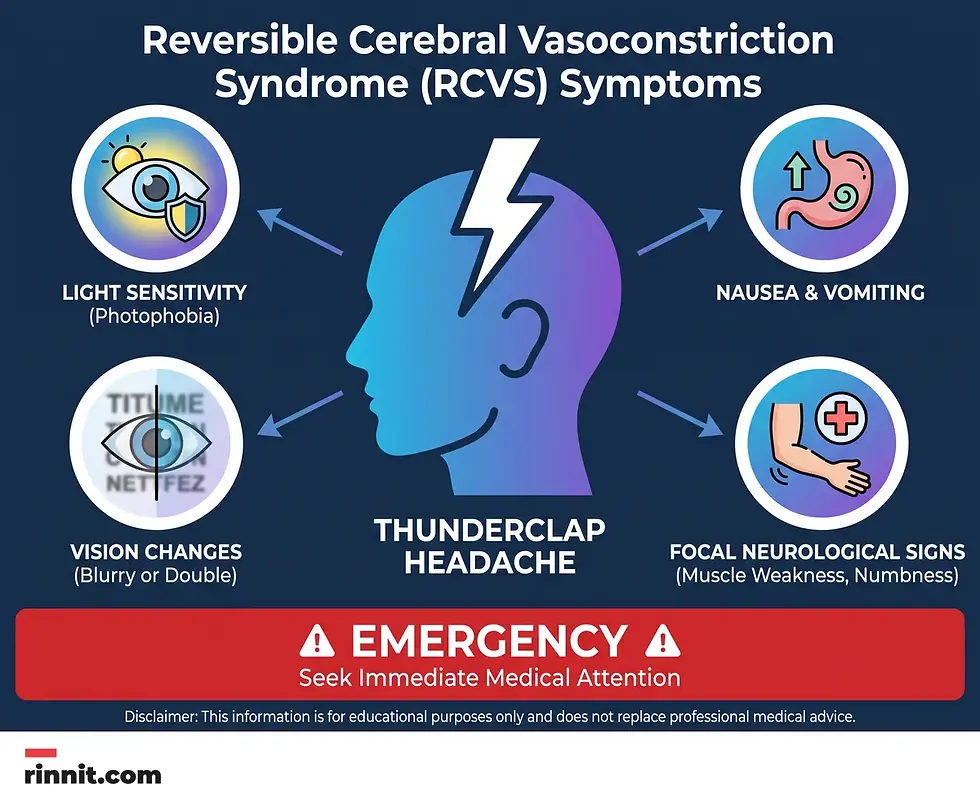
The most distinctive sign of RCVS is the thunderclap headache. Patients frequently describe this as the "worst headache of my life," characterized by a pain that strikes without warning and reaches peak intensity within seconds. While the headache is the primary indicator, the disruption of cerebral blood flow can cause a wide range of additional neurological disturbances.
Beyond the intense pain, individuals may experience sensory sensitivities, such as photophobia (light sensitivity) and phonophobia (sound sensitivity), often accompanied by nausea and vomiting. In more severe instances, RCVS can lead to vision changes, muscle weakness, confusion, seizures, or aphasia, which is the inability to speak or understand language. [1]
Thunderclap headaches are a medical emergency. They are the main symptom of bleeding in and around the brain. A headache that starts suddenly or reaches maximum intensity right away needs immediate emergency care: call your local emergency services. [1] — Cleveland Clinic
What causes RCVS and who is at risk?
RCVS can be triggered by a variety of physiological changes and external substances. Pregnancy is an important trigger, especially in the first six weeks after childbirth, although in a large review vasoactive drugs and substances were a more common trigger (41%) than pregnancy or the postpartum period (21%). [1] Healthcare providers believe these cases are largely driven by the dramatic shifts in hormone levels following delivery. [1]
External substances that affect the circulatory system are also frequent contributors. These include certain prescription medications like antidepressants (specifically SSRIs) and migraine treatments such as triptans. [1] Additionally, stimulants, including caffeine, energy drinks, nicotine patches, and nonmedical drugs like cocaine or amphetamines, can induce the vascular spasms associated with the syndrome. [1]
Hormonal Factors: Estrogen levels are suspected to play a role, contributing to the higher incidence of RCVS in women. [1]
Medical Conditions: A history of migraines or high calcium levels (hypercalcemia) increases the likelihood of developing the condition. [1]
Genetic Risks: Rare conditions like pheochromocytoma, which causes adrenaline-releasing tumors, can predispose individuals to RCVS. [1]
What are the possible complications and emergency risks of RCVS?
RCVS was once considered mostly benign, but it can lead to lasting neurological deficits and acute brain injuries. [1] Approximately 30% of patients may experience minor permanent issues, such as lingering weakness or balance difficulties, while roughly 8% face more severe long-term complications. [1]
The most dangerous aspect of RCVS is its potential to cause acute brain injuries. The vascular narrowing can lead to an ischemic stroke due to lack of blood flow, or it can cause a subarachnoid hemorrhage (SAH), which is bleeding between the brain and the skull. [1] Seizures and white matter disease are also documented complications that can arise in the days following the initial headache.
How is RCVS diagnosed?
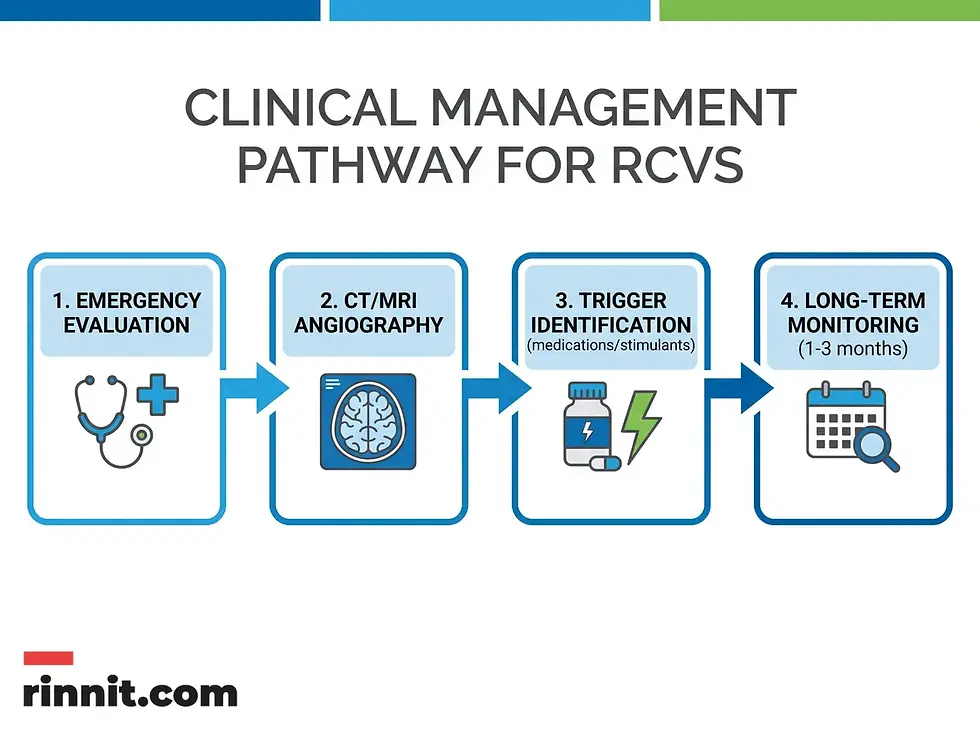
Diagnosing RCVS requires a combination of neurological examinations and advanced imaging. Because the symptoms are nearly identical to those of a stroke or a brain bleed, rapid testing is essential to rule out these time-critical emergencies. Blood tests are also utilized to check for electrolyte imbalances, infections, or clotting disorders [1] that might be contributing to the vascular instability.
Imaging is the definitive tool for identifying the characteristic "string-of-beads" appearance of constricted vessels. CT scans and CT angiograms are often the first step due to their speed in ruling out immediate hemorrhages. MRI and MRA (magnetic resonance angiography) provide more detailed views of blood flow and can detect minor areas of the brain that may be suffering from reduced circulation.
Diagnostic Tool | Purpose in RCVS Evaluation |
|---|---|
CT Angiogram | Rapidly identifies large vessel blockages or major bleeds |
MRI / MRA | Detects subtle blood flow changes and brain tissue impact |
Transcranial Doppler | Uses ultrasound to measure the velocity of blood flow in brain arteries |
Neurological Exam | Assesses motor skills, speech, and sensory responses |
How is RCVS managed, and what is recovery like?
The primary goal of managing RCVS is to prevent further vasospasms and protect the brain from injury. This often involves identifying and removing any triggers, such as specific medications or stimulants. [1] While the thunderclap headaches can recur within the first one to four weeks, the vascular narrowing typically reverses on its own over a period of months. [1] [2]
Patients are usually monitored closely to ensure that complications like strokes do not develop. In some cases, blood pressure management and calcium channel blockers may be discussed by specialists to help stabilize the blood vessels, though the specific treatment plan depends on the underlying cause and the severity of the constriction.
Conclusion and Next Steps
Reversible Cerebral Vasoconstriction Syndrome is a serious but often manageable condition that centers on the health of the brain's vascular system. Recognition of the "thunderclap" headache is the most vital step in ensuring a positive outcome. If you or someone you are with experiences a sudden, severe headache, seek immediate emergency medical evaluation to ensure proper diagnosis and to mitigate the risk of lasting neurological damage.
Frequently Asked Questions
What is the main symptom of RCVS?
The hallmark symptom is a sudden, extremely severe "thunderclap" headache that reaches its maximum intensity almost immediately. [1]
Is RCVS a type of stroke?
No, but it can cause a stroke. RCVS involves temporary spasms of blood vessels, whereas a stroke involves a permanent blockage or a rupture.
Can pregnancy cause RCVS?
Yes. Pregnancy, especially the first six weeks after childbirth, is an important trigger, though drugs and other vasoactive substances are a more common trigger overall. [1]
What medications are linked to RCVS?
Common links include SSRI antidepressants, migraine medications like triptans, and stimulants such as pseudoephedrine. [1]
Is RCVS permanent?
While the vessel narrowing is temporary, up to 30% of people may have minor lasting symptoms like weakness or balance issues. [1]
What is Call-Fleming syndrome?
Call-Fleming syndrome is an older name for RCVS, named after the physicians who first described the condition in 1988. [1]
How is RCVS diagnosed?
RCVS is primarily diagnosed using specialized imaging like MRA or CT angiograms that can visualize the narrowing of brain arteries. [1]
Can caffeine trigger RCVS?
Yes, high intake of caffeine or energy drinks can contribute to the blood vessel spasms seen in RCVS. [1]
What should I do if I have a thunderclap headache?
Call 911 or your local emergency services immediately, as this is a sign of potential brain bleeding or RCVS. [1]
Related Reading
Thunderclap Headaches: The 60-Second Emergency Headache Explained explains sudden severe headaches and why they need emergency care.
Subarachnoid Hemorrhage: Symptoms, Causes, Diagnosis, and Treatment Explained covers bleeding around the brain, a key condition to rule out.
Sex Headaches: Symptoms, Causes, and When to Seek Immediate Care explains headaches during sex, a common RCVS trigger.
Cerebral Angiogram: What It Shows, How to Prepare, What to Expect, Risks and Recovery describes the imaging test that shows narrowed brain arteries.
References
Cleveland Clinic. Reversible Cerebral Vasoconstriction Syndrome. Cleveland Clinic. August 28, 2023. https://my.clevelandclinic.org/health/diseases/16158-reversible-cerebral-vasoconstriction-syndrome
Singhal AB, Hajj-Ali RA, Topcuoglu MA, et al. Reversible cerebral vasoconstriction syndromes: analysis of 139 cases. Archives of Neurology. 2011;68(8):1005-1012. PMID 21482916. https://doi.org/10.1001/archneurol.2011.68
Song TJ, Lee KH, Li H, et al. Reversible cerebral vasoconstriction syndrome: a comprehensive systematic review. European Review for Medical and Pharmacological Sciences. 2021;25(9):3519-3529. PMID 34002826. https://doi.org/10.26355/eurrev_202105_25834
Valencia-Mendoza M, Ramírez-Rodríguez N, Vargas-Avila N, et al. Fatal reversible cerebral vasoconstriction syndrome: a systematic review of case series and case reports. Journal of Clinical Neuroscience. 2019;70:183-188. PMID 31416730. https://doi.org/10.1016/j.jocn.2019.08.014
Medical disclaimer
The information provided in this article is for educational purposes only and should not be used as a substitute for professional medical advice, diagnosis, or treatment. Always seek the advice of your physician or other qualified health provider with any questions you may have regarding a medical condition.



Comments