
Sex Headaches: Symptoms, Causes, and When to Seek Immediate Care

Updated: 2 days ago
Medically reviewed by Dr. Baraa Alnahhal, MD · Last reviewed: September 2026
A sex headache is a headache brought on by sexual activity, especially at the moment of orgasm. There are two types: a dull ache in the head and neck that builds as sexual excitement increases, and the more common sudden, severe, throbbing headache that strikes just before or during orgasm. Most attacks last several minutes, though some linger for hours or even 2 to 3 days, and they often appear in clusters over a few months before disappearing for a year or more. Most sex headaches are harmless primary headaches with no underlying condition — but a sudden-onset headache during sex can occasionally signal a serious blood vessel problem in the brain. Because a first or abruptly starting headache can be serious, you should see a health care provider right away for any headache during sexual activity.
Quick Answer
Who is this for? Anyone who has ever experienced a headache during or immediately after sexual activity — especially if it is your first time, it arrived suddenly, or it comes back repeatedly.
What it is: A headache triggered by sexual activity, most commonly at orgasm — usually a sudden, severe, throbbing pain, or less commonly a dull ache that builds with excitement.
How common/serious: Most sex headaches are harmless and improve rapidly, but some signal serious blood vessel problems — so every first or abrupt attack needs medical evaluation.
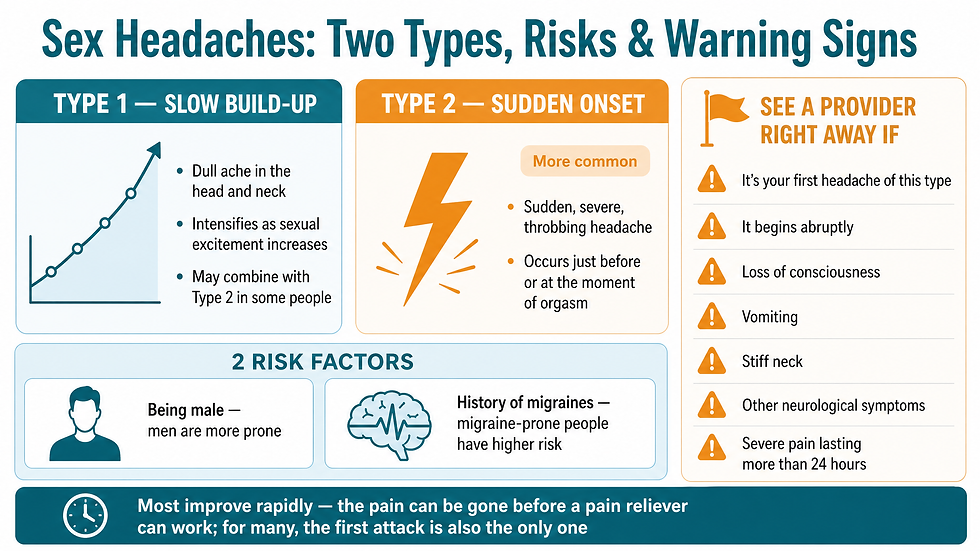
Two types: Slow build-up (dull ache in head and neck that intensifies as excitement increases) and sudden onset (severe throbbing pain just before or at orgasm — the more common type).
Duration and pattern: Most attacks last at least several minutes; some linger for hours or 2 to 3 days. Up to half of people with sex headaches have them over about six months, often in clusters, with some people only ever having one attack.
Two risk factors: Being male, and a history of migraines.
When to seek care: Right away for any headache during sexual activity — especially if it begins abruptly or it is your first of this type.
How it’s diagnosed: Brain imaging (MRI, CT, MRA or CT angiography) to rule out underlying causes; a cerebral angiogram or spinal tap may follow when imaging is normal but the headache was abrupt and recent.
How it’s treated: For many, the first attack is the only one. When attacks are frequent or prolonged and no underlying cause exists, daily preventive medicines or occasional medicines (indomethacin or a triptan an hour before sex) can prevent them.

What Is a Sex Headache?
In rare instances, headaches can be brought on by sexual activity — especially with orgasm. You may notice a dull ache in the head and neck that builds up as sexual excitement increases. Or, more commonly, you may experience a sudden, severe headache just before or during orgasm.
It is reassuring to know that most sex headaches are nothing to worry about. But some can be a sign of something serious, such as problems with the blood vessels that feed the brain — which is why any new headache in this situation deserves prompt medical attention.
What Are the Two Types of Sex Headaches?
There are two recognized types of sex headaches, and in some people the two are combined:
Feature | Type 1 — Slow Build-Up | Type 2 — Sudden Onset |
How it begins | A dull ache that intensifies gradually as sexual excitement increases | A sudden, severe, throbbing headache |
Where the pain is | Head and neck | Typically the whole head |
When it strikes | During rising arousal | Just before or at the moment of orgasm |
How common | Less common | The more common type |
How Long Does a Sex Headache Last?
Most sex headaches last at least several minutes. Others may linger for hours or even 2 to 3 days. Some sex headaches improve rapidly — so quickly that the pain is gone before any pain reliever can work.
What Is the Typical Pattern Over Time?
Many people who have sex headaches experience them in clusters over a few months, and then they may go for a year or more without having any. Up to half of all people with sex headaches experience them over the course of about six months. Some people may only have one attack during their lives.
When Should You See a Doctor?
Sex headaches aren’t usually a cause for concern. But you should consult your health care provider right away if you experience a headache during sexual activity — especially if it begins abruptly or it’s your first headache of this type.
Certain accompanying symptoms make an urgent evaluation even more important, because they point toward an underlying medical problem rather than a harmless primary headache:
Warning Sign | What It May Indicate |
Loss of consciousness | An underlying vascular or neurological problem |
Vomiting | Possible serious cause of the headache |
Stiff neck | Possible bleeding around the brain |
Other neurological symptoms | Requires urgent evaluation |
Severe pain lasting more than 24 hours | More likely to be due to an underlying cause |
What Causes Sex Headaches?
Any type of sexual activity that leads to orgasm can trigger sex headaches.
The slow build-up type and the sudden-onset type can both be primary headache disorders — headaches not associated with any underlying condition. This is the most common and least worrying scenario.
However, sex headaches that come on suddenly are more likely to be associated with an underlying problem. The most serious possibilities involve the blood vessels of the brain and body:
Possible Underlying Cause | What It Means |
Intracranial aneurysm | A widening or bubble in the wall of an artery inside your head |
Arteriovenous malformation (AVM) | An irregular connection between arteries and veins in the brain that bleeds into the spinal fluid-filled space in and around the brain |
Dissection | Bleeding into the wall of an artery leading to the brain |
Reversible cerebral vasoconstriction syndrome | Narrowing of the arteries in the brain |
Stroke | Interrupted blood flow to part of the brain |
Coronary artery disease | Reduced blood flow through the arteries of the heart |
Some medications | Such as birth control pills |
Inflammation from certain infections | Infection-related inflammation triggering the headache |
This list is meant to inform, not alarm — most people with a sudden sex headache are found to have no underlying condition after testing. But because the stakes can be high, ruling these causes out is a core part of the medical workup.
Who Is at Risk?
Sex headaches can affect anyone, but two factors raise the odds:
Risk Factor | What to Know |
Being male | Men are more prone to having sex headaches |
History of migraines | Being prone to migraines increases your risk of sex headaches |
Can Sex Headaches Be Prevented?
Simple behavioral adjustments sometimes help. Sex headaches can occasionally be prevented by stopping sexual activity before orgasm. Taking a more passive role during sex also may help reduce the frequency of attacks. When behavioral measures are not enough and attacks recur, preventive medications are the next step.

How Are Sex Headaches Diagnosed?
Because a headache during sexual activity can rarely signal a serious problem, your provider will likely recommend brain imaging to look for underlying causes:
Test | What It Does |
MRI (magnetic resonance imaging) | Uses a magnetic field and radio waves to create cross-sectional images of the structures within the brain; helps detect underlying causes of the headache |
CT (computed tomography) | An X-ray unit rotates around the body while a computer creates cross-sectional images of the brain and head; used especially if the headache occurred less than 48 to 72 hours beforehand |
MRA / CT angiography | These tests visualize the blood vessels leading to and inside the brain and neck — the key check for aneurysms and vessel problems |
Beyond basic imaging, two further tests may be needed:
Further Test | When It’s Used |
Cerebral angiogram | Shows the neck and brain arteries in detail; a thin, flexible tube is threaded through a blood vessel — usually starting in the groin — to an artery in the neck, and contrast material is injected so an X-ray machine can image the arteries |
Spinal tap (lumbar puncture) | Removes a small amount of the fluid that surrounds the brain and spinal cord; can show whether there is bleeding or an infection — used especially if the headache started abruptly and very recently and brain imaging is normal |
How Are Sex Headaches Treated?
In some cases, your first sex headache may also be your only one. Some sex headaches improve so rapidly that the pain is gone before any pain reliever can work. When attacks recur, though, treatment focuses on prevention.
If you have a history of sex headaches and no underlying cause has been found, your provider may recommend taking preventive medications regularly:
Approach | Medicines | When They’re Used |
Daily medications — beta blockers | Propranolol (Inderal, Innopran XL) or metoprolol (Lopressor, Toprol-XL) | Taken daily to prevent sex headaches; recommended only if you have frequent or prolonged attacks |
Daily medications — calcium channel blocker | Verapamil hydrochloride (Calan SR) | An alternative daily option |
Daily medications — migraine preventives | Other migraine preventive medications | Used in people who have a history of migraine |
Occasional medications | Indomethacin (an anti-inflammatory) or one of the triptans (anti-migraine medicines) | Taken an hour before sex to prevent headaches |
Preparing for Your Appointment
You’re likely to start by seeing your provider, who may refer you to a doctor trained in treating headaches, known as a neurologist.
Be aware of any pre-appointment restrictions — when you make the appointment, ask if there’s anything you need to do in advance, such as restricting your diet. Write down any symptoms you’re experiencing, including any that may seem unrelated to the reason you scheduled the appointment. Write down key personal information, including past illnesses and operations, major stresses or recent life changes, and any medical problems that run in your family. Make a list of all medications, vitamins, and supplements you’re taking. Take a family member or friend along if possible. Write down questions to ask your provider.
Questions to Ask Your Provider
What is likely causing my symptoms or condition?
Are there other possible causes for my symptoms or condition?
What tests do I need?
Is my condition likely temporary or chronic?
What is the best course of action?
What are the alternatives to the primary approach you’re suggesting?
I have these other health conditions — how can I best manage them together?
Are there any restrictions that I need to comply with?
Should I see a specialist?
Is there a generic alternative to the medicine you’re prescribing?
Are there brochures or other printed material I can take? What websites do you recommend?
What Your Provider Will Ask You
When did you first have a sex headache?
How quickly did your headache begin?
When did the headache begin in relation to orgasm?
Have your headaches been continuous or intermittent?
Were there any symptoms besides pain?
Have you had other types of headaches? If so, what are they like?
Has anyone in your immediate family experienced migraines or headaches associated with sexual activity?
What, if anything, seems to improve your headaches?
What, if anything, makes your headaches worse?
Conclusion
Sex headaches are an uncomfortable but usually harmless phenomenon — most are primary headaches with no underlying cause, many people have only a single attack, and for most the episodes fade within about six months. The important exception is the sudden, severe headache that arrives just before or during orgasm, because it can occasionally signal a serious blood vessel problem. That is exactly why the first — or any abruptly starting — sex headache deserves a prompt medical evaluation with brain imaging. Once dangerous causes are ruled out, effective options exist: daily preventive medicines for frequent attackers, an occasional pill an hour before sex, or simple behavioral adjustments.
There is no reason to suffer in silence or to let this condition add stress to your life. If you or a partner has ever had a headache during sexual activity, the safest first step is a conversation with your health care provider.
Frequently Asked Questions
What is a sex headache?
A sex headache is a headache brought on by sexual activity, especially at orgasm. It comes in two forms: a dull ache in the head and neck that builds as excitement increases, or the more common sudden, severe, throbbing headache that strikes just before or during orgasm.
Are sex headaches dangerous?
Most sex headaches are nothing to worry about — they are primary headaches with no underlying condition. However, some sudden-onset sex headaches can be a sign of something serious, such as a problem with the blood vessels that feed the brain. Because of this, any headache during sexual activity — especially a first or abruptly starting one — should be evaluated by a provider right away.
Why do I get a headache when I orgasm?
Sexual activity that leads to orgasm can trigger headaches in susceptible people. Men are more prone to them, and people with a history of migraines have a higher risk. In many cases the headache is a primary disorder with no underlying cause, but sudden-onset headaches can occasionally be associated with aneurysms, arteriovenous malformations, artery dissection, strokes, coronary artery disease, certain medications such as birth control pills, or infections.
How long does a sex headache last?
Most last at least several minutes, and many improve so rapidly that the pain is gone before a pain reliever can work. Others may linger for hours or even 2 to 3 days. Many people experience them in clusters over a few months, then go a year or more without one — up to half of people have them over the course of about six months.
When should I see a doctor about a sex headache?
See your health care provider right away for any headache during sexual activity — especially if it begins abruptly or it’s your first headache of this type. Seek urgent evaluation if the headache comes with loss of consciousness, vomiting, a stiff neck, other neurological symptoms, or severe pain lasting more than 24 hours.
How are sex headaches diagnosed?
Providers typically order brain imaging — an MRI to look for underlying causes, a CT scan especially if the headache occurred less than 48 to 72 hours earlier, and MRA or CT angiography to visualize the blood vessels of the brain and neck. If the headache started abruptly and imaging is normal, a cerebral angiogram or spinal tap (lumbar puncture) may follow to check for bleeding or infection.
How are sex headaches treated?
For many people, the first attack is the only one and no treatment is needed. When attacks recur with no underlying cause found, providers may prescribe daily preventive medicines such as the beta blockers propranolol or metoprolol, the calcium channel blocker verapamil, or migraine preventives. Alternatively, an occasional dose of indomethacin or a triptan taken an hour before sex can prevent the headache. Stopping activity before orgasm or taking a more passive role also may help.
External References
Sex headaches — Symptoms & causes — Symptoms, causes, risk factors, and prevention (source dated May 13, 2022)
Sex headaches — Diagnosis & treatment — Diagnosis, imaging, and preventive treatment options (source dated May 13, 2022)
Health information, not medical advice. This article is for general education and is not a substitute for professional diagnosis or treatment. Always consult a qualified healthcare provider about your own health, and seek emergency care for urgent symptoms.
Comments