Understanding Respiratory Arrest: Emergency Signs, Causes, and Survival

Updated: 2 days ago
Medically reviewed by Dr. Baraa Alnahhal, MD · Last reviewed: October 2026
Respiratory arrest is a life-threatening emergency where breathing stops entirely while a pulse remains. [1] Immediate intervention is required to prevent cardiac arrest and permanent organ damage, which can occur within just five minutes of oxygen deprivation. Causes range from airway blockages and allergies to opioid overdoses. [1] Survival depends on clearing the airway, administering supplemental oxygen, and providing mechanical ventilation. [1] If you encounter someone who has stopped breathing, call emergency services (911 in the United States) immediately and begin CPR.
Quick Answer
Respiratory arrest is a medical emergency in which a person stops breathing but still has a pulse, so oxygen levels plummet and carbon dioxide rises dangerously. [1] Without immediate intervention, such as airway clearance or mechanical ventilation, it typically progresses to cardiac arrest within minutes. [1] Calling 911 and starting CPR right away is vital for survival.
What the research says
Respiratory arrests are rare in hospital and less deadly than cardiac arrests. In a 6-year audit at one Australian teaching hospital, 82 respiratory arrests occurred (0.57 per 1,000 inpatient admissions), with in-hospital mortality of 25.1% compared with 74.9% for cardiac arrests over the same period (p < 0.001); pulmonary edema was the most common cause, followed by aspiration, neurologic events, medication side effects and tracheostomy-tube complications (Husband et al., Resuscitation, 2014) [2].
Early CPR is linked to better survival in cardiac arrest, which breathing failure can lead to. In a meta-analysis of 141 studies of adults who received CPR for out-of-hospital cardiac arrest, survival to hospital discharge was 8.8% overall (95% CI 8.2 to 9.4%) and 11.3% (95% CI 9.3 to 13.2%) among those who received bystander CPR (Yan et al., Critical Care, 2020) [3].
Naloxone given by trained bystanders appears effective for opioid overdose. A literature review on heroin overdose found that a systematic review of naloxone given by first responders and lay bystanders reported 100% survival in eleven studies and 96 to 99% survival in four others, with few if any risks linked to programs that train lay people to give naloxone, although the authors note that further research is needed (Willman et al., Clinical Toxicology, 2017) [4].
What is respiratory arrest and why is it so urgent?
Respiratory arrest is a rare but critical condition that differs from cardiac arrest in one key way: the heart is still beating, but the lungs have ceased to function. [1] During an arrest, the body's oxygen supply is cut off, while carbon dioxide—a metabolic waste product—builds up rapidly in the bloodstream. [1] This imbalance is highly toxic to vital organs, particularly the brain. If oxygen flow is not restored within five minutes, permanent organ damage is likely [1], and death can occur shortly thereafter as the heart eventually fails due to lack of oxygen.
Because survival is measured in minutes, immediate action is the only way to ensure a positive outcome. Healthcare providers emphasize that opening the airway quickly is among the most important factors in saving a life. [1] While respiratory arrest is rare, its potential to transition into full cardiac arrest makes it one of the most urgent scenarios in emergency medicine. Understanding the transition from respiratory distress to full arrest can help witnesses act before the condition becomes fatal.
Feature | Respiratory Arrest | Cardiac Arrest |
Breathing Status | Stopped | Stopped |
Pulse Status | Present (Heart still beating) | Absent (Heart stopped) |
Primary Risk | Progresses to Cardiac Arrest | Fatal without immediate shock/CPR |
Critical Window | ~5 minutes for organ damage | Seconds for loss of consciousness |
What are the symptoms and warning signs of respiratory arrest?
Before a person enters full respiratory arrest, they often exhibit signs of respiratory distress. These early warning signals include visible agitation, confusion, and anxiety [1] as the brain begins to sense falling oxygen levels. A person may struggle for air, producing abnormal sounds like wheezing [1] or gasping. Tachycardia (a fast heart rate) and excessive sweating (diaphoresis) [1] are also common physiological responses to the stress of being unable to breathe.
Once full arrest occurs, the symptoms become unmistakable. The chest will no longer move up and down [1], and the individual will quickly lose consciousness. A telltale sign of severe oxygen deprivation is cyanosis [1], a blue or purple tint appearing on the skin, fingernails, or lips. In cases where the arrest is caused by an obstruction, the person may be seen choking or clutching their throat before collapsing. Recognizing these signs and calling for emergency services immediately is the first step in the chain of survival.

What causes respiratory arrest and who is at risk?
The cessation of breathing can be triggered by a wide variety of internal and external factors. Airway blockages are among the most common causes, often resulting from foreign objects, bodily fluids, or sudden swelling due to trauma or severe allergic reactions. [1] Another significant cause is hypoventilation, or dangerously shallow breathing [1], which is a frequent complication of opioid overdoses or the use of other central nervous system depressants that suppress the brain's respiratory drive.
Certain populations and medical conditions increase the risk of experiencing respiratory arrest. Children and infants are at higher risk due to their tendency to put small objects in their mouths, which can lead to choking. [1] Adults with pre-existing respiratory diseases like asthma are also more vulnerable [1], especially if their condition is not well-managed. Furthermore, the use of addictive substances that slow breathing significantly elevates the risk of a sudden arrest. [1]

How is respiratory arrest managed in an emergency, and what is recovery like?
When respiratory arrest is identified, the immediate goal is to restore oxygen flow to the body. Emergency responders prioritize clearing the airway of any obstructions before providing supplemental oxygen through a mask or tube. [1] In many cases, mechanical ventilation is necessary to breathe for the patient [1] until the underlying cause is resolved. It is important to note that while oxygen is vital, excessive amounts can be harmful by potentially reducing the heart's ability to pump blood effectively. [1]
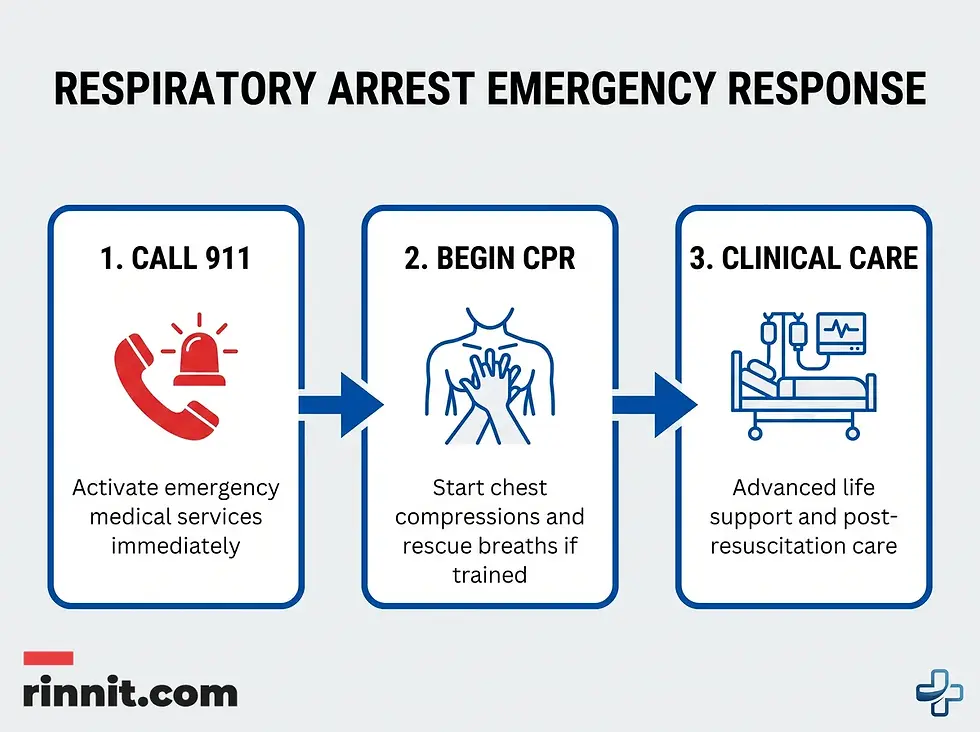
For bystanders, the protocol is clear: call 911 or your local emergency number immediately and begin CPR if the person is unresponsive and not breathing. If an opioid overdose is possible and naloxone (Narcan) is available, give it right away. [1] Dispatchers can often provide step-by-step instructions over the phone until help arrives. [1] Once the patient is stabilized, they are typically monitored in an Intensive Care Unit (ICU) for several days or weeks. [1] Long-term recovery involves managing the original cause of the arrest, such as adjusting asthma medications or participating in smoking cessation programs, to prevent a recurrence.
Conclusion
Respiratory arrest is a harrowing medical event that requires lightning-fast intervention. While the prospect of a person suddenly stopping breathing is frightening, quick action from bystanders and emergency professionals can lead to a full recovery. By managing underlying respiratory diseases, avoiding known allergens, and knowing how to perform basic CPR, individuals can play a crucial role in preventing these emergencies and saving lives when they occur.
Frequently Asked Questions
What is the main difference between respiratory and cardiac arrest?
In respiratory arrest, the person has stopped breathing but still has a pulse. In cardiac arrest, both the breathing and the heart have stopped.
How long can a person survive without breathing?
Permanent organ damage can begin after just five minutes without oxygen. Cardiac arrest usually follows within minutes if breathing is not restored.
What is cyanosis?
Cyanosis is a blue or purple tint on the skin, lips, or nails, indicating a severe lack of oxygen in the blood during respiratory arrest.
Should I perform CPR if someone has a pulse but isn't breathing?
Yes. If a person is unresponsive and not breathing, you should call 911 (or your local emergency number) and begin CPR as directed by emergency dispatchers.
Can an opioid overdose cause respiratory arrest?
Yes. Opioids can cause slow or shallow breathing (hypoventilation), which can lead to a total cessation of breathing.
What are the early warning signs of respiratory arrest?
Early signs include agitation, confusion, wheezing, a fast heart rate, and excessive sweating.
Is respiratory arrest more survivable than cardiac arrest?
Yes, people are generally more likely to survive a respiratory arrest than a cardiac arrest, provided treatment begins immediately.
What is the role of mechanical ventilation in treatment?
Mechanical ventilation uses a machine to breathe for a patient who cannot breathe on their own, ensuring the body receives necessary oxygen.
Why is "too much" oxygen dangerous during treatment?
Administering excessive oxygen can sometimes lower the amount of blood the heart is able to pump, which can be harmful to the patient.
How can I lower my risk of respiratory arrest?
Managing respiratory diseases like asthma, avoiding allergens, and avoiding addictive substances can significantly lower your risk.
Related Reading
Respiratory Failure: Symptoms, Causes, and Management explains when the lungs cannot keep oxygen and carbon dioxide balanced.
CPR: How to Perform It, Steps and When to Use It explains how to give CPR when someone stops breathing.
Sudden Cardiac Arrest: Symptoms, Causes, Diagnosis, and Treatment Explained explains when the heart suddenly stops, a closely related emergency.
Understanding Opioid Overdose: Recognition, Emergency Response, and Prevention explains how opioid overdose stops breathing and how naloxone helps.
References
Cleveland Clinic. Respiratory Arrest. Cleveland Clinic. February 27, 2026. https://my.clevelandclinic.org/health/diseases/respiratory-arrest
Husband A, Mercer I, Detering KM, et al. The epidemiology of respiratory arrests in a teaching hospital. Resuscitation. 2014;85(3):364-368. PMID 24287331. https://doi.org/10.1016/j.resuscitation.2013.11.007
Yan S, Gan Y, Jiang N, et al. The global survival rate among adult out-of-hospital cardiac arrest patients who received cardiopulmonary resuscitation: a systematic review and meta-analysis. Critical Care. 2020;24(1):61. PMID 32087741. https://doi.org/10.1186/s13054-020-2773-2
Willman MW, Liss DB, Schwarz ES, et al. Do heroin overdose patients require observation after receiving naloxone? Clinical Toxicology. 2017;55(2):81-87. PMID 27849133. https://doi.org/10.1080/15563650.2016.1253846
Medical disclaimer
The information provided in this article is for educational purposes only and should not be used as a substitute for professional medical advice, diagnosis, or treatment. Always seek the advice of your physician or other qualified health provider with any questions you may have regarding a medical condition.



Comments