Understanding Renal Oncocytoma: A Guide to Benign Kidney Tumors

Updated: 3 days ago
Medically reviewed by Dr. Baraa Alnahhal, MD · Last reviewed: October 2026
Renal oncocytoma is a rare, noncancerous tumor that develops on the kidney, accounting for roughly 3% to 7% of all kidney growths. [1] These tumors are generally harmless [1], do not spread to other organs, and are often discovered incidentally during imaging for unrelated issues. While most patients remain asymptomatic, some may experience flank pain or blood in their urine. [1] Diagnosis typically involves imaging and a biopsy to distinguish it from malignant conditions. [1] Treatment is not always required, but surgical removal may be recommended for symptomatic or fast-growing tumors. [1]
Quick Answer
A renal oncocytoma is a benign, noncancerous solid tumor that forms on kidney tissue. [1] It is generally harmless, rarely spreads and is usually discovered by chance during scans for other conditions. [1] Many need only periodic monitoring, but surgical removal may be needed if the tumor causes pain or blood in the urine, or grows rapidly. [1]
What the research says
Surgery is common for this benign tumor, and it carries real risk. In the UK national nephrectomy registry (2013 to 2016), oncocytomas made up 1,202 of 32,130 renal surgical cases (3.7%); only 2.9% of patients had a preoperative biopsy, 56.8% had a radical nephrectomy, and one in five (20.2%) had in-hospital complications, including 4% with grade III or higher complications (Neves et al., BJU International, 2018) [2].
Imaging alone can struggle to separate oncocytoma from kidney cancer. In a retrospective study of 25 patients with renal oncocytoma and 73 with chromophobe renal cell carcinoma, all of whom had a central scar, a model combining four CT features identified oncocytoma with 88% sensitivity and 86.3% specificity (area under the curve 0.923) (Li et al., Acta Radiologica, 2022) [3].
What is a renal oncocytoma?
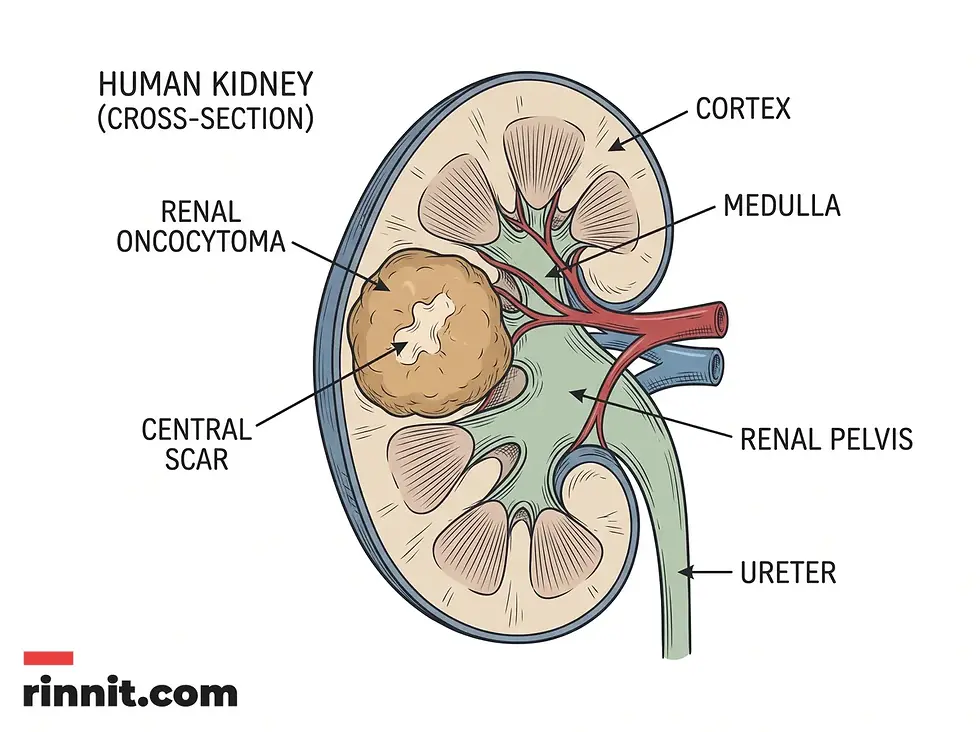
Renal oncocytoma is a specific type of solid growth that occurs within the kidney. Unlike malignant tumors, these are considered benign, meaning they do not typically invade surrounding tissues or metastasize to distant organs. They are relatively rare, representing between 3% and 7% of all identified kidney tumors. [1] On medical imaging, these growths often present as a solid mass, frequently featuring a characteristic central scar [1] that helps healthcare providers distinguish them from other types of renal masses.
For the majority of individuals, learning of a kidney tumor can be alarming, but renal oncocytomas are usually not harmful. They are often referred to as "incidentalomas" because they are frequently found by chance when a patient undergoes an ultrasound, CT scan, or MRI for a completely unrelated medical concern. [1] Because they rarely cause physical problems, many people live with these tumors without ever knowing they exist until a scan reveals them.
Characteristic | Details |
Tumor Type | Benign (Noncancerous) |
Prevalence | 3% to 7% of all kidney tumors |
Common Discovery | Incidentally during unrelated imaging |
Growth Pattern | Typically slow-growing and localized |
What are the symptoms and signs of renal oncocytoma?
Most people diagnosed with a renal oncocytoma do not experience any symptoms at all. The tumor is often small enough that it does not interfere with kidney function or put pressure on surrounding structures. However, if the growth becomes large or is positioned in a way that impacts the renal system, certain clinical signs may emerge. These symptoms are non-specific and can overlap with other renal conditions, requiring a professional medical evaluation.
When symptoms do occur, they most commonly include hematuria, which is the presence of blood in the urine. [1] Some patients may also experience persistent flank pain—a dull ache or sharp pain located in the side or back. In rare instances, a lump or mass may be palpable on the side of the affected kidney. [1] If any of these signs develop, it is important to consult a healthcare provider to determine the cause and rule out more serious conditions.
What causes renal oncocytoma and who is at risk?
The exact cause of renal oncocytomas remains unknown to medical science. [1] While researchers continue to study these tumors, current evidence suggests that genetics and DNA play a significant role in their development. Most cases occur sporadically, but certain hereditary conditions can increase an individual's likelihood of developing these benign growths. For instance, people born with genetic disorders such as tuberous sclerosis complex or Birt-Hogg-Dubé syndrome are at a higher risk. [1]
Birt-Hogg-Dubé syndrome, in particular, is known to cause various growths on the skin and other organs, including the kidneys. [1] In patients with these genetic predispositions, it is more common to find multiple tumors or growths affecting both kidneys simultaneously. [1] Furthermore, these individuals may have a higher rate of recurrence even after a tumor has been successfully removed. [1] For the general population without these genetic markers, the risk of recurrence is extremely low.

How is renal oncocytoma diagnosed and treated?
Diagnosing a renal oncocytoma involves a combination of advanced imaging and pathological analysis. Because these benign tumors can look very similar to renal cell carcinoma (a type of kidney cancer) on a scan, a definitive diagnosis often requires a biopsy. [1] During this procedure, a small sample of tissue is taken and examined by a pathologist. [1] Blood tests may also be performed to assess overall kidney function [1] and ensure the organs are filtering waste effectively.
Treatment strategies vary based on the tumor's size, growth rate, and whether it is causing symptoms. In many cases, a "watchful waiting" approach is adopted, where the tumor is monitored through periodic scans. If the tumor grows rapidly, causes pain, or if its benign nature cannot be confirmed, surgical intervention may be recommended. [1] Common procedures include a partial nephrectomy, where only the tumor is removed, or a radical nephrectomy, which involves removing the entire kidney. [1] Minimally invasive options like cryoablation (freezing) or radiofrequency ablation (heat) are also available in some cases. [1]

Conclusion
Renal oncocytoma is a manageable, benign condition that rarely poses a threat to long-term health. While the discovery of any tumor requires careful medical attention, the noncancerous nature of an oncocytoma provides a positive outlook for most patients. Through regular monitoring and, when necessary, targeted treatment, individuals can maintain their kidney health and overall well-being. Open communication with healthcare providers is essential for determining the best course of action for each unique case.
Frequently Asked Questions
Is a renal oncocytoma the same as kidney cancer?
No. A renal oncocytoma is a benign, noncancerous growth. While it is a tumor, it does not typically spread to other organs or behave like malignant kidney cancer.
Can a renal oncocytoma become cancerous?
It is extremely rare. In very few cases, these tumors have been known to become malignant, but the vast majority remain benign throughout a person's life.
What is a cystic oncocytoma?
A cystic oncocytoma is a rare variation of the tumor that contains fluid-filled areas rather than being composed entirely of solid tissue.
How do doctors tell an oncocytoma apart from cancer?
Doctors use imaging like CT or MRI scans to look for a central scar, but a biopsy is often needed for a pathologist to confirm the diagnosis under a microscope.
Does a renal oncocytoma always need to be removed?
No. If the tumor is small, not growing, and not causing symptoms, your doctor may recommend periodic monitoring instead of surgery.
What are the symptoms of a large renal oncocytoma?
Symptoms can include blood in the urine, a dull ache in the side (flank pain), or a lump that you can feel on your side.
Are there genetic risks for renal oncocytoma?
Yes. Conditions like Birt-Hogg-Dubé syndrome and tuberous sclerosis complex can increase the risk of developing these and other kidney growths.
What happens if I need surgery for an oncocytoma?
Depending on the size and location, a surgeon may perform a partial nephrectomy (removing only the tumor) or a radical nephrectomy (removing the whole kidney).
Can a renal oncocytoma grow back?
Recurrence is very rare after successful removal, except in individuals with specific genetic conditions that predispose them to multiple tumors.
How common is renal oncocytoma?
It is uncommon. Renal oncocytomas make up roughly 3% to 7% of all kidney tumors, and many are found by chance on scans done for other reasons.
Related Reading
Kidney Cancer: Symptoms, Causes & Treatment Guide explains the kidney cancers doctors work to rule out.
Kidney Biopsy: Purpose, Types, Procedure, Risks and Recovery describes how a kidney tissue sample is taken and tested.
Open Partial Nephrectomy: Surgery, Recovery Timeline and Risks explains surgery that removes a kidney tumor while saving the kidney.
Tuberous Sclerosis: Symptoms, Causes, Diagnosis and Treatment — What You Need to Know covers a genetic condition linked to kidney growths, including oncocytomas.
References
Cleveland Clinic. Renal Oncocytoma. Cleveland Clinic. July 22, 2025. https://my.clevelandclinic.org/health/diseases/22209-renal-oncocytoma
Neves JB, Withington J, Fowler S, et al. Contemporary surgical management of renal oncocytoma: a nation's outcome. BJU International. 2018;121(6):893-899. PMID 29397002. https://doi.org/10.1111/bju.14159
Li X, Nie P, Zhang J, et al. Differential diagnosis of renal oncocytoma and chromophobe renal cell carcinoma using CT features: a central scar-matched retrospective study. Acta Radiologica. 2022;63(2):253-260. PMID 33497276. https://doi.org/10.1177/0284185120988109
Medical disclaimer
The information provided in this article is for educational purposes only and should not be used as a substitute for professional medical advice, diagnosis, or treatment. Always seek the advice of your physician or other qualified health provider with any questions you may have regarding a medical condition.



Comments