Tuberous Sclerosis: Symptoms, Causes, Diagnosis and Treatment — What You Need to Know

Updated: 2 days ago
Medically reviewed by Dr. Baraa Alnahhal, MD · Last reviewed: October 2026
Editorial note: This article is provided for educational purposes only. It is not medical advice. If your child has seizures or you notice developmental concerns, seek medical evaluation promptly, and always consult a qualified healthcare professional for diagnosis and treatment decisions.
Quick Answer: What is tuberous sclerosis (TSC)?
Tuberous sclerosis (TSC) is a genetic disorder that causes noncancerous tumors in many parts of the body, most commonly the skin, brain, eyes, kidneys, heart and lungs [1]. A seizure is often the first sign, usually in infancy or childhood [1]. There is no cure and its course is unpredictable, but medicines, surgery and therapies manage symptoms, with lifelong monitoring required [2].
What the research says
Seizures and autism often travel together in TSC. Across 42 studies of 3,542 children with TSC, autism spectrum disorder was linked to a history of seizures (OR 3.79, 95% CI 1.77–8.14) and especially to infantile spasms (OR 3.04, 95% CI 2.17–4.27). It was not linked to tuber number, tuber location or genotype (Mitchell et al., Developmental Medicine & Child Neurology, 2021) [3].
Everolimus did not improve thinking or autism in children. In a 12-month randomized, placebo-controlled trial of 32 children with TSC, everolimus had no benefit on full-scale IQ (treatment effect −5.6 points, 95% CI −12.3 to 1.0) or on autism and other neuropsychological measures (Overwater et al., Neurology, 2019) [4].
Early, targeted seizure care is changing practice. Updated European recommendations note that vigabatrin given before seizures begin may delay seizure onset and lower the risk of epileptic encephalopathy, that adjunctive everolimus works for refractory seizures, and that epilepsy surgery should be considered early in drug-resistant epilepsy (Specchio et al., European Journal of Paediatric Neurology, 2023) [5].
When should you or your child see a doctor about tuberous sclerosis?
Symptoms of tuberous sclerosis may be noticed at birth, or the first symptoms may appear during childhood or even years later in adulthood [1]. Contact your child's healthcare provider if you're concerned about your child's development or you notice any symptoms of tuberous sclerosis — especially repeated seizures or infantile spasms (stiffening of the arms and legs with arching of the back and head), which warrant prompt evaluation.
Growth-related tumors in this condition can cause severe or life-threatening complications in the brain, heart, and kidneys [1], so early diagnosis and lifelong monitoring matter.
What Exactly Is Tuberous Sclerosis?
Tuberous sclerosis (pronounced TOO-bur-us skluh-ROH-sis), also called tuberous sclerosis complex (TSC), is an uncommon genetic disorder that causes tumors to develop in many parts of the body [1]. The word "tumor" here is important: these tumors are not cancer. They are noncancerous (benign) growths — overgrowths of cells and tissue that are not expected.
Symptoms vary widely, depending on where the growths develop and how big they get. That unpredictability is part of what makes the condition challenging for families.
The disorder is often first found during infancy or childhood. Sometimes it is so mild that it isn't diagnosed until adulthood — or not diagnosed at all [1]. At the other end of the spectrum, tuberous sclerosis can cause serious disabilities.
There is no cure for tuberous sclerosis, and the course of the disorder and how bad it gets can't be predicted [1]. But treatments are available to manage symptoms [1].
What Are the Symptoms of Tuberous Sclerosis?
Symptoms are caused by the noncancerous growths, which most commonly develop in the skin, brain, eyes, kidneys, heart and lungs — but any part of the body can be affected [1]. Because each person's growths differ in size and location, symptoms are different for each person with tuberous sclerosis.
Body area | What the growths can cause |
Skin | The most common symptom: patches of lighter skin; small areas of thickened, smooth or bumpy skin; raised, discolored areas on the forehead; small soft bumps under or around the nails; acne-like facial growths that start in childhood [1] |
Brain | Seizures — a seizure is often the first symptom of tuberous sclerosis; in small children, infantile spasms involve stiffening of the arms and legs and arching of the back and head [1] |
Thinking and learning | Developmental delays; limits on the ability to think, reason and learn; autism spectrum disorder or attention-deficit/hyperactivity disorder (ADHD) can also occur [1] |
Behavior | Hyperactivity, self-injury or aggression; issues with social and emotional adjustment [1] |
Kidneys | Growths on the kidneys are common, and more growths may develop with age [1] |
Heart | Growths, if present, are usually largest at birth and shrink as the child gets older [1] |
Lungs | Growths may cause coughing or trouble breathing, especially with physical activity or exercise; lung tumors occur more often in females than in males [1] |
Eyes | White patches on the retina (the light-sensitive tissue at the back of the eye); these usually don't interfere with vision [1] |
Teeth and mouth | Pits in the tooth surface; small growths on the gums, inside of the cheeks, and on the tongue [1] |
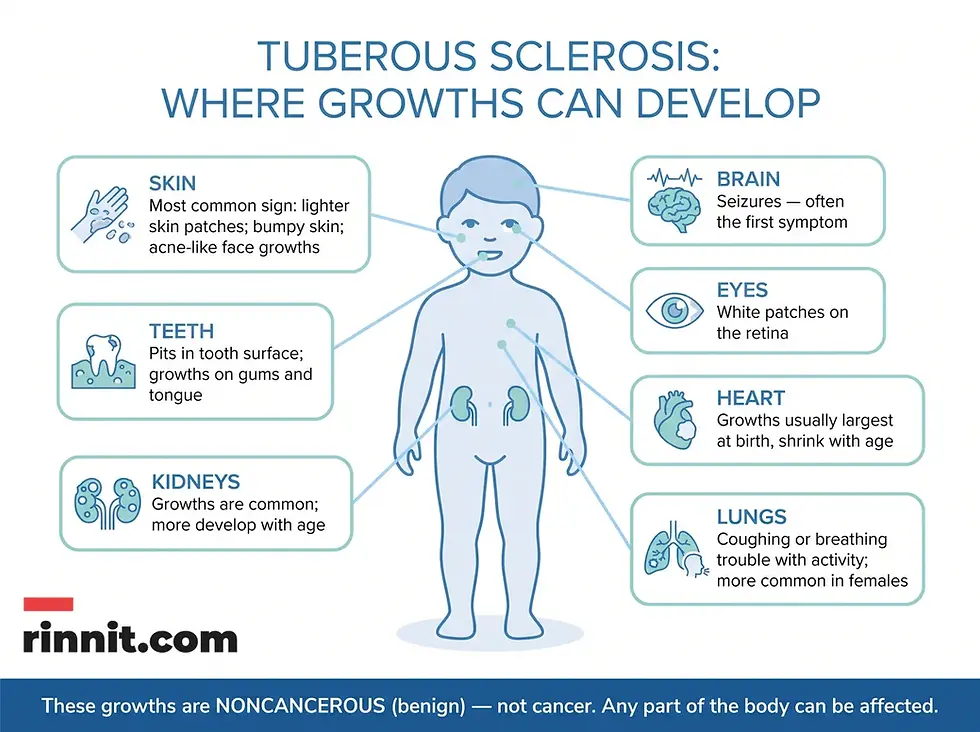
A note on recognizing skin signs across skin tones: lighter skin patches — one of the most common markers — can be easier to spot on darker skin tones, so families should know that this clue applies to every child regardless of complexion.
What Causes Tuberous Sclerosis?
Tuberous sclerosis is a genetic disorder caused by gene changes — sometimes called mutations — in either the TSC1 or the TSC2 gene [1]. These genes are thought to prevent cells from growing too fast or in an out-of-control way. Changes in either gene can cause cells to grow and divide more than needed, which leads to the multiple growths throughout the body that are considered noncancerous tumors [1].
Is Tuberous Sclerosis Inherited?

About two-thirds of people who have tuberous sclerosis have a new change in either the TSC1 or the TSC2 gene linked with the disorder — meaning most people do not have a family history of it [1]. This comes from a random cell division error.
About one-third of people with tuberous sclerosis get a changed TSC1 or TSC2 gene from a parent who has the disorder [1].
Inheritance scenario | What to know |
New gene change (random cell division error) | About two-thirds of people with tuberous sclerosis have a new gene change; most have no family history |
Passed down in families | About one-third of people get the changed gene from a parent with the disorder |
Risk to your own children | If you have tuberous sclerosis, you have up to a 50% chance of passing the changed gene and the disorder to your biological children [1] |
Predicting severity in the next generation | Severity may vary — a parent with tuberous sclerosis may have a child with a milder or a more severe form of the disorder [1] |
What Complications Can Tuberous Sclerosis Cause?
Tuberous sclerosis can cause severe or life-threatening complications, depending on where its noncancerous tumors grow and how large they are. Examples include:
Organ affected | Complication | What it can look like |
Brain | Fluid buildup around the brain (hydrocephalus) | A brain tumor type called subependymal giant cell astrocytoma can grow along the ventricles (fluid-filled spaces) and block fluid flow; symptoms include a head size larger than expected, nausea, headaches, and behavior changes [1] |
Heart | Blood flow blockage or rhythm problems | Growths in the heart, usually in infants, can block blood flow or cause heart rhythm problems [1] |
Kidneys | Kidney damage | Growths can be large and cause potentially serious — even life-threatening — kidney problems: high blood pressure, bleeding, or kidney failure; rarely, kidney growths can become cancerous [1] |
Lungs | Lung failure | Growths damage lung tissue and can lead to collapsed lungs [1]; they interfere with how well the lungs provide oxygen to the rest of the body |
Kidneys and brain | Cancer risk | Tuberous sclerosis is linked with an increased risk of developing cancerous tumors in the kidneys and brain [1] |
Eyes | Vision damage | Growths can interfere with vision if they block too much of the retina, though this is rare [1] |
How Is Tuberous Sclerosis Diagnosed?
Depending on symptoms, you or your child may see several different specialists who are experts in tuberous sclerosis — brain (neurologist), heart (cardiologist), eyes (ophthalmologist), skin (dermatologist) and kidneys (nephrologist), with other specialists added as needed [2].
The healthcare provider usually does a physical exam, talks with you about symptoms and family history, and looks for the growths commonly caused by tuberous sclerosis. The provider also orders several tests, including blood tests and genetic tests, to diagnose the condition and identify related problems [2].
Test | What it checks |
EEG (electroencephalogram) | Seizure evaluation — records electrical activity in the brain and helps determine what's causing seizures [2] |
MRI | Brain, lungs, kidneys and liver evaluation — magnetic field and radio waves create detailed images of the brain or other body parts [2] |
CT scan | X-ray technique creating cross-sectional images, and sometimes 3D images, of the brain or other body parts |
Ultrasound (sonography) | High-frequency sound waves create images of body parts such as the liver, heart and kidneys [2] |
Echocardiogram | Heart evaluation — sound waves produce images of the heart [2] |
ECG or EKG (electrocardiogram) | Heart evaluation — records the electrical activity of the heart [2] |
Eye exam | A light and magnifying lens examine the inside of the eye, including the retina [2] |
Dental exam | Teeth and inside of the mouth, likely including X-rays of the teeth and jaws [2] |
Developmental or mental health evaluation | If needed based on screening — identifies developmental delays, limits on learning and functioning, educational or social problems, or behavioral or emotional disorders [2] |
Genetic testing | Can confirm the diagnosis of tuberous sclerosis [2] |
Genetic testing deserves a special note. If a child is diagnosed with tuberous sclerosis without a family history of the condition, both parents may want to consider genetic testing for tuberous sclerosis for themselves [2]. Genetic counseling can help parents understand the risk of tuberous sclerosis for their other children and any future children [2]. People with tuberous sclerosis may also consider genetic counseling before their child-bearing years to understand their risk of passing on the condition and their options [2].
How Is Tuberous Sclerosis Treated?

Although there is no cure for tuberous sclerosis, treatment can help manage specific symptoms [2]. The five treatment categories are medicine, surgery, therapy, educational and vocational services, and mental health support.
Treatment category | What it does |
Medicine | Anti-seizure medicines may be prescribed to control seizures; other medicines may help manage heart rhythm problems, behavior problems or other symptoms [2]. A medicine called everolimus may be used to treat certain types of brain and kidney growths that can't be removed with surgery [2]; using it early in care may help reduce the risk of seizures [2]. The topical ointment form of a medicine called sirolimus may help treat acne-like skin growths [2]. |
Surgery | If a growth affects the function of a specific organ — such as the kidney, brain or heart — it may be removed with surgery [2]. Surgery sometimes helps control seizures caused by brain growths that don't respond to medicine [2]. Procedures such as dermabrasion or laser treatment may improve the appearance of skin growths [2]. |
Therapy | Early intervention services, such as occupational, physical or speech therapy, may be helpful [2]; they can improve children's ability to manage daily tasks and activities. |
Educational and vocational services | Early intervention and special needs services can help children with developmental delays and behavior issues adapt to the classroom and meet their full potential; social, vocational and rehabilitation services may continue throughout life when needed [2]. |
Mental health and behavior support | Talking with a mental health provider may help people accept and adjust to living with tuberous sclerosis, help with behavior, social or emotional issues [2], and suggest resources. |
Ongoing monitoring: Tuberous sclerosis is a lifelong condition that requires careful monitoring and follow-up, because many symptoms may take years to develop [2]. A schedule of regular appointments with your healthcare provider throughout life may include the same tests done during diagnosis [2]. Finding and managing problems early can help prevent complications [2].
How Do Families Cope With a Tuberous Sclerosis Diagnosis?
If your child is diagnosed with tuberous sclerosis, you and your family may face several challenges and uncertainties. One of the most difficult things about this condition is that it's impossible to predict how your child's health and development will unfold over time.
Your child may have only mild problems and keep up with peers academically, socially, and physically. Or your child may have more-serious health and developmental problems and lead a life that is less independent than you may have expected. Four coping strategies can help:
Coping strategy | What it involves |
Establish a screening schedule | Learn all you can about tuberous sclerosis and work closely with your healthcare provider to set up ongoing screening and monitoring; discovering and treating problems early reduces complications [2] |
Get help early for behavior problems | Behavior is not your fault and not your child's fault; talk to your child's healthcare provider and work with the school or a mental health provider — earlier help improves long-term outcomes [2] |
Provide love and support | Your support is essential to helping your child reach full potential; counseling may help with adjustment and coping, and respite care can give parents relief [2] |
Connect with other families | Ask your child's healthcare team to recommend a support group, or contact the TSC Alliance to find support [2] |
How Should You Prepare for the First Appointment?
Symptoms may be noticed at birth, or you may raise concerns with your child's healthcare provider after noticing something. After an exam, your child may be referred to one or more specialists for testing and treatment. Consider asking a trusted family member or friend to join you for the appointment — someone who can offer emotional support and help you remember all the information.
Before the appointment, make a list of:
Any symptoms your child is experiencing and for how long; if there have been seizures, note what happened before, during and after each one and how long it lasted, and note any birthmarks of concern [2]
Your child's key medical information, including other health problems
All medicines, vitamins, herbs and other supplements your child is taking, with doses
Information about your family history, including whether anyone else in the family has tuberous sclerosis [2]
The questions you want to ask
Questions to ask your child's healthcare provider: What is likely causing my child's symptoms? Are there other possible causes? What kinds of tests does my child need? Should my child see a specialist? [2]
Questions to ask if you're referred to a specialist: Does my child have tuberous sclerosis? What are the treatment options? What approach do you suggest? What are the possible complications? How often will you want to evaluate my child's health and development? Are my other children or family members at increased risk? Should the child and other family members be tested for the genetic changes? What other specialists should the child see? Are there any clinical trials that might help? How can I help my child cope, and how can I find other families living with tuberous sclerosis? [2]
What the doctor will ask you: Be ready to describe your child's symptoms, when you first noticed them, any seizures (with before/during/after details and duration), nausea and vomiting, behavior problems (hyperactivity, aggression, self-injury), attention difficulty, social withdrawal, developmental delays compared with same-age children, and whether any blood relatives have been diagnosed with tuberous sclerosis or have had symptoms without a diagnosis.
Conclusion: Tuberous Sclerosis Can't Be Cured — But It Can Be Managed
Tuberous sclerosis is an unpredictable condition: noncancerous tumors that may touch nearly any organ, symptoms that range from invisible to severe, and a course that no one can forecast. What medicine can do today is substantial — seizure control, tumor-shrinking medicine, organ-preserving surgery, and therapies that help children learn, move, speak and adapt.
The single most important habit is lifelong monitoring: regular checkups and the same tests used at diagnosis, repeated on schedule, because many symptoms take years to appear. Early detection is what keeps complications manageable.
Your next step: If you've noticed seizures, unusual skin patches, or developmental delays in your child — or any of the symptoms listed above in yourself — schedule an appointment with a healthcare provider and bring this article's symptom and question checklists with you.
Related reading: Epilepsy | ADHD | Kidney Angiomyolipoma | Moles | Genetic Mutations
Sources: Mayo Clinic — Tuberous Sclerosis: Symptoms & Causes | Mayo Clinic — Tuberous Sclerosis: Diagnosis & Treatment
Frequently Asked Questions
1. What is tuberous sclerosis in simple terms?
A genetic disorder that causes noncancerous tumors to grow in many parts of the body, most often the skin, brain, eyes, kidneys, heart and lungs. It's also called tuberous sclerosis complex (TSC).
2. Is tuberous sclerosis the same as tuberous sclerosis complex?
Yes. Tuberous sclerosis and tuberous sclerosis complex (TSC) are two names for the same genetic disorder.
3. Is tuberous sclerosis cancer?
No. The growths caused by tuberous sclerosis are noncancerous (benign) tumors — overgrowths of cells and tissue. Rarely, kidney growths can become cancerous, and the condition is linked with an increased risk of cancerous tumors in the kidneys and brain.
4. What causes tuberous sclerosis?
Gene changes (mutations) in either the TSC1 or TSC2 gene. These genes normally prevent cells from growing too fast or out of control; when they change, cells grow and divide more than needed, forming multiple noncancerous growths.
5. Is tuberous sclerosis genetic or inherited?
Tuberous sclerosis is genetic — but not always inherited. About two-thirds of people have a new gene change (a random cell division error) with no family history; about one-third get the changed gene from a parent with the disorder.
6. Can you catch tuberous sclerosis?
No. It's a genetic disorder caused by changes in the TSC1 or TSC2 gene, not an infection or anything that spreads between people.
7. What is the chance of passing tuberous sclerosis to my children?
If you have tuberous sclerosis, you have up to a 50% chance of passing the changed gene and the disorder to your biological children.
8. Will my child's tuberous sclerosis be as severe as mine?
Severity may vary between generations. A parent with tuberous sclerosis may have a child with a milder or a more severe form of the disorder.
9. At what age is tuberous sclerosis usually found?
Tuberous sclerosis is often first found during infancy or childhood. But it can be so mild that it isn't diagnosed until adulthood — or not diagnosed at all.
10. What are the first symptoms of tuberous sclerosis?
A seizure is often the first symptom. Skin changes — patches of lighter skin and small areas of thickened, smooth or bumpy skin — are the most common symptom.
11. What do infantile spasms look like?
In small children, a common seizure type called infantile spasm involves stiffening of the arms and legs and arching of the back and head.
12. Can tuberous sclerosis cause developmental delays?
Yes. It can result in developmental delays and sometimes limits the ability to think, reason and learn. Autism spectrum disorder and ADHD can also occur.
13. Does tuberous sclerosis affect the skin?
Yes — skin changes are the most common symptom. They include lighter skin patches, thickened or bumpy skin areas, raised discolored forehead areas, small soft bumps under or around the nails, and acne-like facial growths starting in childhood.
14. Does tuberous sclerosis affect the lungs?
Yes. Growths in the lungs may cause coughing or trouble breathing, especially with physical activity or exercise. Lung tumors occur more often in females than in males.
15. Can tuberous sclerosis affect the heart?
Yes. Growths in the heart, if present, are usually largest at birth and shrink as the child gets older. In infants, they can block blood flow or cause heart rhythm problems.
16. Does tuberous sclerosis affect the eyes?
Tuberous sclerosis can. Growths may appear as white patches on the retina. They usually don't interfere with vision, though rarely they can block too much of the retina and damage vision.
17. What is hydrocephalus in tuberous sclerosis?
A brain tumor type called subependymal giant cell astrocytoma can grow along the lining of the brain's fluid-filled spaces (ventricles) and block fluid flow. The resulting fluid buildup around the brain — hydrocephalus — can cause a head size larger than expected, nausea, headaches and behavior changes.
18. How is tuberous sclerosis diagnosed?
A healthcare provider does a physical exam, reviews symptoms and family history, and orders tests such as blood tests, genetic tests, EEG, MRI, CT scan, ultrasound, echocardiogram, ECG, eye exam, dental exam, and developmental or mental health evaluation as needed. Genetic testing can confirm the diagnosis.
19. Is there a cure for tuberous sclerosis?
No. There is no cure, and the course of the disorder and how bad it gets can't be predicted. But treatments are available to manage symptoms.
20. What medicines treat tuberous sclerosis?
Anti-seizure medicines control seizures; other medicines manage heart rhythm or behavior problems. A medicine called everolimus may treat certain brain and kidney growths that can't be removed with surgery, and using it early may reduce seizure risk. The topical ointment form of sirolimus may treat acne-like skin growths.
21. Can surgery help with tuberous sclerosis?
Yes. Surgery can remove a growth affecting the function of an organ such as the kidney, brain or heart, and sometimes controls seizures caused by brain growths that don't respond to medicine. Dermabrasion or laser treatment may improve the appearance of skin growths.
22. Do children with tuberous sclerosis need therapy?
Early intervention services — occupational, physical or speech therapy — may be helpful and can improve a child's ability to manage daily tasks and activities.
23. Why does tuberous sclerosis require lifelong monitoring?
Because it's a lifelong condition and many symptoms may take years to develop. A schedule of regular appointments — sometimes including the same tests used at diagnosis — helps find and manage problems early, which can prevent complications.
24. Should parents get genetic testing if their child is diagnosed?
If a child is diagnosed with tuberous sclerosis without a family history of the condition, both parents may want to consider genetic testing for themselves. Genetic counseling can help parents understand risks for other and future children.
25. Is behavior my fault when my child has tuberous sclerosis?
No. The behavior is not your fault — and it's not your child's fault. Getting help early from your child's healthcare provider, school, or a mental health provider improves long-term outcomes.
References
Mayo Clinic Staff. Tuberous sclerosis: Symptoms and causes. Mayo Clinic. December 6, 2022. https://www.mayoclinic.org/diseases-conditions/tuberous-sclerosis/symptoms-causes/syc-20365969
Mayo Clinic Staff. Tuberous sclerosis: Diagnosis and treatment. Mayo Clinic. December 6, 2022. https://www.mayoclinic.org/diseases-conditions/tuberous-sclerosis/diagnosis-treatment/drc-20365971
Mitchell RA, Barton SM, Harvey AS, et al. Factors associated with autism spectrum disorder in children with tuberous sclerosis complex: a systematic review and meta-analysis. Dev Med Child Neurol. 2021;63(7):791-801. PMID 33432576. https://doi.org/10.1111/dmcn.14787
Overwater IE, Rietman AB, Mous SE, et al. A randomized controlled trial with everolimus for IQ and autism in tuberous sclerosis complex. Neurology. 2019;93(2):e200-e209. PMID 31217257. https://doi.org/10.1212/WNL.0000000000007749
Specchio N, Nabbout R, Aronica E, et al. Updated clinical recommendations for the management of tuberous sclerosis complex associated epilepsy. Eur J Paediatr Neurol. 2023;47:25-34. PMID 37669572. https://doi.org/10.1016/j.ejpn.2023.08.005
Medical disclaimer
This article is for general educational purposes only and does not constitute medical advice. Always consult a qualified healthcare professional for diagnosis, treatment decisions, and personal health guidance. If your child has seizures or you notice developmental concerns, seek medical evaluation promptly.



Comments