What Is a Kidney Angiomyolipoma? Symptoms, Size, and Treatment Options

Updated: 2 days ago
Medically reviewed by Dr. Baraa Alnahhal, MD · Last reviewed: September 2026
Editorial note: This article is for general education only. It is not medical advice, a diagnosis, or a treatment plan. Angiomyolipomas are benign (noncancerous) kidney tumors — but any kidney mass should be confirmed by a healthcare provider, because some kidney cancers can look similar on imaging. If you have been told you have a kidney tumor, or if you develop flank pain, blood in your urine, or a sudden severe pain with dizziness, see a healthcare provider promptly.
TL;DR
Angiomyolipoma is a benign (noncancerous) kidney tumor made of blood vessels, fat, and smooth muscle. It is the most common type of benign kidney tumor, affecting fewer than 1 in 100 people [1]. Most people never have symptoms, and the tumor is often found by accident on a scan. Small tumors (under about 4 cm, or 1.5 inches) usually only need monitoring with yearly imaging. Larger tumors may be treated with embolization, ablation, surgery, or medication to reduce bleeding risk [1].
Quick Answer: What Is an Angiomyolipoma of the Kidney?
An angiomyolipoma (AML) is a harmless kidney tumor composed of three tissues — fat, smooth muscle, and blood vessels — that gives it a golden-yellow appearance [1]. It is not cancer, grows slowly or not at all in most cases, and rarely turns into anything dangerous. Most people learn they have one only because a scan ordered for another reason happens to show it. Treatment depends on size: tumors under about 4 cm are usually monitored, while larger ones may be treated to prevent bleeding [1].
What Exactly Is an Angiomyolipoma?
An angiomyolipoma (an-jee-oh-mahy-OH-li-POH-muh) is a mass in the kidney. The name tells you what it is made of: angio (blood vessels), myo (muscle), and lipoma (fat). These tumors are typically golden yellow because of their fat content, and they range from about half an inch to 8 inches (1–20 centimeters) across [1].

The word "tumor" understandably sounds frightening. It is worth being precise about what this one is. An angiomyolipoma is a benign tumor — it does not invade other tissues or spread the way cancer does. In fact, it is the most common type of benign kidney tumor in adults [1]. It goes by several other names, including AML, renal angiomyolipoma, renal AML, and RAML [1].
Term you might hear | What it means |
Angiomyolipoma (AML) | A benign kidney tumor made of blood vessels, smooth muscle, and fat [1] |
Benign tumor | A growth that is not cancer and does not spread |
Retroperitoneal hemorrhage | Serious internal bleeding when a tumor ruptures into the belly area [1] |
mTOR inhibitor | A medication that can shrink or slow these tumors by targeting their genetic pathway [1] |
Embolization | A procedure that blocks the blood supply to the tumor so it shrinks [1] |
Partial nephrectomy | Surgery removing part of the kidney while keeping the rest [1] |
How Common Is a Kidney Angiomyolipoma?
Angiomyolipomas are rare in absolute terms but are the most common benign kidney tumor. Overall prevalence is estimated at roughly 0.13% to 2.2% of people, with one recent review citing about 0.44% in the general population — fewer than 1 in 100 people [1] [4] [5]. Kidney tumor specialists classify them as accounting for only 0.3% to 3% of all kidney tumors, because cancerous tumors are far more common overall [4].
Group | Estimated prevalence of angiomyolipoma |
General population | ~0.13%–0.44% (fewer than 1 in 100 people) [4] [5] |
People with tuberous sclerosis complex (TSC) | 50%–80% develop at least one AML [4] [6] |
People with lymphangioleiomyomatosis (LAM) | 45%–60% develop AMLs, often multiple and in both kidneys [4] |
Who gets angiomyolipomas | Detail |
Sex | More common in women, roughly 2–4 times more often than men [4] [6] |
Age | Most often found between ages 40 and 60 [1] |
How found | Majority discovered by accident on scans done for other reasons [4] [5] |
Single or multiple | Usually one tumor; can be multiple, or appear in both kidneys [1] |
A key distinction matters for understanding risk. About 80% of angiomyolipomas are sporadic (occurring on their own in otherwise healthy people), while about 20% are hereditary, linked to genetic conditions such as tuberous sclerosis complex or lymphangioleiomyomatosis [4]. The hereditary type tends to be more aggressive — larger, faster-growing, and more prone to bleeding — which is why people with those conditions get regular kidney imaging [4].
What Causes Angiomyolipoma of the Kidney?
For the majority of people with angiomyolipoma, the cause is never identified — it simply appears [1]. Researchers suspect that changes (mutations) in the TSC1 or TSC2 genes play a role in many cases. These are tumor suppressor genes that produce a protein called tuberin, which helps control how cells grow. When the genes are altered, cells may grow out of control and form the tumor [1].
Growth is usually very slow. Many classic angiomyolipomas never grow at all, and when they do, the average rate is about one-sixteenth of an inch (0.19 centimeters) per year [1]. Two important accelerators are known: pregnancy (hormone changes can speed growth, so treatment before pregnancy is sometimes advised) and the estrogenic effects that partly explain why women are affected more often [1] [4].
Proposed factor | How it contributes |
TSC1/TSC2 gene changes | Disrupt tuberin protein, allowing uncontrolled cell growth [1] [4] |
Female hormones | Higher rates in women; faster growth during pregnancy; exogenous estrogen may increase bleeding risk [1] [4] |
Tuberous sclerosis complex | 50%–80% of people with TSC develop AML, often larger and bilateral [4] [6] |
Lymphangioleiomyomatosis (LAM) | 45%–60% of LAM patients develop AML [4] |
NF1 or von Hippel-Lindau disease | Recognized associations requiring screening [1] |
It is worth emphasizing what angiomyolipoma is not caused by: not diet, not exercise, not anything you did or did not do. For most people it is a random, often lifelong silent finding.
What Are the Symptoms of Angiomyolipoma of the Kidney?
Here is the single most important fact about symptoms: most people with an angiomyolipoma have no symptoms at all [1]. The tumor is typically discovered incidentally when a CT, MRI, or ultrasound is done for an unrelated reason.
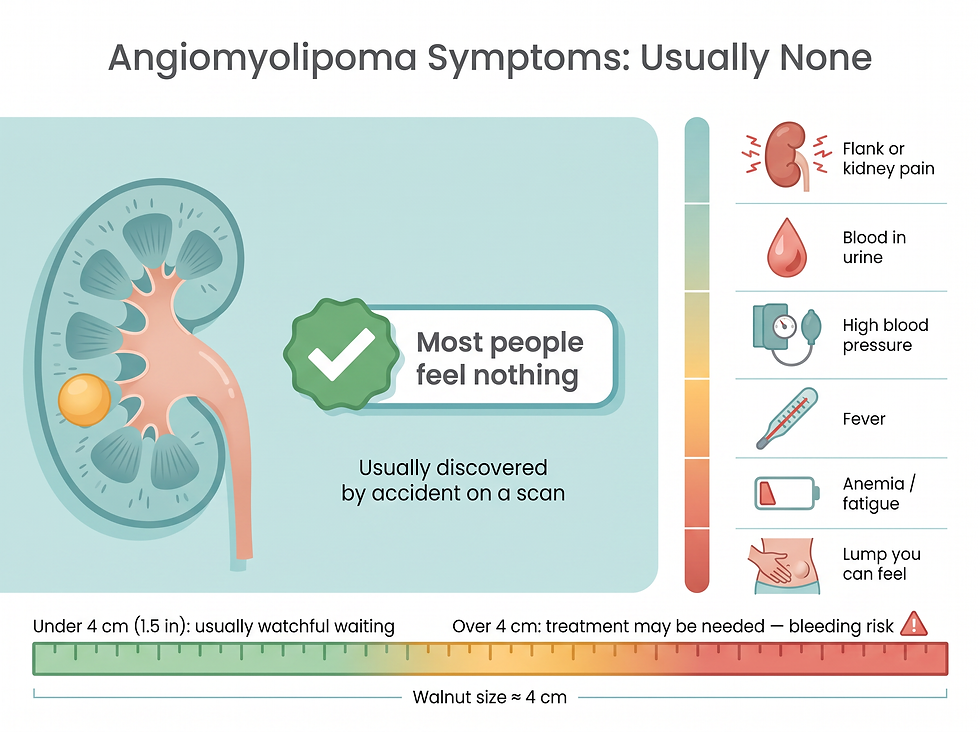
When the mass does get big — usually larger than about 1.5 inches (4 centimeters, roughly walnut-sized) — it can cause problems [1]. Recognized symptoms include:
Symptom | How it shows up |
No symptoms | Most cases — tumor found incidentally on imaging [1] |
Flank or kidney pain | Ache in the side or back [1] |
Bleeding (hemorrhage) | The most serious complication if a tumor ruptures [1] |
Blood in urine (hematuria) | A typical warning sign [4] |
High blood pressure | Tumor pressing on kidney tissue [1] |
Anemia | From chronic blood loss, causing fatigue [1] |
Fever, nausea, vomiting | Less common; can accompany bleeding [1] |
A lump you can feel | Only with very large tumors [1] |
There is one scenario that requires immediate emergency care. If part of the tumor bursts, blood can fill the abdomen (retroperitoneal hemorrhage) — a serious, potentially life-threatening situation [1]. Signs include sudden severe flank or abdominal pain, dizziness, confusion, rapid heart rate, shallow breathing, and pale skin. Call emergency services or go to an emergency department right away if these occur [1] [4].
Is Angiomyolipoma of the Kidney Dangerous?
For most people, no — but the answer depends on size and type. The tumor itself is benign, and in rare cases only the epithelioid subtype can develop into cancer; providers monitor those cases closely [1]. The realistic danger of the common classic type is bleeding: large tumors (above about 4 cm) carry a real risk of rupture and internal hemorrhage [1] [4].
Research adds nuance to the "4 cm rule." Tumor size over 4 cm or internal aneurysms over 5 mm are the classic risk thresholds, and in one frequently cited imaging study, every hemorrhagic lesion was larger than 4 cm with an aneurysm of at least 5 mm [1] [7]. But size alone is imperfect — a meaningful minority of smaller tumors can also bleed, and some very large tumors stay stable without treatment [4] [7]. That is one more reason the decision to treat is always made with a specialist based on your individual imaging, not a single measurement.
How Is Angiomyolipoma of the Kidney Diagnosed?
Diagnosis almost always starts — and often ends — with imaging. Because angiomyolipoma is the classic "accidental finding," it is commonly spotted on a CT, MRI, or ultrasound ordered for something else entirely [1].
Step | What happens | Why it matters |
Imaging (CT, MRI, ultrasound) | Reveals the tumor's fat content — its fingerprint [1] | Confirms the classic benign pattern in most cases |
Comparison with kidney cancer | Some AML types can look like cancer on scans [1] | Drives the need for certainty when the picture is unclear |
Kidney biopsy (less often) | A small tissue sample is tested [1] | Rules cancer in or out when imaging is ambiguous |
Because some angiomyolipomas mimic kidney cancer on scans, providers do not guess — they confirm [1]. If cancer needs to be excluded, a biopsy settles it. For people with tuberous sclerosis, LAM, NF1, or von Hippel-Lindau disease, regular screening imaging is recommended to catch tumors early, before they grow large [1].
Is There Treatment for Angiomyolipoma of the Kidney?
Yes — but many people never need any. The decision hinges on size, symptoms, and pregnancy plans [1].
Tumors under 4 cm (1.5 inches): The usual approach is watchful waiting — yearly imaging to monitor size, with treatment only if the tumor grows or causes symptoms [1]. A systematic review of surveillance studies confirms that active surveillance is first-line management for small, symptom-free tumors, and that tumors under 2 cm may not even need routine monitoring [5].
Tumors over 4 cm: Treatment aims to stop growth or remove the tumor to lower bleeding risk [1]. Options include:
Treatment | How it works | Best for |
Arterial embolization | Tiny beads block the tumor's blood supply, shrinking it and cutting bleeding risk [1] | Larger tumors at bleeding risk |
Ablation therapy | Radiofrequency waves, heat, or cold gas destroy the tumor [1] | Small-to-medium tumors |
Partial nephrectomy | Surgeon removes part of the kidney, sparing the rest [1] | Larger or complicated tumors |
Radical nephrectomy | Entire affected kidney removed [1] | Rarely needed; very large tumors |
mTOR inhibitor medication | Addresses the genetic pathway; can stop growth or shrink tumors [1] [4] | TSC-associated or multiple tumors |

Treatment risks include bleeding, infection, scarring, and — in some instances — kidney failure, all of which your team will discuss before any procedure [1]. Recovery varies: after ablation or embolization, hospital stays are measured in hours or an overnight stay; after kidney surgery, expect a few days in the hospital and up to six weeks for full recovery [1].
What Is the Outlook for Angiomyolipoma of the Kidney?
The prognosis is very good. This is a benign tumor that rarely becomes cancer, and the majority of people live with it without ever needing treatment [1]. Even after successful treatment, two things are worth knowing: tumors can regrow, and it is possible to develop multiple tumors in one or both kidneys — which is why follow-up imaging continues after treatment [1].
Situation | What to expect |
Small, symptom-free tumor | Yearly imaging; often no treatment ever needed [1] [5] |
Large tumor (>4 cm) | Treatment to prevent bleeding; strong outcomes [1] |
TSC- or LAM-associated | More tumors, faster growth; close monitoring and medication options [1] [4] |
After treatment | Possible regrowth; continued imaging follow-up [1] |
Pregnancy plans | Discuss treatment before conceiving — growth accelerates in pregnancy [1] [4] |
Practical self-care recommendations include drinking plenty of water, eating balanced meals, managing blood pressure, and quitting smoking [1]. And if you have any new symptoms — abdominal or back pain, blood in your urine, fever, nausea, upper-leg pain, or signs of shock — contact a healthcare provider promptly [1].
Key Takeaways
Angiomyolipoma is a benign (noncancerous) kidney tumor made of fat, blood vessels, and smooth muscle — the most common benign kidney tumor, found in fewer than 1 in 100 people [1] [5]. Most people never have symptoms and discover it only on a scan done for another reason. Small tumors (under ~4 cm) are managed with watchful waiting and annual imaging; larger ones can be treated with embolization, ablation, surgery, or mTOR-inhibitor medication to prevent bleeding [1]. It rarely turns into cancer, but tumors can regrow or appear in both kidneys, and people with tuberous sclerosis or LAM need closer monitoring [1] [4].
If you have been told you have a kidney tumor, or if you develop flank pain, blood in your urine, or sudden severe pain with dizziness, see a healthcare provider. For anyone considering pregnancy with a known angiomyolipoma, discuss treatment timing before conceiving [1].
Frequently Asked Questions
Is an angiomyolipoma cancer? No. An angiomyolipoma is a benign (noncancerous) tumor. Only the rare epithelioid subtype carries any meaningful cancer potential, and providers monitor those cases closely [1].
Does an angiomyolipoma need to be removed? Not usually. Tumors smaller than about 4 cm (1.5 inches) are typically monitored with yearly imaging, and most never need treatment. Removal or other treatment is reserved for larger, symptomatic, or fast-growing tumors [1] [5].
What size is dangerous for a kidney angiomyolipoma? Tumors larger than about 4 cm (1.5 inches) carry a higher risk of bleeding and are the usual treatment threshold, though size alone is not a perfect predictor — internal aneurysms and other factors matter too [1] [4] [7].
What causes angiomyolipoma? Often the cause is never identified. Changes in the TSC1 or TSC2 tumor suppressor genes are suspected in many cases; the tumor is also strongly associated with tuberous sclerosis complex and lymphangioleiomyomatosis [1] [4].
Can an angiomyolipoma cause high blood pressure? Yes. A growing tumor can contribute to high blood pressure, which is one of the recognized symptoms of larger angiomyolipomas [1].
Is angiomyolipoma hereditary? The tumor itself is usually sporadic (about 80% of cases), but roughly 20% are linked to hereditary conditions — most notably tuberous sclerosis complex, in which 50%–80% of people develop AMLs [4] [6].
Can an angiomyolipoma come back after treatment? Yes. Tumors can regrow even after treatment, and multiple tumors can occur in one or both kidneys, which is why imaging follow-up continues [1].
Can I get pregnant with an angiomyolipoma? Pregnancy can accelerate tumor growth and raise bleeding risk, so anyone with a known angiomyolipoma who is considering children should discuss treatment timing with their provider first [1] [4].
References
Cleveland Clinic — Angiomyolipoma of the Kidney (medically reviewed, last updated 08/05/2025)
National Cancer Institute — Angiomyolipoma (Cancer Terms Dictionary)
StatPearls / NIH — Renal Angiomyolipoma (Rout P, Leslie SW; updated 05/02/2024)
Long-Term Results After Arterial Embolization of Renal Angiomyolipoma (Journal of Urology)
Vos N, Oyen R — Renal Angiomyolipoma: The Good, the Bad, and the Ugly (J Belgian Soc Radiol, 2018)
Comments