Understanding Reinke’s Edema: Causes, Symptoms, and Vocal Recovery

Updated: 2 days ago
Medically reviewed by Dr. Baraa Alnahhal, MD · Last reviewed: October 2026
Definition: Reinke’s edema, also known as polypoid corditis, is a noncancerous condition with fluid buildup in the outer layer of the vocal folds.
Main cause: Long-term smoking, resulting in a noticeably deeper, hoarse, and raspy voice.
Treatment: Mild cases may improve with smoking cessation and reflux management, while severe swelling often requires surgery.
Recovery: Vocal rest and therapy help restore vocal quality and prevent recurrence.
Quick Answer
Reinke's edema is a voice disorder involving significant vocal cord swelling from fluid buildup in Reinke's space. It is most common in long-term smokers and causes a deeper, raspy voice. The condition is benign, but severe swelling can occasionally obstruct the airway. Treatment typically involves quitting smoking, managing acid reflux and sometimes surgery to remove excess tissue. [1]
What the research says
Cancer is uncommon in Reinke’s edema, but recurrence is high. A clinical review reports that, although Reinke’s edema shares its main risk factor (tobacco) with laryngeal cancer, dysplasia is found in only 0% to 3% of cases. Treatment centers on smoking cessation, voice therapy, and reflux control, and the authors note that recurrence is high (Tavaluc and Tan-Geller, Otolaryngol Clin North Am, 2019).
Surgery follows smoking cessation, and no single technique has proven superior. A management review notes that the condition affects under 1% of the population, that the current standard of care is surgical excision after smoking cessation, with the microflap technique favored for bulky lesions, and that there is little direct comparison between approaches and no obviously superior method (Dewan et al., Laryngoscope Investig Otolaryngol, 2022).
What is Reinke's edema?
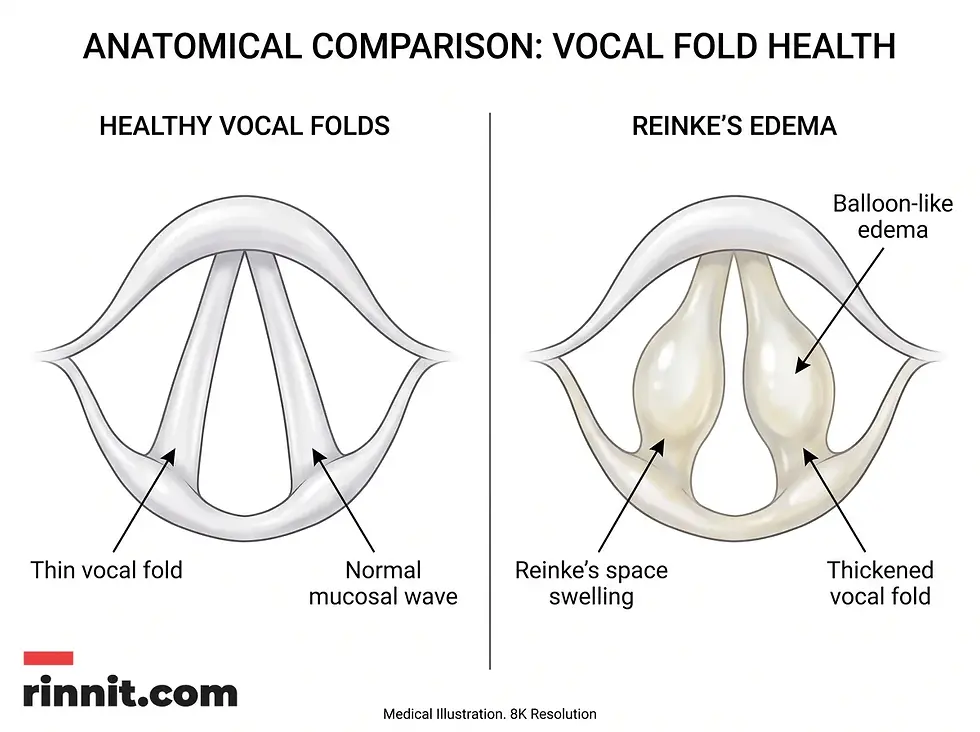
Reinke’s edema, clinically referred to as polypoid corditis, is a voice disorder defined by the accumulation of fluid in the outer layer of the vocal folds. This layer, known as the Reinke’s space, becomes swollen and heavy, which directly alters the vibration of the vocal cords during speech. Although the condition is benign and does not involve cancerous cells, it is a clear indicator of long-term vocal cord damage.
The condition is relatively rare, affecting less than 1% of the general population, and is most frequently diagnosed in individuals over the age of 50. Statistics suggest that females are more likely to seek treatment for Reinke’s edema. This trend is largely attributed to the fact that the hallmark symptom, a significant deepening of the voice, is more socially and personally noticeable in women than in men, who may already have naturally deeper voices. [1]
Feature | Description |
Primary Cause | Long-term tobacco use (smoking) |
Vocal Impact | Lowered pitch, hoarseness, raspiness |
Cellular Nature | Benign (noncancerous) |
Target Demographic | Smokers over age 50; predominantly female patients |
What are the symptoms and voice changes of Reinke's edema?
The most prominent symptom of Reinke’s edema is a gradual and noticeable change in vocal quality. Patients often report that their voice sounds lower in pitch and has developed a persistent raspiness or hoarseness. Because the vocal cords are heavier due to fluid buildup, speaking often requires significantly more effort, leading to vocal fatigue or strain by the end of the day.
In more advanced or severe cases, the swelling can become large enough to impact physical comfort and breathing. Patients may experience neck tightness, discomfort while singing or talking, and an inability to reach higher vocal ranges. In extreme instances, the swollen tissue can partially block the airway, leading to shortness of breath (dyspnea) or noisy breathing known as stridor. [1]
What causes Reinke's edema and who is at risk?
The overwhelming majority of Reinke’s edema cases are caused by a long-term history of smoking. The irritants in tobacco smoke cause chronic inflammation and fluid retention in the delicate tissues of the voice box. Beyond smoking, chronic acid reflux (GERD) or laryngopharyngeal reflux (LPR) can also contribute to the condition by exposing the vocal folds to stomach acid.
Other contributing factors include:
Vocal Trauma: Repetitive overuse of the voice, such as excessive shouting or singing without proper technique.
Environmental Irritants: Prolonged exposure to harsh chemicals or industrial pollutants.
Secondary Health Issues: Untreated thyroid conditions or chronic respiratory irritations can sometimes exacerbate vocal fold swelling. [1]

How is Reinke's edema diagnosed and treated?
Diagnosis is typically performed by an otolaryngologist (ENT specialist) using laryngoscopy. This procedure allows the provider to visualize the vocal folds directly, where Reinke’s edema often appears as pale, translucent swelling that resembles water balloons or tiny grapes. A voice analysis may also be conducted to record and evaluate pitch, airflow, and vocal quality.
Treatment focuses on restoring vocal function and preventing the swelling from returning. The first and most critical step is quitting smoking, which can reverse mild cases. If nonsurgical methods, such as voice therapy or reflux medication, do not resolve the issue, surgical options like microlaryngoscopy or laser therapy may be necessary to remove the excess tissue. Post-operative recovery usually requires five to seven days of complete vocal rest and four to six weeks of overall healing. [1]

Conclusion and Next Steps
Reinke’s edema is a manageable condition that, while not life-threatening, significantly impacts an individual's communication and vocal identity. The link between long-term smoking and vocal cord damage is undeniable in this condition. By prioritizing smoking cessation and seeking early intervention from vocal health specialists, most patients can achieve a significant improvement in vocal quality and overall throat comfort.
Frequently Asked Questions
Can Reinke’s edema be cured without surgery?
In mild cases, Reinke’s edema may be reversed by quitting smoking and managing underlying causes like acid reflux. However, many patients with significant swelling will eventually require surgical intervention to restore their voice.
Why does Reinke’s edema make the voice deeper?
The voice deepens because fluid buildup makes the vocal folds heavier and more swollen. These heavier folds vibrate more slowly than healthy ones, which naturally lowers the pitch of the voice.
Is Reinke’s edema a type of cancer?
No, Reinke’s edema is a benign (noncancerous) condition. It involves fluid buildup in the vocal folds. Precancerous changes (dysplasia) are found only rarely, in about 0% to 3% of cases, so removed tissue is usually checked.
How long is the recovery after vocal cord surgery?
General recovery takes about four to six weeks. However, patients are typically required to maintain complete vocal rest, meaning no speaking at all, for the first five to seven days after the procedure.
Who is most at risk for developing Reinke’s edema?
Individuals over the age of 50 with a long-term history of smoking are at the highest risk. Females are more frequently diagnosed, likely because the vocal changes are more apparent.
What does Reinke’s edema look like on the vocal cords?
During a medical exam, the vocal cords appear swollen and may have growths that resemble tiny water balloons or grapes. This swelling can occur on one or both sides of the voice box.
Can acid reflux cause Reinke’s edema?
Yes, chronic acid reflux (GERD) and laryngopharyngeal reflux (LPR) are known secondary causes of vocal fold swelling, as the acid irritates the delicate lining of the Reinke’s space.
What is the "Reinke's space"?
The Reinke’s space is the gelatinous outer layer of the vocal folds. When fluid builds up specifically in this layer, it results in the condition known as Reinke’s edema.
Will my voice go back to normal after I stop smoking?
Quitting smoking is the most important step in treatment and can prevent the condition from worsening. In very mild cases, it may improve the voice, but surgery is often needed to fully restore vocal quality.
What are the symptoms of Reinke's edema?
The main sign is a low, deep, husky or hoarse voice that slowly gets worse. If the swelling is large, some people have noisy breathing or shortness of breath, which should be checked by a doctor right away.
Related Reading
Vocal Cord Lesions: Understanding Nodules, Polyps, and Cysts explains other vocal cord growths that cause hoarseness.
Understanding Laryngeal Cancer: Symptoms, Causes, and Treatment Options covers voice box cancer, which shares smoking as a key risk.
Laryngoscopy: What It Is, Why It's Done, Types, Procedure and Results describes the camera exam used to view the vocal cords.
Nicotine Replacement Therapy (NRT): A Guide to Quitting Smoking explains nicotine replacement options that help people quit smoking.
References
Cleveland Clinic. Reinke's Edema. Cleveland Clinic Health Library. Accessed October 11, 2026. https://my.clevelandclinic.org/health/diseases/reinkes-edema
Tavaluc R, Tan-Geller M. Reinke's edema. Otolaryngol Clin North Am. 2019;52(4):627-635. PMID: 31101355. DOI: https://doi.org/10.1016/j.otc.2019.03.006
Dewan K, Chhetri DK, Hoffman H. Reinke's edema management and voice outcomes. Laryngoscope Investig Otolaryngol. 2022;7(4):1042-1050. PMID: 36000026. DOI: https://doi.org/10.1002/lio2.840
Medical disclaimer
This article is for informational purposes only and is not a substitute for professional medical advice, diagnosis, or treatment. Always seek the advice of your physician or other qualified health provider with any questions you may have about a medical condition.



Comments