Understanding Pyomyositis: Symptoms, Causes, and Treatments

Updated: 2 days ago
Medically reviewed by Dr. Baraa Alnahhal, MD · Last reviewed: October 2026
Pyomyositis is a rare bacterial infection that causes pus-filled abscesses deep in the muscles. [1] It typically causes muscle pain, swelling, fever, and limited mobility, and it is most often caused by Staphylococcus aureus (a staph infection). [1] It is treated with antibiotics and, in some cases, abscess drainage. [1]
Quick Answer
Pyomyositis is a rare but serious bacterial muscle infection that forms a pus-filled abscess, most commonly in the thigh or pelvic muscles. [1] It is mainly caused by Staphylococcus aureus and progresses through three stages. [1] Early diagnosis with MRI and antibiotic treatment are critical to prevent complications such as sepsis. It is curable when caught early, though severe cases need surgery.
What the research says
Muscle pain is the main warning sign, and staph is the leading germ. [2] In a retrospective study of 43 pyomyositis and 18 infectious myositis cases at one tertiary center, 95% of patients had muscle pain and 49% reported fever, staphylococcal species caused 46% of infections, and diabetes affected about one third of patients (Radcliffe et al., Open Forum Infectious Diseases, 2021).
Most people are treated successfully, but drainage is often needed. [2] In the same study, the overall treatment success rate was 84%, the median length of antibiotic therapy was 18 days, and 28% of patients needed more than one drainage procedure (Radcliffe et al., Open Forum Infectious Diseases, 2021).
Treatment combines drainage with targeted antibiotics. A review of purulent infectious myositis (the newer name for tropical pyomyositis) concluded that treatment needs percutaneous or open drainage plus antibiotics guided by culture results, that rising rates of methicillin-resistant Staphylococcus aureus (MRSA) make vancomycin worth including, and that ultrasound (superficial) or contrast CT or MRI (deep) helps confirm the diagnosis (Habeych et al., Journal of the Neurological Sciences, 2020 [3]).
What Is Pyomyositis?
Pyomyositis is a rare bacterial infection that develops deep within the skeletal muscles, leading to the formation of a swollen, pus-filled area known as an abscess. Unlike superficial skin infections, pyomyositis occurs within the muscle tissue itself, making it difficult to detect through visual inspection alone. [1] The condition most frequently affects the larger muscles of the lower body, particularly the thigh and pelvic regions [1], although it can occur in other muscle groups.
Because the infection is deep-seated, it often presents as unexplained muscle pain or tenderness before any visible swelling or lumps appear. [1] As the abscess grows, it may cause the affected area to feel hard or tender to the touch, and the individual may experience significant difficulty using the muscle normally. For instance, an infection in the thigh muscle often results in a noticeable limp or inability to walk without pain.

What are the symptoms and stages of pyomyositis?
The symptoms of pyomyositis vary depending on the severity of the infection and how far it has progressed. Initially, patients may experience localized pain, tenderness, or cramping in the affected muscle, often accompanied by a fever and chills. [1] As the condition advances, swelling, redness, or a hard lump may become palpable under the skin, and the individual may find their range of motion severely limited.
Healthcare providers typically categorize pyomyositis into three clinical stages based on the extent of the infection:
Stage 1: The muscle becomes painfully inflamed, and a hard area or lump may begin to form. [1]
Stage 2: A pus-filled abscess develops within the muscle. This stage, which usually lasts one to three weeks, is when most individuals are diagnosed due to severe pain and fever.
Stage 3: The infection spreads systemically throughout the body, potentially leading to multiple abscesses, organ failure, and life-threatening complications. [1]
What causes pyomyositis and who is at risk?
The vast majority of pyomyositis cases are caused by the bacteria Staphylococcus aureus, commonly known as a staph infection. [1] In some instances, Group A Streptococcus may also be the culprit. [1] Medical experts are still investigating exactly how these bacteria penetrate deep muscle tissue, as a visible break in the skin is not always required for the infection to take hold. [1]
While pyomyositis can affect anyone, certain factors significantly increase an individual's risk. The condition is historically more common in tropical climates, but cases occur globally. Key risk factors include:
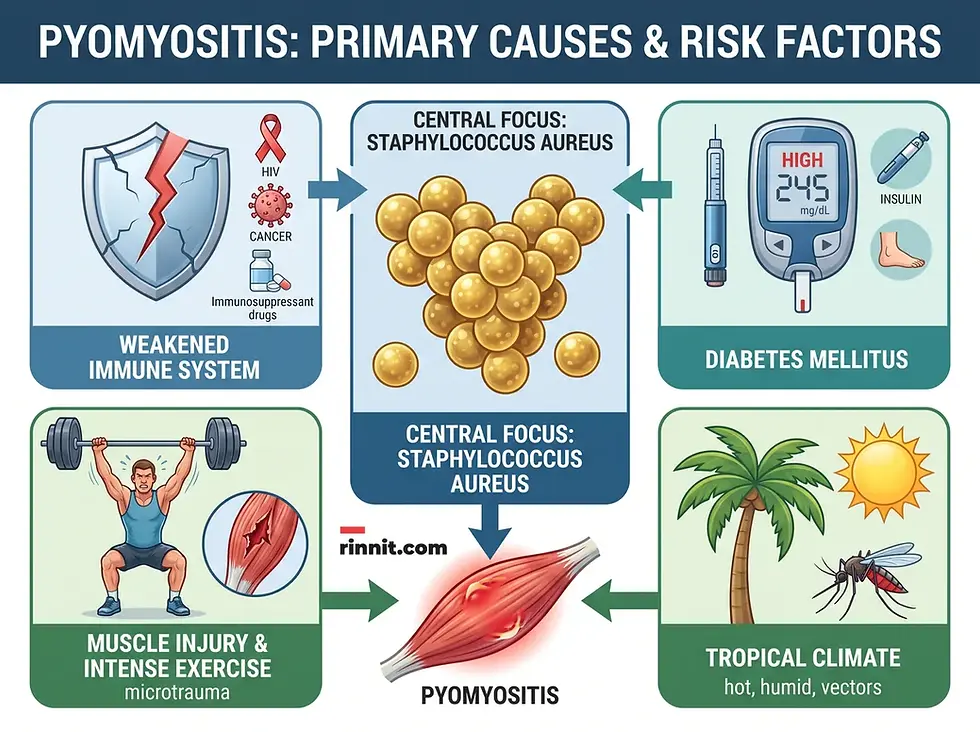
How is pyomyositis diagnosed?
Diagnosing pyomyositis can be challenging because its early symptoms often mimic more common conditions like muscle strains or cellulitis. To confirm a diagnosis, healthcare providers rely heavily on advanced imaging techniques. An MRI is the most effective tool for visualizing the deep-seated abscesses and inflammation associated with the condition, though CT scans may also be utilized.
In addition to imaging, providers may conduct blood tests to look for signs of systemic infection or perform a bacterial culture. [1] A culture involves taking a sample from the infected area to identify the specific type of bacteria responsible, which helps in selecting the most effective antibiotic treatment.
How is pyomyositis managed and treated?
The primary treatment for pyomyositis involves a course of antibiotics to eliminate the underlying bacterial infection. [1] Depending on the severity, these medications may be administered intravenously in a hospital setting or taken orally at home. Treatment typically lasts about two to three weeks, and longer courses may be needed if the infection has spread.
In many cases, medical intervention beyond antibiotics is required to resolve the abscess. This often involves draining the pus from the infected area. [1] In severe or advanced cases where the infection is widespread, surgery may be necessary to completely remove the necrotic tissue and ensure the infection is fully eradicated.

Conclusion and Next Steps
Pyomyositis is a serious condition that requires prompt medical attention to prevent life-threatening complications like septic shock. While the infection is rare, it is highly curable when diagnosed in its early stages. If you experience persistent, unexplained muscle pain accompanied by a fever, it is essential to consult a healthcare provider immediately. Early intervention with antibiotics and proper wound management are the most effective ways to ensure a full recovery and prevent the spread of infection.
Frequently Asked Questions
Is pyomyositis contagious?
No, pyomyositis itself is not contagious, though the bacteria that cause it can be spread through direct contact with an infected person or contaminated surfaces.
Can pyomyositis go away on its own?
No, pyomyositis is a bacterial infection that can be fatal if left untreated. It requires professional medical intervention, usually including antibiotics.
Where does pyomyositis most commonly occur?
Pyomyositis most frequently affects the large muscles of the lower body, such as the thigh and pelvic muscles.
What is the difference between myositis and pyomyositis?
Myositis is a general term for muscle inflammation, while pyomyositis is a specific type of inflammation caused by a bacterial infection.
Can intense exercise cause pyomyositis?
While exercise itself doesn't cause the infection, a recently injured muscle from intense physical activity can be a risk factor that allows bacteria to take hold.
Is surgery always required for pyomyositis?
Not always. If caught early in Stage 1 or 2, antibiotics and simple drainage may be sufficient. Surgery is typically reserved for severe or systemic cases.
How long does treatment usually last?
Antibiotic treatment generally lasts about two to three weeks, but the total recovery time depends on the severity of the infection and the individual's overall health.
What happens if pyomyositis is left untreated?
Untreated pyomyositis can lead to septic shock, organ damage, and death as the infection spreads through the bloodstream.
Can children get pyomyositis?
Yes, pyomyositis can affect individuals of any age, including children, particularly those with underlying risk factors.
What should I do if I suspect I have pyomyositis?
Seek medical attention immediately if you have unexplained fever and worsening muscle pain, especially if a lump or swelling develops.
Related Reading
Staph Infections: Symptoms, Causes, Treatment, and Prevention — Complete Guide explains the bacteria behind most pyomyositis and how infections are treated.
What Is an MRSA Infection? A Plain-Language Guide to This Tough Staph Germ explains drug-resistant staph infections and how they are treated.
Osteomyelitis: Symptoms, Causes, and Treatment explains bone infections that can occur alongside deep muscle infections.
Cellulitis: Symptoms, Causes, Diagnosis and Treatment — What You Need to Know explains a skin infection that can look like early pyomyositis.
References
Cleveland Clinic. Pyomyositis. Cleveland Clinic. May 19, 2025. https://my.clevelandclinic.org/health/diseases/22408-pyomyositis
Radcliffe C, et al. Pyomyositis and infectious myositis: a comprehensive, single-center retrospective study. Open Forum Infectious Diseases. 2021;8(4):ofab098. PMID 33884279. https://doi.org/10.1093/ofid/ofab098
Habeych ME, et al. Purulent infectious myositis (formerly tropical pyomyositis). Journal of the Neurological Sciences. 2020;413:116767. PMID 32172014. https://doi.org/10.1016/j.jns.2020.116767
Medical disclaimer
The information provided in this article is for educational purposes only and should not be used as a substitute for professional medical advice, diagnosis, or treatment. Always seek the advice of your physician or other qualified health provider with any questions you may have regarding a medical condition.



Comments