Understanding Perfusion Pressure: Your Heart’s Oxygen Delivery System

Updated: 3 days ago
Medically reviewed by Dr. Baraa Alnahhal, MD · Last reviewed: October 2026
Perfusion pressure is the force that keeps blood flowing to every part of the body. Coronary perfusion pressure (CPP) is especially important because it makes sure the heart muscle gets enough oxygen to pump blood nonstop, particularly when the body needs more oxygen, such as during exercise. When CPP is too low, heart muscle cells can die, which can lead to a heart attack [1].
Quick Answer: What is coronary perfusion pressure (CPP)?
Coronary perfusion pressure (CPP) is the pressure that pushes blood from the aorta into the coronary arteries and through the heart muscle. It matters because the heart uses about 70% to 80% of the oxygen in the blood passing through its arteries. If CPP drops too low, the heart lacks oxygen, which can cause ischemia or a heart attack. [1]
What the research says
Perfusion pressure targets guide care after cardiac arrest. A 2025 emergency medicine review of post-cardiac-arrest care recommends aiming for a mean arterial pressure of at least 65 mmHg, preferably above 80 mmHg, to improve end-organ and cerebral perfusion pressure (Long & Gottlieb, Am J Emerg Med, 2025).
In an animal study, restoring coronary perfusion pressure helped restart the heart. In 32 pigs in cardiac arrest, balloon occlusion of the aorta after 30 minutes of CPR raised coronary perfusion pressure (42.1 vs 3.6 mmHg in the first 7 minutes) and the return of spontaneous circulation rate (75% vs 12.5%); these were animal experiments, not human trials (Siemieniak et al., Resusc Plus, 2024).
Higher coronary perfusion pressure tracked with successful resuscitation. In a swine cardiac arrest model (16 animals), coronary perfusion pressure and other circulation markers were significantly greater during CPR in the 11 animals that were resuscitated than in those that were not (Shi et al., Am J Emerg Med, 2021).
Research summaries are based on article abstracts retrieved from PubMed.
What is the function of coronary perfusion pressure?
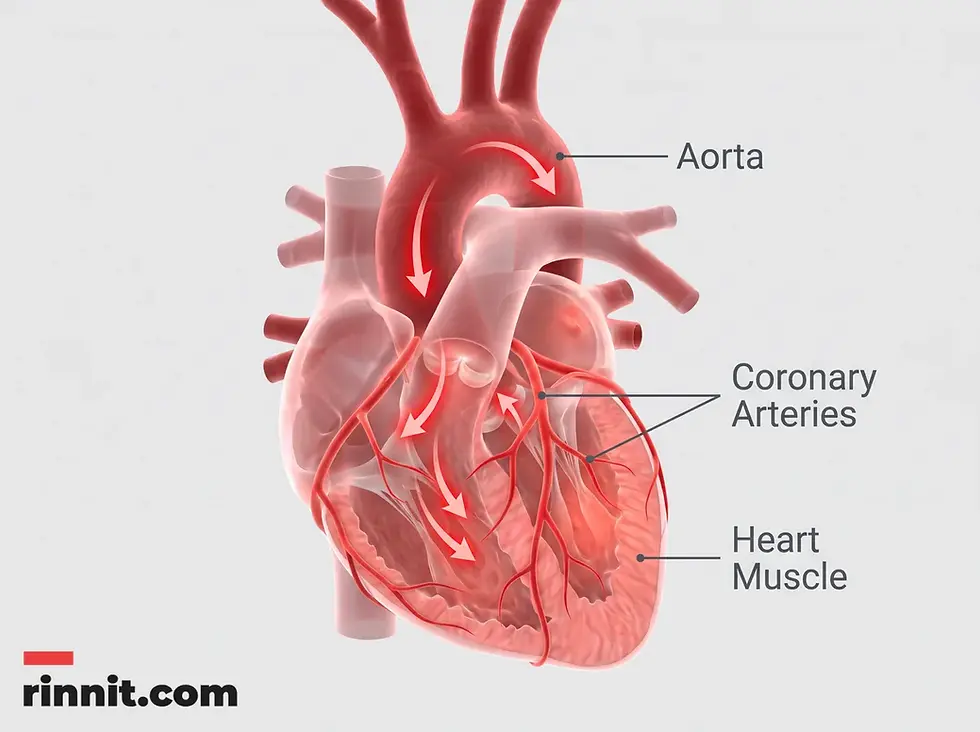
Perfusion pressure keeps blood flowing to every part of your body. Coronary perfusion pressure is the pressure that moves blood from the aorta into the coronary arteries and then through the heart muscle. The heart must work without stopping, so it needs a steady supply of oxygen, and it uses about 70% to 80% of the oxygen in the blood that passes through its coronary arteries [1].
Adequate pressure is most important when the demand for oxygen rises, such as during exercise or when the heart rate increases for other reasons. Adequate perfusion pressure is also essential for the brain, where it is called cerebral perfusion pressure [1].
Component | Role |
Aorta | The main artery that blood is pushed out into; the coronary arteries branch from it. |
Coronary arteries | The vessels that carry oxygen-rich blood to the heart muscle. |
Heart muscle | The tissue that needs most of the oxygen delivered (70% to 80% of what passes through). |
Left ventricle | The heart chamber whose pressure between beats is used to calculate CPP. |
What conditions are related to coronary perfusion pressure?
Low coronary perfusion pressure means the heart muscle does not get enough oxygen, a problem called myocardial ischemia that can lead to a heart attack. If the ischemia is severe or lasts more than a few minutes, it can damage the heart muscle and cause a heart attack [1]. Other conditions related to CPP problems include:
Coronary artery disease
Coronary artery spasm
Heart failure
Cardiogenic shock
How is coronary perfusion pressure (CPP) measured and calculated?
Coronary perfusion pressure is measured with echocardiography or a heart catheterization and calculated from two pressures taken between heartbeats. Unlike blood pressure, it is not something that is checked routinely; it is typically measured during invasive procedures or when deciding how best to treat coronary artery disease [1]. Two measurements are taken between heartbeats:
Aortic diastolic pressure (ADP): the pressure in the aorta between beats. It is the lower number of a blood pressure reading.
Left ventricular end-diastolic pressure (LVEDP): the pressure inside the left ventricle between beats.
CPP is calculated by subtracting LVEDP from ADP. For example, an ADP of 80 mm Hg and an LVEDP of 20 mm Hg give a CPP of 60 mm Hg [1].

When does your heart need more oxygen and affect perfusion pressure?
Coronary perfusion pressure problems are more likely when someone with cardiovascular disease is in a situation where the heart needs more oxygen. These situations include being [1]:
Physically active.
Stressed.
Eating.
Cold.
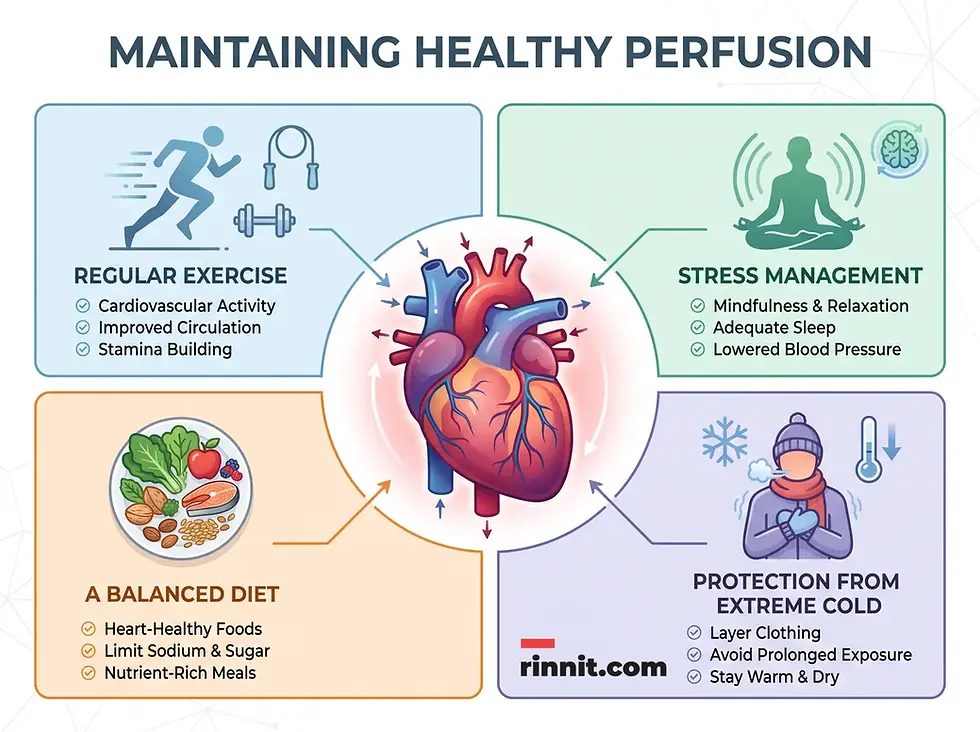
CPP cannot be checked at home. If you have a heart condition, ask your provider which situations to be careful about. Healthy habits such as regular exercise, stress management, a balanced diet, and dressing warmly in cold weather support overall heart health.
Conclusion
Perfusion pressure quietly makes sure that the organs, especially the heart and brain, receive the oxygen they need. By driving blood from the aorta into the coronary arteries, coronary perfusion pressure protects the heart muscle from damage and from events such as a heart attack. Understanding what influences it can help with early detection and management of cardiovascular risk [1].
When should you see a doctor about coronary perfusion pressure?
If you are worried about your heart health, see your provider. Call 911 right away for chest pain or pressure that lasts more than a few minutes or comes with shortness of breath, a cold sweat, nausea or lightheadedness, as these can be heart attack signs. Early evaluation of your cardiovascular system can help identify problems before they lead to serious complications.
Frequently Asked Questions
What is the most important type of perfusion pressure?
Coronary perfusion pressure is especially important because it ensures the heart muscle itself has enough oxygen to keep pumping [1].
Why does the heart need so much oxygen?
The heart works nonstop and uses about 70% to 80% of the oxygen in the blood that passes through its coronary arteries, more than any other organ [1].
What happens if perfusion pressure is too low?
Low coronary perfusion pressure can cause myocardial ischemia, a lack of oxygen to the heart muscle, which can lead to heart muscle damage and a heart attack [1].
Is perfusion pressure the same as blood pressure?
No, but blood pressure is used to calculate it. The lower number of a blood pressure reading is the aortic diastolic pressure, one of the two measurements used [1].
How is CPP calculated?
By subtracting left ventricular end-diastolic pressure (LVEDP) from aortic diastolic pressure (ADP) [1].
What is ADP?
ADP stands for aortic diastolic pressure, the pressure in your aorta between heartbeats [1].
What is LVEDP?
LVEDP is left ventricular end-diastolic pressure, the pressure inside the left ventricle between heartbeats [1].
When do doctors measure CPP?
Typically during invasive procedures, or when deciding how best to treat coronary artery disease. It is measured with echocardiography or cardiac catheterization [1].
Can stress affect perfusion pressure?
Stress is one of the situations in which the heart needs more oxygen, so problems with CPP are more likely to show up then in people who have cardiovascular disease [1].
What other organ needs high perfusion pressure?
The brain. Adequate perfusion pressure to the brain is called cerebral perfusion pressure [1].
Related Resources
External resource for deeper reading:
Cleveland Clinic. Coronary Perfusion Pressure. Cleveland Clinic Health Library. Last updated July 17, 2025. https://my.clevelandclinic.org/health/body/23135-perfusion-pressure
Related Reading
Coronary Arteries: The Lifelines of the Heart explains the arteries that carry oxygen-rich blood to the heart muscle.
Coronary Artery Disease: Symptoms, Causes, Diagnosis, Treatment and Prevention — What You Need to Know covers how narrowed heart arteries reduce blood flow to the heart.
Angina: Symptoms, Causes, Treatment & Complete Guide explains chest pain caused by too little blood flow to the heart.
Acute Coronary Syndrome: Complete Guide to Symptoms, Causes, Diagnosis, and Treatment describes sudden blockages of heart blood flow and emergency treatment.
References
Cleveland Clinic. Coronary Perfusion Pressure. Cleveland Clinic Health Library. Last updated July 17, 2025. https://my.clevelandclinic.org/health/body/23135-perfusion-pressure
Long B, Gottlieb M. Emergency medicine updates: managing the patient with return of spontaneous circulation. Am J Emerg Med. 2025;93:26-36. PMID: 40133018. doi:10.1016/j.ajem.2025.03.039
Siemieniak S, Greiving T, Shepard N, Rall J, Nowadly C. Endovascular aortic occlusion improves return of spontaneous circulation after longer periods of cardiopulmonary resuscitation: a translational study in pigs. Resusc Plus. 2024;18:100603. PMID: 38510375. doi:10.1016/j.resplu.2024.100603
Shi L, Xu J, Wang J, et al. Automated pupillometry helps monitor the efficacy of cardiopulmonary resuscitation and predict return of spontaneous circulation. Am J Emerg Med. 2021;49:360-366. PMID: 34246167. doi:10.1016/j.ajem.2021.06.058
Medical disclaimer
This article is for informational purposes only and is not a substitute for professional medical advice, diagnosis, or treatment. Always seek the advice of your physician or other qualified health provider with any questions you may have about a medical condition.



Comments