Understanding Pantaloon Hernia: Causes, Symptoms, and Repair

Updated: 3 days ago
Medically reviewed by Dr. Baraa Alnahhal, MD · Last reviewed: October 2026
A pantaloon hernia is a groin hernia in which a direct and an indirect inguinal hernia are present on the same side, sitting on either side of a group of blood vessels. It is also called a "saddlebag" hernia. It is more common in males and people over 65, it has a higher risk of coming back than a single hernia, and it is repaired with surgery, either open or minimally invasive [1].
Quick Answer: What is a pantaloon hernia?
A pantaloon hernia is a combination of a direct and an indirect inguinal hernia on the same side of the groin, straddling the inferior epigastric vessels. It causes a groin bulge, aching and pressure and is more common in males and people over 65. It is repaired with open or minimally invasive surgery and has a higher recurrence risk. [1]
What the research says
Minimally invasive repair works for this pattern in children. In a case report of a 12-year-old boy with a right-sided pantaloon hernia, surgeons performed single-port laparoscopic repair of both the direct and indirect components; he went home on postoperative day 1, with no recurrence, pain, or groin infection at 6-month follow-up (Wang et al., Front Pediatr, 2026).
Robotic repair has been used in adults, including with more than two defects. In a case report of a 74-year-old man, a right pantaloon hernia was found along with femoral and obturator hernias during robotic repair; one large mesh covered all four defects and he went home within three hours. The authors advise surgeons to actively look for additional defects during dissection (Kessler et al., Cureus, 2026).
Research summaries are based on article abstracts retrieved from PubMed. Both studies are single-patient case reports, so they illustrate what is possible rather than how often it works.
What Is a Pantaloon Hernia?
A pantaloon hernia is a type of inguinal hernia in which two hernias are present on the same side of the groin. One is a direct hernia and the other is an indirect hernia, and they sit on either side of the inferior epigastric vessels, a group of blood vessels in the abdominal wall [1]. The name comes from the resemblance to a pair of trousers. You may also hear the term "saddlebag" hernia [1].
In an indirect hernia, tissue pushes through the opening of the inguinal canal. In a direct hernia, tissue pushes through a weak spot in the back wall of the canal. In a pantaloon hernia, both are present together [1].
What are the symptoms of a pantaloon hernia?
Signs of a pantaloon hernia are the same as for other groin hernias [1]:
A bulge in the groin
Aching or pressure in the groin
Swelling
Nausea and vomiting
Sudden nausea can also be a sign of a complication, which needs urgent attention [1].
Complications to know about
Complication | What it means |
|---|---|
Incarceration | Herniated tissue becomes trapped and cannot be pushed back into the abdomen. |
Strangulation | Blood flow to the trapped tissue is cut off. This is a medical emergency that needs immediate surgery. |
Seek emergency care if a groin bulge becomes firm, painful, or cannot be pushed back, especially with nausea or vomiting.

Visual guide to the symptoms and potential complications of a pantaloon hernia.
What causes a pantaloon hernia and who is at risk?
A pantaloon hernia is more common in males and in people over 65 [1]. Cleveland Clinic lists these risk factors [1]:
Overweight or obesity
Pregnancy
A chronic cough
Chronic constipation
A family history of inguinal hernia
Frequent heavy lifting
How is a pantaloon hernia diagnosed?
A healthcare provider examines the groin for a bulge. Tests may include an ultrasound or a CT scan [1]. Because a pantaloon hernia can be hard to recognize before surgery, it is sometimes identified during laparoscopic or robotic repair, when surgeons can see both defects directly [2] [3].
How is a pantaloon hernia treated?
A pantaloon hernia is repaired with surgery, and the best approach depends on your anatomy, your health and your surgeon's experience. Both hernias are addressed in the same operation, using one of two approaches [1]:
Open surgery, through a single larger incision
Minimally invasive surgery, through small incisions, done laparoscopically or with robotic assistance
Which approach is best depends on your anatomy, your health, and your surgeon's experience.

Overview of surgical repair options for pantaloon hernias, including open and minimally invasive techniques.
What is recovery and the outlook after pantaloon hernia repair?
After surgery, you will likely go home the same day and return to normal daily activities within about a week [1]. Follow your surgeon's instructions on lifting and activity, because a pantaloon hernia has a higher risk of coming back than a single hernia [1]. Report a returning bulge or new pain to your surgeon promptly.
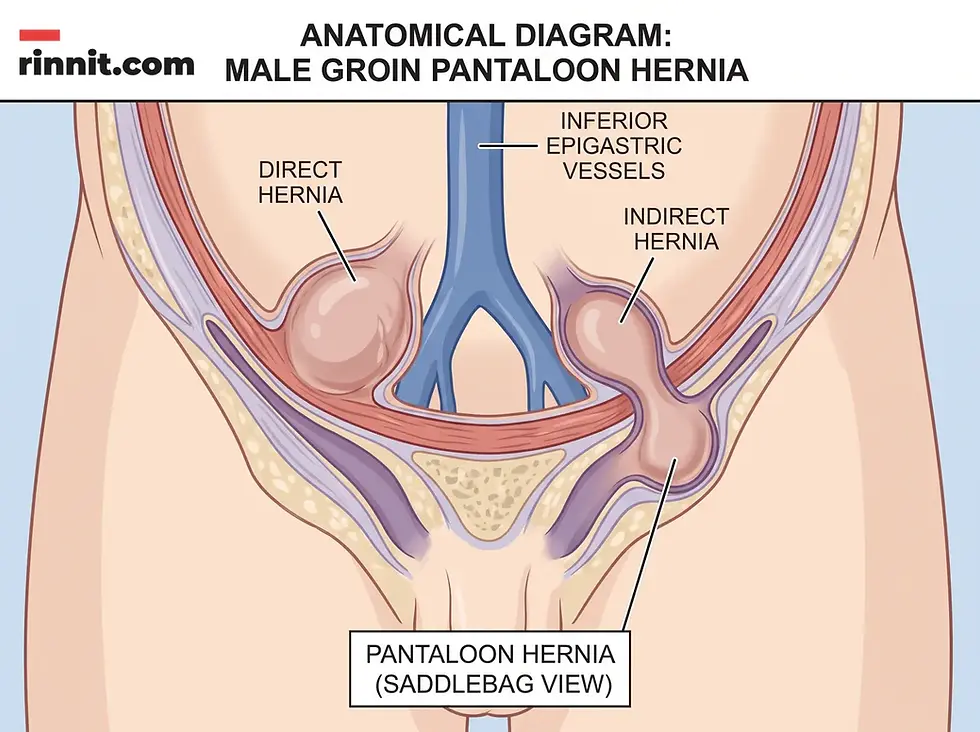
Anatomical illustration showing the direct and indirect components of a pantaloon hernia.
When should you see a doctor about a pantaloon hernia?
See a healthcare provider if you notice a bulge, aching, or pressure in your groin. Go to the emergency department if the bulge is firm, painful, or cannot be pushed back, or if you have sudden nausea and vomiting with a groin bulge.
What is the bottom line on pantaloon hernia?
A pantaloon hernia is two inguinal hernias, one direct and one indirect, on the same side of the groin. It is repaired with open or minimally invasive surgery, most people return to normal daily activities within about a week, and it has a higher risk of coming back than a single hernia, so following your surgeon's advice matters [1].
Frequently Asked Questions
What is a pantaloon hernia?
A pantaloon hernia is a direct and an indirect inguinal hernia on the same side of the groin, sitting on either side of the inferior epigastric blood vessels.
Why is it called a pantaloon hernia?
The two hernias sit on either side of a group of blood vessels, like the legs of a pair of trousers (pantaloons). It is also called a saddlebag hernia.
What are the symptoms of a pantaloon hernia?
Common signs are a bulge in the groin, aching, pressure, and swelling. Nausea and vomiting can also occur, and sudden nausea can signal a complication.
Who gets pantaloon hernias?
Pantaloon hernias are more common in males and in people over 65.
What are the risk factors?
Risk factors include overweight or obesity, pregnancy, a chronic cough, chronic constipation, a family history of inguinal hernia, and frequent heavy lifting.
How is a pantaloon hernia diagnosed?
A provider examines the groin, and tests may include an ultrasound or a CT scan.
How is a pantaloon hernia treated?
A pantaloon hernia is repaired with surgery, either open surgery or a minimally invasive approach (laparoscopic or robotic).
Is a pantaloon hernia more likely to come back?
Yes. A pantaloon hernia has a higher risk of coming back than a single hernia.
How long is recovery after surgery?
You will likely go home the same day and return to normal daily activities within about a week. Follow your surgeon's instructions on lifting and activity.
When is a groin hernia an emergency?
Go to the emergency department if the bulge is firm, painful, or cannot be pushed back, or if you have sudden nausea and vomiting with a groin bulge.
Related Resources
External resource for deeper reading:
Cleveland Clinic. Pantaloon Hernia. Cleveland Clinic. Medically reviewed; last updated February 17, 2026. https://my.clevelandclinic.org/health/diseases/pantaloon-hernia
Related Reading
Inguinal Hernia: Symptoms, Causes, and When Surgery Is Needed explains inguinal hernias and when surgery is needed.
Femoral Hernia: Causes, Symptoms, and Treatment covers femoral hernias, another type of groin hernia.
Hernia Repair Surgery: Procedures, Recovery, and Outcomes explains open and keyhole hernia repair and recovery.
Surgical Mesh for Hernia Repair: Types, Placement, Risks, and Recovery describes the mesh used to strengthen hernia repairs.
References
Cleveland Clinic. Pantaloon Hernia. Cleveland Clinic Health Library. Last updated February 17, 2026. https://my.clevelandclinic.org/health/diseases/pantaloon-hernia
Wang H, Li D, Yao Y, et al. Laparoscopic management of a pediatric pantaloon hernia with contralateral patent processus vaginalis: a case report. Front Pediatr. 2026;14:1941318. PMID: 42745930. DOI: 10.3389/fped.2026.1941318
Kessler JJ, Kavic S, Bonatti HJ. Robotic repair of right-sided direct inguinal, indirect inguinal, femoral, and obturator hernias (quadruple groin hernias). Cureus. 2026;18(7):e111887. PMID: 42540713. DOI: 10.7759/cureus.111887
Medical disclaimer
This article is for informational purposes only and is not a substitute for professional medical advice, diagnosis, or treatment. Always seek the advice of your physician or other qualified health provider with any questions you may have about a medical condition.



Comments