Understanding Microtia: Causes, Grades, and Treatment Options

Updated: 3 days ago
Medically reviewed by Dr. Baraa Alnahhal, MD · Last reviewed: October 2026
Microtia is a rare congenital condition in which a baby is born with an underdeveloped or missing outer ear. It can cause conductive hearing loss, and it is manageable with early hearing checks, ear prosthetics, and reconstructive surgery[1].
Quick Answer: What is microtia?
Microtia is a rare condition affecting the shape and appearance of a baby's outer ear, ranging from minor differences to a missing outer ear, and it affects up to 4 in 10,000 babies worldwide. It may cause some hearing loss but not deafness. It is usually diagnosed at birth, and management includes hearing follow-up, hearing aids and ear reconstruction. [1]
What the research says
Treatment is often multidisciplinary and multistaged. A clinical review notes that many cases of microtia cannot be treated effectively with conservative measures and need some form of reconstruction. Options include porous polyethylene implants, autologous rib grafting, and autologous chondrocyte frameworks, and treating the conductive hearing loss is equally important (Romo et al., Facial Plast Surg, 2025 [2]).
Rib cartilage and implant reconstructions have different risk profiles. A meta-analysis of 11 studies with 3,816 patients found that porous polyethylene implants were associated with a higher rate of framework exposure than rib cartilage grafts (difference 6.97%, 95% CI 0.07–13.86%). Differences in infection and repeat operations were not statistically significant, and the authors note that study quality and heterogeneity limit the conclusions (Finestone et al., Cleft Palate Craniofac J, 2026 [3]).
Long-term complications of reconstruction are uncommon, but follow-up matters. A systematic review of 29 publications reported that individual long-term complications occurred in less than 10% of rib cartilage reconstructions and less than 15% of porous polyethylene reconstructions. The authors recommend a surgical follow-up of at least five years (Ronde et al., J Plast Reconstr Aesthet Surg, 2021 [4]).
What Is Microtia?
Microtia is a rare, congenital condition that affects the shape and appearance of a baby's outer ears. The ear may be very small, or the outer ear may be missing some cartilage and skin. Rarely, a baby is born without an outer ear. It happens when the ear does not develop normally in the fetus, and experts estimate that it affects up to 4 in 10,000 babies worldwide[1].
Microtia may cause conductive hearing loss, in which sound does not make it effectively to the inner ear. The condition is always present from birth, and its severity varies[1].
What are the grades of microtia?
Grades describe how the condition affects the baby's ear[1]:
Grade | Description |
Grade 1 | The outer ear is smaller than average, with minor issues in some parts of the ear. |
Grade 2 | The upper part of the ear is affected, and the ear canal may be unusually narrow. |
Grade 3 | The most common form. It affects the whole ear and the ear canal. |
Grade 4 | The outer ear is missing (anotia). |
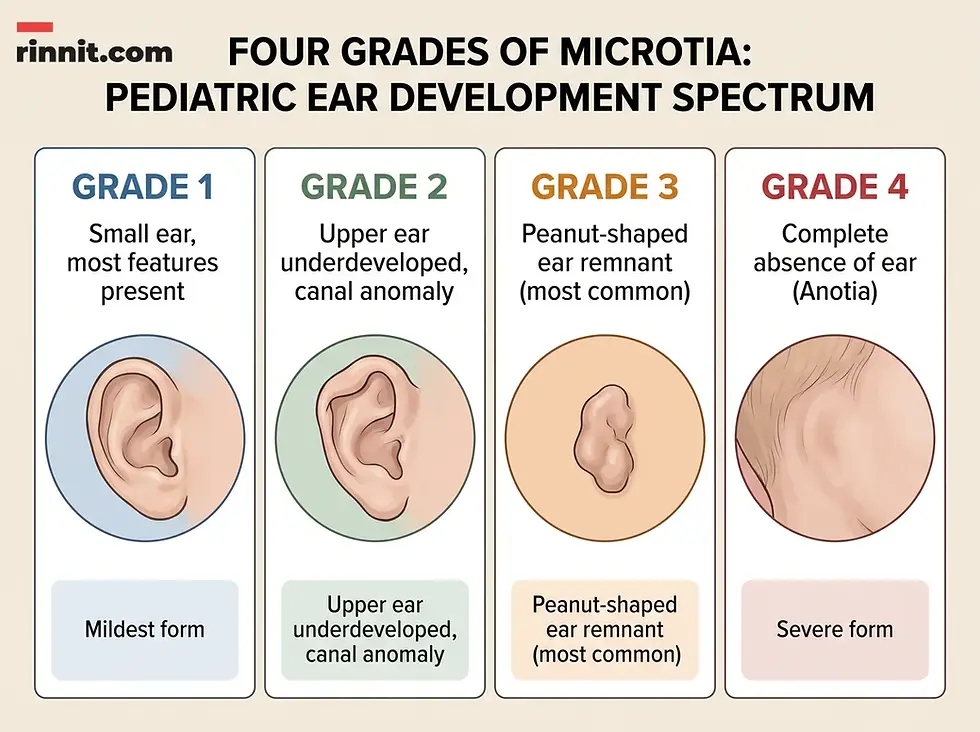
Microtia ranges from a slightly smaller ear (grade 1) to a missing outer ear (grade 4).
What are the symptoms and complications of microtia?
Microtia is identified right after birth, and its symptoms can include hearing loss, missing ear tissue, an undeveloped ear canal or a smaller or missing outer ear. Symptoms may include[1]:
Hearing loss in the affected ear.
Missing cartilage or tissue in the outer ear.
A missing or undeveloped ear canal.
A missing outer ear.
A smaller-than-expected ear.
The most common complication is hearing loss when the middle ear is affected. Another complication may be less obvious. Surgery can make the difference less noticeable, but most providers recommend waiting until the ear is more developed. During those years, a child and their peers may become more aware of the difference, which can make the child self-conscious, affect self-esteem, and lead to social isolation. If that happens, ask the child's healthcare provider for help and support[1].
What causes microtia, and what are the risk factors?
Microtia often happens for no known reason, but genetic variations, inherited disorders and family history can contribute. Known contributors include[1]:
Genetic variations that happen during early pregnancy.
Inherited disorders, such as hemifacial microsomia, which may come with microtia.
Family history: biological parents who have microtia may pass it on to their children.

Genetic changes, inherited disorders, and family history can each contribute to microtia.
How is microtia diagnosed?
Microtia is usually diagnosed right after birth with a physical exam, and a CT scan or auditory brainstem response test may be used to check inside the ear. To see what is happening inside the ear, they may use[1]:
A CT scan to get a detailed picture of the middle and inner ear.
An auditory brainstem response test, done by an audiologist, which measures the electrical response to sound in the auditory nerve and brainstem.
How is microtia treated and managed?
Treatment focuses on hearing and on the appearance of the ear, and it is often multistaged and individualized[1][2].
Hearing
Follow-up hearing tests: all babies born in the United States have hearing screening, but a baby with microtia should have follow-up tests as soon as possible. Early diagnosis and treatment of hearing loss reduce the chance of communication and speech problems.
Bone-anchored hearing aids: surgically implanted hearing devices that may restore some hearing. A child may have this surgery if microtia affects the ear canal.
Appearance
Ear prosthetics: usually made of silicone, attached with adhesive or magnets. They need maintenance over time, and the care team can explain how to look after them.
Otoplasty (surgery): older children may have otoplasty, also called ear reconstruction, if they have grade 3 or 4 microtia. It reshapes the ear or creates a new external ear. Providers often wait until the ear has grown, so children are often 7 or 8 years old before surgery.
Psychological support: counseling or support from a child psychologist can help with self-esteem during the wait for surgery.

Care combines hearing management, reconstructive options, and psychological support.
What is the outlook for microtia?
Treatment, including surgery, can fix the shape or appearance of a child's outer ear, and surgery may also help improve hearing loss when the ear canal is not fully developed. Microtia may cause some hearing loss, but it does not make a person deaf. Your child's care team understands the challenges you and your child may face, so do not hesitate to ask for support[1].
What is the bottom line on microtia?
Microtia is a rare condition that is treatable, and it benefits from a team approach involving pediatricians, audiologists, and surgeons. Early hearing assessment protects speech and communication development, and reconstructive options can be considered at the right age. If your child has been diagnosed with microtia, schedule a consultation with a specialist to discuss hearing screening and long-term options[1].
Frequently Asked Questions
What is microtia?
Microtia is a rare congenital condition in which a baby is born with a small, underdeveloped, or missing outer ear.
How common is microtia?
Experts estimate that it affects up to 4 in 10,000 babies worldwide.
Are there different types of microtia?
Yes. It is classified into four grades, from a slightly smaller ear (grade 1) to a missing outer ear (grade 4). Grade 3 is the most common.
Does microtia cause deafness?
No. It can cause some hearing loss, but it does not cause a person to lose all of their hearing.
What causes a baby to be born with microtia?
Microtia often happens for no known reason. Known contributors include genetic variations during early pregnancy, inherited disorders such as hemifacial microsomia, and a parent who has the condition.
When is microtia usually diagnosed?
Usually right after the baby is born.
Can microtia be treated with surgery?
Yes. Older children with grade 3 or 4 microtia may have otoplasty to reshape or create a new outer ear. Providers often wait until a child is 7 or 8 years old.
What are ear prosthetics?
Ear prosthetics are usually made of silicone and attach with adhesive or magnets. They need maintenance over time.
How does microtia affect a child's self-esteem?
Because the ear looks different, a child may become self-conscious as they grow, which is why counseling or support from a child psychologist is often suggested.
What is a bone-anchored hearing aid?
A bone-anchored hearing aid is a surgically implanted hearing device that may restore some hearing. It may be used when microtia affects the ear canal.
Related Reading
Hemifacial Microsomia: A Comprehensive Guide to Causes, Symptoms, and Care explains uneven facial growth that often occurs with microtia.
Goldenhar Syndrome: What It Is, Why It Happens, and How It's Treated explains a birth condition affecting the ear, eye and spine.
Bone-Anchored Hearing Aid (BAHA): How It Works, Surgery, Recovery, and Results explains a hearing device that sends sound through the skull bone.
What Is Conductive Hearing Loss? Symptoms, Causes, Diagnosis & Treatment Explained explains hearing loss caused by blocked sound in the outer or middle ear.
References
Cleveland Clinic. Microtia. Cleveland Clinic. March 4, 2026. https://my.clevelandclinic.org/health/diseases/21063-microtia
Romo T 3rd, Horne S, Ferzli G Jr. Contemporary treatment of microtia-atresia. Facial Plast Surg. 2025;41(2):191-197. PMID 38588716. https://doi.org/10.1055/s-0044-1785454
Finestone SA, Ortiz-Ocasio LS, Shetty A, et al. Rib autograft versus porous polyethylene implant outcomes in microtia reconstruction: a meta-analysis and systematic review. Cleft Palate Craniofac J. 2026;63(6):1667-1676. Epub 2025 Jun 16. PMID 40519136. https://doi.org/10.1177/10556656251349274
Ronde EM, Esposito M, Lin Y, et al. Long-term complications of microtia reconstruction: a systematic review. J Plast Reconstr Aesthet Surg. 2021;74(12):3235-3250. PMID 34481742. https://doi.org/10.1016/j.bjps.2021.08.001
Medical disclaimer
This article is for informational purposes only and is not a substitute for professional medical advice, diagnosis, or treatment. The clinical information in this guide reflects source material last reviewed in March 2026.



Comments