Goldenhar Syndrome: What It Is, Why It Happens, and How It's Treated

Updated: 3 days ago
Medically reviewed by Dr. Baraa Alnahhal, MD · Last reviewed: October 2026
Quick Answer
Goldenhar syndrome is a rare birth defect affecting the face, eyes, ears and spine. Main signs include facial asymmetry, ear irregularities and spinal abnormalities. It is caused by chromosomal changes during pregnancy and is rarely hereditary. It is usually diagnosed at birth and treated with reconstructive surgery, hearing or vision aids, and speech or physical therapy. [1]
What the research says
How common it is. A European registry study of 355 infants with oculo-auriculo-vertebral spectrum found a prevalence of 3.8 per 100,000 births when the condition was defined as microtia or other ear anomalies plus at least one major characteristic anomaly. That is lower than the estimate of 1 in 3,500 to 5,000 births quoted by Cleveland Clinic, because studies define and count the condition differently. In the registry, microtia (88.8%), hemifacial microsomia (49.0%) and ear tags (44.4%) were the most frequent anomalies, 69.5% of infants had anomalies of other organs or systems (congenital heart defects in 27.8%), and twinning, assisted reproductive techniques and maternal pre-pregnancy diabetes were confirmed as risk factors [2].
Cause. A review of the genetics and clinical features describes OAVS as a developmental disorder involving structures that come from the first and second pharyngeal arches in the embryo. Both genetic and environmental factors are thought to contribute, but the mechanisms are still poorly understood [3].
Treatment timing. In a prospective cohort of children with hemifacial microsomia treated with mandibular distraction osteogenesis (24 patients followed for 5 years), children operated on at age 1 to 3 years showed significant and sustained improvements in facial symmetry compared with those operated on at age 4 to 6 years. This was a small study from a single centre, and the authors call for further research [4].
What Is Goldenhar Syndrome?
Goldenhar syndrome is a rare craniofacial condition present at birth that impacts the development of the face and skull. Medical professionals often refer to it as oculo-auriculo-vertebral spectrum (OAVS). This name highlights the primary areas affected: the eyes (oculo), ears (auriculo), and spine (vertebral). The term "spectrum" is used because the condition can range from very mild physical differences to severe abnormalities involving internal organs.
The condition occurs in approximately 1 in every 3,500 to 5,000 births and is slightly more common in males [1]. The most recognizable feature is hemifacial microsomia, where the bones and muscles on one side of the face are underdeveloped. While the right side is most commonly affected, up to 1 in 3 babies experience these differences on both sides of their face [1].
Feature | Description |
Common Name | Goldenhar Syndrome |
Medical Name | Oculo-Auriculo-Vertebral Spectrum (OAVS) |
Prevalence | About 1 in 3,500 to 5,000 births (estimates vary) |
Key Areas Affected | Eyes, ears, spine, and facial bones/muscles |
Lifespan | Generally normal with appropriate treatment |

What Are the Symptoms and Linked Conditions?
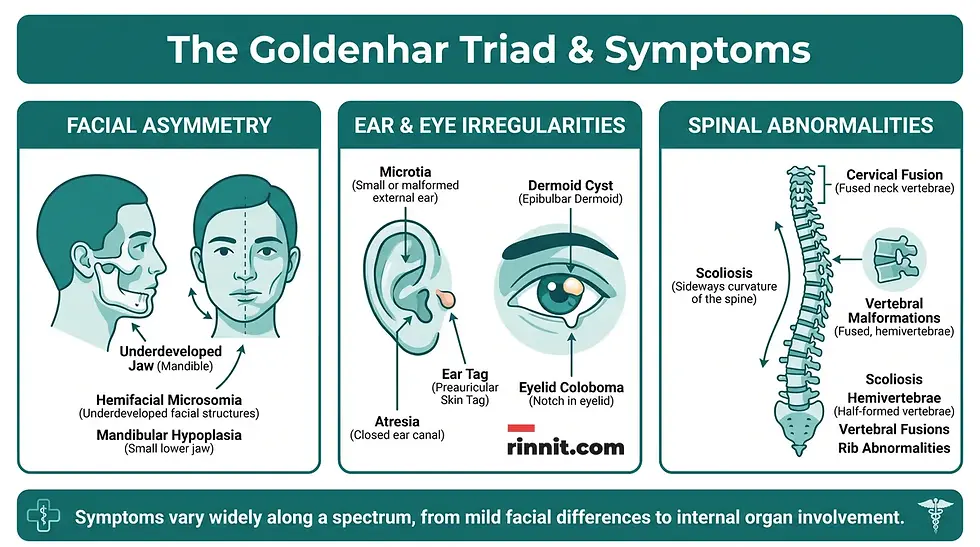
The symptoms of Goldenhar syndrome vary significantly between individuals. The most common sign is facial asymmetry, often involving an underdeveloped jaw, cheek, and eye on one side. However, the condition can also impact various other systems in the body.
Facial and Sensory Issues
Children with Goldenhar syndrome frequently have ear irregularities, such as a very small or missing ear (microtia/anotia), which can lead to hearing loss. Eye issues are also common, including benign eye cysts known as dermoid cysts, crossed eyes, or missing eyelid tissue. These sensory challenges often require early intervention to prevent developmental delays in speech and communication [1].
Skeletal and Organ Involvement
Beyond the face, the condition often affects the spine, leading to curved vertebrae (scoliosis) or abnormal spinal bones. In more severe cases, internal organs such as the kidneys, heart, and lungs may be involved. Up to 15 out of 100 children with Goldenhar syndrome may have an intellectual disability, particularly if the central nervous system is affected [1].
Associated Conditions
Cleft lip or palate: Irregularities in the roof of the mouth or lip.
Obstructive sleep apnea: Breathing interruptions during sleep, often caused by an underdeveloped jaw.
Speech difficulties: Challenges with language development due to hearing loss or facial structure.
What Causes Goldenhar Syndrome?
While the exact cause of Goldenhar syndrome remains unknown, experts believe it is related to chromosomal changes that occur during embryonic development. These changes impact how the face and head form in the womb. For the vast majority of families, the condition is not hereditary; only about 2% of babies born with the syndrome have a first-degree relative (parent or sibling) with the same condition [1].
Risk Factors
Most babies with Goldenhar syndrome are born from healthy pregnancies where the parents did everything right. However, some research suggests certain factors may increase the risk [1][2]:
Diabetes in the mother: Diabetes that was present before pregnancy.
Twin pregnancies: The condition is more common in pregnancies involving twins.
Medications: Exposure to specific drugs during pregnancy, such as certain medications for depression (fluoxetine), seizures (primidone), or retinoic acid (found in the acne medication isotretinoin).
How Is It Diagnosed and Treated?
Diagnosis usually happens at birth based on the baby's physical appearance. In mild cases, a child might not be diagnosed until they are older and their facial features become more distinct. Rarely, jaw or ear changes can be detected before birth [1].
Diagnostic Tests
To understand the extent of the condition, healthcare providers may use:
Imaging scans: X-rays or CT scans to check the skull, spine, lungs, and kidneys.
Heart tests: Echocardiograms or EKGs to ensure proper heart function.
Eye and ear exams: Detailed checks for cysts, vision issues, and hearing levels.
Sleep studies: Monitoring for signs of obstructive sleep apnea.
Treatment Approaches
Treatment is highly personalized and depends on the severity of the symptoms. A multidisciplinary team of specialists, including audiologists, plastic surgeons, and speech-language pathologists, works together to manage the child's care [1].
Common interventions include:
Reconstructive surgery: To improve facial symmetry, repair cleft palates, or correct heart and spinal defects.
Hearing and vision aids: Use of hearing aids, auditory implants, or eyeglasses to support sensory development.
Therapies: Speech therapy for communication and physical therapy for movement or pain management.
Feeding support: Special bottles or tubes for infants who have difficulty swallowing.

Navigating a rare diagnosis? Visit Rinnit.com for comprehensive guides on craniofacial conditions, connecting with specialist care teams, and finding support networks for families.
Frequently Asked Questions
Does Goldenhar syndrome affect intelligence?
Most children with Goldenhar syndrome have normal intelligence. However, up to 15 out of 100 may have intellectual disabilities, especially if there are abnormalities in the central nervous system.
Is Goldenhar syndrome hereditary?
In most cases, it is not. Only about 2% of affected children have a first-degree relative with the condition.
Can the facial differences be corrected?
Yes. Reconstructive surgery can significantly improve facial symmetry and function, such as repairing an underdeveloped jaw or ear.
What is the "triad" of Goldenhar syndrome?
The traditional triad includes facial asymmetry (underdeveloped jaw), atypical ear and eye development, and spinal abnormalities.
Does the condition affect life expectancy?
Generally, no. Most people with Goldenhar syndrome live a normal lifespan, though severe heart or lung issues can impact the outlook.
When is Goldenhar syndrome usually diagnosed?
Goldenhar syndrome is most often diagnosed at birth based on physical features, but mild cases may be found later in childhood.
What is hemifacial microsomia?
Hemifacial microsomia is a condition where the tissues on one side of the face are underdeveloped, which is a hallmark sign of Goldenhar syndrome.
Are both sides of the face always affected?
No. It usually affects only one side (typically the right), but up to 1 in 3 children have symptoms on both sides.
What are dermoid cysts?
Dermoid cysts are benign (noncancerous) cysts that can appear on the eye in children with Goldenhar syndrome.
Can Goldenhar syndrome be prevented?
Since the exact cause is unknown, there is no known way to prevent it. Most cases occur in healthy pregnancies.
What specialists treat this condition?
A team typically includes a pediatrician, ENT (ear, nose, and throat doctor), ophthalmologist, plastic surgeon, and speech therapist.
Does it cause hearing loss?
Yes, ear irregularities or a missing ear canal can lead to significant hearing loss, often requiring hearing aids.
Is it the same as Treacher Collins syndrome?
No, though they share some facial features, they are different conditions with different genetic causes.
Can it cause breathing problems?
Yes, an underdeveloped jaw can lead to obstructive sleep apnea, which may require surgery or specialized breathing support.
What support is available for families?
Counseling and support groups can help families manage the emotional aspects of the diagnosis and learn to advocate for their child's needs.
Related Reading
References
Cleveland Clinic. Goldenhar Syndrome. Cleveland Clinic. Last updated February 24, 2026. https://my.clevelandclinic.org/health/diseases/22808-goldenhar-syndrome
Barisic I, et al. Prevalence, prenatal diagnosis and clinical features of oculo-auriculo-vertebral spectrum: a registry-based study in Europe. Eur J Hum Genet. 2014;22(8):1026-33. PMID 24398798. https://doi.org/10.1038/ejhg.2013.287
Beleza-Meireles A, et al. Oculo-auriculo-vertebral spectrum: a review of the literature and genetic update. J Med Genet. 2014;51(10):635-45. PMID 25118188. https://doi.org/10.1136/jmedgenet-2014-102476
Huang W, et al. Mandibular Distraction Osteogenesis in Children with Hemifacial Microsomia: A 5-Year Follow-Up of a Prospective Cohort Trial. Plast Reconstr Surg. 2026;157(5):899-908. PMID 41086380. https://doi.org/10.1097/PRS.0000000000012535
Medical disclaimer
This article is for general educational purposes only and is not a substitute for professional medical advice, diagnosis, or treatment. Always seek the advice of your physician or other qualified healthcare provider with any questions you may have about a medical condition. Never disregard professional medical advice or delay seeking care because of something you have read here. If you think you may have a medical emergency, call your doctor or emergency services immediately.



Comments