Hemifacial Microsomia: A Comprehensive Guide to Causes, Symptoms, and Care

Updated: 2 days ago
Medically reviewed by Dr. Baraa Alnahhal, MD · Last reviewed: October 2026
Quick Answer: 5 Key Facts
Hemifacial microsomia is a congenital condition in which facial structures do not develop typically during the first weeks of pregnancy, affecting an estimated 1 in 3,000 to 5,600 live births. It can involve the jawbone, external ear and facial muscles and may affect breathing, feeding and hearing. Treatment usually spans infancy through early adulthood with a multidisciplinary team. [1] [2]
What the research says
How common: A 2020 review in the Journal of Craniofacial Surgery reports a prevalence of 1 in 3,000 to 5,600 live births, making it the second most common congenital facial difference. [2]
Hearing is often affected: In a retrospective cohort of 213 patients with craniofacial microsomia assessed before age 18, 183 (85.9%) had hearing impairment. In patients with one-sided craniofacial microsomia, 21.8% had hearing loss in both ears, and hearing impairment was not significantly associated with speech-language delay. [4]
Cause is multifactorial: A review in the Journal of Dental Research describes three proposed mechanisms (vascular abnormality and hemorrhage, damage to Meckel's cartilage, and abnormal neural crest cell development) and notes that none explains every presentation. [3]
What is hemifacial microsomia?
Hemifacial microsomia is a condition present at birth in which one side of the face is underdeveloped. It most often affects one side, but a bilateral form can affect both. It mainly involves structures derived from the first and second branchial arches in the embryo, which leads to differences in the cheekbone, jaw and ear.
It is the second most common congenital facial difference and shows a wide spectrum of severity. In mild cases it may involve only a small skin tag or a slightly misshapen ear. In more severe cases it can affect the skull structure, the jaw and the function of the facial nerve.

Affected area | Common manifestations |
External ear | Microtia (small or misshapen ear), skin tags |
Lower jaw | Underdeveloped jawbone (mandible), uneven smile |
Eyes | Microphthalmia (abnormally small eye) in some cases |
Teeth | Hypodontia (missing permanent teeth) |
Internal organs | Rare involvement of the heart, kidneys or spine |
Identifying symptoms and complications
Signs are physical and usually apparent at birth, and they vary with the structures involved. When the facial nerve is involved, facial weakness can cause an uneven smile or difficulty closing the eye on the affected side.
Potential complications
Hearing loss is a main concern when the outer or middle ear is affected. In one cohort, most hearing impairment was conductive. [4] Jaw and facial muscle differences can cause feeding difficulties and, in some children, poor weight gain, as well as speech problems. Vision problems may occur if the eye socket or the eye itself is underdeveloped.
Causes and the diagnostic process
The exact cause is not fully understood. It is thought to arise from a disruption in facial development during the first weeks of pregnancy. Research points to several possible contributors, including vascular events and bleeding in the developing face, disturbed neural crest cell development, certain exposures (for example thalidomide or retinoic acid), maternal diabetes, and variants in genes such as OTX2, PLCD3 and MYT1. [3] Because it sometimes occurs in more than one family member, a hereditary component is possible.
How it is diagnosed
Diagnosis can sometimes begin before birth with detailed prenatal ultrasound or MRI. After birth, a physical examination by a neonatologist or craniofacial specialist is the main way to confirm it. To see how far bone and tissue are involved, doctors may use:
X-rays: to assess jaw and skull development.
CT scans: to give a detailed 3D view of the facial structure.
Management and treatment pathways
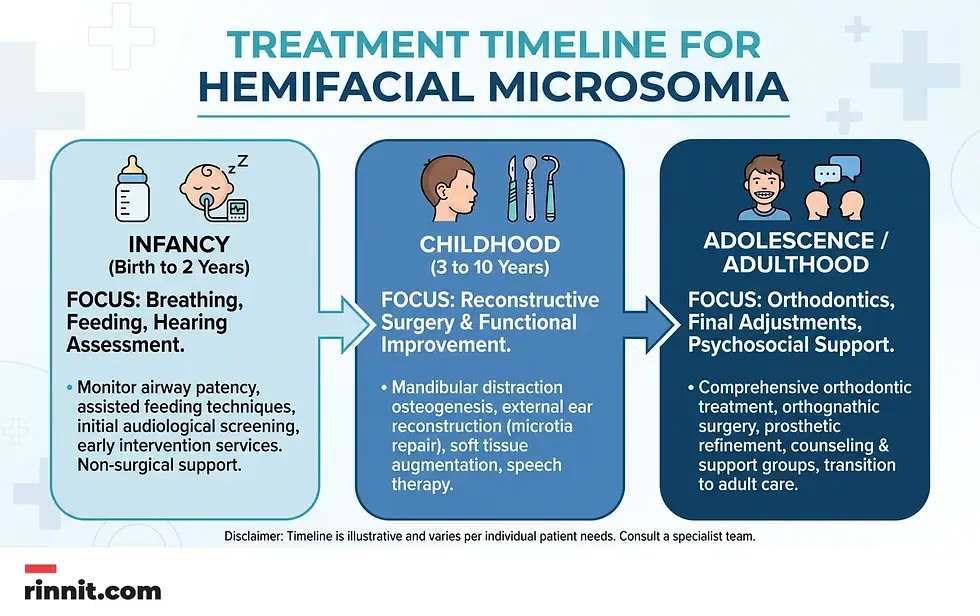
Treatment is individualized and depends on severity. Care often begins in infancy with a focus on breathing and feeding, then shifts to reconstructive goals as the child grows.
Neonatal and infancy care
For newborns with severe jaw underdevelopment, breathing and feeding come first. A tracheostomy (to help breathing) or tube feeding (to ensure nutrition) may be needed in the first weeks of life in severe cases.
Reconstructive surgery and therapy
During childhood and adolescence, a series of operations may be planned to improve function and appearance. These can include jaw (maxillofacial) surgery, ear reconstruction by a plastic surgeon, and eye procedures. Nonsurgical support matters just as much:
Hearing aids: to manage hearing loss and support language development.
Speech therapy: to help with swallowing and clear speech.
Orthodontics: braces and other devices for missing or misaligned teeth.
Psychological support: a review notes a modestly elevated risk of behavior and social-competence difficulties in this population. [2]
Hemifacial microsomia vs. Goldenhar syndrome
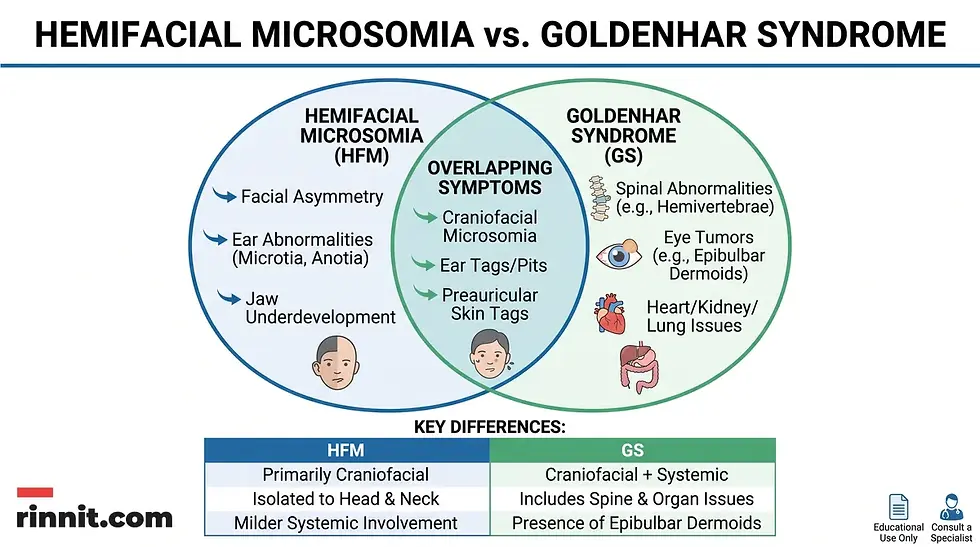
The two conditions overlap and are often considered part of the same spectrum. Goldenhar syndrome adds features such as spinal abnormalities and noncancerous growths on the eye. For a full explanation, read our guide: Goldenhar Syndrome: What It Is, Why It Happens and How It's Treated.
Conclusion
A diagnosis of hemifacial microsomia marks the start of a long-term medical journey, but with modern reconstructive surgery, hearing and speech support, and attention to emotional well-being, children can lead full, healthy lives. Early intervention and regular hearing checks help protect both function and quality of life.
For more resources on craniofacial health and pediatric care, visit Rinnit.com.
Related Reading
Frequently Asked Questions
Is hemifacial microsomia the same as Goldenhar syndrome?
Not exactly. Hemifacial microsomia is often described as part of the same spectrum as Goldenhar syndrome, but Goldenhar syndrome also involves features such as spinal abnormalities and noncancerous growths on the eye.
Can hemifacial microsomia be prevented?
No. The cause is not fully understood and the condition develops very early in pregnancy, so there is no known way to prevent it.
Will my child's life expectancy be affected?
In most cases, no. Children with hemifacial microsomia generally have a normal life expectancy, although care is long-term.
How many surgeries will my child need?
The number of surgeries varies widely. Some children need only one or two procedures, while others have a series of operations through adolescence, depending on severity.
Does it always affect hearing?
Not always, but hearing problems are very common. In one study of 213 children and teens, 85.9% had some hearing impairment [4], so regular hearing tests are advised.
Can it affect both sides of the face?
Yes. This is called bilateral hemifacial microsomia, and it is less common than the one-sided form.
What is microtia?
Microtia means an underdeveloped or small external ear. It is a common sign of hemifacial microsomia.
When do surgeries usually stop?
Most reconstructive procedures are planned around growth and are often completed by early adulthood, once facial growth has settled. Your craniofacial team will set the timing.
Is the condition hereditary?
Hemifacial microsomia can be. Most cases appear without a clear family history, but it sometimes runs in families, and research has reported variants in genes such as OTX2, PLCD3 and MYT1 [3].
Can it be detected during pregnancy?
Sometimes. Detailed prenatal ultrasound or MRI can identify facial underdevelopment before birth, although mild cases may only be recognized after delivery.
Will my child need speech therapy?
Many children do, especially when the jaw, teeth or facial muscles are significantly affected. A speech-language pathologist can assess this.
What is hypodontia?
Hypodontia is the medical term for missing permanent teeth. It can occur with hemifacial microsomia and is managed with orthodontic and dental care.
Are there nonsurgical treatments?
Yes. Hearing aids, orthodontics (braces and appliances), speech therapy and psychological support all help manage function and well-being.
How does it affect a child's social life?
Looking different can be challenging. Reviews note a modestly elevated risk of behavior and social-competence difficulties [2], so counseling and open family communication are valuable.
What is a tracheostomy?
A tracheostomy is a surgical opening in the neck into the windpipe that helps a baby breathe. It is used only in severe cases where the jaw is very small and the airway is compromised.
References
Cleveland Clinic. Hemifacial Microsomia. Cleveland Clinic. Last updated November 11, 2024. https://my.clevelandclinic.org/health/diseases/22810-hemifacial-microsomia
Paul MA, et al. Hemifacial Microsomia Review: Recent Advancements in Understanding the Disease. J Craniofac Surg. 2020;31(8):2123-2127. PMID 33136839. https://doi.org/10.1097/SCS.0000000000006616
Chen Q, et al. Etiology and Pathogenesis of Hemifacial Microsomia. J Dent Res. 2018;97(12):1297-1305. PMID 30205013. https://doi.org/10.1177/0022034518795609
van Dop D, et al. Prevalence of and Risk Factors for Hearing Impairment in Craniofacial Microsomia. J Oral Maxillofac Surg. 2025;83(2):167-176. PMID 39549723. https://doi.org/10.1016/j.joms.2024.10.011
Medical disclaimer
This guide is for educational purposes only and is not medical advice. Always seek the advice of a physician or other qualified health provider with any questions about a medical condition. If you think you may have a medical emergency, call your doctor or emergency services immediately.



Comments