Understanding Granulocytes: The Frontline of Your Immune System

Updated: 3 days ago
Medically reviewed by Dr. Baraa Alnahhal, MD · Last reviewed: October 2026
Quick Answer
Granulocytes are white blood cells containing small, enzyme-filled granules that rush to sites of infection or inflammation to fight bacteria, parasites and allergens. The four main types are neutrophils, eosinophils, basophils and mast cells, each with unique roles. A healthy granulocyte count typically ranges between 1,500 and 8,500 cells per microliter of blood.
What the research says
Medicine that boosts granulocyte production lowers infection risk when counts drop during chemotherapy. A review of 17 randomized trials with 3,493 adults found that granulocyte colony-stimulating factor (G-CSF) cut febrile neutropenia by 46% and infection-related deaths by 45% (Kuderer et al., J Clin Oncol, 2007) [2].
Supporting granulocyte levels during chemotherapy is also linked to better survival. A meta-analysis of 61 randomized comparisons found a relative risk of death from any cause of 0.93 with G-CSF support, about 7% lower than without it (Lyman et al., Ann Oncol, 2013) [3].
What are granulocytes in the immune system?
Granulocytes, also known as granular leukocytes or polymorphonuclear leukocytes (PMN cells), are essential components of the innate immune system. These cells are characterized by the presence of small granules in their cytoplasm, which are essentially storage sacs for potent enzymes and chemicals. When your body encounters a threat, such as a bacterial infection or an allergic trigger, these cells migrate to the affected area to initiate a protective response.
These cells are primarily produced in the bone marrow and typically have a short lifespan, often living for only a few days before being replaced. This rapid turnover ensures that your immune system always has a fresh supply of active defenders ready to respond to new challenges.
What do granulocytes do, and what types are there?
Each type of granulocyte is equipped with a specific set of enzymes, allowing them to target different types of threats. They work collectively to maintain your body’s internal environment and protect against external pathogens.
Neutrophils
Neutrophils are the most abundant granulocytes, making up approximately 40% to 60% of all white blood cells. They are the primary attackers of bacteria; a single neutrophil can consume up to 20 bacteria during its short lifespan. Their presence is often the first sign that the body is fighting an active infection.
Eosinophils
Eosinophils are specialized defenders that primarily target parasites and play a significant role in allergic reactions. They are involved in almost all immune responses and are particularly active during asthma episodes or seasonal allergy flares.
Basophils and Mast Cells
Basophils and mast cells are structurally similar and both release histamine and heparin. Histamine helps escort allergens out of the body, while heparin acts as a blood thinner to prevent clotting at sites of inflammation. While basophils circulate in the blood, mast cells reside in the tissues, providing a localized defense.
What do granulocytes look like, and what are their normal ranges?
Granulocytes are measured through a complete blood count (CBC), which provides the absolute number of each cell type per unit volume of blood.
Cell Type | Percentage of WBCs | Primary Function |
Neutrophils | 40% – 60% | Attacking bacteria and fungi |
Eosinophils | 1% – 3% | Fighting parasites and allergens |
Basophils | 0.4% – 1% | Releasing histamine and heparin |
Granulocytes (Total) | N/A | 1,500 – 8,500 cells/µL |
The normal range for total granulocytes is generally between 1,500 and 8,500 cells per microliter of blood (1.5 – 8.5 x 10^9/L). These values may vary slightly depending on the specific laboratory conducting the test.

What conditions and disorders affect granulocytes?
Changes in granulocyte levels can indicate various health issues, ranging from temporary infections to chronic bone marrow disorders.
High Granulocyte Counts (Granulocytosis)
A high count, or granulocytosis, often indicates that the body is responding to an infection, inflammation, or an autoimmune disease. Specific elevations include basophilia (high basophils) and eosinophilia (high eosinophils), which is frequently seen in patients with asthma or inflammatory bowel disease.
Low Granulocyte Counts (Neutropenia)
A low count, particularly of neutrophils (neutropenia), can increase the risk of frequent and severe infections. This condition may point to bone marrow disorders like leukemia or aplastic anemia. Agranulocytosis is a severe, life-threatening form of neutropenia that requires immediate medical attention.

How are granulocytes tested, and what care is involved?
Monitoring granulocyte health is a routine part of modern healthcare. Providers use a complete blood count (CBC) to identify the absolute numbers of neutrophils, eosinophils, and basophils.
Managing Immune Health
Maintaining a healthy immune system involves supporting your bone marrow’s ability to produce these vital cells. While specific treatments depend on the underlying condition, common interventions include:
Antibiotics: To assist neutrophils in fighting bacterial infections.
Corticosteroids: To manage inflammation and overactive immune responses.
G-CSF Injections: To stimulate the bone marrow to produce more granulocytes.
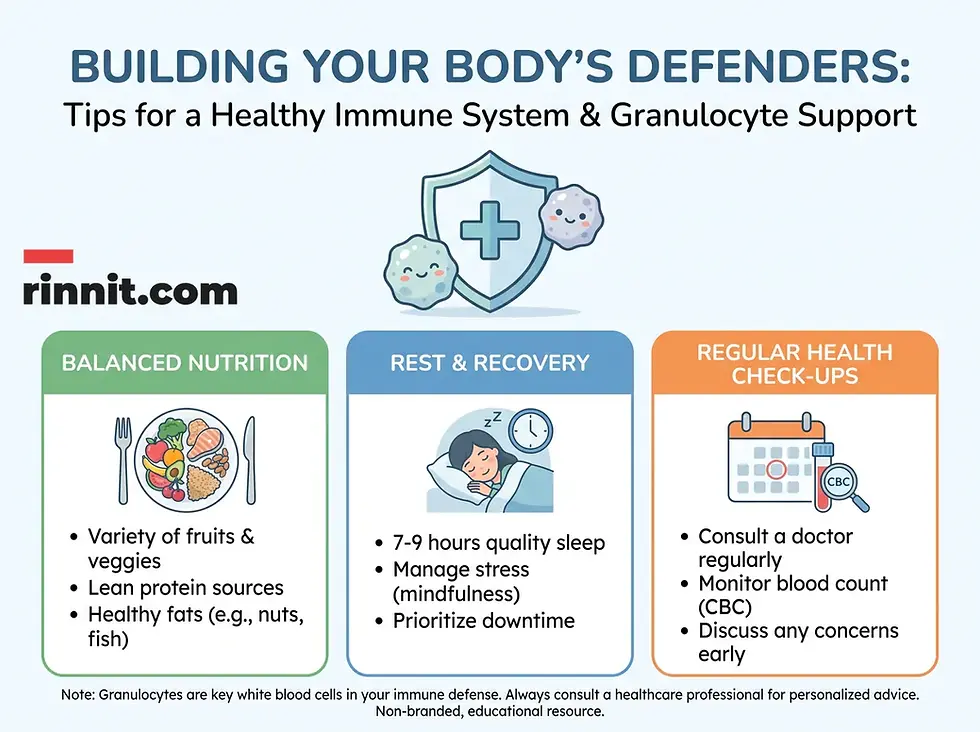
Lifestyle Support: A balanced diet and adequate rest to provide the raw materials needed for cell production.
Conclusion
Granulocytes are the unsung heroes of the immune system, providing a rapid and effective defense against a wide array of threats. By understanding their functions and monitoring their levels, you can take proactive steps to protect your health and ensure your body’s frontline defenses remain strong.
If you have concerns about your immune health or frequent infections, consult with a healthcare professional. A simple blood test can provide the clarity needed to optimize your wellness and detect potential issues early.
Frequently Asked Questions
What are the four types of granulocytes?
The four types are neutrophils, eosinophils, basophils, and mast cells, each targeting different pathogens.
What does a high granulocyte count mean?
A high count, or granulocytosis, usually means your body is fighting an infection, inflammation, or an allergic reaction.
What is the normal range for granulocytes?
The normal range is typically between 1,500 and 8,500 cells per microliter of blood.
How are granulocytes different from other white blood cells?
Granulocytes contain enzyme-filled granules in their cytoplasm, which they release to fight threats, unlike non-granular white blood cells.
What are immature granulocytes?
Immature granulocytes are cells that have not fully developed in the bone marrow. Their presence in the blood can indicate a strong response to infection or a bone marrow issue.
Which granulocyte is the most common?
Neutrophils are the most common, making up about 40% to 60% of all white blood cells.
What is neutropenia?
Neutropenia is a low level of neutrophils, which can make you more susceptible to infections.
Do granulocytes live a long time?
No, granulocytes typically live for only a few days before being replaced by new cells from the bone marrow.
Can allergies affect my granulocyte levels?
Yes, eosinophils and basophils often increase during allergic reactions or asthma episodes.
How do I check my granulocyte levels?
A routine complete blood count (CBC) test is the standard way to measure your absolute granulocyte levels.
Related Reading
Understanding Neutrophils: Your Body's First Line of Immune Defense explains the most common granulocyte and how it fights infection.
Understanding Eosinophils: Your Body's Defense Against Invaders describes the granulocytes involved in allergies and parasite defense.
Basophils: The Immune System’s Largest Granulocytes covers the rarest granulocyte and its role in allergic reactions.
Agranulocytosis: The Rare, Life-Threatening Drop in Infection-Fighting Neutrophils explains a dangerous drop in granulocytes and its warning signs.
Sources
Cleveland Clinic. Granulocytes. Cleveland Clinic. August 7, 2024. https://my.clevelandclinic.org/health/body/22016-granulocytes
Kuderer NM, Dale DC, Crawford J, et al. Impact of primary prophylaxis with granulocyte colony-stimulating factor on febrile neutropenia and mortality in adult cancer patients receiving chemotherapy: a systematic review. J Clin Oncol. 2007;25(21):3158-3167. PMID 17634496. https://doi.org/10.1200/JCO.2006.08.8823
Lyman GH, Dale DC, Culakova E, et al. The impact of the granulocyte colony-stimulating factor on chemotherapy dose intensity and cancer survival: a systematic review and meta-analysis of randomized controlled trials. Ann Oncol. 2013;24(10):2475-2484. PMID 23788754. https://doi.org/10.1093/annonc/mdt226
Medical disclaimer
The information provided in this article is for educational purposes only and should not be used as a substitute for professional medical advice, diagnosis, or treatment. Always seek the advice of your physician or other qualified health provider with any questions you may have regarding a medical condition.



Comments