Agranulocytosis: The Rare, Life-Threatening Drop in Infection-Fighting Neutrophils

Updated: 2 days ago
Medically reviewed by Dr. Baraa Alnahhal, MD · Last reviewed: September 2026
TL;DR
Agranulocytosis is a very rare, life-threatening condition in which your body has very low levels of neutrophils — the most common type of granulocyte, the white blood cells that fight infection and arrive first when you're sick. With too few neutrophils, the body can't effectively fight infections and may develop sepsis. It comes in two forms: acquired (usually a very rare drug reaction, estimated at 1 to 7 people per million) and congenital (Kostmann syndrome, present at birth, affecting about 1 in 200,000 babies). It is diagnosed when the absolute neutrophil count (ANC) falls below 100 per microliter (normal is at least 1,500). If medication is the cause, stopping it often cures the condition, with neutrophil levels typically normalizing within 1 to 3 weeks. Sepsis warning signs — fast heart rate, rapid breathing, shaking chills — mean go to the emergency room immediately.
Quick Answer
What it is: Agranulocytosis is a very rare, life-threatening condition where neutrophil levels — the most common infection-fighting white blood cells — drop dangerously low, leaving the body unable to effectively fight infections.
How it is measured: It is diagnosed when the absolute neutrophil count (ANC) falls below 100 neutrophils per microliter of blood; people normally have at least 1,500 per microliter, and counts under 1,500 indicate the broader condition neutropenia.
Main causes: A very rare reaction to certain medications (drug-induced agranulocytosis, estimated at 1 to 7 per million people), autoimmune diseases, bone marrow failure, certain infections, vitamin B12 or folate deficiency, and long-term lead or mercury exposure.
Treatment and outlook: Stop or change the offending medication and treat underlying disease; options include antibiotics, immunosuppressants like prednisone, G-CSF therapy, and stem cell transplant. Drug-induced cases often cure with recovery of neutrophil levels in 1 to 3 weeks.
What Is Agranulocytosis?
Agranulocytosis (ay-GRAN-yoo-loh-sy-TOH-sis) is a very rare, life-threatening condition that happens when you have very low levels of neutrophils, a type of granulocyte.
Granulocytes are a group of white blood cells that fight infections. Neutrophils are the most common type of granulocyte. They're first on the scene when you're sick. In agranulocytosis, you don't have enough neutrophils, so your body isn't able to effectively fight infections. You may develop sepsis.

With normal neutrophil levels, the most common granulocyte is plentiful and the body fights infections effectively. In agranulocytosis, neutrophils are dangerously low, leaving the body unable to fight infections and at risk of sepsis from frequent or non-healing infections. The scale: normal is at least 1,500 neutrophils per microliter, neutropenia is below 1,500, and agranulocytosis — the most severe form — is below 100.
What Are the Types of Agranulocytosis?
The two types of this rare condition are:
Type | Key Details |
Acquired agranulocytosis | Something affects your neutrophils; may be a very rare side effect of certain medications; estimated to affect 1 to 7 people out of 1 million |
Congenital agranulocytosis | Present at birth; also known as Kostmann syndrome; a genetic change during fetal development affects how bone marrow makes neutrophils; estimated to affect 1 in 200,000 babies |
This article focuses on acquired agranulocytosis.
What Are the Symptoms of Agranulocytosis?
This condition doesn't cause symptoms by itself. But it increases your risk of severe infections that may cause symptoms, including:
Symptom | Detail |
Extreme tiredness | Feeling exhausted for no clear reason |
Fever and chills | May reach 104°F (40°C) |
Faster heart rate and breathing | Signs of infection or sepsis |
Muscle weakness | Sudden weakness or lightheadedness |
Sore throat | Plus bleeding, inflamed gums |
Sores in mouth and throat | Can make it difficult to swallow |

Agranulocytosis itself causes no symptoms — but the infections it enables do: extreme tiredness, fever and chills, faster heart rate and breathing, muscle weakness, sore throat with bleeding or inflamed gums, mouth and throat sores that make swallowing difficult, and sudden weakness or lightheadedness. The sepsis warning signs demand immediate emergency care: dizziness, fast heart rate, rapid breathing, shortness of breath, shaking or chills, warm or sweaty skin for no reason, and weakness.
What Causes Agranulocytosis?
A very rare reaction to certain medications can cause acquired agranulocytosis. Healthcare providers may call this drug-induced agranulocytosis. Other causes are conditions that affect your body's ability to make neutrophils and exposure to toxic substances.
Drug-Induced Agranulocytosis
Agranulocytosis is a very rare but serious chemotherapy side effect. Researchers link several medications to this condition:
Medication Class | Example Medications |
Antibiotics | Amoxicillin |
Antifungal medication | Clotrimazole |
Anti-inflammatory medication | Sulfasalazine |
Antipsychotic medication | Clozapine |
Antiviral medication | Valganciclovir |
Pain medication | Metamizole |
Thyroid medications | Carbimazole and thiamazole |
It's important to remember that drug-induced agranulocytosis rarely happens. Talk to your healthcare provider if you have any concerns about side effects. They'll explain why a drug is part of your treatment plan and what to do if you experience side effects.
Medical Conditions That Lower Neutrophils
Some conditions attack neutrophils or keep your bone marrow from making them, so you have low neutrophil levels. Examples include:
Cause Category | Examples | How It Lowers Neutrophils |
Autoimmune diseases | Lupus and rheumatoid arthritis | The immune system makes antibodies that inappropriately attack and destroy your neutrophils |
Bone marrow failure | Aplastic anemia, leukemia, myelodysplastic syndrome | Aplastic anemia attacks stem cells in your bone marrow so cells don't become neutrophils; leukemia and myelodysplastic syndrome involve abnormal blood stem cells that can't mature and crowd out healthy blood stem cells |
Infections | Bacterial: typhoid fever, tuberculosis; viral: hepatitis, HIV | Keep your bone marrow from making neutrophils |
Vitamin deficiency | Vitamin B12 and folate deficiencies, plus some other nutrient deficiencies | Can affect neutrophil production |
Long-term exposure to lead or mercury may also cause this condition.
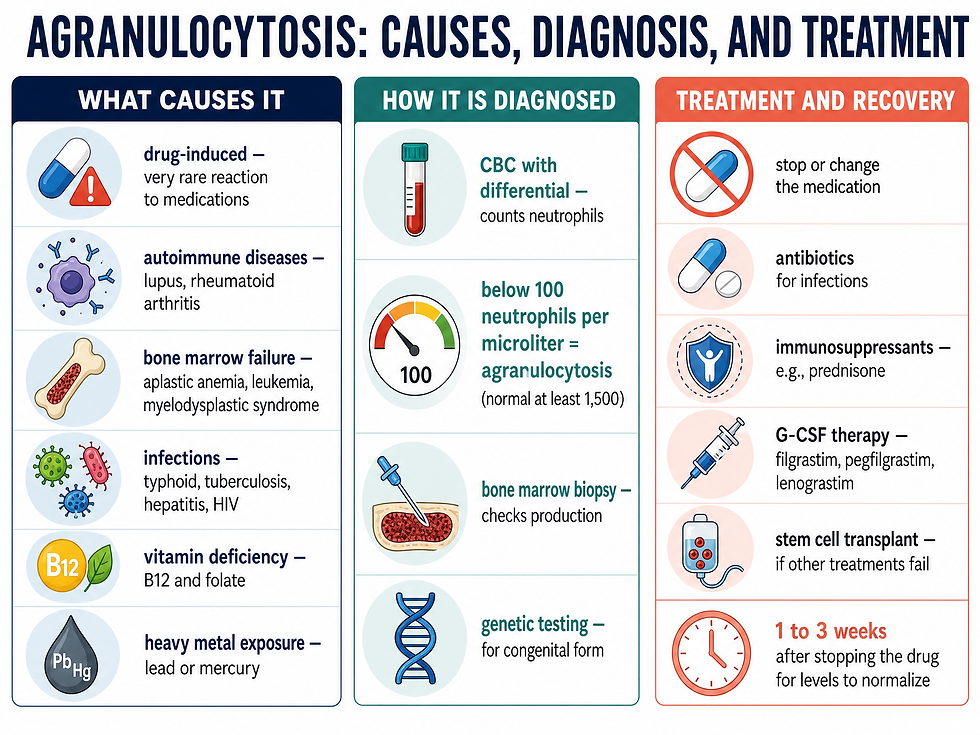
Agranulocytosis is most often drug-induced — a very rare reaction to medications like amoxicillin, clozapine, or sulfasalazine — but autoimmune diseases, bone marrow failure, infections, vitamin B12 or folate deficiency, and lead or mercury exposure can also cause it. Diagnosis centers on a CBC with differential: below 100 neutrophils per microliter confirms agranulocytosis, with bone marrow biopsy and genetic testing as further steps. Treatment means stopping or changing the medication, treating infections, and in resistant cases G-CSF therapy or a stem cell transplant; drug-induced cases typically recover in 1 to 3 weeks.
What Are the Complications?
Sepsis is the most serious complication. It can happen if you have frequent infections or infections that don't go away. Sepsis is life-threatening. You need medical treatment right away if you have sepsis.
You're more likely to experience complications with agranulocytosis if you're over age 65 or if you have other health conditions, like heart, kidney, or lung disease.
How Is Agranulocytosis Diagnosed?
Healthcare providers will ask about your symptoms and health. For example, they'll ask if you've had recent infections that keep coming back or don't go away. They'll ask if you have an autoimmune disease or bone marrow disorder diagnosis. And they'll ask what prescription medications you take.
A provider will do tests, including:
Test | What It Checks |
CBC with differential | Checks your neutrophil levels; agranulocytosis occurs when the absolute neutrophil count (ANC) is fewer than 100 neutrophils per microliter of blood; normally, people have at least 1,500 neutrophils per microliter |
Bone marrow biopsy | A provider gets a sample of your bone marrow; a medical pathologist checks neutrophil levels in the sample |
Genetic testing | You may have tests if your provider thinks you have congenital agranulocytosis |
How Is Agranulocytosis Treated?
Rarely, agranulocytosis is a reaction to medication. In that case, your healthcare provider will prescribe another type of drug and treat any underlying disease that affects your neutrophils.
Treatment | When It Is Used |
Antibiotics | If you have an infection; your provider will prescribe antibiotics and other medications to treat it |
Immunosuppressants | If an autoimmune disorder causes agranulocytosis; medicines that calm your immune system, like prednisone |
G-CSF therapy (granulocyte colony-stimulating factor) | Boosts neutrophil production; providers may prescribe filgrastim (Neupogen), pegfilgrastim (Neulasta), or lenograstim (Granocyte) |
Stem cell (bone marrow) transplant | Recommended if other treatments aren't effective; donor stem cells help make more neutrophils |
How Long Does Recovery Take?
Different things may affect your recovery. If medication causes the condition, it may take one to three weeks after you stop it for your neutrophil levels to return to normal. It will take much more time to recover from a stem cell (bone marrow) transplant.
How Do You Protect Yourself While Neutrophils Recover?
There are steps you can take to protect your health while your neutrophils bounce back:
Protective Step | Why It Helps |
Wash your hands | Reduces exposure to infection-causing germs |
Avoid people who are sick | Lowers your infection risk while defenses are down |
Make and store food properly | Avoids food poisoning |
When Should I See a Healthcare Provider?
Agranulocytosis may start as chills, fever, and feeling very tired. Talk to a healthcare provider if you have a fever of 104 degrees Fahrenheit (40 degrees Celsius) or feel very tired for no reason.
Go to the emergency room right away if you have symptoms like:
Sepsis Emergency Sign | Action |
Dizziness or feeling lightheaded | Go to the ER right away |
Fast heart rate | Go to the ER right away |
Rapid breathing | Go to the ER right away |
Shortness of breath | Go to the ER right away |
Shaking or chills | Go to the ER right away |
Warm or sweaty skin for no reason | Go to the ER right away |
Weakness | Go to the ER right away |
Sepsis causes these symptoms. Without prompt treatment, sepsis can be fatal.
What's the Outlook for Agranulocytosis?
Stopping the medication that causes agranulocytosis often cures it. Your healthcare provider may recommend frequent checkups to monitor neutrophil levels if you need to take a drug that increases your risk of agranulocytosis.
What's the Difference Between Agranulocytosis and Neutropenia?
Agranulocytosis is a severe form of neutropenia. Neutropenia involves having lower-than-normal levels of white blood cells.
Measure | Neutrophils per Microliter | Condition |
Normal | At least 1,500 | Healthy range |
Neutropenia | Fewer than 1,500 | Lower-than-normal levels |
Agranulocytosis | Fewer than 100 | The most severe form of neutropenia |
People with fewer than 1,500 neutrophils per microliter of blood have neutropenia. People with fewer than 100 neutrophils per microliter of blood have the most severe form of neutropenia, agranulocytosis.
Conclusion
Agranulocytosis is one of those rare conditions where a medication or illness quietly strips the body of its front-line infection fighters. Neutrophils — the most common granulocyte and the first cells on the scene when you're sick — drop to dangerously low levels, and the body suddenly can't defend itself against everyday infections. What makes this condition deceptive is that it produces no symptoms of its own: the warning signs are the infections it enables, from unexplained fever and chills to bleeding gums and sores that make swallowing difficult. Diagnosis hinges on a single, precise number — an absolute neutrophil count below 100 per microliter of blood, where normal is at least 1,500. Drug-induced agranulocytosis, estimated at just 1 to 7 people per million, is the most familiar route: antibiotics, antipsychotics, thyroid drugs, and others can rarely trigger it. The good news is that stopping the offending medication often cures the condition, with neutrophil levels typically recovering within one to three weeks. The danger zone is sepsis — and sepsis doesn't wait. Fast heart rate, rapid breathing, shaking chills, and unexplained weakness mean the emergency room, now, not tomorrow.
CTA: If you've been on a medication linked to agranulocytosis and develop a fever of 104°F (40°C), chills, bleeding gums, or exhaustion with no explanation, contact a healthcare provider immediately — and never take it upon yourself to stop a prescribed medication without their guidance. If sepsis warning signs appear, go to the emergency room right away. If you take a high-risk medication long term, ask your provider about a neutrophil monitoring plan and the protective habits — hand hygiene, avoiding sick people, safe food handling — that keep you safer while your defenses recover.
Frequently Asked Questions
What is agranulocytosis?
Agranulocytosis is a very rare, life-threatening condition in which you have very low levels of neutrophils — the most common type of granulocyte, the white blood cells that fight infections and arrive first when you're sick. Without enough neutrophils, your body can't effectively fight infections and you may develop sepsis.
How rare is agranulocytosis?
Very rare. Acquired agranulocytosis — usually a rare side effect of certain medications — is estimated to affect 1 to 7 people out of 1 million. The congenital form (Kostmann syndrome), present at birth, affects an estimated 1 in 200,000 babies.
What causes agranulocytosis?
The most common known cause is a very rare reaction to certain medications (drug-induced agranulocytosis), including amoxicillin, clotrimazole, sulfasalazine, clozapine, valganciclovir, metamizole, and thyroid medications like carbimazole. Other causes include autoimmune diseases such as lupus and rheumatoid arthritis, bone marrow failure (aplastic anemia, leukemia, myelodysplastic syndrome), infections like typhoid fever, tuberculosis, hepatitis, and HIV, vitamin B12 or folate deficiency, and long-term exposure to lead or mercury.
How is agranulocytosis diagnosed?
A CBC with differential blood test checks neutrophil levels: agranulocytosis is diagnosed when the absolute neutrophil count (ANC) is fewer than 100 neutrophils per microliter of blood, where people normally have at least 1,500. A bone marrow biopsy can check neutrophil production, and genetic testing may be done if the congenital form is suspected.
What is the difference between agranulocytosis and neutropenia?
Agranulocytosis is the most severe form of neutropenia. Neutropenia means lower-than-normal white blood cell levels — fewer than 1,500 neutrophils per microliter of blood. Agranulocytosis is defined as fewer than 100 neutrophils per microliter.
How long does it take to recover from agranulocytosis?
If a medication caused the condition, neutrophil levels may return to normal one to three weeks after you stop it — stopping the drug often cures the condition. Recovery from a stem cell (bone marrow) transplant takes much longer.
What are the emergency signs of agranulocytosis?
Sepsis warning signs mean go to the emergency room right away: dizziness or feeling lightheaded, fast heart rate, rapid breathing, shortness of breath, shaking or chills, warm or sweaty skin for no reason, and weakness. Without prompt treatment, sepsis can be fatal. Contact a provider sooner for a fever of 104°F (40°C) or extreme tiredness for no reason.
Can you prevent agranulocytosis?
You can't fully prevent it, but you can lower risk: talk to your provider about any concerns with high-risk medications before starting them, use safe food-handling and hand hygiene while neutrophils recover, avoid people who are sick, and attend frequent neutrophil-level checkups if you must stay on a medication that raises your risk.
Internal Links
External References
Bystrom R, Patel B. Bone Marrow Failure Syndromes: Aplastic Anemia, Acquired and Constitutional; Paroxysmal Nocturnal Hemoglobinuria; Pure Red Blood Cell Aplasia; and Agranulocytosis. In: Rodgers G, Young N, eds. The Bethesda Handbook of Clinical Hematology. 5th ed. Philadelphia, PA: Wolters Kluwer; 2025: chap 6.
Merck Manuals, Consumer Version. Neutropenia (updated 2/2025)
National Health Service (U.K.). Low white blood cell count (updated 7/28/2023)
Rice L, Zieske AW, Jung M. Neutrophilic leukocytosis, neutropenia, monocytosis, and monocytopenia. In: Hoffman R, Benz EJ, Silberstein LE, et al., eds. Hematology: Basic Principles and Practice. 8th ed. Philadelphia, PA: Elsevier; 2023: chap 49.
Medical Disclaimer
This article is for general informational purposes only and is not a substitute for professional medical advice, diagnosis, or treatment. Agranulocytosis is a rare, life-threatening blood disorder in which neutrophil counts drop below 100 per microliter of blood, leaving the body vulnerable to severe infections and sepsis. Sepsis warning signs — fast heart rate, rapid breathing, shaking chills, unexplained weakness — are medical emergencies requiring immediate emergency department care. Do not stop or change any prescribed medication without consulting your healthcare provider. Only a licensed healthcare provider can diagnose agranulocytosis through blood testing such as a CBC with differential, and individual treatment decisions should always be made with your care team. Never delay seeking medical care because of something you have read here.
Comments