Understanding Aponeurosis: Function, Anatomy, and Common Examples

Updated: 3 days ago
Medically reviewed by Dr. Baraa Alnahhal, MD · Last reviewed: October 2026
Quick Answer
An aponeurosis is a flat sheet of dense fibrous connective tissue that connects muscles to bones or cartilage. Unlike rounded tendons, these thin sheaths act like springs to absorb energy and provide stability for posture and movement. [1] Found throughout the body, they protect underlying nerves and vessels, support muscle fibers and help transfer mechanical loads during activity.
What the research says
Stretching helps plantar fasciitis, and plantar fascia-specific stretching worked better than calf stretching. A systematic review and meta-analysis of eight randomized trials found moderate-quality evidence for a larger pain reduction with plantar fascia-specific stretching than with calf stretching. Overall, evidence for stretching ranged from moderate to very low quality, and the authors described its effect as large and comparable to other therapies (PubMed: Siriphorn & Eksakulkla, J Bodyw Mov Ther, 2020 [2]).
Low-level laser therapy reduced pain in plantar fasciitis and lower-limb tendinopathy. A meta-analysis of 18 randomized trials found pain fell by 13.15 mm on a 100 mm visual analogue scale (95% CI 7.82 to 18.48) at the end of therapy and by 12.56 mm (95% CI 5.69 to 19.42) 4 to 12 weeks later. No adverse events were reported, but long-term data were not available (PubMed: Naterstad et al., BMJ Open, 2022 [3]).
Heavy hand-arm workloads were linked to Dupuytren’s disease, which involves the palmar aponeurosis. A systematic review and meta-analysis of 15 studies found higher odds of Dupuytren’s disease with hand-transmitted vibration (odds ratio 2.0; 95% CI 1.5 to 2.7; moderate-quality evidence), lifting or carrying loads (OR 1.5; 95% CI 1.1 to 2.0) and combined mechanical exposures (OR 2.1; 95% CI 1.4 to 3.1), with low-quality evidence for the latter two (PubMed: Jahn et al., Occup Environ Med, 2024 [4]).
What is an aponeurosis?
Aponeurosis is a specialized type of connective tissue that plays a vital role in the human body's structural integrity and movement. As a thin, flat sheath, it acts as a critical bridge between muscle fibers and the bones or cartilage they move. Found throughout the body, aponeuroses provide the strength and stability necessary for maintaining posture while absorbing energy during physical activity.
What is the anatomy and structure of an aponeurosis?
Aponeuroses are composed of dense, fibrous connective tissue, primarily consisting of bundles of collagen fibers. These fibers are organized in a parallel pattern, which provides significant strength to the tissue. [1] Within this structure are fibroblasts, which are cells responsible for releasing collagen to maintain the sheath's integrity. [1]
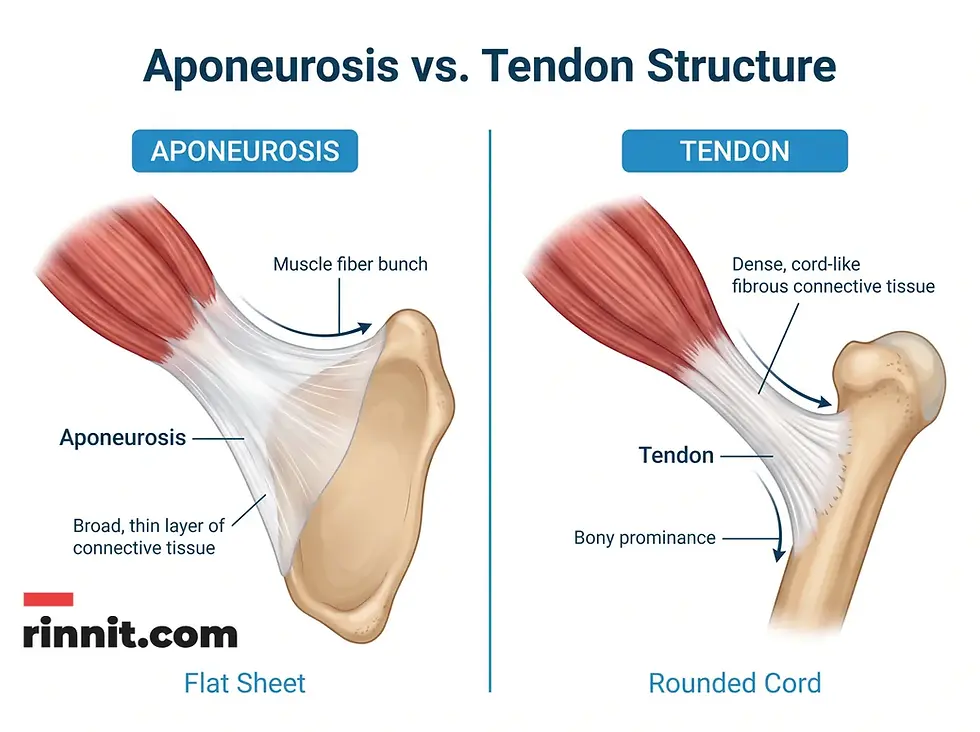
Structurally, aponeuroses differ from other connective tissues like tendons and fascia, though they share similar materials:
Feature | Aponeurosis | Tendon | Fascia |
Shape | Flat, thin sheet. | Rounded, rope-like cord. | Fibrous tissue wrap. |
Function | Absorbs energy; provides stability. | Stretching and contracting; facilitates flexibility. | Supports muscles, organs, and bones. |
Location | Often hidden under bone and muscle. | Extends directly from muscles. | Surrounds internal structures. |
Injury Risk | Rarely injured due to protected location. | More easily injured due to exposure. | Variable depending on location. |
What does an aponeurosis do in the body?
An aponeurosis mainly serves as an insertion point where muscle fibers connect to bones or cartilage. When muscles flex or extend, the aponeurosis functions like a spring, enduring tension and extra pressure while absorbing energy. [1] This mechanism is essential for:
Structural Strength: Providing a firm foundation for muscle attachment.
Stability: Helping maintain the body's posture and alignment.
Protection: Covering and shielding underlying nerves, vessels, and muscles.
Load Transfer: Distributing force evenly across different bodily regions.

What are notable examples of an aponeurosis in the human body?
Aponeurosis tissue is found in several key areas of the body, and each one serves a specific mechanical purpose.
Name | Location | Primary Function |
Epicranial Aponeurosis | Upper skull. | Supports muscles controlling facial expressions. |
Palmar Aponeurosis | Palm of the hand. | Enables gripping and cupping; protects tendons. |
Plantar Aponeurosis | Sole of the foot. | Supports the arch; protects nerves and vessels. |
Bicipital Aponeurosis | Inner elbow area. | Protects the brachial artery and median nerve. |
Erector Spinae Aponeurosis | Lower back. | Aids in breathing, posture, and load transfer. |
External Oblique Aponeurosis | Abdominal wall. | Helps twist the trunk and move the spine. |

What health conditions can involve an aponeurosis or aponeuroses?
Aponeurosis problems can contribute to conditions such as Dupuytren's disease in the hand and plantar fasciitis in the foot, though aponeuroses are generally well protected. For instance, the shortening or thickening of the palmar aponeurosis can lead to Dupuytren’s disease [1], which affects hand function. Similarly, overstretching the plantar aponeurosis (often referred to as the plantar fascia) is a common cause of plantar fasciitis, resulting in significant foot pain.
Conclusion
Aponeurosis is an indispensable component of the human musculoskeletal system. By acting as a thin but powerful bridge between muscles and bones, it ensures that the body can move efficiently while remaining stable. Whether protecting the brain beneath the scalp or supporting the arch of the foot, these connective sheaths are fundamental to daily physical function and long-term health.
If you are experiencing persistent pain in your palms, soles, or lower back, it may be related to the connective tissues supporting your muscles. Consult a healthcare professional or physical therapist to discuss management strategies, such as targeted stretching or ergonomic adjustments, to maintain the health of your aponeuroses and tendons.
Frequently Asked Questions
1. What is the plural of aponeurosis?
The plural form of aponeurosis is aponeuroses.
2. How does an aponeurosis differ from a tendon?
An aponeurosis is a flat, thin sheet of tissue that provides stability and absorbs energy. A tendon is a thick, rope-like structure that allows for flexibility and movement of bones.
3. What are aponeuroses made of?
Aponeuroses are composed of dense, fibrous connective tissue containing parallel bundles of collagen fibers and collagen-releasing cells called fibroblasts.
4. Why are aponeuroses rarely injured?
Aponeuroses are typically hidden under multiple layers of bone and muscle, which protects them from the direct impacts and strains that often affect exposed tendons.
5. What is the epicranial aponeurosis?
The epicranial aponeurosis is a thin, helmet-like layer beneath the scalp that supports the muscles responsible for facial expressions.
6. How does the palmar aponeurosis help the hand?
Located in the palm, it attaches to the skin to allow for gripping and cupping objects while protecting the underlying tendons and muscles.
7. What happens if the plantar aponeurosis is overstretched?
Overstretching this tissue, also known as the plantar fascia, can lead to a painful condition called plantar fasciitis.
8. What is the role of the erector spinae aponeurosis?
Located in the lower back, it helps separate spinal muscles from abdominal muscles and is important for breathing, posture, and load transfer.
9. Can aponeurosis act like fascia?
Yes, aponeuroses can function similarly to fascia, which is fibrous tissue that wraps around and supports muscles, organs, and bones.
10. What is the bicipital aponeurosis?
The bicipital aponeurosis is a wide sheet of tissue in the biceps near the inner elbow that protects the brachial artery and median nerve.
Related Reading
Understanding Fascia: The Body's Internal Support Network explains the connective tissue sheets related to aponeuroses.
Understanding the Linea Alba: Anatomy, Function, and Health describes the belly midline where abdominal aponeuroses meet.
Plantar Fasciitis: Why Your Heel Hurts, How It Heals, and the Habits That Keep It Away covers heel pain from irritation of the foot's plantar aponeurosis.
Fasciectomy for Dupuytren's Contracture explains surgery for Dupuytren's disease of the palmar aponeurosis.
References
Cleveland Clinic. Aponeurosis. Cleveland Clinic. Jul. 5, 2022. https://my.clevelandclinic.org/health/body/23407-aponeurosis
Siriphorn A, Eksakulkla S. Calf stretching and plantar fascia-specific stretching for plantar fasciitis: a systematic review and meta-analysis. J Bodyw Mov Ther. 2020;24(4):222-232. PMID 33218515. https://doi.org/10.1016/j.jbmt.2020.06.013
Naterstad IF, Joensen J, Bjordal JM, et al. Efficacy of low-level laser therapy in patients with lower extremity tendinopathy or plantar fasciitis: systematic review and meta-analysis of randomised controlled trials. BMJ Open. 2022;12(9):e059479. PMID 36171024. https://doi.org/10.1136/bmjopen-2021-059479
Jahn A, Andersen JH, Descatha A, et al. Dupuytren’s disease and occupational mechanical exposures: a systematic review and meta-analysis. Occup Environ Med. 2024;81(10):535-542. PMID 39317441. https://doi.org/10.1136/oemed-2024-109649
Medical Disclaimer
This article is for informational purposes only and does not constitute medical advice. Always seek the advice of your physician or other qualified health provider with any questions you may have regarding a medical condition. Never disregard professional medical advice or delay in seeking it because of something you have read here.



Comments