The Coccyx: Understanding Your Tailbone Anatomy and Function

Updated: 2 days ago
Medically reviewed by Dr. Baraa Alnahhal, MD · Last reviewed: October 2026
Quick Answer
The coccyx is a small, curved bone at the base of the spine, below the sacrum. [1] It is formed by three to five fused vertebrae. [1] It is part of the body’s support system, acting as one leg of a tripod when seated. [1] It also anchors the gluteus maximus and pelvic floor muscles. [1] Falls can injure it, causing pain (coccydynia).
What the research says
Tailbone pain usually calls for non-surgical care first, with surgery reserved for refractory cases. A systematic review of 64 studies (1,980 patients) found larger average pain reductions with radiofrequency therapy (5.11 cm on a visual analog scale), shockwave therapy (5.06), coccygectomy (4.86) and injection (4.22) than with stretching/manipulation (2.19) or usual conservative care (1.69), and concluded that treatment should progress from noninvasive methods before coccygectomy is considered. (Andersen et al., Global Spine J, 2021) [2]
Backward falls are a commonly implicated cause, and obesity-related overload and coccyx shape can also contribute. A systematic review of 16 clinical trials (858 patients, primarily women) notes that traumatic injury, particularly backward falls, is commonly implicated in coccygodynia, while non-traumatic causes include degenerative joint disease, overloading from obesity and morphological variations of the coccyx; conservative measures such as physiotherapy and shockwave therapy showed promise in pain management. (Mazzoleni et al., Ann Jt, 2025) [3]
Nerve-targeted procedures help when conservative care fails. A systematic review of 7 studies (189 patients) of ganglion impar block or radiofrequency ablation noted that nearly 90% of coccydynia cases can be managed conservatively, and reported success rates above 85% with either procedure in patients not responding to conservative treatment (mean pain score fell from 7.83 at baseline to 3.11 in the short term after a block). (Choudhary et al., Rev Bras Ortop, 2021) [4]
The human spine concludes with a small but significant structure known as the coccyx. While often dismissed as a mere evolutionary leftover, this bone performs essential mechanical functions that contribute to our ability to sit comfortably and maintain balance. Understanding its anatomy and the conditions that affect it is key to managing the pain that often follows an injury to this sensitive area.
What is the anatomy of the coccyx, and why do humans have a tailbone?
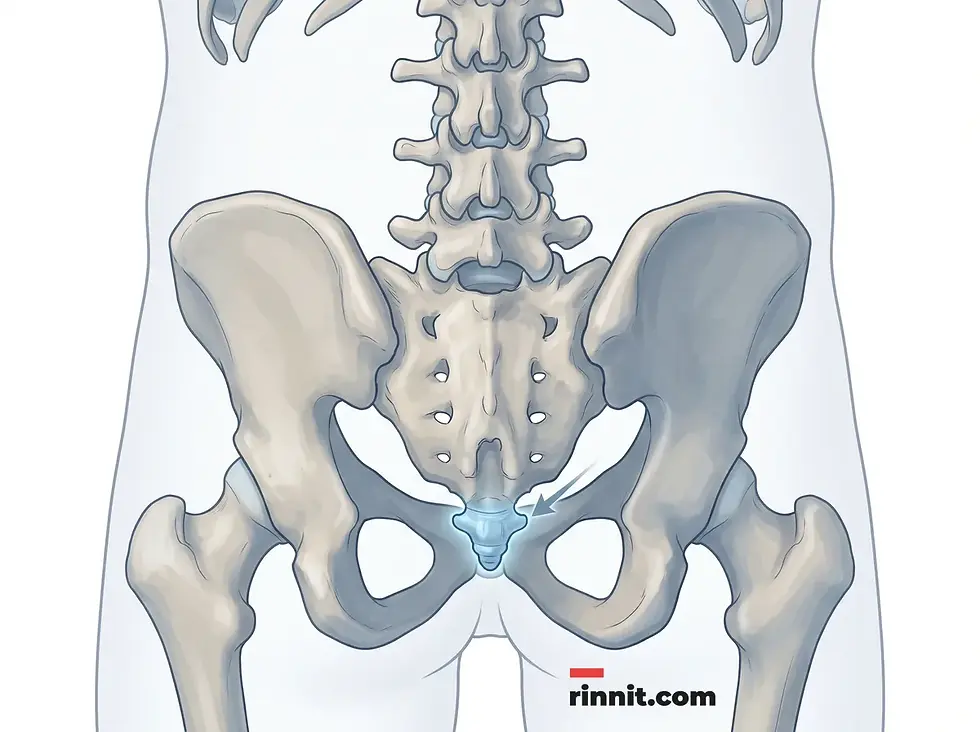
The coccyx is the terminal segment of the vertebral column. It is generally referred to as a single bone, though it is actually a composite of several vertebrae that have fused together over time. Most individuals possess four fused vertebrae in their tailbone, although variations between three and five are considered normal within the human population. [1]
Feature | Description |
|---|---|
Location | The base of the spine, immediately following the sacrum. [1] |
Structure | A curved, triangular bone formed by 3–5 fused vertebrae. |
Origin | An evolutionary vestige or remnant of the tail found in ancestral species. |
Nerve Supply | Connected to several nerves that provide sensation to the pelvic region. [1] |
What mechanical functions does the coccyx (tailbone) perform?
Despite its small stature, the coccyx is a hardworking component of the skeletal system. Its primary role is weight distribution. When you sit down, your body weight is supported by a “tripod” formed by the coccyx and the two ischial tuberosities (the “sit bones”) of the pelvis. This arrangement ensures stability and prevents excessive pressure on any single point of the lower body.
In addition to its supportive role, the tailbone serves as an anchor for several critical muscles and connective tissues. These include the gluteus maximus, which is essential for hip movement, and the levator ani, a key muscle in the pelvic floor that supports internal organs.
Weight Distribution: It works with the pelvis to balance the body while seated.
Muscle Attachment: It provides a stable base for buttock and pelvic floor muscles.
Connective Support: It anchors various tendons and ligaments in the lower torso. [1]
What common tailbone (coccyx) injuries occur, and who is at risk?
The most frequent cause of tailbone pain is direct trauma, typically from a fall where a person lands flat on their buttocks. [1] Such impacts can lead to bone bruises or fractures. [1] Furthermore, repetitive strain from sitting on hard surfaces for extended periods can also cause inflammation and discomfort.
Injury/Condition | Description | Common Symptoms |
|---|---|---|
Bone Fracture | A break in one or more of the fused vertebrae of the coccyx. | Sharp pain when sitting or standing up. |
Bone Bruise | Internal bleeding and inflammation of the bone tissue. | Persistent dull ache and tenderness in the tailbone area. |
Repetitive Strain | Inflammation caused by prolonged pressure or poor posture. | Pain that worsens with long periods of sitting. |
Certain factors can increase the likelihood of developing coccyx issues. For instance, pregnancy and childbirth can put significant pressure on the tailbone, potentially leading to displacement or injury. [1] Additionally, individuals with a higher Body Mass Index (BMI) may experience increased stress on the coccyx during seated activities. [1] [3]

How are coccyx injuries diagnosed, and what does recovery involve?
When tailbone pain persists for more than a few days, medical evaluation is necessary. Healthcare providers use imaging tests such as X-rays, CT scans, or MRIs [1] to visualize the bone and surrounding tissues. They also look for “pain patterns”—how the discomfort changes with different positions or activities—to help identify the specific cause. [1]
Most tailbone injuries heal with conservative care. [4] This often involves resting the area, using specialized cushions to relieve pressure, and taking over-the-counter pain relievers to manage inflammation. While surgery is extremely rare, it may be considered for severe, chronic cases that do not respond to other treatments. [2]
Protecting Your Tailbone
Maintaining a healthy lifestyle can reduce the risk of coccyx injuries. This includes practicing good posture, using ergonomic seating, and engaging in exercises that strengthen the core and pelvic floor. If your discomfort extends into the lower back, our guide to understanding lower back pain explains common causes and solutions.

Conclusion
The coccyx may be a small bone, but its role in supporting our weight and anchoring essential muscles is indispensable. By understanding how it functions and recognizing the risks associated with falls and prolonged sitting, we can better protect this terminal point of our spine. If you experience persistent tailbone pain, seeking professional medical advice is the first step toward a full and comfortable recovery.
Next Steps for Health
If you suffer from tailbone pain, try using a “doughnut” or wedge-shaped cushion when sitting to reduce direct pressure on the coccyx. Avoid sitting on hard surfaces for long periods and practice standing up slowly to minimize sharp pain. For those who play contact sports, ensure you wear appropriate protective gear. If pain radiates to other areas or does not improve within a few days, schedule an appointment with your primary care provider for an imaging assessment.
Frequently Asked Questions
1. What is the coccyx?
The coccyx is the medical term for the tailbone, the final bone at the base of the spinal column.
2. Is the tailbone really a remnant of a tail?
Yes, it is considered a vestigial structure, an evolutionary leftover from when human ancestors had tails.
3. How many bones make up the coccyx?
The coccyx is usually composed of four vertebrae fused together, though some people have three or five.
4. Where exactly is the tailbone located?
The tailbone is at the very bottom of the spine, positioned just below the triangle-shaped sacrum.
5. What does the coccyx do when we sit?
The coccyx acts as one leg of a tripod to help distribute your body weight and maintain balance.
6. Which muscles attach to the tailbone?
Major attachments include the gluteus maximus and the pelvic floor muscles (levator ani).
7. Why does falling on your butt hurt so much?
The coccyx sits very close to the skin with little protective padding, making it sensitive to direct impact.
8. What is coccydynia?
Coccydynia is the medical term for persistent pain in the coccyx or tailbone area.
9. Can sitting for too long damage the tailbone?
Yes, prolonged sitting, especially on hard surfaces, can cause repetitive strain and inflammation.
10. How do doctors test for a broken tailbone?
Doctors typically use imaging tests such as X-rays, CT scans, or MRIs to check for fractures.
11. Does a broken tailbone always need a cast?
No, the tailbone cannot be placed in a cast; treatment usually involves rest and pressure relief.
12. Can pregnancy cause tailbone pain?
Yes, pregnancy and childbirth can strain or injure the coccyx.
13. What is a pain pattern?
A pain pattern is a description of how your pain changes based on your position, the time of day, or your activities.
14. Are there any cancers that affect the coccyx?
While rare, certain cancers like chordoma or metastatic prostate and colon cancer can damage the bone.
15. What is the difference between the sacrum and the coccyx?
The sacrum is a larger, triangle-shaped bone located immediately above the smaller, terminal coccyx.
Related Reading
Coccydynia: Tailbone Pain Causes, Symptoms, Treatment, and Relief explains tailbone pain and the treatments that help.
Pilonidal Cyst: Symptoms, Causes, and Treatment covers painful cysts that form near the tailbone.
Pelvis: Anatomy, Bones, Function, Shapes and Common Conditions describes the pelvic bones that surround the tailbone.
Understanding Your Spine: The Foundation of Movement and Support explains the spinal column that ends at the coccyx.
References
Cleveland Clinic. Coccyx (Tailbone): Anatomy, Function & Common Conditions. Cleveland Clinic. Last updated January 17, 2024. https://my.clevelandclinic.org/health/body/coccyx-tailbone
Andersen GØ, et al. Coccydynia-The Efficacy of Available Treatment Options: A Systematic Review. Global Spine Journal. 2021;12(7):1611-1623. PMID 34927468. https://doi.org/10.1177/21925682211065389
Mazzoleni MG, et al. Management of coccygodynia: talking points from a systematic review of recent clinical trials. Annals of Joint. 2025;10:9. PMID 39981432. https://doi.org/10.21037/aoj-24-40
Choudhary R, et al. Improvement in Pain Following Ganglion Impar Blocks and Radiofrequency Ablation in Coccygodynia Patients: A Systematic Review. Revista Brasileira de Ortopedia. 2021;56(5):558-566. PMID 34733426. https://doi.org/10.1055/s-0041-1735829
Medical disclaimer
This article is for informational purposes only and does not constitute medical advice. Consult a healthcare professional for diagnosis and treatment.



Comments