Tethered Spinal Cord: Symptoms, Causes, Diagnosis, and Treatment

Updated: 2 days ago
Medically reviewed by Dr. Baraa Alnahhal, MD · Last reviewed: October 2026
Quick Answer: What is a tethered spinal cord?
A tethered spinal cord is a condition in which the spinal cord abnormally attaches to the wall of the spinal canal instead of moving freely. This creates tension that can restrict blood flow to spinal nerves and may damage the cord as a child grows. It is often linked with spina bifida, and surgery is the main treatment when needed. [1]
What the research says
In adults, pain is the most common symptom and the one that responds best to surgery. A meta-analysis of 730 adults (97% treated with detethering) found pain in 81%, motor deficits in 63%, sensory deficits in 61%, bladder dysfunction in 56% and bowel dysfunction in 15% before surgery; 81% of patients reported improved pain after detethering (O’Connor et al., World Neurosurg, 2020). [2]
In children, retethering is far more common after complex surgery. In 363 tethered cord release operations in 340 children, secondary retethering requiring repeat surgery occurred in 1.4% of simple cases and 11.9% of complex cases; five-year progression-free survival in complex cases was 62.6% (Pan et al., J Neurosurg Pediatr, 2023). [3]
Untethering looks promising for occult tethered cord, but its indications remain debated. A systematic review of 10 reports (234 patients) found urinary symptoms improved in 59–100% of those affected after filum section, and back or leg pain resolved or improved, yet the authors call surgical indications controversial (Rezaee & Keykhosravi, Br J Neurosurg, 2022). [4]

How does a tethered spinal cord affect the body?
The spinal cord is a thick column of tissue that runs from the base of the skull toward the center of the back. Nerve signals traveling through it help the body move and feel sensations. [1]
Normally, the spinal cord moves freely within the spinal canal. With tethered cord syndrome, an abnormal attachment limits that movement. The resulting tension may stretch the spinal cord, damage it, or restrict blood flow to spinal nerves. [1]
In children, growth can increase the stretch on the spinal cord. This is why symptoms may become more noticeable as a child gets older, even when signs were not obvious at birth. [1]
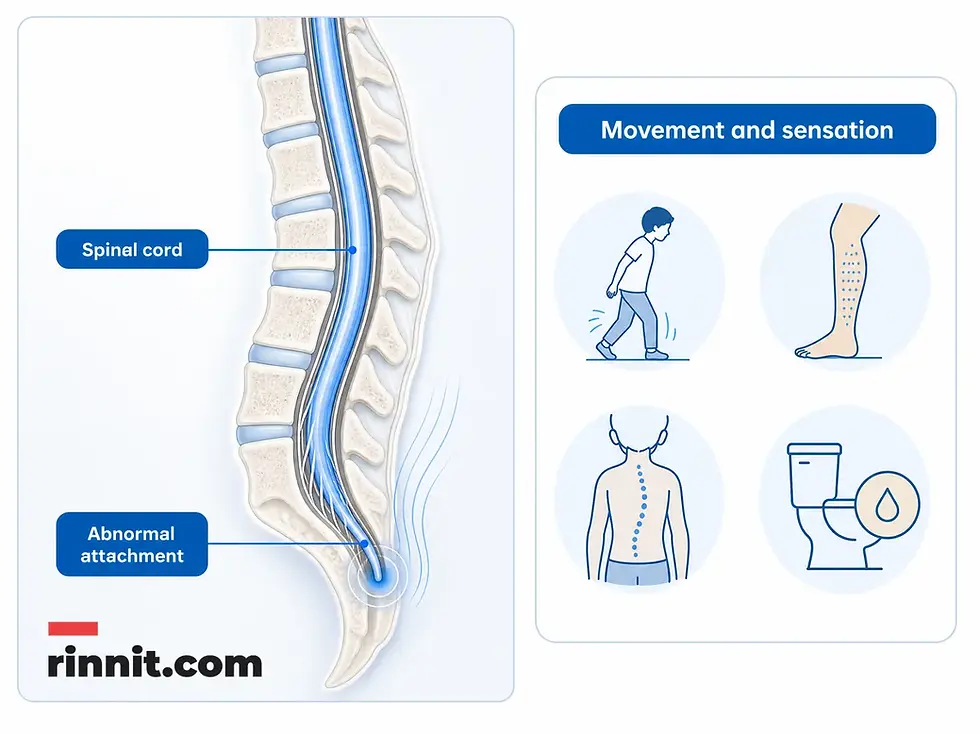
What are the symptoms of tethered spinal cord syndrome?
Symptoms can differ from person to person. Some babies have symptoms at birth. More often, symptoms develop in children as they grow. Rarely, symptoms first appear in adulthood when a tethered cord was not diagnosed earlier. [1]
Possible symptoms in children and adults include:
Possible sign or symptom | How it may appear |
Difficulty walking | Changes in walking ability or movement control. |
Lower-back skin signs | A dimple, benign tumor, patch of hair, discolored skin, hemangioma, or skin tag. |
Numbness | Reduced sensation in the legs or back. |
Leg or back pain | Severe pain that may extend toward the rectum or genital area. |
Scoliosis | A sideways curve of the spine. |
Bladder or bowel-control problems | New or worsening difficulty controlling bladder or bowel function. |
Syringomyelia | A fluid-filled cyst in the spinal cord. |
Muscle atrophy | Loss of muscle mass. |
The presence of one of these signs does not establish a diagnosis. A healthcare provider needs to evaluate the symptoms and, when appropriate, order imaging.
Is a tethered spinal cord present at birth?
Yes, a tethered spinal cord can be present at birth, or it can be acquired later in life. A tethered spinal cord may be congenital, meaning it is present at birth, or acquired later in life. [1]
Congenital causes include an abnormally thick filum terminale, the tissue between the tip of the spinal cord and the sacrum, and spina bifida. Children with spina bifida may have a tethered spinal cord at birth or may develop tethering later.
In more severe spina bifida, such as myelomeningocele, the lower end of the spinal cord and spinal canal may not form completely during fetal development. In less severe spina bifida, such as spina bifida occulta, a lipoma or thickened filum may attach the spinal cord abnormally to the canal wall. [1]
Can surgery for spina bifida lead to tethering?
Yes, surgery for spina bifida can lead to tethering when scar tissue later forms around the spinal cord and reattaches it to the spinal canal. Children with spina bifida often have surgery early in life to close the opening in the spine. Scar tissue may later form around the cord and reattach it to the spinal canal. [1]
As a child grows, that attachment can stretch the spinal cord and contribute to tethered spinal cord syndrome. Symptoms may increase or flare during periods of growth. [1]
A tethered spinal cord can also occur without obvious spina bifida. [1]
What causes an acquired tethered spinal cord?
Acquired tethering develops later rather than being present from birth. Possible causes include:
Acquired cause | How it may contribute |
Scar tissue after spinal cord surgery | Scar tissue can attach the cord to the spinal canal. |
Infection | An infection may contribute to abnormal attachment or scarring. |
Severe spinal trauma | Major injury can alter the tissues around the spinal cord. |
Tumor | A tumor can affect the spinal cord or surrounding structures. |
Some researchers believe genetic factors may make a person more likely to develop spina bifida. A genetic link to tethered cord syndrome itself has not been proven. [1]
Who is most likely to develop tethered cord syndrome?
Tethered spinal cord syndrome occurs most often in people who have had open spina bifida. Some experts estimate that up to 1 in 2 children with a history of myelomeningocele may develop tethered cord syndrome. However, tethering can occur without obvious spina bifida. [1]
Because symptoms may emerge during growth or later in adulthood, a person’s age and current symptoms are important parts of the evaluation.
How is a tethered spinal cord diagnosed?
A neurologist usually diagnoses a tethered spinal cord. The evaluation typically includes a physical examination and questions about symptoms, movement, sensation, and bladder or bowel control.
Imaging tests help show the spinal cord, spinal nerves, spinal canal, and surrounding structures. [1]
Test | What it helps show |
MRI | The spinal cord, nerves, and surrounding structures; it is the most common diagnostic test. |
Myelogram | Whether the spinal cord is tethered to the spinal canal after contrast dye is placed in the thecal sac and X-rays are taken. |
CT scan | How contrast dye flows around the spinal cord, often after a myelogram. |
Ultrasound | How the spinal cord moves within the spinal canal; used most often in young infants. |
The exact tests depend on the person’s age, symptoms, history, and the questions the healthcare team needs to answer.
What is the main treatment?
Surgery is the main treatment for a tethered spinal cord. A neurosurgeon generally performs the procedure. [1]
The surgical approach varies according to factors such as the thickness of the filum terminale, where the cord is tethered, and whether the patient is an adult or child. In general, the surgeon makes an incision in the lower back, gently removes scar tissue when present, and detaches the spinal cord from the spinal canal.

What happens after tethered spinal cord surgery?
Light activities can usually resume shortly after surgery, but strenuous activity must be avoided while the area heals. This restriction is typically at least six to eight weeks, although the surgeon’s instructions determine the appropriate timeline. [1]
Some people need physical or occupational therapy to help regain function. Surgery is intended to prevent ongoing injury to nerves, but it is unlikely to reverse nerve damage that has already occurred. [1]
As a result, some people may continue to have muscle weakness or motor-control problems after treatment. [1]
Will a tethered spinal cord need more than one surgery?
Most people need only one surgery. However, up to 1 in 5 children may need more than one surgery. Repeat surgery may be needed if symptoms return or increase after a significant growth spurt. [1]
Children ages 7 to 12 have the highest risk of needing repeat surgery. Follow-up care helps the healthcare team watch for changes in symptoms and function. [1]
What is the outlook?
People who receive treatment for a tethered spinal cord typically live a normal lifespan. Earlier treatment is associated with a better chance of full recovery. [1]
Some symptoms, especially motor-control problems, numbness, or weakness, may not go away. Persistent symptoms are more likely when surgery occurs later in life or when nerve damage was already present. [1]
The outlook is individual. It depends on the symptoms, the degree and location of tethering, the timing of treatment, and whether symptoms recur during growth.
Can tethered spinal cord syndrome be prevented?
Tethered spinal cords are not preventable. Prompt evaluation and treatment can increase the chance of reversing symptoms. [1]
See a healthcare provider promptly if you or your child develops possible symptoms, such as walking difficulty, numbness, severe back or leg pain, new bladder or bowel-control problems, scoliosis, or a noticeable lower-back skin finding.
What questions should you ask a healthcare provider about a tethered spinal cord?
Useful questions about a tethered spinal cord include its early signs, which tests diagnose it, which treatments fit and whether symptoms could return.
What are the early signs of tethered spinal cord?
Which tests can diagnose it?
What treatment options are appropriate?
Could symptoms return after treatment?
What activity restrictions should follow surgery?
Could physical or occupational therapy help?
Conclusion: Living with a tethered spinal cord
A tethered spinal cord occurs when the spinal cord abnormally attaches to the spinal canal. The attachment can create tension, stretch the cord, and affect nerve function, especially as a child grows. [1]
Symptoms may include walking difficulty, lower-back skin signs, numbness, pain, scoliosis, bladder or bowel-control problems, syringomyelia, or muscle loss. MRI is the most common diagnostic test, and surgery is the main treatment when tethering is causing symptoms or ongoing nerve risk. [1]
Prompt evaluation can improve the chance of reversing symptoms. Recovery may include activity restrictions and physical or occupational therapy, while some existing weakness, numbness, or motor-control problems may persist. [1]
Frequently Asked Questions
What is tethered cord syndrome?
Tethered cord syndrome is another name for a tethered spinal cord. It occurs when the spinal cord abnormally attaches to the spinal canal, limiting movement and creating tension.
Can adults have a tethered spinal cord?
Yes. Symptoms most often develop during childhood growth, but adults may develop symptoms if the condition was not diagnosed earlier.
Is a tethered spinal cord the same as spina bifida?
No. They are different conditions, although tethered spinal cord can occur with spina bifida. A person can also have a tethered spinal cord without obvious spina bifida.
What are the first signs of tethered spinal cord in a child?
Possible signs include difficulty walking, numbness, leg or back pain, scoliosis, bladder or bowel-control problems, or a lower-back dimple, patch of hair, discolored patch, hemangioma, benign tumor, or skin tag.
Is MRI used to diagnose tethered spinal cord?
Yes. MRI is the most common test used to diagnose tethered spinal cord because it shows the spinal cord, nerves, and surrounding structures.
Is surgery always needed?
Surgery is the main treatment, but the need for surgery depends on symptoms, the location and nature of the tethering, and the risk of ongoing nerve injury. A neurosurgeon evaluates the situation.
How long is recovery after tethered cord surgery?
Light activity can typically resume soon after surgery, but strenuous activity is usually restricted for at least six to eight weeks or according to the surgeon’s instructions.
Can symptoms remain after surgery?
Yes. Surgery is intended to prevent continuing nerve injury, but it may not reverse damage that has already occurred. Weakness or motor-control problems may continue.
Can tethered cord symptoms come back?
Tethered cord symptoms can. Most people need only one surgery, but some children may need repeat surgery if symptoms return or increase after significant growth.
Can tethered spinal cord be prevented?
No. Tethered spinal cords are not preventable, but prompt evaluation and treatment can improve the chance of reversing symptoms.
When should I seek medical care?
Contact a healthcare provider promptly for possible symptoms such as walking difficulty, numbness, severe back or leg pain, scoliosis, lower-back skin changes, or new bladder or bowel-control problems.
Related Reading
Myelomeningocele: Causes, Diagnosis, Treatment and Long-Term Care explains the severe form of spina bifida often linked with tethering.
Neurogenic Bladder: Causes, Symptoms, and Management explains bladder problems caused by nerve damage and how they are managed.
Chiari Malformation: Types, Symptoms, Causes, Diagnosis & Treatment Guide covers a brain and spine condition that can occur with spina bifida.
MRI (Magnetic Resonance Imaging): Uses, What to Expect, Safety and Results explains how MRI scans create detailed images of the spine.
References
Cleveland Clinic. Tethered Spinal Cord. Cleveland Clinic. Last updated March 2, 2023. https://my.clevelandclinic.org/health/diseases/24672-tethered-spinal-cord
O’Connor KP, Smitherman AD, Milton CK, et al. Surgical treatment of tethered cord syndrome in adults: a systematic review and meta-analysis. World Neurosurg. 2020;137:e221-e241. PMID 32001403. https://doi.org/10.1016/j.wneu.2020.01.131
Pan J, Boop SH, Barber JK, et al. Perioperative complications and secondary retethering after pediatric tethered cord release surgery. J Neurosurg Pediatr. 2023;32(5):607-616. PMID 37728397. https://doi.org/10.3171/2023.6.PEDS23259
Rezaee H, Keykhosravi E. Effect of untethering on occult tethered cord syndrome: a systematic review. Br J Neurosurg. 2022;36(5):574-582. PMID 34709093. https://doi.org/10.1080/02688697.2021.1995589
Disclaimer
This article is for general educational purposes and is not a substitute for professional medical advice, diagnosis or treatment. Always seek the advice of a qualified health provider with any questions you may have regarding a medical condition.
It is not a diagnosis, emergency protocol, prescription or personal treatment plan. A qualified healthcare professional should evaluate individual symptoms, imaging findings, treatment decisions and recovery questions. Do not delay care when new neurological, bladder, bowel, walking or sensation changes appear.



Comments