Testicular Trauma: Symptoms, Treatment and When to Get Help

Updated: 2 days ago
Medically reviewed by Dr. Baraa Alnahhal, MD · Last reviewed: October 2026
Important: This article is educational and does not diagnose an injury. If the severity is uncertain, seek emergency medical evaluation. Severe pain or swelling, an open injury, trouble urinating, fever or worsening symptoms should not be ignored.
Quick Answer: What is testicular trauma?
Testicular trauma is an injury to one or both testicles, ranging from a bruise to a severe injury that may affect the testicle's covering, position, blood flow or function. Most bruises recover, but severe pain, swelling, an open wound, urinary symptoms or uncertain severity should be assessed urgently. [1]
Question | Short answer |
What is a contusion? | A bruised testicle, sometimes with a hematoma (blood pooled beneath tissues). |
Who is at higher risk? | People who ride motorcycles or play contact sports. |
How is it checked? | Questions about the injury, a physical exam and often a painless testicular ultrasound. |
How is a mild injury treated? | Rest, ice, over-the-counter pain relievers, scrotal support and prescribed antibiotics if needed. |
When is it an emergency? | Any question about severity, an injury through the scrotum, severe swelling with pain and bruising, fever, worsening pain, urinary trouble or blood in the urine that does not stop. |
What the research says
Testicular and scrotal trauma is rare, but nearly half of hospitalized patients needed an operation. An analysis of the US National Trauma Data Bank (2007–2015) identified 8,030 adult male patients (0.23%) with scrotal or testicular injury. A penetrating mechanism occurred in 50.5% of cases and blunt trauma in 44.6%; 74.5% had isolated scrotal or testicular trauma, and 48.3% required a scrotal or testicular operation. Motorcycle collisions carried a higher risk than bicycle collisions for scrotal or testicular trauma (odds ratio 5.40, 95% CI 4.40–6.61) and for subsequent surgery (odds ratio 4.93, 95% CI 3.82–6.36). Because this database covers trauma-center patients, it over-represents severe injuries (Grigorian et al., Res Rep Urol, 2018). [2]
Ultrasound is the first-line test, and surgery is considered when rupture is definite or suspected. A literature review of testicular rupture after blunt scrotal trauma, one of the most common complications of blunt scrotal injury, found that after history and physical examination scrotal ultrasound is the first-line auxiliary examination, MRI can add information, and surgical exploration and repair may be necessary when rupture is definite or suspicious. It also highlights follow-up to monitor symptoms and testicular function after treatment (Wang et al., Int Urol Nephrol, 2016). [3]

What is a testicular contusion?
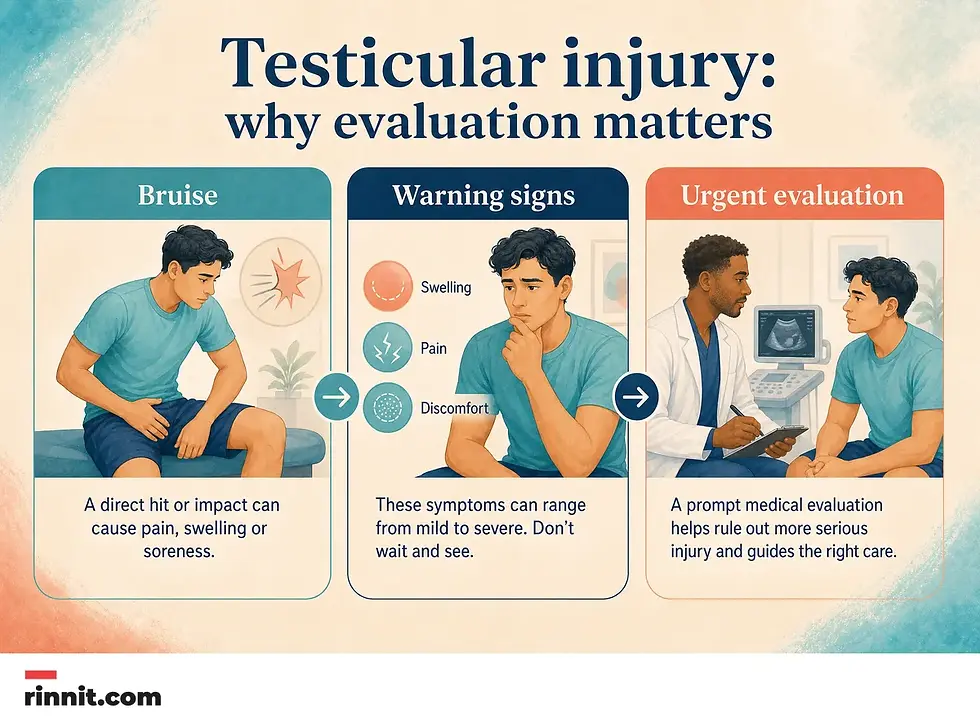
A testicular contusion is a bruised testicle. The testicles hang outside the body in a pouch-like structure called the scrotum. The scrotum covers them, but it does not contain muscles or bones that can protect them from impact. [1]
A testicle may absorb the force of an injury without serious damage. In other cases, the injury can cause a hematoma, which is a buildup of blood beneath tissues. [1]
What problems can testicular trauma cause?
In addition to bruising, an injury can cause twisting of the spermatic cord, tearing of the protective covering around the testicle, skin coming off the testicle, movement out of position or detachment of a testicle. Trauma can also interfere with the testicles' ability to make sperm and hormones or block blood flow. [1]
Possible injury | Why it matters |
Contusion or bruise | May cause pain, bruising and swelling. |
Hematoma | Blood can pool beneath tissues. |
Spermatic-cord twisting (torsion) | Can affect the testicle's blood supply. |
Rupture | The protective covering can tear. |
Displacement or detachment | The testicle may move out of position or detach. |
Skin loss | A large amount of skin may be removed in a severe injury. |
What are the symptoms of testicular trauma?
Symptoms may include severe pain in the scrotum, visible bruising or discoloration, swelling, lower-belly pain or discomfort, nausea or vomiting, fever, blood in the urine and pain while urinating. [1]
Symptoms alone cannot show how serious an injury is. A person should contact a healthcare provider after a testicular injury, particularly when pain or swelling is severe or symptoms are worsening.
Symptom | What to know |
Severe scrotal pain | May occur with a bruise or a more serious injury. |
Bruising or discoloration | Can be visible on the scrotum. |
Swelling | May be mild or severe. |
Lower-belly discomfort | Can accompany a testicle injury. |
Nausea or vomiting | May occur after trauma. |
Fever | Needs medical attention after an injury. |
Blood in urine or painful urination | Requires provider assessment. |
What causes testicular trauma?
Testicular trauma can result from blunt force, such as a kick, punch or thrown object. Baseballs are one example. Car, motorcycle and bicycle accidents, machinery accidents, animal bites, knives and bullets are other possible causes. These events can cause minor problems such as scraped skin or major problems such as a tear in the protective covering around the testicle and blood pooling beneath tissues. [1]
Who is at risk?
A testicular bruise can affect anyone who has at least one testicle. The risk is higher for people who ride motorcycles or play contact sports. One way to reduce risk during contact sports is to wear an athletic supporter. Safety while driving, riding a bicycle or motorcycle and operating machinery can also reduce the chance of injury.
What complications can occur?
Complication | Description |
Infection | Infection can develop after an injury. |
Inflammation | Injured tissue may become inflamed. |
Infertility | Trauma can affect reproductive function. |
Low testosterone | Trauma can affect hormone production. |
Urologic problems | Injury can lead to urinary or other urologic concerns. |
Short-term sexual-performance issues | Some injuries can affect sexual performance temporarily. |
How is testicular trauma diagnosed?
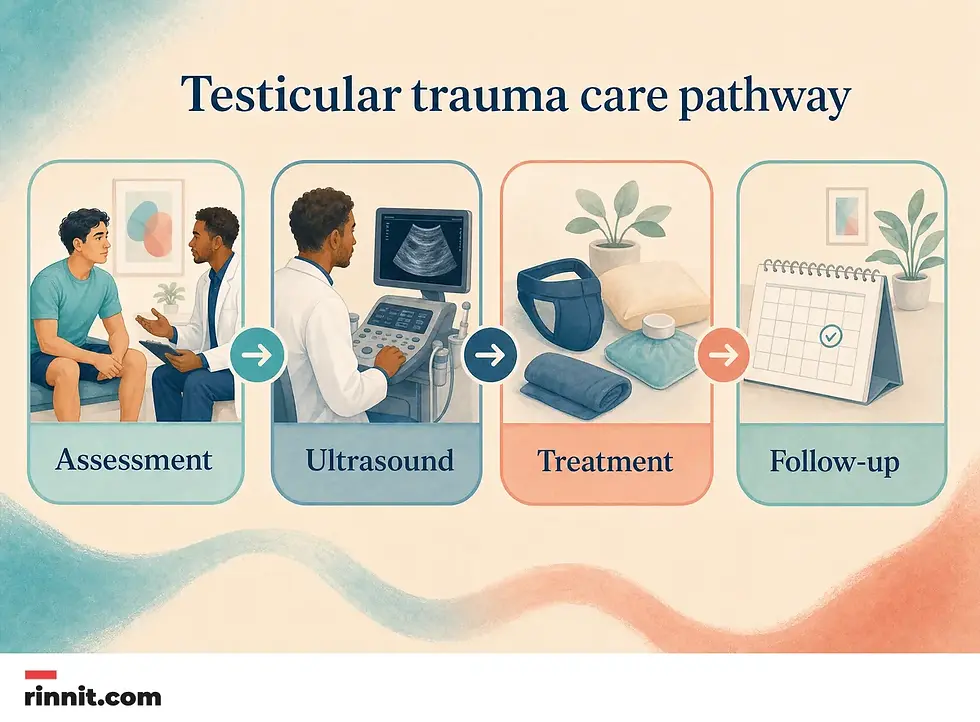
A healthcare provider will ask how the injury happened and perform a physical examination to assess whether the testicle and nearby structures look and feel normal. [1]
A provider may order a testicular ultrasound, a painless test that creates a picture of what is happening inside the scrotum. A reassuring ultrasound makes a serious injury less likely, while a tear, displacement or lack of blood flow is concerning. In severe cases, or when a person is not improving after 48 hours, surgery may be needed to diagnose the injury. [1]
Evaluation step | What it helps assess |
Questions about the event | How the force or injury occurred. |
Physical exam | Whether the testicle and nearby structures look and feel normal. |
Testicular ultrasound | What is happening inside the scrotum, including possible tearing, displacement or blood-flow problems. |
Surgery in selected cases | Diagnosis of severe injury or injury not improving after 48 hours. |
How is testicular trauma treated?
For a mild testicular bruise, a healthcare provider may recommend rest, over-the-counter pain relievers, ice, scrotal support and prescribed antibiotics if needed. Follow the provider's instructions rather than assuming an injury is mild. [1]
Some injuries need immediate treatment, including injuries that go through the scrotum and testicles, remove a large amount of skin or show signs of twisting or blocked blood flow. Surgery may repair or reattach the testicle. Rarely, a damaged testicle may need to be removed, a procedure called an orchiectomy. If one or both testicles must be removed, a provider may suggest sperm banking. [1]
Treatment situation | What may be done |
Mild bruise | Rest, over-the-counter pain relievers, ice, scrotal support and prescribed antibiotics if needed. |
Open or severe injury | Immediate treatment may be needed. |
Twisting or blocked blood flow | Immediate treatment may be needed. |
Damaged testicle | Surgery may repair or reattach it; rarely, removal may be necessary. |
Possible loss of one or both testicles | Sperm banking may be suggested. |
How long does recovery take?
For a mild injury, a person should rest for 24 to 48 hours. Contact a provider if symptoms worsen or there is no improvement after 48 hours. Swelling after a more severe injury or surgery may last up to eight weeks. After a testicular contusion, a follow-up visit is likely in one or two weeks. [1]
Recovery point | Guidance |
Mild injury | Rest for 24 to 48 hours. |
No improvement or worsening | See a healthcare provider. |
More severe injury or surgery | Swelling may last up to eight weeks. |
Follow-up | Often one or two weeks after a contusion. |
When is a testicular injury an emergency?
If there is any question about the severity of a testicular injury, go to the nearest emergency department. Seek medical care for an injury that goes through the scrotum, severe testicular swelling with pain and bruising, fever after an injury, pain that does not stop or gets worse, blood in the urine that does not stop or gets worse, trouble urinating or any symptom that worries you.
Do not wait to see whether a potentially serious injury improves when there is severe pain, major swelling, an open wound, urinary difficulty or uncertainty about severity.
What questions should you ask a healthcare provider about testicular trauma?
Question | Why it can help |
How bad is this injury? | Clarifies the suspected severity. |
Will I need surgery? | Helps explain the treatment plan. |
How soon would surgery take place? | Clarifies timing when surgery is considered. |
When can I play sports again? | Helps guide a safe return to activity. |
Conclusion: Prompt evaluation protects options
Testicular trauma can be a mild bruise or a serious injury involving the protective covering, position, blood flow or tissue function. A healthcare provider may use an examination and testicular ultrasound to assess the injury. Mild bruises may improve with rest, ice, pain relievers and scrotal support as directed, while open injuries, severe swelling, twisting, blocked blood flow, urinary symptoms, fever, worsening pain or uncertain severity need prompt or emergency assessment. [1]
After any testicular injury, contact a qualified healthcare provider. If the injury may be severe or you are unsure how serious it is, go to the nearest emergency department. [1]
Frequently Asked Questions
Is a bruised testicle serious?
Many testicular injuries are mild and most people with testicular bruising recover. However, a bruise can occur alongside a more serious injury, so severe symptoms, worsening symptoms or uncertainty about severity warrant medical evaluation.
How do I know if a testicle injury needs urgent care?
Seek emergency care if the injury goes through the scrotum, causes severe swelling with pain and bruising, involves uncertain severity, or is followed by worsening pain, fever, persistent or worsening blood in the urine or trouble urinating.
What does a testicular ultrasound show?
A testicular ultrasound is a painless way to create a picture of what is happening inside the scrotum. It can help a provider look for a tear, displacement or lack of blood flow.
What should I do for a mild testicular bruise?
A provider may recommend rest, over-the-counter pain relievers, ice, scrotal support and prescribed antibiotics if needed. Rest for 24 to 48 hours and contact a provider if symptoms worsen or do not improve after 48 hours.
Can testicular trauma affect fertility or hormones?
Yes. Complications can include infertility and low testosterone because trauma can interfere with the testicles' ability to make sperm and hormones.
Can a testicle be repaired after an injury?
A provider may perform surgery to repair or reattach a damaged testicle. Rarely, a damaged testicle may need to be removed. Sperm banking may be suggested if one or both testicles must be removed.
How long can swelling last after testicular trauma?
Swelling from a more severe injury or surgery may last up to eight weeks. A follow-up visit is likely one or two weeks after a testicular contusion.
When can I play sports again?
Ask your healthcare provider when it is safe to return to sports. Timing depends on the injury and recovery.
How can I reduce the risk of testicular trauma?
Wearing an athletic supporter during contact sports and using care while driving, biking, riding motorcycles or operating machinery can reduce risk.
Can a hit to the testicles cause testicular torsion?
Yes. An injury can sometimes twist the spermatic cord and cut off the testicle's blood supply. Sudden, severe scrotal pain after an injury needs emergency care right away, because torsion is time-sensitive.
Related Reading
Ruptured Testicle: Emergency Symptoms, Causes, and Treatment explains the signs of a ruptured testicle and emergency repair.
Testicular Torsion: Symptoms, Causes, Diagnosis and Treatment — What You Need to Know explains why a twisted testicle needs emergency treatment.
Testicular Ultrasound: Checking Lumps, Pain and Swelling describes the painless scan used to check an injured testicle.
Orchiectomy: A Comprehensive Guide to Testicle Removal Surgery explains when and how a damaged testicle is surgically removed.
References
Cleveland Clinic. Testicular Contusion: Causes, Symptoms, Risks & Treatment. Cleveland Clinic. Updated August 21, 2025. https://my.clevelandclinic.org/health/diseases/22814-testicular-trauma
Grigorian A, Livingston JK, Schubl SD, et al. National analysis of testicular and scrotal trauma in the USA. Res Rep Urol. 2018;10:51-56. PMID 30128306. https://doi.org/10.2147/RRU.S172848
Wang Z, Yang JR, Huang YM, et al. Diagnosis and management of testicular rupture after blunt scrotal trauma: a literature review. Int Urol Nephrol. 2016;48(12):1967-1976. PMID 27567912. https://doi.org/10.1007/s11255-016-1402-0
Medical disclaimer
This article is for general educational purposes and is not a substitute for professional medical advice, diagnosis or treatment. Always seek the advice of a qualified healthcare professional with any questions about a medical condition or treatment.



Comments