Ruptured Testicle: Emergency Symptoms, Causes, and Treatment

Updated: 2 days ago
Medically reviewed by Dr. Baraa Alnahhal, MD · Last reviewed: October 2026
A ruptured testicle is a critical medical emergency occurring when the protective membrane surrounding the organ breaks due to significant force or penetrating trauma. [1] Unlike minor groin injuries, the severe pain and swelling associated with a rupture do not subside with rest. Prompt surgical intervention is essential to repair the damage and preserve reproductive function, though one healthy testicle is typically sufficient for fertility. [1]
Quick Answer
Testicular rupture occurs when a force of 50 pounds or more, or a penetrating wound, breaks the tunica albuginea, the membrane covering the testicle. [1] This allows the internal sperm-producing structures to protrude. [1] Symptoms include intense pain, bruising, and nausea. [1] Diagnosis requires an ultrasound, and most cases necessitate emergency surgery. [1] Early treatment improves the likelihood of a full recovery. [1]
What the research says
Ultrasound is the first-line test and was highly sensitive for rupture after blunt trauma, but it does not always show the tear itself. In 33 patients who had surgical exploration after blunt scrotal trauma (16 with a testis rupture), ultrasound raised suspicion of rupture in every ruptured testis (sensitivity 100%, specificity 65%), but the tunica albuginea breach itself was visible in only 8 patients (Guichard et al., Urology, 2008) [2].
After a scrotal gunshot wound, a negative ultrasound should not rule out rupture. Among 75 patients with scrotal gunshot wounds who had ultrasound before exploration, surgery found 40 testicular ruptures in 35 patients, of which 30 testicles were salvaged and 10 needed orchiectomy; ultrasound sensitivity was only 60% (specificity 95%), with 16 missed injuries (Powers et al., The Journal of Urology, 2018) [3].
Imaging guides care, but surgical exploration is advised when rupture is definite or suspected. A review of 16 years of literature on testicular rupture after blunt scrotal trauma concluded that scrotal ultrasound is the first-line examination, MRI is a vital complementary test, and surgical exploration and repair may be necessary when the diagnosis is definite or suspicious (Wang et al., International Urology and Nephrology, 2016) [4].
What are the emergency symptoms of a ruptured testicle?
A ruptured testicle is fundamentally different from the common, temporary pain of a minor hit to the groin. In a rupture, the tunica albuginea, the tough, fibrous covering of the testicle, is breached, often leading to internal bleeding and the displacement of seminiferous tubules. [1] [4] This injury is a medical emergency that requires rapid clinical assessment to prevent long-term complications or the loss of the organ.
The primary indicator of a rupture is severe, persistent pain that does not improve with ice or rest. Patients often experience significant swelling and bruising of the scrotum, accompanied by systemic symptoms like nausea and vomiting. [1] In some cases, the trauma may also cause lower abdominal pain or visible blood in the urine. [1] If these symptoms follow an impact or injury, immediate emergency care is necessary.
Symptom Category | Clinical Indicators | Warning Signs |
|---|---|---|
Local Pain | Intense, sharp, or throbbing testicular pain. | Pain that persists or worsens over time. |
Physical Changes | Scrotal swelling; dark bruising or hematoma. | Visible deformity or extreme tenderness. |
Systemic Response | Nausea; vomiting; fever following the injury. | Lower abdominal discomfort. |
Urinary Signs | Hematuria (blood in urine); dysuria (painful peeing). | Inability to urinate normally. |
How does a ruptured testicle injury happen, and what are common causes?
Testicular rupture typically requires a substantial amount of force, estimated at 50 pounds or more, to break the protective membrane. [1] This often occurs when the testicle is suddenly crushed against the hard bones of the pelvis. [1] While the scrotum is flexible, the lack of muscle or bone for direct protection makes the testicles vulnerable to high-impact trauma. [1]
Injuries are categorized as either blunt force or penetrating. Blunt force trauma is frequently seen in contact sports, such as being hit by a high-speed ball or puck, or resulting from kicks, falls, and vehicle crashes. [1] Penetrating injuries, though less common, include bites, gunshot wounds, or stabs. [1] Adolescents and young adults participating in sports are statistically at the highest risk for these types of traumatic injuries.

How is a ruptured testicle diagnosed and told apart from other conditions?
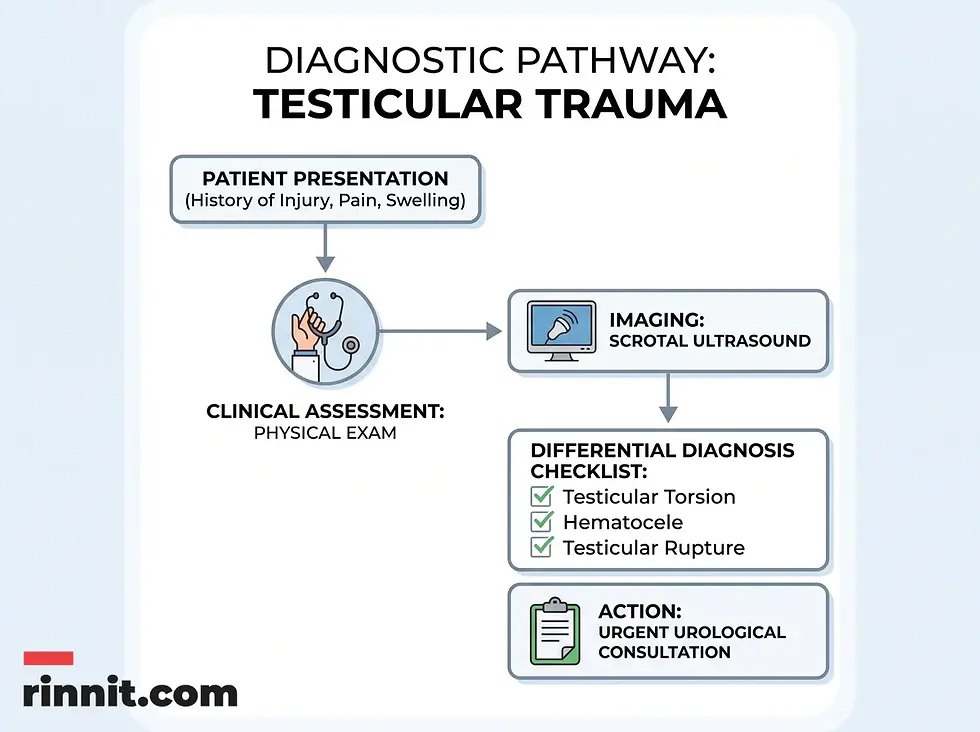
When a patient presents with suspected testicular trauma, healthcare providers must distinguish a rupture from other serious conditions that can mimic its symptoms. Testicular torsion (the twisting of the spermatic cord), infections, or a hematocele (a collection of blood in the scrotal sac) [1] all require different clinical approaches. A physical exam and a detailed history of the injury are the first steps in the diagnostic process.
Imaging helps confirm a suspected rupture, but surgery is sometimes the only way to be sure. An ultrasound is typically the first-line tool [4] used to visualize the integrity of the testicular membrane and assess blood flow. In more complex cases, an MRI may be utilized. [1] [4] Additionally, urinalysis is often performed [1] to check for signs of infection or internal bleeding that could indicate damage to the surrounding urinary structures.
How is a ruptured testicle treated with surgery, and what is recovery like?
The majority of ruptured testicles require emergency surgery [1] to ensure the best possible outcome. The goals of the procedure are to control internal bleeding, remove any non-viable tissue, and carefully suture the tears in the tunica albuginea. [1] In instances where the damage is too extensive to repair, a surgeon may need to perform an orchiectomy, which is the complete removal of the affected testicle. [1]
Recovery from surgery typically spans several weeks to two months. [1] During the initial healing phase, patients are advised to manage pain with nonsteroidal anti-inflammatory drugs (NSAIDs) and wear supportive garments like a jockstrap. [1] It is critical to avoid strenuous physical activity, contact sports, and sexual activity for several weeks [1] to allow the dissolvable stitches to heal and the swelling to subside.

Frequently Asked Questions
Can a ruptured testicle heal on its own?
No, a rupture is a medical emergency that almost always requires surgery to repair the torn membrane and prevent permanent damage.
Will I become infertile if I lose one testicle?
Not usually. One healthy testicle is typically sufficient to produce enough sperm and testosterone for normal fertility and sexual function.
How much force does it take to rupture a testicle?
It generally takes a force of 50 pounds or more, or a penetrating injury, to break the tunica albuginea.
What is the tunica albuginea?
The tunica albuginea is the tough, fibrous membrane that covers and protects the internal structures of the testicle.
Is blood in the urine a sign of a rupture?
Yes, hematuria (blood in the urine) can occur following significant testicular trauma and should be evaluated by a doctor.
How long is the recovery after surgery?
Full recovery can take several weeks to two months, depending on the severity of the injury and the type of surgery performed.
Can sports protective gear prevent a rupture?
Yes, wearing a properly fitted athletic cup and jockstrap significantly reduces the risk of rupture during high-impact sports.
What is an orchiectomy?
An orchiectomy is the surgical removal of a testicle, which may be necessary if the organ is too severely damaged to be repaired.
Is a ruptured testicle the same as a bruised testicle?
No. A bruise is a minor injury to the blood vessels, while a rupture is a physical break in the protective membrane of the organ.
When can I return to sports after a rupture?
You must wait several weeks and receive clearance from a urologist, as returning too early can risk re-injury during the healing process.
Related Reading
Testicular Trauma: Symptoms, Treatment and When to Get Help explains the range of testicle injuries and when to seek care.
Testicular Ultrasound: Checking Lumps, Pain and Swelling describes the imaging test used to check an injured testicle.
Testicular Torsion: Symptoms, Causes, Diagnosis and Treatment — What You Need to Know explains another testicle emergency that needs fast surgery.
Orchiectomy: A Comprehensive Guide to Testicle Removal Surgery explains surgery to remove a testicle that cannot be saved.
References
Cleveland Clinic. Ruptured Testicle. Cleveland Clinic. October 15, 2025. https://my.clevelandclinic.org/health/diseases/23245-ruptured-testicle
Guichard G, El Ammari J, Del Coro C, et al. Accuracy of ultrasonography in diagnosis of testicular rupture after blunt scrotal trauma. Urology. 2008;71(1):52-56. PMID 18242364. https://doi.org/10.1016/j.urology.2007.09.014
Powers R, Hurley S, Park E, et al. Usefulness of preoperative ultrasound for the evaluation of testicular rupture in the setting of scrotal gunshot wounds. The Journal of Urology. 2018;199(6):1546-1551. PMID 29391177. https://doi.org/10.1016/j.juro.2018.01.076
Wang Z, Yang JR, Huang YM, et al. Diagnosis and management of testicular rupture after blunt scrotal trauma: a literature review. International Urology and Nephrology. 2016;48(12):1967-1976. PMID 27567912. https://doi.org/10.1007/s11255-016-1402-0
Medical disclaimer
The information provided in this article is for educational purposes only and should not be used as a substitute for professional medical advice, diagnosis, or treatment. Always seek the advice of your physician or other qualified health provider with any questions you may have regarding a medical condition.



Comments