Tarsal Coalition: Symptoms, Causes, Treatment, Surgery, and Recovery

Updated: 3 days ago
Medically reviewed by Dr. Baraa Alnahhal, MD · Last reviewed: October 2026
Quick Answer: What is a tarsal coalition?
A tarsal coalition is an abnormal connection of bone, cartilage or fibrous tissue between two or more tarsal bones in the back of the foot. It usually develops before birth and affects children or teens. Some people have no symptoms, while others have foot pain, stiffness or flat feet. Diagnosis uses imaging, and treatment is considered only when symptoms occur. [4]
What the research says
About 1 in 17 people in a CT-based study had a coalition, and over half had it in both feet. Among 839 patients who had CT of both feet and ankles, overall prevalence was 6.0%, talocalcaneal coalition was the most common type, and bilateral occurrence was 56.5%. The study was retrospective and in a single East Asian hospital population (Park et al., Scientific Reports, 2022). [1]
Surgery improved outcomes in about three-quarters of cases, with few complications. A systematic review of 25 studies (760 coalitions, weighted average follow-up 44 months) found good, excellent or improved patient-reported outcomes in 77.8% of surgically treated coalitions; open resection with material interposition had a clinical success rate of 78.8%, and complications occurred in 4.96%. The evidence was retrospective case series with a high risk of bias (Polt et al., Archives of Orthopaedic and Trauma Surgery, 2023). [2]
In adults, conservative care alone had limited impact on outcomes in the studies reviewed. A systematic review of talocalcaneal coalition resection in 72 adults reported that a trial of conservative management or a rehabilitation regimen had a limited impact on overall outcome, with better scores for endoscopic resection or interposition of a tendon; the authors note a shortage of high-quality literature (Dermanis et al., Cureus, 2022). [3]

Where is a tarsal coalition located?
The tarsal bones sit toward the back of the foot, near the arch, heel, and ankle. They work together to support normal foot function. A tarsal coalition occurs when two or more of these bones are connected abnormally. [4]
The connection can involve bone, cartilage, or fibrous tissue growing across a foot joint. The most common types involve the talus and calcaneus or the calcaneus and navicular. Other types are less common. [4]
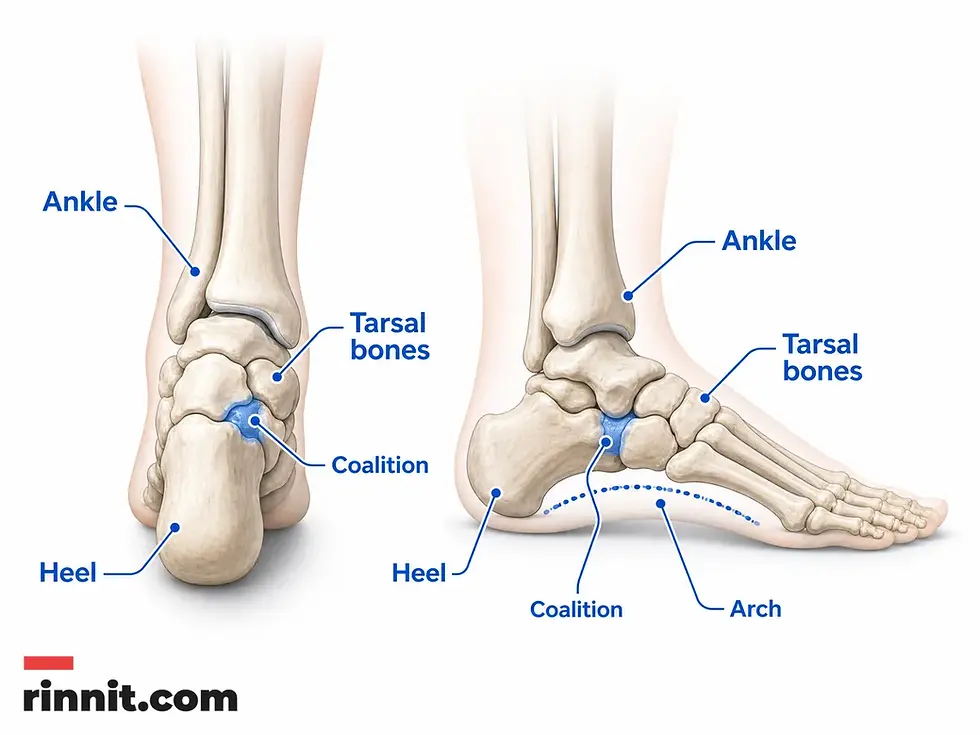
Foot area | Role in understanding tarsal coalition |
Ankle | The coalition is located in the rear-foot region below or near the ankle. |
Heel | The heel is formed in part by the calcaneus, one of the bones commonly involved. |
Arch | Changes in foot movement or flat feet can affect walking and activity. |
Tarsal bones | These bones work together for proper foot function. |
Coalition | The abnormal connection may be bone, cartilage, or fibrous tissue. |
Is tarsal coalition genetic?
Most cases are caused by genetic factors. The coalition usually develops when the foot bones form improperly during fetal development. Symptoms may not become apparent until the bones and joints are more stressed during late childhood, adolescence, or adulthood.
Adults can also develop a tarsal coalition after trauma, arthritis in the joints, or infection.
Possible origin | What it means |
Genetic or developmental | Most coalitions form before birth as the foot bones develop improperly. |
Trauma | An injury may contribute to a coalition in adulthood. |
Arthritis | Joint arthritis may be associated with adult-onset cases. |
Infection | Infection is another possible adult cause. |
Who does tarsal coalition affect?
Tarsal coalition generally affects children and teenagers. Symptoms commonly begin between ages 9 and 16, although the age of onset can vary widely. Some people do not notice symptoms until adulthood.
A tarsal coalition can affect one foot or both. Approximately half of people with the condition have issues with both feet, which is called bilateral tarsal coalition. [4]
How common is tarsal coalition?
Tarsal coalition affects about 1% to 6% of the population. Many cases are never diagnosed because they do not cause visible foot deformity or painful symptoms.
Frequency detail | What it tells you |
Overall occurrence | About 1% to 6% of the population is affected. |
Both feet | About half of affected people have issues with both feet. |
Undiagnosed cases | Some coalitions cause no symptoms and are never identified. |
What are the symptoms of tarsal coalition?
Symptoms range from occasional aches and pains to walking difficulty and other functional problems. Symptoms depend on the type and location of the coalition and may not appear until late childhood, adolescence, or adulthood.
Common symptoms include pain or stiffness below the ankle, around the middle or back of the foot. Pain may increase with higher levels of activity. Some people notice symptoms after a minor foot or ankle injury. [4]
Flat feet may contribute to walking difficulty and can increase the risk of ankle sprains.
Symptom or finding | How it may appear |
Pain | Aching or pain below the ankle or around the middle or back of the foot. |
Stiffness | Reduced flexibility or a stiff feeling in the rear or middle foot. |
Flat feet | The foot may appear flatter and walking may become more difficult. |
Activity-related pain | Symptoms may increase as activity levels rise. |
After-injury symptoms | Pain or other symptoms may begin after a minor foot or ankle injury. |
Walking difficulty | Pain, stiffness, or flat feet may affect function. |
Why can symptoms appear later?
A tarsal coalition may exist for years without obvious symptoms. Pain can begin in late childhood or adolescence, but some people do not develop symptoms until adulthood.
Symptoms may become more noticeable as activity increases or after a minor foot or ankle injury. This timing does not necessarily mean the coalition formed recently; the underlying connection may have been present earlier.
Can tarsal coalition affect both feet?
Yes. Approximately half of people with tarsal coalition have issues with both feet. A person may have symptoms in one foot, both feet, or no symptoms at all. [4]
A healthcare provider can examine each foot and ankle and use imaging to understand the location and extent of the coalition.
How is tarsal coalition diagnosed?
Diagnosis begins with an examination of the foot and ankle. A healthcare provider may evaluate pain, stiffness, movement, flat feet, and walking difficulty. Imaging tests help confirm the diagnosis.
X-rays provide an overview of the foot bones. CT scans show greater detail than X-rays and are commonly used to diagnose tarsal coalition. MRI scans show soft tissues as well as bones. [4]
Test | What it can show |
Foot and ankle examination | Pain, stiffness, movement, alignment, and functional problems. |
X-ray | An overview of the foot bones. |
CT scan | More detailed images of the bones; commonly used to diagnose tarsal coalition. |
MRI | Images of soft tissues as well as bones. |

Does every tarsal coalition need treatment?
No. Treatment is recommended only when a tarsal coalition causes symptoms. Some people have no painful symptoms or visible deformity and may not need treatment. [4]
If symptoms occur, the care plan depends on their severity, the coalition, and the effect on walking or activities.
What are the nonsurgical treatments?
Nonsurgical care may reduce stress on the foot and ease pain. Options include temporarily stopping activities that cause flare-ups, steroid injections, orthotics or arch supports, and temporary immobilization in a boot or cast. [4]
Rest typically lasts three to six weeks when used to reduce stress and alleviate pain. If painful symptoms worsen with weight gain, a healthcare provider may discuss a personalized weight-loss plan. [4]
Nonsurgical option | What it may involve |
Rest | Temporarily stop activities that cause flare-ups; three to six weeks is typically sufficient. |
Steroid injection | An injection may provide pain relief. |
Orthotics | Shoe inserts or arch supports may stabilize the foot and ease discomfort. |
Boot or cast | Temporary immobilization may limit movement and reduce stress on the tarsal bones. |
Personalized weight-loss plan | May be discussed when painful symptoms worsen with weight gain. |
When is tarsal coalition surgery considered?
Surgery may be considered when symptoms are significant or when nonsurgical care does not adequately address the problem. The surgical approach depends on the severity and characteristics of the coalition.
Two options described for tarsal coalition are resection and fusion.
Resection
Resection removes the coalition and replaces it with tissue or muscle from another area of the body. It is the most common surgical option and can preserve normal foot function in most people. [4]
Fusion
Severe cases may be treated with joint fusion. During fusion, bones are held in place with screws, staples, or plates. The goal is to limit movement and place the bones in a more favorable position. [4]
Surgical option | What it involves |
Resection | Removes the coalition and replaces it with tissue or muscle from another area. |
Fusion | Joins or stabilizes bones with screws, staples, or plates in severe cases. |
What happens if tarsal coalition is left untreated?
Some people may have enough pain and discomfort that they stop participating in activities they enjoy. Over time, an untreated tarsal coalition can lead to a stiff foot later in life.
Not every coalition causes symptoms or requires treatment. A provider can help determine whether symptoms are related to the coalition and whether monitoring, nonsurgical care, or surgery is appropriate.
What are the risks of tarsal coalition surgery?
As with any surgical procedure, tarsal coalition surgery carries risks. Possible complications include infection, hematoma, poor wound healing, poor bone healing, nerve injury, blood clot, flail toes or hammertoes, and stiffness or weakness in a toe.
Possible complication | Plain-language meaning |
Infection | An infection may develop after surgery. |
Hematoma | Blood may collect in the surgical area. |
Poor wound healing | The incision may take longer to heal. |
Poor bone healing | The bones may not heal as expected. |
Nerve injury | A nerve may be affected during or after surgery. |
Blood clot | A clot may form as a surgical complication. |
Flail toes or hammertoes | Toe position or stability may change. |
Toe stiffness or weakness | A toe may feel stiff or weaker after surgery. |
How long does recovery take?
Recovery after tarsal coalition surgery typically takes between six and 12 months. It may take longer depending on age, the severity of the condition, and whether arthritis is present.
Healing time varies from person to person. A healthcare provider can explain what recovery may involve for a specific procedure and situation.
Can you play sports with tarsal coalition?
Sports can be more challenging for people with tarsal coalition, but participation may still be possible. Anyone diagnosed with the condition should ask a healthcare provider about activity limitations.
If an activity contributes to a flare-up, stopping that activity and resting may help reduce stress and pain. Persistent pain should be evaluated.
How can you live with tarsal coalition?
At the first sign of a flare-up, stop the activity that may be contributing to symptoms. Rest is often sufficient. If pain persists, schedule an appointment so a healthcare provider can recommend a management plan.
Possible management tools include injections or orthotics. A provider can tailor the approach to symptoms, walking difficulty, activity needs, and the severity of the condition.
Can tarsal coalition be prevented?
Tarsal coalition is usually genetic, so it cannot be totally prevented. Symptoms can be managed successfully with proper care.
Because adult cases may also be associated with trauma, arthritis, or infection, a provider can help evaluate symptoms that develop later in life.
When should you see a healthcare provider?
See a healthcare provider if you have pain that does not go away or persistent stiffness. An evaluation can help establish a management plan tailored to your needs.
A healthcare provider should also be involved when pain affects walking, activities, sports, or quality of life.
Situation | Recommended next step |
Pain that does not go away | Schedule an evaluation. |
Persistent stiffness | Discuss symptoms with a healthcare provider. |
Pain after a minor foot or ankle injury | Seek evaluation if symptoms persist or worsen. |
Walking difficulty or flat feet | Ask about examination and imaging. |
Symptoms that limit sports | Ask about activity limitations and management. |
What questions should you ask the care team about tarsal coalition?
Useful questions for the care team about tarsal coalition include where it is, which imaging you need, whether surgery is needed and how long recovery takes.
Where is the coalition located? Location helps explain which bones and joints are involved.
Is one foot affected or both? About half of affected people have issues with both feet.
Which imaging test do I need? X-rays, CT, and MRI provide different information.
Do I need treatment or monitoring? Treatment is recommended when symptoms occur.
How long should I rest? Rest is often used for three to six weeks during a flare-up.
Could orthotics or a boot help? These may stabilize the foot or reduce movement and stress.
When would surgery be considered? Severity and symptoms help guide the treatment choice.
Which surgical option is appropriate? Resection and fusion have different purposes.
What is the expected recovery time? Recovery typically takes six to 12 months after surgery.
When can I return to sports? Activity limits should be discussed individually.
Conclusion
A tarsal coalition is an abnormal connection between bones in the back of the foot. It most often develops from genetic factors before birth, but symptoms may not appear until late childhood, adolescence, or adulthood.
Some people never develop symptoms. Others experience pain, stiffness, flat feet, increased pain with activity, or difficulty walking. Diagnosis combines a foot and ankle examination with imaging such as X-rays, CT scans, or MRI.
Treatment is usually needed only when symptoms occur. Rest, steroid injections, orthotics, and temporary boot or cast immobilization may help. Surgery may involve resection or fusion, and recovery typically takes six to 12 months.
Want a clearer next step for foot and ankle questions? Read more about foot health and talk with a healthcare provider about persistent pain or stiffness before making decisions.
Frequently Asked Questions
What is a tarsal coalition?
A tarsal coalition is an abnormal connection between two or more bones in the back of the foot. The connection may involve bone, cartilage, or fibrous tissue.
Is tarsal coalition genetic?
Most cases are linked to genetic factors and develop when the foot bones form improperly during fetal development. Trauma, arthritis, or infection may also be associated with adult cases.
At what age do tarsal coalition symptoms start?
Symptoms often begin between ages 9 and 16, but they can start in late childhood, adolescence, or adulthood.
What are the most common symptoms?
Symptoms may include pain or stiffness below the ankle, around the middle or back of the foot, difficulty walking due to flat feet, increased pain with activity, or symptoms after a minor foot or ankle injury.
How common is tarsal coalition?
Tarsal coalition affects about 1% to 6% of the population. Approximately half of affected people have issues with both feet.
How is tarsal coalition diagnosed?
A provider examines the foot and ankle and may order X-rays, a CT scan, or an MRI. CT scans show more detail than X-rays and are commonly used to diagnose the condition.
Does every tarsal coalition need surgery?
No. Treatment is recommended only when the coalition causes symptoms. Nonsurgical care may be used before surgery, depending on the situation.
What nonsurgical treatments may help?
Options may include rest, steroid injections, orthotics or arch supports, and temporary boot or cast immobilization. A provider may also discuss a personalized weight-loss plan if symptoms worsen with weight gain.
What surgeries are used?
Resection removes the coalition and replaces it with tissue or muscle from another area. Fusion may be used in severe cases to limit movement and place the bones in a more favorable position.
How long is recovery after surgery?
Recovery typically takes six to 12 months, though it may take longer depending on age, severity, and arthritis.
Can I play sports with tarsal coalition?
Sports may be possible, but they can be more challenging. Ask a healthcare provider about activity limitations.
When should I seek care?
Seek care for pain that does not go away or persistent stiffness. An evaluation can establish a management plan tailored to your needs.
Related Reading
Flat Feet: When You Need Treatment — and When You Don't explains flat feet, a common sign of tarsal coalition.
Subtalar Fusion: Procedure, Recovery, and Long-Term Outcomes describes a joint fusion surgery sometimes used for severe cases.
Orthotics: Types, Uses and How Custom Shoe Inserts Work explains shoe inserts that can ease foot pain and support the arch.
Foot X-Ray: What It Shows, Why It's Done, What to Expect and Results describes the imaging test that often first shows a coalition.
References
Park JJ, Seok HG, Woo IH, et al. Racial differences in prevalence and anatomical distribution of tarsal coalition. Sci Rep. 2022;12(1):21567. PMID 36513745. https://doi.org/10.1038/s41598-022-26049-6
Polt M, Graf DA, Brunner S, et al. Outcomes of surgical management for tarsal coalitions: a systematic review. Arch Orthop Trauma Surg. 2023;143(12):6993-7008. PMID 37462747. https://doi.org/10.1007/s00402-023-04982-z
Dermanis AA, Elmajee M, Duffaydar H, et al. Talocalcaneal coalition resection in the adult population: a systematic review. Cureus. 2022;14(10):e30581. PMID 36299599. https://doi.org/10.7759/cureus.30581
American Academy of Orthopaedic Surgeons. Tarsal Coalition. OrthoInfo. Accessed October 30, 2026. https://www.orthoinfo.org/diseases--conditions/tarsal-coalition/
Disclaimer
This article is for general educational purposes and is not a substitute for professional medical advice, diagnosis or treatment. Always seek the advice of a qualified health provider with any questions you may have regarding a medical condition.
It explains tarsal coalition, its location, causes, symptoms, diagnosis, nonsurgical care, surgery, recovery and sports considerations. It does not diagnose tarsal coalition or provide a personal treatment plan. Tarsal coalition varies in location, severity and symptoms, so examination findings, imaging, activity limits, treatment choices, surgery and recovery should be discussed with a qualified healthcare provider.



Comments