Synovial Cyst of the Spine: Causes, Symptoms, and Care

Updated: 3 days ago
Medically reviewed by Dr. Baraa Alnahhal, MD · Last reviewed: October 2026
TL;DR: A synovial cyst is a non-cancerous, fluid-filled sac that typically forms between the joints of the spine, most commonly in the lower back. [1] While many cysts do not cause symptoms, others can press on nearby nerves, leading to back pain, leg weakness, or numbness. [1] Treatment ranges from observation and physical therapy to specialized injections or surgery, depending on the severity of symptoms and nerve involvement.
Quick Answer: What is a synovial cyst?
Synovial cysts are fluid-filled sacs that develop between the facet joints of the spine, usually from aging, arthritis or injury, when excess synovial fluid makes the joint membrane balloon outward. They often cause no symptoms but can cause back pain, leg numbness and weakness if they press on nerves. [1] Management includes pain medicine, physical therapy, aspiration or surgery.
What the research says
Some cysts resolve without surgery. A systematic review of 16 reported cases of spontaneous resolution (average age about 56) found that most cysts were at L4–L5 (68.8%) and in women (68.8%), and that resolution took about 10.7 months on average from symptom onset. The authors support a conservative approach with careful follow-up in selected patients, but the evidence comes from individual case reports (Litak et al., World Neurosurg, 2025) [2].
When surgery is needed, smaller approaches look at least as good. A meta-analysis of 22 studies found no significant difference between minimally invasive and traditional surgery in dural tears, residual cyst, recurrence, reoperation, or operating time, while minimally invasive approaches gave better functional improvement (p = 0.004) and shorter hospital stays and less bleeding (Chen et al., Arch Orthop Trauma Surg, 2024) [3].
What is a Synovial Cyst?
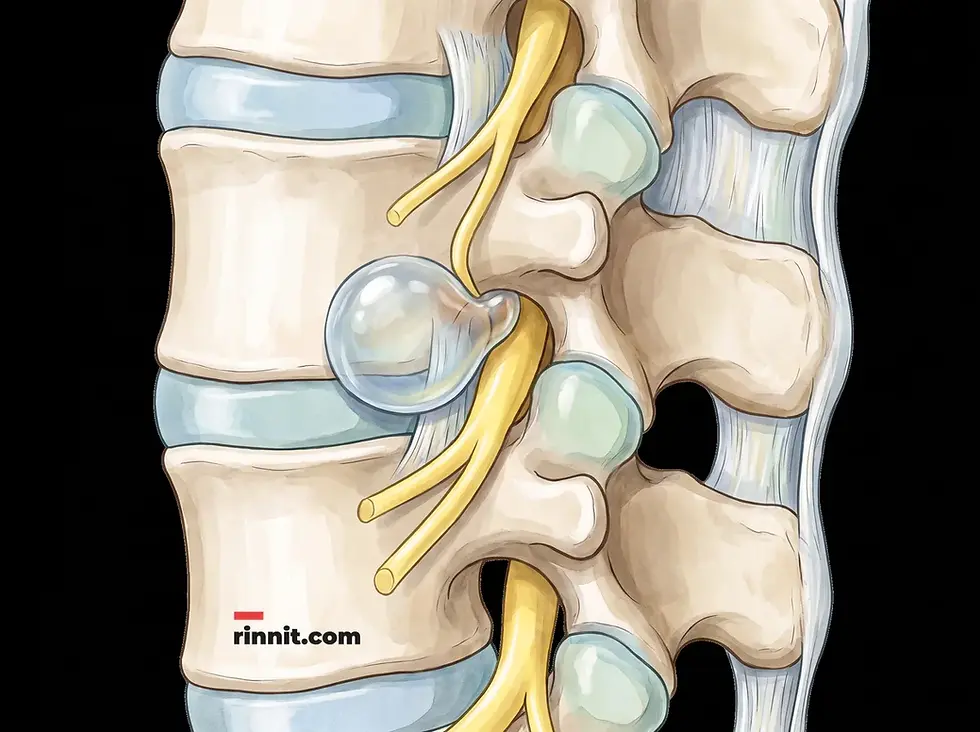
A synovial cyst is a fluid-filled growth that develops between the facet joints of the spine. These joints are the small connections that hold the spinal bones together, allowing for movement and stability. Each facet joint is lined with a synovial membrane that produces fluid to cushion the joint. A cyst forms when this fluid builds up excessively, causing the membrane to swell and protrude from its normal position. [1]
While these growths can occur anywhere in the spine, they are most frequently found in the lumbar spine, or lower back. It is important to note that synovial cysts are almost never cancerous and do not increase the risk of developing cancer. [1] They are technically the same type of growth as a ganglion cyst, which commonly appears on the hands or feet, but the term "synovial cyst" is specifically applied when they occur within the spinal structure.
What causes a synovial cyst of the spine, and who is at risk?
A synovial cyst of the spine is most often linked to age-related wear and tear, and spinal arthritis and spine injuries can also contribute. Because of this, the condition is most common in individuals over the age of 50. [1] Several factors can contribute to the formation of these cysts:
Natural Aging: Over time, the disks and facet joints in the spine naturally break down, which can lead to the accumulation of excess fluid.
Spinal Arthritis: Inflammation from arthritis can damage the facet joints, prompting the body to produce extra synovial fluid in an attempt to stabilize the area. [1]
Spine Injuries: Although less common than age-related causes, trauma to the spine can damage the joints and trigger cyst formation. [1]

What are the symptoms of a synovial cyst of the spine?
Many people have a synovial cyst without ever realizing it because the growth may not cause any noticeable symptoms. [1] However, if the cyst grows large enough to press against spinal nerves, it can cause significant discomfort.
Symptom Category | Common Signs |
|---|---|
Pain | Persistent back pain; referred pain in the buttocks or legs. |
Sensory Changes | Tingling or numbness in the legs, groin, or buttocks. |
Motor Function | Muscle weakness in the legs; difficulty walking. |
Positional Effects | Symptoms that improve or worsen when sitting, standing, or lying down. |
What complications can a synovial cyst of the spine cause?
If left unmanaged, a synovial cyst can lead to complications, the most common of which is spinal stenosis. This involves a narrowing of the spinal canal, which can intensify pain and numbness and make physical movement more difficult. [1] In extremely rare and severe cases, a cyst may press on the nerves that control bladder and bowel function, leading to a loss of control. [1] Such instances require immediate medical attention.
How is a synovial cyst of the spine diagnosed?
A synovial cyst of the spine is diagnosed with a physical exam combined with imaging tests such as an X-ray, MRI or CT scan. [1] A healthcare provider will assess the patient's back, check for areas of tenderness, and discuss the history and nature of the symptoms. To confirm the presence and location of a cyst, one or more of the following tests are typically used:
X-ray: Provides a basic view of the spinal bones and joint alignment.
MRI (Magnetic Resonance Imaging): Offers detailed images of soft tissues, including the cyst and nearby nerves.
CT Scan (Computed Tomography): Uses X-rays to create cross-sectional views of the spine.

What are the treatment options for a synovial cyst of the spine?
Treatment is not always necessary for a synovial cyst, particularly if it is not causing pain or neurological issues. In such cases, a provider may recommend periodic monitoring through follow-up appointments and imaging. [1] If symptoms are present, several management strategies are available.
Treatment Type | Description and Goals |
|---|---|
Medication | Use of NSAIDs or acetaminophen to reduce pain and inflammation. [1] |
Physical Therapy | Exercises to strengthen back muscles and reduce pressure on the spine. [1] |
Injections | Corticosteroids to treat inflammation or nerve blocks to numb pain. |
Aspiration | Using a needle to drain fluid from the cyst (recurrence is possible). [1] |
Cyst Rupture | Safely bursting the cyst with sterile fluid if aspiration is not feasible. [1] |
Surgery | Surgical removal of the cyst; may include spinal fusion for stability. [1] |
What is the long-term outlook for a synovial cyst of the spine?
The prognosis for individuals with a synovial cyst is generally positive, as the condition is highly treatable. Patients may need to try several different conservative treatments before finding the most effective approach. [1] While surgery is often successful in removing the cyst and relieving pressure, there is always a small chance that a cyst may reform in the same location or in a different part of the spine.
Conclusion
Synovial cysts of the spine are common age-related growths that often cause no symptoms but can press on nerves and cause back pain, leg numbness, or weakness. Most people do well with monitoring, medication, physical therapy, or injections, and surgery is kept for severe or persistent cases.
What are the next steps for a synovial cyst of the spine?
If you are experiencing persistent back pain, leg weakness, or unusual numbness, do not ignore these warning signs. Early intervention can prevent complications like spinal stenosis and help you return to your daily activities comfortably. Schedule a consultation with a specialist today to discuss your symptoms and explore the best treatment path for your spinal health. Seek urgent care for sudden weakness or any loss of bladder or bowel control.
Related reading on Rinnit: Spinal Stenosis: Symptoms, Causes, Diagnosis, and Treatment — Complete Guide · Understanding Lower Back Pain: Causes, Symptoms, and Solutions · Sciatica: Complete Guide to Symptoms, Causes, Diagnosis, and Treatment · PLIF Surgery: A Complete Guide to Posterior Lumbar Interbody Fusion
Frequently Asked Questions
Are synovial cysts cancerous?
No, synovial cysts are almost never cancerous and do not indicate a higher risk of cancer.
Can a synovial cyst go away on its own?
Synovial cysts don't typically disappear, but spontaneous resolution has been reported in rare cases, and many cysts remain small and never cause symptoms, requiring no treatment.
What is the difference between a synovial cyst and a ganglion cyst?
Synovial cysts and ganglion cysts are the same type of fluid-filled sac, but synovial cysts occur in the spine, while ganglion cysts appear on hands or feet.
Who is most at risk for these cysts?
People over the age of 50 are most at risk due to natural age-related joint wear.
Can a synovial cyst cause leg pain?
Yes, if the cyst presses on spinal nerves, it can cause referred pain in the legs and buttocks.
Is surgery always required?
No, surgery is typically reserved for cases involving severe pain, weakness, or failure of other treatments.
What is spinal stenosis?
Spinal stenosis is a narrowing of the spinal canal that can be caused by a synovial cyst, leading to increased pain and numbness.
Can physical therapy help?
Yes, strengthening the back muscles can help take pressure off the spine and alleviate symptoms.
How is a synovial cyst diagnosed?
A synovial cyst is diagnosed through a physical exam and imaging tests like MRI, CT scans, or X-rays.
What is aspiration?
Aspiration is a procedure where a needle is used to drain the fluid from the cyst.
Do these cysts grow back?
There is a chance of recurrence, even after aspiration or surgical removal.
Can an injury cause a synovial cyst?
Yes, trauma to the spine can damage facet joints and lead to cyst formation, though it is less common than aging.
Are injections effective?
Corticosteroid injections can be very effective at reducing the inflammation that causes symptoms.
What happens if a cyst ruptures?
If a provider ruptures a cyst, the fluid harmlessly leaks into the spinal area, often providing immediate relief.
When should I see a doctor?
You should see a provider if you have back pain lasting over a week or experience sudden weakness or loss of sensation.
References
Cleveland Clinic. Synovial Cyst. Cleveland Clinic. December 10, 2025. https://my.clevelandclinic.org/health/diseases/synovial-cyst
Litak J, Kamieniak P, Szymoniuk M, et al. Complete spontaneous resolution of lumbar synovial cyst: a case report and systematic literature review. World Neurosurg. 2025;205:124712. PMID 41390085. https://doi.org/10.1016/j.wneu.2025.124712
Chen Y, Yu P, Li Z, et al. Outcomes and adverse events for spinal synovial cysts surgical treatment: a systematic review and meta-analysis. Arch Orthop Trauma Surg. 2024;144(8):3275-3289. PMID 39039314. https://doi.org/10.1007/s00402-024-05460-w
Medical Disclaimer
This article is for informational purposes only and does not constitute medical advice. Always seek the advice of your physician or other qualified health provider with any questions you may have regarding a medical condition.



Comments