Swan-Ganz Catheterization: What It Measures, How It's Done and Recovery

Updated: 2 days ago
Written and medically reviewed by Dr. Baraa Alnahhal, MD · Last reviewed: November 2026 · How we review
Quick Answer: What is Swan-Ganz catheterization?
Swan-Ganz catheterization places a thin tube, also called a pulmonary artery catheter, through a large vein and the right side of the heart into the pulmonary artery. It lets the care team measure pressures inside the heart and lungs and estimate how much blood the heart pumps. Serious complications happen in about 1% of procedures in experienced centers. [1]
What the research says
Routine use did not change survival in intensive care. In a randomized trial of 1,041 critically ill adults in 65 UK intensive care units, hospital death rates were 68% with a pulmonary artery catheter and 66% without it, a difference that was not significant. Insertion problems occurred in 46 of 486 people who received one, and none were fatal. (Harvey et al., The Lancet, 2005) [2]
In heart failure, the catheter added information but not longer life. Among 433 people hospitalized with severe heart failure, adding a pulmonary artery catheter to careful clinical assessment did not change days alive out of hospital or death rates (4.7% vs 5.0%). Expected in-hospital side effects were more common with the catheter (21.9% vs 11.5%). (Binanay et al., JAMA, 2005) [3]
Key takeaways
A Swan-Ganz catheter monitors how well blood moves through your heart and lungs. [1]
It is threaded from a vein in your leg, neck or chest into your pulmonary artery under X-ray guidance. [1]
It can estimate filling pressures, pulmonary artery pressure, cardiac output and valve function. [1]
Serious complications are uncommon, about 1% in experienced centers, though minor problems are more common. [1]
Today, noninvasive echocardiography is used more often for critically ill people. [1]
What is a Swan-Ganz catheter?
A Swan-Ganz catheter is a long, thin, flexible tube that lets providers see how well blood moves through your heart and lungs. Another name for it is a pulmonary artery catheter, and the test is sometimes called pulmonary artery catheterization. [1]
The catheter has four lumens, or small tubes, that feed into one main tube. Each port has its own job. [1]
What does a Swan-Ganz catheter measure?
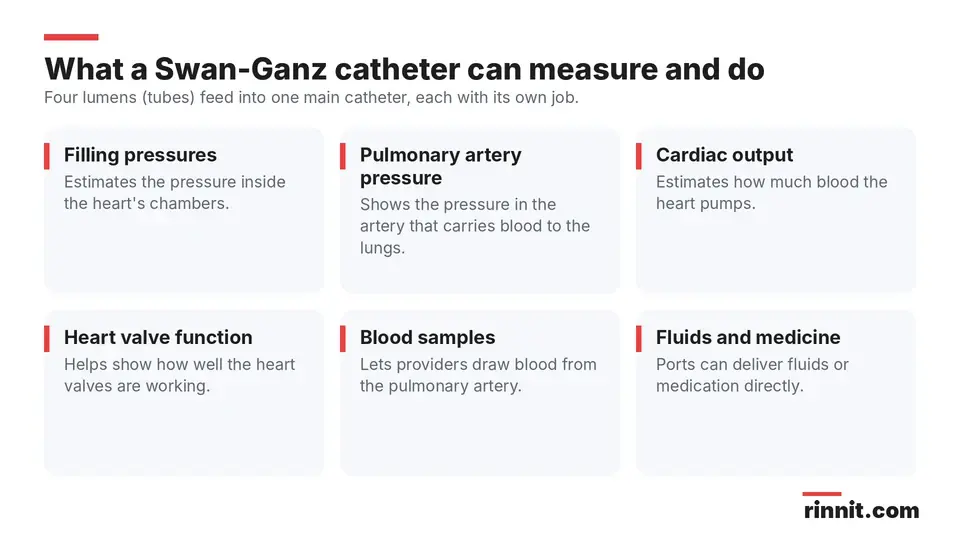
One catheter can gather several kinds of information at the bedside.
Function | What it tells your care team |
Filling pressures | Pressure inside the chambers of your heart |
Pulmonary artery pressure | Pressure in the artery that carries blood to your lungs |
Cardiac output | How much blood your heart pumps |
Valve function | How well your heart valves are working |
Blood sampling | Lets providers draw blood from the pulmonary artery |
Medicine and fluids | Ports can deliver fluids or medication |
Sources: [1]
A small balloon at the tip of the catheter helps guide it into place. [1]
Is a Swan-Ganz catheter still used?
Yes. Providers still use it, and it has long been considered a gold standard for this kind of heart monitoring. For critically ill people, though, they now more often use echocardiography because it is noninvasive. [1]
Who needs a Swan-Ganz catheter?
Your provider may recommend one if you have: [1]
Shortness of breath that needs further evaluation
Heart failure or abnormal heart rhythms (arrhythmias)
Cardiogenic shock or distributive shock
Constrictive pericarditis or cardiac tamponade
A heart attack
Pulmonary hypertension or a pulmonary embolism
Adult congenital heart disease
It may also be used before or after a heart transplant, the placement of a left ventricular assist device (LVAD) or other surgery. [1]
How do you prepare for Swan-Ganz catheterization?
Before the procedure, you may need to: [1]
Stop certain medicines if your provider tells you to
Fast (not eat or drink) for several hours
Sign a consent form
You will also receive a sedative through an IV to help you relax. [1]
What happens during the procedure?
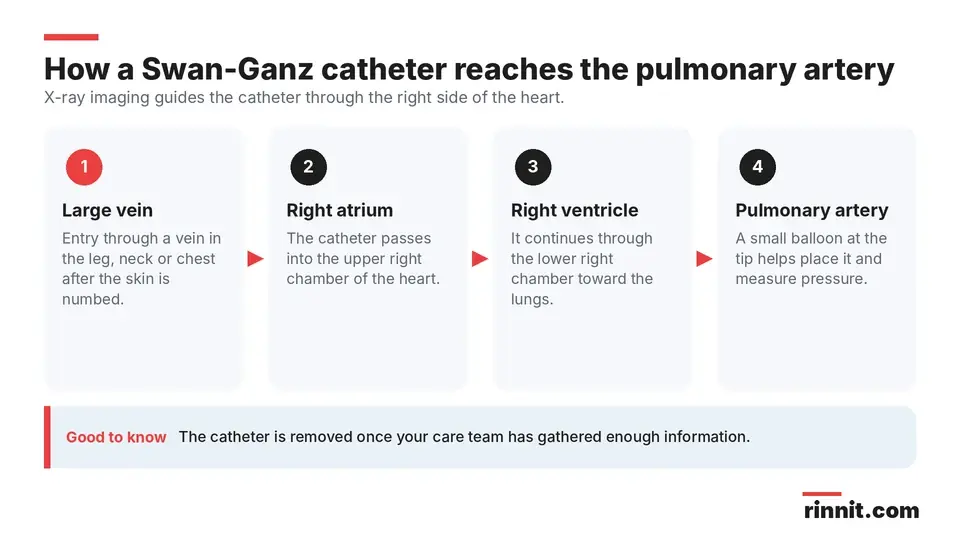
Your provider numbs the skin over a large vein in your leg, neck or chest. They then thread the catheter through the vein, guided by X-ray images, through the right side of your heart and into your pulmonary artery. [1]
Once your care team has gathered enough information, they remove the catheter. [1]
What happens after the procedure?
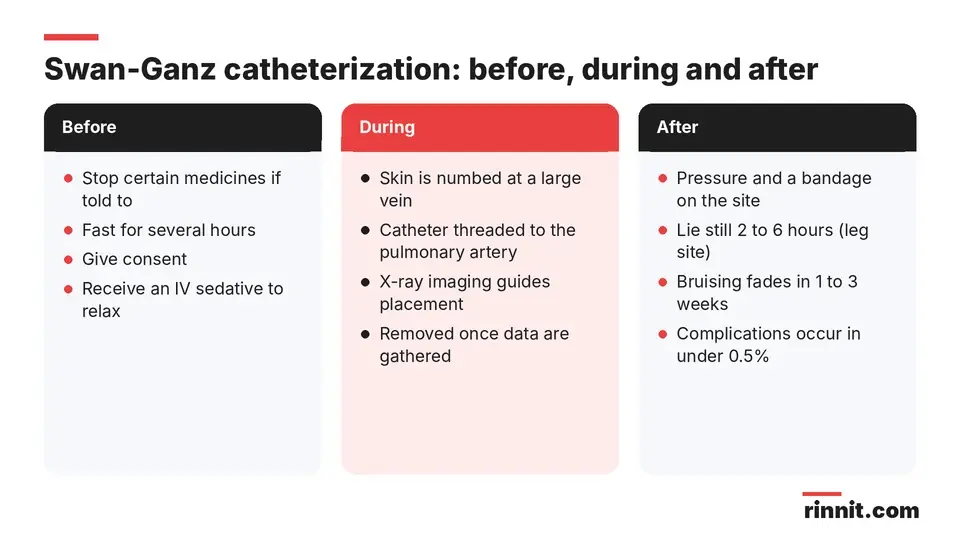
After the catheter comes out, a provider presses on the insertion site and covers it with a bandage. [1]
What are the risks of a Swan-Ganz catheter?
Serious complications are uncommon, about 1% of procedures in experienced centers, but minor problems during insertion are more common. Possible risks include: [1]
Infection
Air embolism (an air bubble in a blood vessel)
Collapsed lung, if a vein under the collarbone is used
Abnormal heart rhythms
Damage to the heart wall, a heart valve or the pulmonary artery
What do the results mean?
Your provider uses the results to guide treatment, confirm a condition and see how severe it is. Depending on what they find, treatment may include medication, a procedure or surgery. [1]
When should you call your doctor?
Contact your provider if: [1]
The insertion wound swells or leaks blood or fluid
The leg where the catheter was placed becomes numb or swollen
Conclusion
Swan-Ganz catheterization gives your care team a direct look at pressures and blood flow inside your heart and lungs. It is usually done in people who are seriously ill or are being evaluated for complex heart and lung problems, and serious complications are uncommon.
If you have questions about why this test was chosen for you, or whether a noninvasive test such as an echocardiogram could answer the same question, ask your care team.
Keep learning: Read our pulmonary hypertension guide or our guide to cardiac catheterization. For more background, see the MedlinePlus page on Swan-Ganz right heart catheterization.
FAQ
What is a Swan-Ganz catheter?
It is a thin, flexible tube placed through a large vein into your pulmonary artery to monitor blood flow and pressures in your heart and lungs. [1]
What is another name for a Swan-Ganz catheter?
It is also called a pulmonary artery catheter. [1]
What does a Swan-Ganz catheter measure?
Heart filling pressures, pulmonary artery pressure, cardiac output and how well the heart valves work. [1]
Why would someone need a Swan-Ganz catheter?
It is used for problems such as heart failure, shock, pulmonary hypertension, pulmonary embolism and before or after a heart transplant or LVAD. [1]
Where is a Swan-Ganz catheter inserted?
Through a large vein in the leg, neck or chest. [1]
Are you awake during Swan-Ganz catheterization?
You receive a sedative through an IV to help you relax, and the skin is numbed. [1]
Is a Swan-Ganz catheter still used today?
Yes, though echocardiography is now used more often for critically ill people because it is noninvasive. [1]
How common are complications?
Serious complications occur in about 1% of procedures in experienced centers; minor problems are more common. [1]
How long do you lie still after a Swan-Ganz catheter?
If it was placed in the leg, you lie still for two to six hours. [1]
When should I call my doctor afterward?
Call if the site swells or leaks blood or fluid, or your leg becomes numb or swollen. [1]
Related Reading
Pulmonary Hypertension: Complete Guide to Symptoms, Causes, Diagnosis, and Treatment explains a condition this catheter helps measure and confirm.
Cardiogenic Shock: The Heart-Failure Emergency Where Minutes Matter — Plain-English Guide covers one of the emergencies where pressure monitoring guides care.
Congestive Heart Failure: Symptoms, Stages, and How It's Treated describes the heart condition most often linked to this test.
Cardiac Tamponade: The Emergency When Fluid Squeezes Your Heart — Signs, Causes, and Rapid Treatment explains another condition this catheter can help evaluate.
Pulmonary Embolism Guide: Symptoms, Causes, Diagnosis, and Treatment covers a lung condition where heart and lung pressures matter.
References
Cleveland Clinic. Swan-Ganz Catheterization. Cleveland Clinic. Last updated January 16, 2023. https://my.clevelandclinic.org/health/diagnostics/24606-swan-ganz-catheterization
Harvey S, Harrison DA, Singer M, et al. Assessment of the clinical effectiveness of pulmonary artery catheters in management of patients in intensive care (PAC-Man): a randomised controlled trial. Lancet. 2005;366(9484):472-477. PMID 16084255. https://doi.org/10.1016/S0140-6736(05)67061-4
Binanay C, Califf RM, Hasselblad V, et al. Evaluation study of congestive heart failure and pulmonary artery catheterization effectiveness: the ESCAPE trial. JAMA. 2005;294(13):1625-1633. PMID 16204662. https://doi.org/10.1001/jama.294.13.1625
Medical disclaimer
This article is for general education only and does not replace advice from a qualified healthcare professional. Talk to your doctor about your own diagnosis and treatment, and seek emergency care right away for severe or sudden symptoms.



Comments