Superior Mesenteric Artery (SMA) Syndrome: Causes, Symptoms, and Recovery

Updated: 2 days ago
Medically reviewed by Dr. Baraa Alnahhal, MD · Last reviewed: October 2026
Medical emergency: Vomiting that will not stop, severe or worsening belly pain or swelling, vomiting blood, or signs of dehydration (very dry mouth, dizziness, little or no urine) need emergency care right away. SMA syndrome can lead to dangerous dehydration and salt imbalances, and in rare cases to serious complications such as a hole in the digestive tract.
Quick Answer: What is SMA syndrome?
Superior mesenteric artery syndrome is a rare digestive disorder in which the aorta and superior mesenteric artery compress the duodenum, partly or fully blocking food leaving the stomach. It usually follows loss of the fat pad around the artery from rapid weight loss, illness or surgery. Treatment starts with nutrition support to regain weight, with bypass surgery for severe cases.
What the research says
Most patients are young, and treatment usually works. A 2023 review reported a median patient age of 23 years (range 0–91) and a female-to-male ratio of 3:2. Conservative treatment (posture, decompression, and nutrition) had reported success rates of 70% to 80%, and surgery such as laparoscopic duodenojejunostomy had reported success rates of 80% to 100% when conservative treatment failed (Oka et al., World J Clin Cases, 2023) [3].
Do not wait too long on non-surgical care. A systematic review of 38 studies of SMA syndrome after colorectal surgery found that 62.9% of patients were managed successfully without surgery, most of them within 2 to 4 weeks, and the authors advise considering surgery if there is no improvement within 4 weeks (Alsaleh et al., Ann Med Surg, 2025) [4].
Surgery works well, but long-term results vary. In a retrospective series of 13 patients who had laparoscopic surgery (12 with a duodenojejunostomy), 8 patients (61.5%) had excellent results after a median follow-up of 94 months, while others had delayed stomach emptying or a return of symptoms (Cienfuegos et al., World J Surg, 2020) [5].
Key takeaways
SMA syndrome is rare. It compresses the third part of the duodenum between the aorta and the SMA.
Loss of the mesenteric fat pad after rapid weight loss is the most common cause.
The classic pattern is belly pain, nausea, or fullness soon after eating, along with weight loss.
CT or CT angiography is the usual test, and it can measure the space between the aorta and the SMA.
Small high-calorie meals and left-side positioning help, and surgery is reserved for cases that do not respond.
Most people recover fully once weight is restored or the blockage is bypassed.
What is superior mesenteric artery (SMA) syndrome?
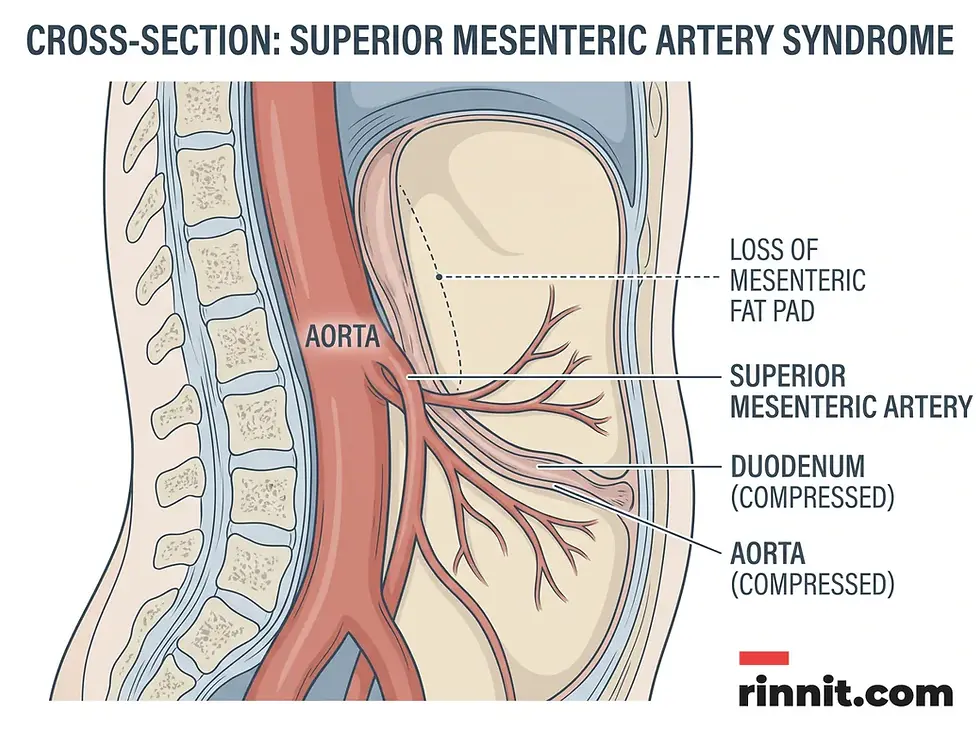
Food normally leaves the stomach and passes through the duodenum to continue digesting. In SMA syndrome, the aorta (the body's main artery) and the superior mesenteric artery close in on the duodenum like a crushed straw, so food struggles to get through. The condition is also called Wilkie syndrome, cast syndrome, or aortomesenteric compass syndrome. [3]
Normally, the SMA leaves the aorta at an angle of roughly 38° to 65°, and a cushion of fat keeps a gap of about 10 to 28 mm between the two vessels. When the fat pad shrinks, the angle can fall below about 25° and the gap below about 8 mm, which is enough to block the duodenum. Because the blockage reduces how much a person can eat, weight loss can continue and make the squeeze tighter, a cycle that doctors call a vicious circle.
What causes superior mesenteric artery syndrome, and who is at risk?
The most common cause is loss of the mesenteric fat pad. This layer of fatty tissue normally surrounds the SMA and keeps the space between the arteries open. Conditions or events that cause rapid, significant weight loss are the usual trigger, but some people have body shapes or surgeries that narrow the space in other ways.
Category | Examples |
Rapid weight loss | Anorexia nervosa and other eating disorders, cancer, malabsorption syndromes, AIDS, chronic wasting illness, substance use disorder |
Injury and critical illness | Severe burns, major trauma, spinal cord injury or paralysis [1] |
Surgery | Bariatric surgery, spinal deformity surgery such as scoliosis correction, and bowel surgery such as colectomy or ileal pouch procedures |
Other factors | Prolonged bed rest or a body cast, some spinal curvatures, and congenital differences in the position of the duodenum or its supporting ligament |
Possible genetic link | Some families have been reported, but more research is needed |
What are the symptoms and warning signs of superior mesenteric artery syndrome?
Symptoms differ from person to person. They can be mild and come and go, or severe and constant. They usually begin or get worse soon after eating, and high-fiber meals can be especially uncomfortable. [1] Many people eat less to avoid the pain, which leads to more weight loss and tightens the squeeze.
Symptom type | Common experiences |
Digestive distress | Abdominal pain, nausea, vomiting, and bloating |
Eating habits | Feeling full after a few bites (early satiety) and indigestion |
Whole-body signs | Unexplained weight loss and constipation |
Physical responses | Frequent belching and discomfort that worsens after meals |

Possible complications
If it is not treated, SMA syndrome can cause serious problems:
Severe malnutrition and dehydration
Electrolyte imbalances, such as low potassium and sodium
Widening of the stomach (gastric dilation) and gastric outlet obstruction
Shock from fluid loss and, rarely, a hole (perforation) in the digestive tract
How is superior mesenteric artery syndrome diagnosed with imaging?
Diagnosis begins with a physical exam and a review of your medical history, especially any recent weight loss. Because the symptoms overlap with eating disorders, functional dyspepsia, gastroparesis, ulcers, and other causes of upper-gut obstruction, imaging is needed to confirm the diagnosis.
CT scan or CT angiography (CTA) is usually the test of choice [3] because it can measure the angle and the distance between the aorta and the SMA and can show a widened stomach and duodenum above the squeeze. Other tests that may be used include an upper GI series, upper endoscopy, abdominal X-ray, ultrasound, and MRI or magnetic resonance angiography. Endoscopy also helps rule out other causes of blockage. Blood tests are not diagnostic, but they can show dehydration and salt imbalances that need to be corrected.
How is superior mesenteric artery syndrome managed and treated?
Treatment usually starts without surgery. The goals are to relieve pressure on the duodenum and restore nutrition. For many people, regaining weight rebuilds the fat pad and widens the space between the arteries. Doctors generally allow several weeks of non-surgical treatment before deciding that it has failed, and one study found an overall success rate of about 71%, with symptoms returning in about 16% of people.
Approach | What it involves |
Nutritional support | Several small, high-calorie meals through the day, meal-replacement shakes, and easy-to-digest foods such as soup, eggs, and yogurt [1] |
Positioning after meals | Lying on the left side with the right knee pulled toward the chest, or sitting and pulling the knees up, to ease pressure on the duodenum [1] |
Feeding support | A tube passed through the nose into the small intestine (nasojejunal tube) or intravenous nutrition (TPN) when eating is not enough [1] |
Medication | Metoclopramide, which helps the stomach empty, may be used in some cases [1] |
Surgery | Duodenojejunostomy or gastrojejunostomy to bypass the blocked section, or the Strong procedure to move the duodenum, for severe cases or when other treatment fails [1] |
When someone is severely malnourished, nutrition is restarted carefully under medical supervision, because feeding too quickly can cause refeeding syndrome. If an eating disorder is behind the weight loss, treating it is a key part of recovery, together with the digestive treatment.
Surgery is saved for severe cases or for people who do not improve. The most common operation today is a laparoscopic duodenojejunostomy, which connects the jejunum to the duodenum so food can bypass the squeezed section. [3] [5] In a gastrojejunostomy, the stomach is connected to the jejunum instead. At a few specialized centers, an endoscopic stent can create a bypass without an incision.

What is the outlook and long-term recovery for SMA syndrome?
The outlook is generally excellent when SMA syndrome is diagnosed early and treated before complications develop. As weight returns, the fat cushion around the artery rebuilds and digestion usually goes back to normal. [1] How well someone does also depends on the underlying cause. Regular follow-up is important to make sure weight is maintained and symptoms do not return. If you have symptoms again after treatment, such as weight loss or belly pain, tell your provider, because it can mean the duodenum is under pressure again.
When should you see a healthcare provider about SMA syndrome?
See a healthcare provider for SMA syndrome symptoms such as recurring belly pain, nausea, early fullness, unexplained weight loss or repeated vomiting.
Belly pain, nausea, or feeling full after only a few bites that keeps coming back
Unexplained weight loss
Repeated vomiting
A return of symptoms after treatment
Seek emergency care for vomiting that will not stop, severe belly pain or swelling, vomiting blood, or signs of dehydration.
Conclusion
SMA syndrome is uncommon, but it can be serious because it makes it hard to eat and absorb nutrients. The good news is that it is treatable. Many people improve with careful nutrition and positioning, and surgery gives a dependable option when that is not enough. If you notice pain after eating together with weight loss, early medical attention gives the best chance of a full recovery.
Related reading
Frequently Asked Questions
What is SMA syndrome?
SMA syndrome is a rare digestive disorder in which the aorta and the superior mesenteric artery compress the duodenum, the first part of the small intestine.
What does SMA stand for?
SMA stands for superior mesenteric artery. The condition is also known as Wilkie syndrome, cast syndrome, or aortomesenteric compass syndrome.
What is the duodenum?
The duodenum is the first section of the small intestine, just after the stomach. Food passes through it before the rest of digestion continues.
Why does the compression happen?
The compression usually happens because the fat pad that cushions the SMA has shrunk, which narrows the angle between the SMA and the aorta.
What causes loss of the fat pad?
Rapid weight loss from illness, an eating disorder, surgery, or injury is the most common cause.
Is SMA syndrome genetic?
Some cases may have a genetic link, and a few families have been reported, but more research is needed to confirm it.
What are the most common symptoms?
Belly pain after eating, nausea, vomiting, feeling full quickly, bloating, and weight loss.
Why do symptoms get worse after eating?
Food and gas build up behind the squeezed duodenum, which increases pressure and pain.
Can SMA syndrome be life-threatening?
Yes. If it is not treated, it can lead to severe malnutrition, dehydration, salt imbalances, aspiration pneumonia, shock, or a hole in the digestive tract.
How is SMA syndrome diagnosed?
Doctors use a physical exam and imaging. CT or CT angiography is the usual test, and an upper GI series, endoscopy, or MRI may also be used.
What is the first-line treatment?
Non-surgical care comes first. It focuses on nutrition to regain weight, positioning after meals, and a feeding tube or IV nutrition when needed.
How does positioning help?
Lying on the left side with the right knee pulled toward the chest can temporarily widen the space between the arteries and relieve pressure on the duodenum.
When is surgery needed?
Surgery is usually kept for severe cases or when nutrition and other non-surgical treatment have not worked after a fair trial.
Can you fully recover?
Yes. Most people recover well once they regain weight and the fat pad rebuilds, or after surgery to bypass the blockage.
What happens if it is left untreated?
Untreated SMA syndrome can cause severe malnutrition and complications such as dehydration, electrolyte imbalances, aspiration pneumonia, shock, and a hole in the digestive tract.
Sources
Cleveland Clinic. Superior Mesenteric Artery (SMA) Syndrome. Cleveland Clinic. Last updated September 30, 2025. https://my.clevelandclinic.org/health/diseases/sma-syndrome
Goosenberg E, Collier SA. Superior Mesenteric Artery Syndrome. StatPearls [Internet]. StatPearls Publishing; last updated July 5, 2026. PMID 29489172. https://www.ncbi.nlm.nih.gov/books/NBK482209/
Oka A, Awoniyi M, Hasegawa N, et al. Superior mesenteric artery syndrome: diagnosis and management. World J Clin Cases. 2023;11(15):3369-3384. PMID 37383896. https://doi.org/10.12998/wjcc.v11.i15.3369
Alsaleh N, Yaseen W, Alshamat RA, et al. Superior mesenteric artery syndrome following colorectal surgery: a systematic review. Ann Med Surg (Lond). 2025;87(5):2763-2773. PMID 40337396. https://doi.org/10.1097/MS9.0000000000003209
Cienfuegos JA, Hurtado-Pardo L, Valentí V, et al. Minimally invasive surgical approach for the treatment of superior mesenteric artery syndrome: long-term outcomes. World J Surg. 2020;44(6):1798-1806. PMID 32030438. https://doi.org/10.1007/s00268-020-05413-5
Medical disclaimer
The information in this article is for educational purposes only and is not a substitute for professional medical advice, diagnosis, or treatment. Always seek the advice of your physician or another qualified health provider with any questions you may have about a medical condition. Never disregard professional medical advice or delay seeking it because of something you have read here. If you think you may have a medical emergency, call your doctor or your local emergency number immediately.



Comments