Superior Mesenteric Artery: Anatomy, Function, and Clinical Significance

Updated: 2 days ago
Medically reviewed by Dr. Baraa Alnahhal, MD · Last reviewed: October 2026
Medical emergency: Sudden, severe abdominal pain, especially with vomiting, bloody stool, or a very ill feeling, can be a sign of acute mesenteric ischemia, which is a surgical emergency. Go to the nearest emergency department right away.
Quick Answer: What is the superior mesenteric artery?
The superior mesenteric artery is a large artery branching off the front of the abdominal aorta that supplies the midgut, including parts of the pancreas, small intestine and colon. Steady flow through it lets the intestines digest food and absorb nutrients, and reduced flow can quickly damage the bowel. It can also compress nearby structures, causing Nutcracker and SMA syndromes.
What the research says
Acute mesenteric ischemia is rare but dangerous when untreated. The World Society of Emergency Surgery's updated guidelines estimate that it accounts for 0.09% to 0.2% of all acute surgical admissions, and they note that mortality remains around 50% if it goes untreated, which is why early diagnosis and timely treatment are the cornerstones of care (Bala et al., World J Emerg Surg, 2022) [3].
CT angiography is the test of choice. A 2025 systematic review and meta-analysis (81 studies pooled into 14 meta-analyses) found that CT angiography had a sensitivity of 92.0% and a specificity of 98.8% for diagnosing acute mesenteric ischemia (Reintam Blaser et al., Sci Rep, 2025) [4].
Delays are costly and restoring blood flow helps. In a meta-analysis of 51 studies covering 10,425 patients, delay to surgery was associated with higher mortality (odds ratio 2.51, 95% CI 1.58–3.99), while revascularization was associated with survival (odds ratio 0.30, 95% CI 0.13–0.69) (Sumbal et al., J Surg Res, 2022) [5].
Key takeaways
The SMA arises from the aorta at about the level of the first lumbar vertebra, roughly 1 cm below the celiac trunk and above the renal arteries. [2]
Its main branches are the inferior pancreaticoduodenal, jejunal and ileal, ileocolic, right colic, and middle colic arteries.
The marginal artery of Drummond links the SMA with the inferior mesenteric artery and can act as a backup route for blood, although it is weak or absent in some people.
Conditions that affect the SMA include mesenteric ischemia, mesenteric aneurysm, Nutcracker syndrome, and SMA syndrome.
A heart-healthy lifestyle protects the artery, and severe abdominal pain, bloody stool or urine, or unexplained weight loss should be checked promptly.
Anatomy and Location of the Superior Mesenteric Artery
The SMA is the second of the three large unpaired branches that leave the front of the abdominal aorta. The celiac trunk, which supplies the liver, stomach, and spleen, comes first. [1] The SMA follows about 1 cm lower, and the renal arteries to the kidneys arise just below it. [1] [2] The inferior mesenteric artery, which supplies the lower digestive tract, is the third. The word "superior" simply tells it apart from that lower artery.
After it leaves the aorta, the SMA passes behind the neck of the pancreas [1] [2] and then enters the root of the small-bowel mesentery, the fold of tissue that holds the intestines in place. It runs on the left side of the superior mesenteric vein, which carries blood away from the same region of the gut. Two neighbors explain the conditions described later: the left renal vein passes between the aorta and the origin of the SMA, and the third part of the duodenum passes between the SMA and the aorta. [2]
Feature | Description |
Origin | Front of the abdominal aorta, near the L1 vertebra |
Location | Midgut region, behind the pancreas |
Main job | Deliver oxygen-rich blood to the pancreas and intestines |
Key neighbors | Superior mesenteric vein, left renal vein, duodenum |

Branches and Blood Supply
The SMA acts as a hub. Its branches fan out to the part of the digestive tract that develops from the embryonic midgut.
Inferior pancreaticoduodenal artery: the first branch. It supplies the head of the pancreas and the duodenum and connects with the superior pancreaticoduodenal artery from the celiac system. [1] [2]
Jejunal and ileal arteries: several branches from the left side of the SMA that supply the jejunum and ileum. They form loops called arcades inside the mesentery, and small straight vessels from those arcades feed the bowel wall. [2]
Ileocolic artery: the lowest branch. It supplies the terminal ileum, the cecum, the appendix, and the start of the ascending colon. [1] [2]
Right colic artery: supplies the ascending colon on the right side of the abdomen. [1] [2]
Middle colic artery: supplies the transverse colon [1] [2], mainly its first two-thirds.
The marginal artery of Drummond: a built-in backup
The outer branches of the SMA (the ileocolic, right colic, and middle colic arteries) join with branches of the inferior mesenteric artery along the edge of the colon. This chain of connections is called the marginal artery of Drummond. [2] If one of the large arteries is blocked, blood can sometimes reach the colon through this route. [2] It is not equally well developed in everyone, and where it is weak or missing, such as near the splenic flexure of the colon, the bowel is more vulnerable to damage when blood flow falls. [2]
Conditions That Affect the Superior Mesenteric Artery
Several problems can interfere with the SMA, ranging from blockages inside the artery to compression from outside it.
Condition | What happens | Common symptoms |
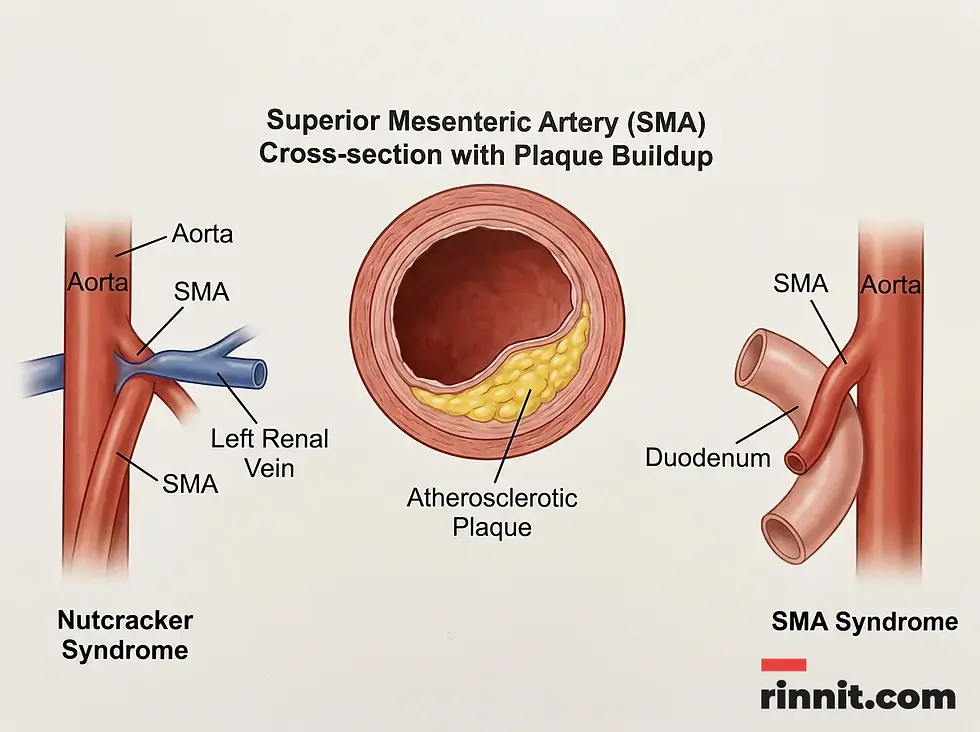
Mesenteric ischemia | Severe abdominal pain (acute); pain after eating and weight loss (chronic) | |
Mesenteric aneurysm | A weak spot in the artery wall bulges outward [1] | Often none until it enlarges; severe pain if it ruptures |
Nutcracker syndrome | Flank pain, blood in the urine, pelvic congestion [1] | |
SMA syndrome | Pain and fullness after eating, nausea, vomiting, weight loss [2] |
Mesenteric ischemia
Mesenteric ischemia happens when blood flow to the intestine falls too low. In the acute form, a clot suddenly blocks the artery. It may travel there from the heart (an embolus) or form in an artery already narrowed by plaque (a thrombus). [2] Less often, blood flow drops without a blockage, for example during shock or very low blood pressure. [2] The chronic form develops slowly as atherosclerosis narrows the artery, and it often causes pain after meals and weight loss. Acute mesenteric ischemia is an emergency because the bowel can die within hours.
Mesenteric aneurysm
An aneurysm is a weakened, bulging section of the artery wall. Aneurysms of the SMA are uncommon and may cause no symptoms for years, so they are often found by chance on scans done for another reason. The main concern is that a large aneurysm can rupture. [1]
Nutcracker syndrome
In Nutcracker syndrome, the left renal vein is pinched in the narrow space between the SMA and the aorta. Blood backs up behind the squeeze, which can cause flank pain, blood in the urine, and pelvic congestion. [1]
SMA syndrome
In SMA syndrome, the same two vessels squeeze the duodenum instead. Food has trouble leaving the stomach, which causes pain and fullness after eating, nausea, and vomiting. [1] [2] It is rare and is often linked to major weight loss. [1] [2]
Protecting Your Vascular Health
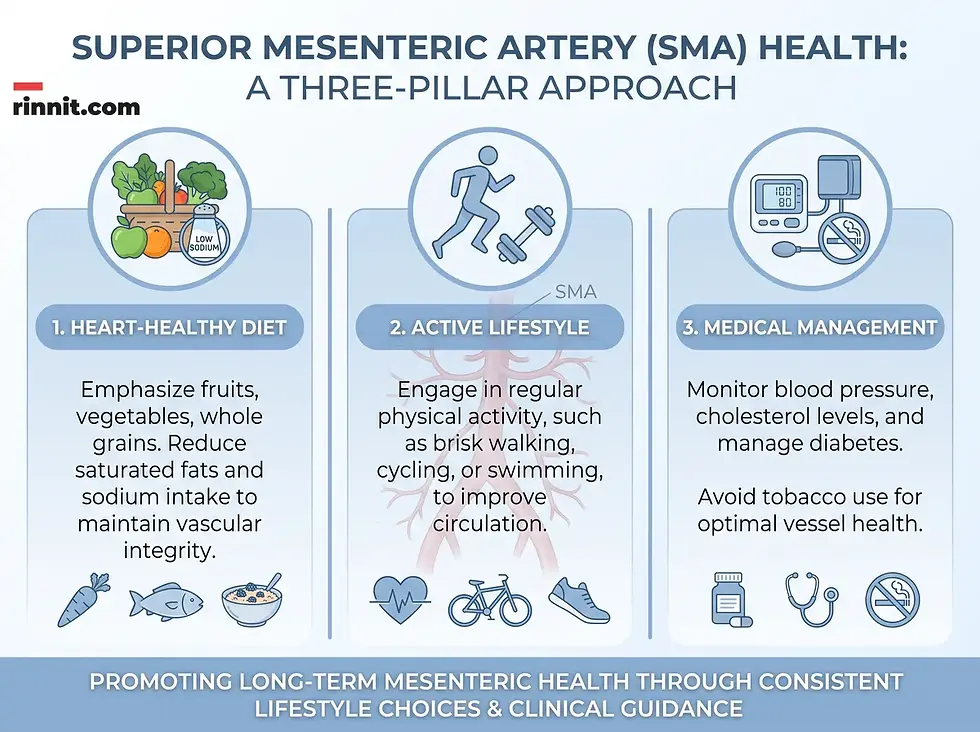
Because the SMA can be narrowed by atherosclerosis, the habits that protect your heart and other arteries also protect this artery.
Move most days of the week. [1] Regular physical activity supports healthy circulation.
Eat a heart-healthy diet that is low in salt, saturated fat, and cholesterol. [1]
Do not smoke. [1] Tobacco damages artery walls and raises the risk of clots. Ask your provider for help quitting if you need it.
Maintain a healthy weight. [1]
Manage diabetes, high cholesterol, and high blood pressure, which can all damage arteries. [1]
When to See a Healthcare Provider
Contact your healthcare provider if you notice any of the following:
Sudden, severe abdominal pain needs emergency care right away. Do not wait to see whether it passes.
Conclusion
The superior mesenteric artery supplies most of the small intestine and much of the large intestine, so digestion and nutrient absorption depend on it. Knowing where it runs, what it feeds, and which conditions can affect it helps you recognize warning signs early. Controlling blood pressure, cholesterol, and blood sugar, staying active, and avoiding tobacco are practical ways to protect it. If you are worried about your digestive or vascular health, talk with a healthcare provider about the right checks for you.
Related reading
Frequently Asked Questions
What is the superior mesenteric artery?
It is a major branch of the abdominal aorta that supplies blood to the pancreas and to most of the small and large intestines.
Where is the superior mesenteric artery located?
It arises from the front of the aorta at about the level of the first lumbar vertebra, below the celiac trunk and above the renal arteries, and then passes behind the pancreas on its way to the intestines.
What organs does the SMA supply?
It supplies the head of the pancreas, the lower duodenum, the jejunum, the ileum, the cecum, the appendix, the ascending colon, and most of the transverse colon.
What are the main branches of the SMA?
The main branches are the inferior pancreaticoduodenal artery, the jejunal and ileal arteries, the ileocolic artery, the right colic artery, and the middle colic artery.
How is the superior mesenteric artery different from the inferior mesenteric artery?
The superior artery supplies the midgut, from the lower duodenum to most of the transverse colon. The inferior artery supplies the hindgut, which is the lower part of the large intestine.
What is the marginal artery of Drummond?
It is a chain of connections along the colon that links branches of the SMA and the inferior mesenteric artery. It can provide a backup blood supply if one of the main arteries is blocked, but it is weak or absent in some people.
What is mesenteric ischemia?
It is a condition in which blood flow to the intestine is reduced or cut off. It can be sudden (acute) or develop slowly (chronic), and acute cases are medical emergencies.
What can block the SMA?
Common causes are a clot that travels from the heart, a clot that forms in an artery narrowed by plaque, and plaque buildup itself. Very low blood flow during shock can also starve the intestine without a true blockage.
What is Nutcracker syndrome?
It occurs when the SMA and the aorta squeeze the left renal vein. It can cause flank pain, blood in the urine, and pelvic congestion.
What is SMA syndrome?
It is a rare condition in which the SMA and the aorta squeeze the duodenum, making it hard for food to leave the stomach. It often follows significant weight loss.
Can an SMA aneurysm cause symptoms?
Many cause none and are found by chance on imaging. If one grows or ruptures, it can cause severe abdominal pain, and a rupture is an emergency.
Can SMA conditions be life-threatening?
Yes. Acute mesenteric ischemia and a ruptured aneurysm are emergencies that need immediate care. SMA syndrome and Nutcracker syndrome can also cause serious complications if they are not treated.
Is the SMA a peripheral artery?
Cleveland Clinic describes it as a peripheral artery, meaning an artery that carries blood to parts of the body farther from the heart. Anatomists also call it a visceral artery because it supplies abdominal organs.
How can I keep my SMA healthy?
Follow a heart-healthy diet, stay active, do not smoke, keep a healthy weight, and keep diabetes, cholesterol, and blood pressure under control.
When should I see a doctor about SMA symptoms?
See a healthcare provider for severe abdominal pain, blood in the stool or urine, or unexplained weight loss. Go to the emergency department for sudden, severe abdominal pain.
Sources
Cleveland Clinic. Superior Mesenteric Artery. Cleveland Clinic. Last updated July 26, 2021. https://my.clevelandclinic.org/health/body/21679-superior-mesenteric-artery
Shaikh H, Wehrle CJ, Khorasani-Zadeh A. Anatomy, Abdomen and Pelvis: Superior Mesenteric Artery. StatPearls [Internet]. StatPearls Publishing; last updated July 24, 2023. PMID 30137844. https://www.ncbi.nlm.nih.gov/books/NBK519560/
Bala M, Catena F, Kashuk J, et al. Acute mesenteric ischemia: updated guidelines of the World Society of Emergency Surgery. World J Emerg Surg. 2022;17(1):54. PMID 36261857. https://doi.org/10.1186/s13017-022-00443-x
Reintam Blaser A, Koitmäe M, Laisaar KT, et al. Radiological diagnosis of acute mesenteric ischemia in adult patients: a systematic review and meta-analysis. Sci Rep. 2025;15(1):9875. PMID 40119151. https://doi.org/10.1038/s41598-025-94846-w
Sumbal R, Ali Baig MM, Sumbal A. Predictors of mortality in acute mesenteric ischemia: a systematic review and meta-analysis. J Surg Res. 2022;275:72-86. PMID 35220147. https://doi.org/10.1016/j.jss.2022.01.022
Medical disclaimer
The information in this article is for educational purposes only and is not a substitute for professional medical advice, diagnosis, or treatment. Always seek the advice of your physician or another qualified health provider with any questions you may have about a medical condition. Never disregard professional medical advice or delay seeking it because of something you have read here. If you think you may have a medical emergency, call your doctor or your local emergency number immediately.



Comments