Subcutaneous ICD (S-ICD): How It Works, Procedure and Recovery

Updated: 3 days ago
Written and medically reviewed by Dr. Baraa Alnahhal, MD · Last reviewed: November 2026 · How we review
Quick Answer
A subcutaneous implantable cardioverter defibrillator (S-ICD) is a type of ICD placed under the skin instead of through the veins into the heart. It watches your heart rhythm and delivers a shock to stop dangerous fast rhythms, helping prevent sudden cardiac death. It can't pace the heart. The battery lasts about five years.
What the research says
The S-ICD was as safe as a standard ICD: in the PRAETORIAN trial of 849 people followed about 4 years, device complications or inappropriate shocks occurred in 15.1% with the S-ICD versus 15.7% with a transvenous ICD; the S-ICD had fewer device complications but more inappropriate shocks (Knops RE et al., New England Journal of Medicine, 2020) [2]
S-ICDs had far fewer lead problems: a review of 26 studies with nearly 13,000 people found S-ICD users had much lower odds of lead displacement or fracture (odds ratio 0.25) and lead failure (odds ratio 0.12) than transvenous ICD users (Nso N et al., International Journal of Cardiology, 2022) [3]
Key takeaways
An S-ICD sits under the skin, not inside the heart.
It shocks dangerous fast rhythms to prevent sudden cardiac death.
It may lower the risk of lead problems and heart infections.
It can't pace a slow heart.
The battery lasts about five years.
What is an S-ICD?
It's a type of implantable cardioverter defibrillator. Standard ICDs use one to three leads through veins into the heart; an S-ICD uses a single lead under the skin. It monitors and shocks but, as of 2022, can't pace the heart. Sources: [1]
Who it's for

It can't pace, so it isn't for people who need a pacemaker.
A past sudden cardiac arrest.
High infection risk or a past ICD infection.
Heart anatomy that's hard to reach through veins.
A very active lifestyle or a younger age. Sources: [1]
S-ICD vs. transvenous ICD

Both prevent sudden cardiac death.
Feature | S-ICD | Transvenous ICD |
Leads | One, under the skin | One to three, through veins |
Inside the heart | No | Yes |
Pacing | No | Yes |
Lead problems and infection | May be lower | Higher |
Sources: [1, 2, 3]
How to prepare
Stop certain medicines, such as blood thinners, a few days before as directed.
Don't eat or drink on the day of the procedure.
Arrange a ride home. Sources: [1]
What happens during the procedure
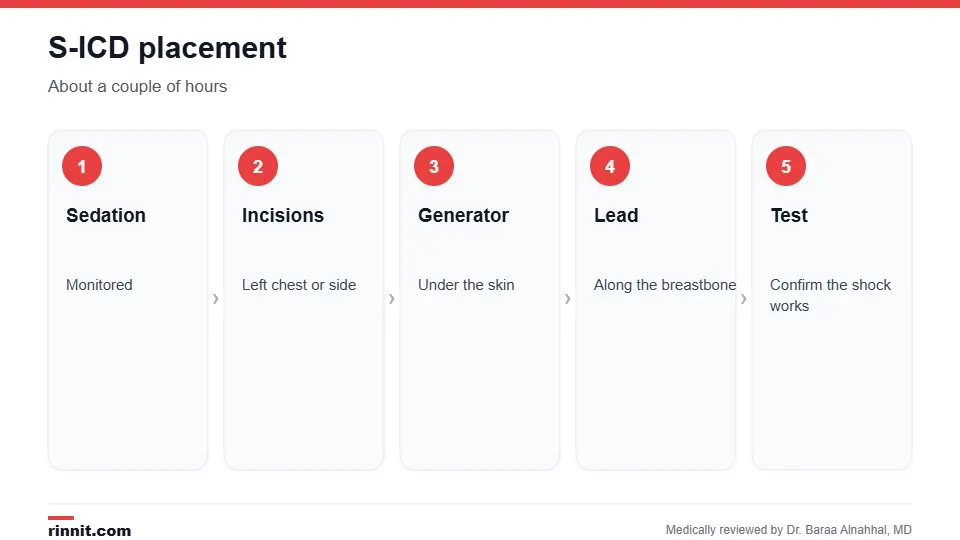
It usually takes a couple of hours.
You get sedation, and your heart, blood pressure and oxygen are monitored.
Two or three small incisions are made on the left chest or under the left arm.
The generator is placed under the skin near your rib cage.
The lead is tunneled along your breastbone toward your neck.
The team triggers an abnormal rhythm to confirm the device shocks correctly.
The incisions are closed. Sources: [1]
Risks
Bleeding or blood clots.
Damage to nearby tissues.
Incision infection.
Skin wearing thin over the device.
Device movement or lead irritation.
Unnecessary shocks. Sources: [1, 2]
Recovery and living with an S-ICD
Most people go home the same day.
Follow-up visits check your heart, device and battery.
Carry an ID card and tell all providers you have one.
Check with your doctor before travel and security screening.
When the battery runs out, a surgeon replaces the device. Sources: [1]
Learn more about defibrillators and device replacement. Sources: [1]
When to call your provider
Chest pain or shortness of breath.
Dizziness.
Fluid or pus from the incision.
Redness, swelling or pain at the incision.
Heart symptoms that don't go away. Call 911 if you get more than one shock in a short time, or a shock with chest pain, fainting or trouble breathing. Sources: [1]
Conclusion
An S-ICD protects you from deadly heart rhythms without placing wires in your heart. Ask your cardiologist whether it fits your heart condition and lifestyle.
Keep learning: read about ICDs and sudden cardiac arrest.
Frequently asked questions
What is an S-ICD?
A defibrillator placed under the skin instead of through the veins.
What does it do?
It shocks dangerous fast rhythms to prevent sudden cardiac death.
How is it different from a regular ICD?
Its single lead stays under the skin, not inside the heart.
Can an S-ICD pace my heart?
No. It can only monitor and shock.
Who is it best for?
People at high infection risk, active people and younger people.
How long does placement take?
About a couple of hours.
Will I stay overnight?
Most people go home the same day.
How long does the battery last?
About five years on average.
Can the battery be recharged?
No. The device is replaced when it runs out.
Can it give unnecessary shocks?
Yes, this can happen.
Related Reading
Understanding Implantable Cardioverter Defibrillators (ICD) standard ICDs.
Defibrillator: What It Is, Types, How It Works and Recovery types of defibrillators.
What Is Ventricular Tachycardia? A Plain-Language Guide to the Fast Heart Rhythm That Starts in the Heart's Lower Chambers a rhythm it treats.
Sudden Cardiac Arrest: Symptoms, Causes, Diagnosis, and Treatment Explained what an S-ICD prevents.
Wearable Defibrillator: How It Works, Uses, Risks and Daily Life an external option.
References
Cleveland Clinic. Subcutaneous Implantable Cardioverter Defibrillator (S-ICD). Cleveland Clinic. Last updated August 5, 2022. https://my.clevelandclinic.org/health/treatments/21046-subcutaneous-implantable-cardioverter-defibrillator-s-icd
Knops RE, Olde Nordkamp LRA, Delnoy PHM, et al. Subcutaneous or transvenous defibrillator therapy. New England Journal of Medicine. 2020;383(6):526-536. PMID 32757521. https://doi.org/10.1056/NEJMoa1915932
Nso N, Nassar M, Lakhdar S, et al. Comparative assessment of transvenous versus subcutaneous implantable cardioverter-defibrillator therapy outcomes: an updated systematic review and meta-analysis. International Journal of Cardiology. 2022;349:62-78. PMID 34801615. https://doi.org/10.1016/j.ijcard.2021.11.029
Medical disclaimer
This article is for general education only and does not replace advice from a qualified healthcare professional. Talk to your doctor about your own diagnosis and treatment, and seek emergency care right away for severe or sudden symptoms.



Comments