Subclavian Artery Stenosis: Symptoms, Causes, and Care

Updated: 2 days ago
Medically reviewed by Dr. Baraa Alnahhal, MD · Last reviewed: October 2026
Quick Answer
Subclavian artery stenosis is a narrowing of the artery that supplies blood to the arm, usually caused by plaque buildup. It can cause arm pain, cramping or numbness with use, though many people have no symptoms. Comparing arm blood pressures and imaging diagnose it. Treatment includes exercise, diet and medications, plus angioplasty with stenting when symptoms occur.
What the research says
Roughly 2% of people in the community have it. A cross-sectional study of 4,223 people defined significant subclavian stenosis as a blood pressure difference of 15 mm Hg or more between the arms and found it in 1.9% of two community cohorts and 7.1% of two clinical cohorts; it was linked to current smoking (odds ratio 2.61) and to peripheral artery disease (odds ratio 5.11) (Shadman et al., J Am Coll Cardiol, 2004) [2].
An arm-to-arm pressure gap is a clue, not a diagnosis. A meta-analysis of 17 studies found that an inter-arm systolic pressure difference of 10 mm Hg or more was associated with peripheral artery disease (risk ratio 2.22, 95% CI 1.41–3.5; 8 cohorts, 4,774 people) and was highly specific (91.9%) but not very sensitive (16.6%); two invasive studies also linked it to subclavian stenosis (Singh et al., J Am Soc Hypertens, 2015) [3]. That is why imaging is used to confirm the finding.
Stents open the artery more often at first, but long-term results look similar. A meta-analysis of 35 studies (1,726 patients) found higher technical success with stenting than with angioplasty alone (92.8% vs 86.8%), while long-term patency (76.9% vs 79.6%) and symptom resolution (82.2% vs 73.0%) did not differ significantly; the authors rated confidence in the estimates as low (Ahmed et al., Cardiovasc Intervent Radiol, 2016) [4].
What is subclavian artery stenosis?
Subclavian artery stenosis is a condition characterized by the narrowing of one of the primary arteries that supply oxygenated blood to the arms. This narrowing most frequently occurs because of a buildup of plaque, a combination of fats, cholesterol, and other substances, inside the arterial walls. This process, known as atherosclerosis, is similar to the plaque buildup that causes peripheral artery disease (PAD) in the legs, and subclavian artery stenosis can be thought of as a form of PAD.
In the United States, about 2% to 7% of people have this condition, and the figure rises to about 19% among people who have peripheral vascular disease. [1] It occurs more often in females. [1] The left subclavian artery is affected more often than the right because it branches directly from the aorta, while the right branches from a different artery. [1] Rarely, both sides are narrowed.
Although the condition can be asymptomatic, it serves as a critical indicator that plaque may be accumulating in other vital arteries throughout the body.

What are the symptoms and warning signs of subclavian artery stenosis?
Many people with subclavian artery stenosis do not notice symptoms because the body uses collateral circulation, other blood vessels that pick up the slack, to make sure the arm receives enough blood. When symptoms do occur, they typically develop gradually once the narrowing reaches about 50%. [1]
The most common symptoms are related to reduced blood flow during physical activity involving the affected arm. These signs can affect daily functioning and should be evaluated by a healthcare professional.
Symptom Type | Common Manifestations |
|---|---|
Activity-Related | Muscle cramps, pain, or a feeling of tiredness in the arm during use. |
Neurological | Tingling or numbness (paresthesia) in the affected arm. |
Rare Signs | Dizziness, fainting, or vertigo, which are more likely if a steal syndrome develops. |
Physical Signs | A cool hand, a weak pulse in one arm, or wounds on the hand that are slow to heal. |
Possible complications include subclavian steal syndrome, coronary steal syndrome, a piece of plaque breaking off and blocking a smaller blood vessel closer to the fingers, reduced blood flow to the heart, brain, or arm, and transient ischemic attack (TIA). [1]
What causes subclavian artery stenosis, and what are the risk factors?
Atherosclerosis is the most common cause of subclavian artery narrowing, but several other conditions can lead to stenosis. These include inflammation of the blood vessels (vasculitis), radiation therapy to the chest, and compression from thoracic outlet syndrome. Less common causes include Takayasu's arteritis, fibromuscular dysplasia, and neurofibromatosis. [1]
Understanding the risk factors is essential for prevention and management. Many of them are linked to overall cardiovascular health and lifestyle choices.
Risk Factor Category | Specific Examples |
|---|---|
Demographics | Being in your 50s or 60s; being female, since the condition occurs more often in females. |
Medical Conditions | High blood pressure, diabetes, high cholesterol, peripheral artery disease in the legs, and Takayasu's arteritis. |
Lifestyle Choices | Tobacco use, a sedentary lifestyle, and a diet high in saturated or trans fats. |
Physical Metrics | Having a body mass index (BMI) greater than 25. [1] |

How is subclavian artery stenosis diagnosed?
Healthcare providers typically diagnose subclavian artery stenosis with a physical examination and specialized imaging tests. A key step is comparing blood pressure in both arms. A difference of more than 10 to 15 millimeters of mercury (mmHg) suggests narrowing in the artery of the arm with the lower pressure. [1]
Physical Exam: Checking pulses, looking for a cool hand or slow-healing wounds, and listening with a stethoscope for a whooshing sound (bruit).
Ultrasound: A non-invasive test used to check the speed and direction of blood flow through the artery.
CT and MR Angiograms: Advanced imaging that gives detailed views of the blood vessels and the extent of any blockage.
Traditional Angiogram: An invasive procedure that uses contrast dye to visualize the arteries, sometimes using digital subtraction to make bones and other structures less visible.
How is subclavian artery stenosis managed and treated?
Treatment depends on whether you have symptoms and how severe the narrowing is. If you have no symptoms, the narrowing itself does not need treatment, but your provider will want to address the plaque buildup behind it to prevent a heart attack or stroke.
For people with symptoms, healthcare providers may recommend medications or procedures to restore blood flow and prevent complications such as subclavian steal syndrome or TIA. Endovascular therapy has been shown to relieve symptoms in properly selected patients. [5]
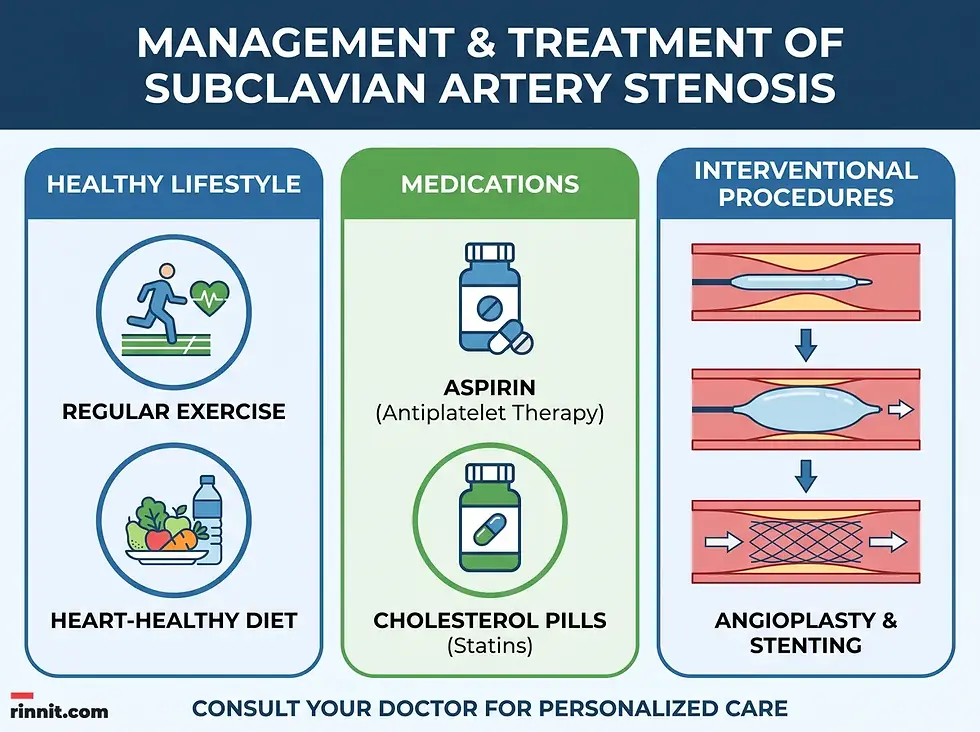
Lifestyle Changes: Being physically active for at least 30 minutes on most days of the week, staying at a healthy weight, avoiding tobacco, and eating foods low in saturated and trans fats. [1]
Medications: Aspirin, cholesterol-lowering medicines, and blood pressure medicines are commonly prescribed, along with medication for vasculitis if that is the cause.
Angioplasty and Stenting: A minimally invasive procedure that opens the narrowed artery with a small balloon and, often, a mesh tube (stent).
Bypass Surgery: In rare cases, a surgeon creates a new path for blood flow using another artery to go around the blockage.
Cleveland Clinic reports that angioplasty relieves symptoms in more than 95% of cases, and a pooled analysis of 35 studies found that about 77% to 80% of treated arteries stayed open over long-term follow-up. [1] Most people rest for a day or so afterward and can return to work within a week or less. After stenting, people typically take aspirin and clopidogrel to keep the stent from closing, with check-ups every six months for the first two years and yearly after that. [1]
Conclusion
Subclavian artery stenosis is a manageable condition and an important indicator of overall vascular health. Whether or not symptoms are present, addressing the underlying plaque buildup is vital for reducing the risk of heart attack and stroke. With healthy lifestyle choices and modern medical interventions, people can manage the condition and protect their long-term arterial health.
What are the next steps for subclavian artery stenosis?
If you notice a difference in the strength of your pulse, or you have pain and numbness in your arm during activity, schedule an evaluation with your healthcare provider. Call 911 right away for sudden weakness or numbness on one side, trouble speaking, vision loss or severe dizziness, which can signal a stroke or TIA. Early detection and proactive management of arterial narrowing are key to protecting your cardiovascular future.
Frequently Asked Questions
1. What is subclavian artery stenosis?
It is the narrowing of the artery that supplies blood to your arm, usually because of plaque buildup.
2. What causes the narrowing?
The most common cause is atherosclerosis (plaque), but it can also be caused by vasculitis, radiation to the chest, thoracic outlet syndrome, Takayasu's arteritis, fibromuscular dysplasia, or neurofibromatosis.
3. What are the common symptoms?
Arm pain, muscle cramps, tiredness, and tingling or numbness during use of the affected arm are the most frequent signs. Dizziness, fainting, and vertigo are rare.
4. Why is it more common on the left side?
The left subclavian artery branches directly off the aorta, which makes it more prone to plaque buildup than the right one, which branches from a different artery.
5. How is it diagnosed?
Doctors check the pulse and compare blood pressure in both arms, listen for a whooshing sound (bruit), and use imaging such as ultrasound, CT angiography, or MR angiography.
6. What is a significant blood pressure difference between the arms?
A difference of more than 10 to 15 mmHg is a key clue. The pressure is lower in the arm supplied by the narrowed artery.
7. Can I have stenosis without symptoms?
Yes. Many people have no symptoms because other arteries supply enough blood to the arm. It can still be a warning sign of plaque in other arteries.
8. What are the risk factors?
Smoking, high blood pressure, high cholesterol, diabetes, a sedentary lifestyle, a diet high in saturated or trans fat, a BMI over 25, and peripheral artery disease in the legs.
9. What is subclavian steal syndrome?
It is a complication in which a severe blockage causes blood to flow backward in a vertebral artery, drawing blood away from the brain to supply the arm.
10. How is it treated?
Treatment includes lifestyle changes and medications. When symptoms are present, angioplasty (often with a stent) is the usual procedure, and bypass surgery is rarely needed.
11. What medications are used?
Aspirin, cholesterol-lowering medicines, and blood pressure medicines are commonly used. If vasculitis is the cause, medication for that condition is added.
12. What is angioplasty?
It is a minimally invasive procedure in which a small balloon opens the narrowed artery, often followed by placing a mesh tube (stent) to keep it open.
13. How long is the recovery from angioplasty?
Most people rest for about a day and can return to work and drive within a week or less. Recovery from bypass surgery takes longer.
14. Is treatment always required?
No. If you have no symptoms, the narrowing itself does not need treatment, but the underlying plaque buildup and its risk factors still do.
15. Can lifestyle changes help?
Yes. Regular exercise, a heart-healthy diet low in saturated and trans fats, a healthy weight, and quitting tobacco are essential for managing the condition and preventing it from returning.
Trusted External Resources
Related Reading
Subclavian Artery: Anatomy, Essential Functions, and Care explains where the subclavian artery runs and what it supplies.
Arteriosclerosis & Atherosclerosis: Symptoms, Causes, Diagnosis & Treatment — Complete Guide explains the plaque buildup behind most cases of artery narrowing.
Angioplasty: Procedure, Types, Risks and Recovery describes how a balloon and stent open a narrowed artery.
Carotid Artery Disease: The Silent Stroke Risk in Your Neck, Explained covers narrowing of the neck arteries and its stroke risk.
References
Cleveland Clinic. Subclavian Artery Stenosis. Cleveland Clinic. Last updated November 30, 2023. https://my.clevelandclinic.org/health/diseases/subclavian-artery-stenosis-and-disease
Shadman R, Criqui MH, Bundens WP, et al. Subclavian artery stenosis: prevalence, risk factors, and association with cardiovascular diseases. J Am Coll Cardiol. 2004;44(3):618-623. PMID 15358030. https://doi.org/10.1016/j.jacc.2004.04.044
Singh S, Sethi A, Singh M, et al. Simultaneously measured inter-arm and inter-leg systolic blood pressure differences and cardiovascular risk stratification: a systemic review and meta-analysis. J Am Soc Hypertens. 2015;9(8):640-650.e12. PMID 26160261. https://doi.org/10.1016/j.jash.2015.05.013
Ahmed AT, Mohammed K, Chehab M, et al. Comparing percutaneous transluminal angioplasty and stent placement for treatment of subclavian arterial occlusive disease: a systematic review and meta-analysis. Cardiovasc Intervent Radiol. 2016;39(5):652-667. PMID 26630966. https://doi.org/10.1007/s00270-015-1250-9
Saha T, Naqvi SY, Ayah OA, et al. Subclavian artery disease: diagnosis and therapy. Am J Med. 2017;130(4):409-416. PMID 28109967. https://doi.org/10.1016/j.amjmed.2016.12.027
Medical Disclaimer
This article is for informational purposes only and does not constitute medical advice. Always seek the advice of your physician or other qualified health provider with any questions you may have regarding a medical condition. Never disregard professional medical advice or delay in seeking it because of something you have read in this article. If you think you may have a medical emergency, call your doctor or emergency services immediately.



Comments