Stereotactic Radiosurgery (SRS): Precision Non-Invasive Treatment for Brain Abnormalities

Updated: 3 days ago
Medically reviewed by Dr. Baraa Alnahhal, MD · Last reviewed: October 2026
Quick Answer
Stereotactic radiosurgery is a non-surgical radiation treatment that focuses many tiny beams on precise targets in the brain to shrink or destroy tumors, seal abnormal blood vessels and block pain signals without incisions. The image-guided procedure typically takes one to four hours, and most patients go home the same day, offering an alternative to traditional neurosurgery.
What the research says
SRS alone caused less cognitive decline than SRS plus whole-brain radiation. In a trial of 213 patients with 1 to 3 brain metastases, cognitive deterioration at 3 months occurred in 63.5% of patients treated with SRS alone versus 91.7% of those who also had whole-brain radiotherapy, with no significant difference in overall survival (median 10.4 vs 7.4 months; hazard ratio 1.02, 95% CI 0.75–1.38) (Brown et al., JAMA, 2016) [2].
Skipping whole-brain radiation raises the chance of relapse in the brain. In 132 patients with 1 to 4 brain metastases, the 12-month brain tumor recurrence rate was 76.4% with SRS alone versus 46.8% with SRS plus whole-brain radiotherapy, while median survival was similar (8.0 vs 7.5 months; P = .42) (Aoyama et al., JAMA, 2006) [3]. This is why careful follow-up imaging is part of SRS care.
What is stereotactic radiosurgery (SRS)?
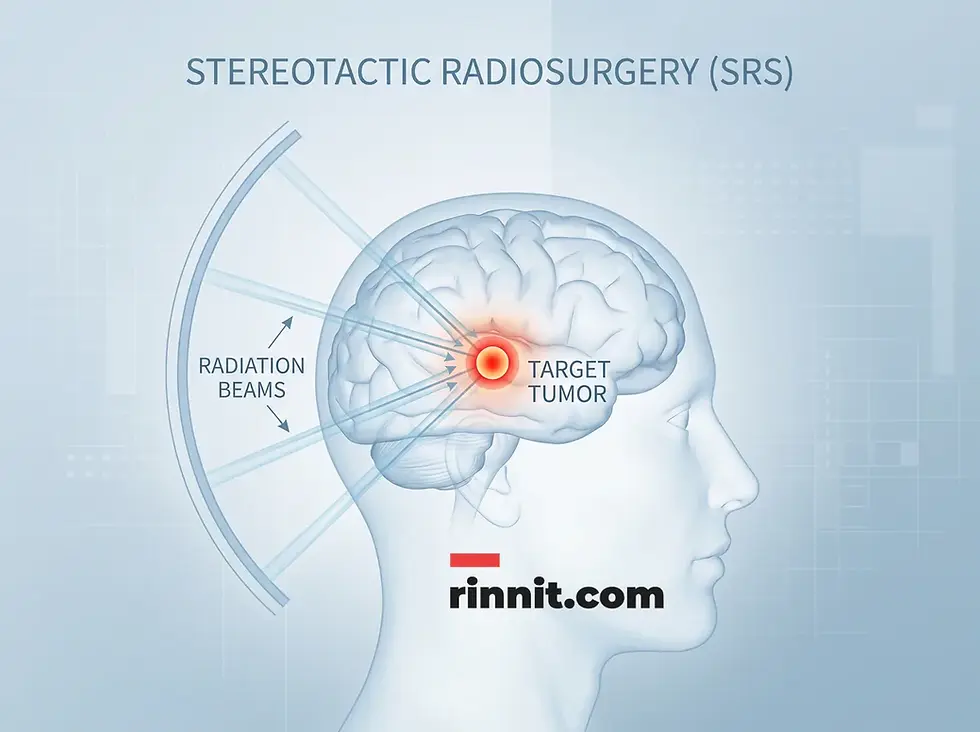
Stereotactic radiosurgery is a cornerstone of modern cancer and neurological care. It is a specialized form of image-guided radiation therapy designed to treat small brain tumors and other abnormalities inside the skull. [1] Its hallmark is precision: sophisticated computer planning directs multiple tiny, high-dose beams to a specific target. The beams meet at the exact location of the diseased tissue, delivering a high dose to the target while surrounding healthy brain tissue receives far less. [1] For background on radiation treatment in general, see our guide to radiation therapy.
Although the term "surgery" is used, SRS is entirely non-invasive and needs no cuts or incisions. [1] That makes it valuable for patients whose tumors sit near vital structures, such as major blood vessels or critical nerves, where open surgery would be too risky. Beyond cancerous and noncancerous tumors (see our guide to brain tumors), SRS is also used for functional problems, such as sealing arteriovenous malformations (AVMs) or treating trigeminal neuralgia by blocking abnormal nerve signals. [1]
What technologies are used in stereotactic radiosurgery (SRS)?
SRS is delivered with several types of advanced equipment. Each offers its own way of holding the patient still and directing the radiation beams, so the care team can tailor treatment to the patient's needs.
Technology | How It Works | Clinical Use |
|---|---|---|
Gamma Knife | A stationary unit with a head frame or mask delivers many focused gamma radiation beams. [1] | Mainly brain tumors and functional neurological conditions. |
Linear accelerator (LINAC) | A linear accelerator on a rotating gantry (or robotic arm in some systems) moves in arcs around the patient, delivering high-energy X-ray beams. [1] | Versatile; used for the brain (SRS) and the body (stereotactic body radiation therapy, SBRT). |
Proton therapy | Uses concentrated streams of high-energy particles (protons) to target tissue. [1] | A newer and less common form of SRS [1] that offers precise depth control. |

What happens during stereotactic radiosurgery, from preparation to delivery?
Preparation involves a thorough review of your medical history and detailed explanations from the care team. On the day of treatment, you are usually advised to avoid jewelry and makeup. [1] The treatment session typically lasts between one and four hours, depending on the complexity of the target and the technology used. [1]
The procedure follows a precise sequence. First, you are positioned on the treatment table and an immobilization device, such as a custom-fitted head frame or mask, is placed to prevent movement. [1] Next, imaging scans, including MRI and CT, pinpoint the exact location and shape of the target. [1] Using this data, the medical team designs a customized radiation plan. Finally, the SRS unit delivers the radiation beams as planned, a process that is painless. [1]
What are the benefits of stereotactic radiosurgery (SRS)?
The main advantage of SRS is effective treatment of serious conditions without the risks of invasive surgery. With no incisions, the risk of wound infection and surgical complications is much lower. [1] SRS is also often completed in a single session [1], which allows a faster return to daily activities than traditional neurosurgery.
Benefit | Description | Clinical Significance |
|---|---|---|
Non-invasive | No surgical incisions or cuts are required. | Avoids the risks of surgical bleeding, wound infection, and general anesthesia. |
High precision | Targets diseased tissue with pinpoint accuracy, typically within about a millimeter. | Spares healthy brain tissue and reduces side effects. |
Single session | Most treatments are completed in one visit. [1] | More convenient and shortens overall treatment time. |
Versatility | Treats both cancerous and benign conditions. [1] | Effective for tumors, vascular malformations, and some chronic pain conditions. |
What are recovery and the long-term outlook after stereotactic radiosurgery?
Most patients go home shortly after SRS. [1] The medical team may observe you for a few hours to make sure there are no immediate side effects. [1] SRS is generally well tolerated, but some people have mild, temporary side effects such as fatigue, nausea, or headaches [1], which usually resolve within a few days to a couple of weeks. If hair loss occurs in the treated area, it usually begins to grow back within two to three months. [1]
Long-term success is monitored with follow-up appointments and imaging. A follow-up visit is typically scheduled about one month after the procedure, with MRI or CT scans several months later to see how the target has responded. [1] For many people, SRS shrinks or stabilizes tumors and offers a durable solution for complex brain conditions with minimal disruption to daily life.

Conclusion
Stereotactic radiosurgery offers a precise, non-invasive alternative to traditional brain surgery. By combining advanced imaging with highly concentrated radiation, SRS provides an important treatment option for patients with complex brain tumors and neurological abnormalities, with few side effects and no surgical recovery.
What are the next steps for stereotactic radiosurgery (SRS)?
If you or a loved one is considering stereotactic radiosurgery, the first step is a consultation with a radiation oncologist or neurosurgeon. They will review your medical condition and imaging to decide whether you are a candidate for SRS, guide you through preparation, and build a personalized treatment plan.
Frequently Asked Questions
1. Is stereotactic radiosurgery actually surgery?
No. Despite the name, it is a non-invasive radiation treatment that needs no incisions or cuts.
2. Does the procedure hurt?
The radiation delivery itself is painless, though you may feel some pressure from the head frame if one is used.
3. How long does the treatment take?
The whole process, including setup and planning, typically takes between one and four hours.
4. Will I be awake during the procedure?
Yes. Most patients stay awake and can talk to the medical team through an intercom.
5. Can I go home the same day?
Yes. Most SRS treatments are done on an outpatient basis, and patients can go home shortly afterward.
6. What conditions can SRS treat?
SRS is used for cancerous and noncancerous brain tumors, arteriovenous malformations (AVMs), and trigeminal neuralgia.
7. What are the most common side effects?
Common side effects include temporary fatigue, nausea, headaches, and, in some people, localized hair loss or skin changes.
8. How accurate is the radiation delivery?
SRS is extremely precise, targeting diseased tissue typically within about a millimeter while sparing healthy brain tissue.
9. How does SRS differ from traditional radiation?
SRS delivers a much higher dose of radiation to a very small, precise area, often in a single session.
10. What is Gamma Knife?
Gamma Knife is a type of SRS technology that uses many focused beams of radiation, typically for brain targets.
11. What is LINAC-based SRS?
LINAC (linear accelerator) systems deliver high-energy X-ray beams from multiple angles around the patient.
12. Will my hair fall out?
Hair loss may occur only in the specific area where the radiation beams enter the scalp, and it usually grows back.
13. When will I know if the treatment worked?
Follow-up MRI or CT scans are typically performed several months after the procedure to assess the results.
14. Are there any activities I should avoid after SRS?
Most patients return to normal activities within a day or two, but your doctor will give you specific guidance.
15. Is SRS covered by insurance?
Coverage varies by insurer, country, and diagnosis. Ask your care team to help you check coverage and any pre-authorization requirements.
16. How do I prepare for stereotactic radiosurgery?
Your care team reviews your medical history, tells you when to stop eating and drinking anything except water, and tells you whether to stop any medications before treatment [1]. Pre-treatment MRI and CT scans, and sometimes an angiogram, map the target and plan the radiation beams, and you may wear a head frame or mask to keep you still and protect healthy tissue [1]. On treatment day, do not wear jewelry or makeup; the session is not painful and takes one to four hours, or three to five sessions if the dose is fractionated [1].
17. When should I call my doctor after stereotactic radiosurgery?
Tell your provider about any symptoms that may be late effects of stereotactic radiation [1]. Common side effects include fatigue, headaches, nausea or vomiting, diarrhea, hair loss and skin changes; your provider can prescribe medicines for them, and fatigue, nausea and vomiting usually resolve within one to two days up to a few weeks [1]. Providers may also prescribe corticosteroids to reduce brain swelling, and you have a follow-up visit at about one month with imaging within a few months to check the response [1].
Related Reading
Trusted External Resources
References
Cleveland Clinic. Stereotactic Radiosurgery. Cleveland Clinic. Last updated May 9, 2025. https://my.clevelandclinic.org/health/procedures/stereotactic-radiosurgery
Brown PD, Jaeckle K, Ballman KV, et al. Effect of radiosurgery alone vs radiosurgery with whole brain radiation therapy on cognitive function in patients with 1 to 3 brain metastases: a randomized clinical trial. JAMA. 2016;316(4):401-409. PMID 27458945. https://doi.org/10.1001/jama.2016.9839
Aoyama H, Shirato H, Tago M, et al. Stereotactic radiosurgery plus whole-brain radiation therapy vs stereotactic radiosurgery alone for treatment of brain metastases: a randomized controlled trial. JAMA. 2006;295(21):2483-2491. PMID 16757720. https://doi.org/10.1001/jama.295.21.2483
Medical Disclaimer
This article is for informational purposes only and does not constitute medical advice. Always seek the advice of your physician or other qualified health provider with any questions you may have regarding a medical condition or treatment. Never disregard professional medical advice or delay in seeking it because of something you have read in this article.



Comments