Skin Lesions: Types, Causes, and Management Strategies

Updated: 2 days ago
Medically reviewed by Dr. Baraa Alnahhal, MD · Last reviewed: October 2026
Quick Answer: What is a skin lesion?
A skin lesion is any abnormal area of skin compared with the surrounding surface, often caused by injury, infection or disease. [1] Most, such as freckles, skin tags and moles, are benign and need no treatment unless bothersome. [1] Lesions that change in size, bleed or fail to heal may indicate skin cancer. [1] Diagnosis involves examination and possibly biopsy. [1]
What the research says
Dermoscopy improves melanoma detection, but only in experienced hands. A meta-analysis of 27 studies found that dermoscopy raised diagnostic accuracy for melanoma by 49% compared with inspection by the unaided eye (log odds ratio 4.0 vs 2.7), while untrained or less experienced examiners did no better than clinical inspection alone (Kittler et al., Lancet Oncol, 2002 [2]).
Daily sunscreen may lower melanoma risk. In a randomized trial of 1,621 adults in Queensland, Australia, 11 new primary melanomas were identified in the daily-sunscreen group versus 22 in the discretionary-use group 10 years after the trial ended (hazard ratio 0.50, 95% CI 0.24 to 1.02, borderline statistical significance). For invasive melanomas the counts were 3 versus 11 (Green et al., J Clin Oncol, 2011 [3]).
The burden of skin cancer is large and growing. Using national survey data, the average number of U.S. adults treated for skin cancer each year rose from 3.4 million (2002–2006) to 4.9 million (2007–2011), and average annual treatment costs rose from $3.6 billion to $8.1 billion (Guy et al., Am J Prev Med, 2015 [4]).
What are skin lesions?
Skin lesions are localized areas of the skin that look different from the surrounding healthy tissue. These abnormalities are extremely common and affect people of all ages and skin types. While many lesions are present at birth, such as certain moles or birthmarks, others develop over time due to environmental factors, infections, or internal health changes. The vast majority of these growths are benign (non-cancerous), but they can occasionally serve as early warning signs of more complex systemic issues or skin cancer.
The terminology can be confusing. For instance, "skin sore" is a term often used interchangeably with "lesion," though it more specifically refers to open areas like ulcers. [1] Even common conditions like acne are medically classified as skin lesions. [1] Understanding the nature of a lesion, whether it is a simple pimple or a potentially malignant growth, is the first step in maintaining long-term skin health.
How are skin lesions classified as primary or secondary?
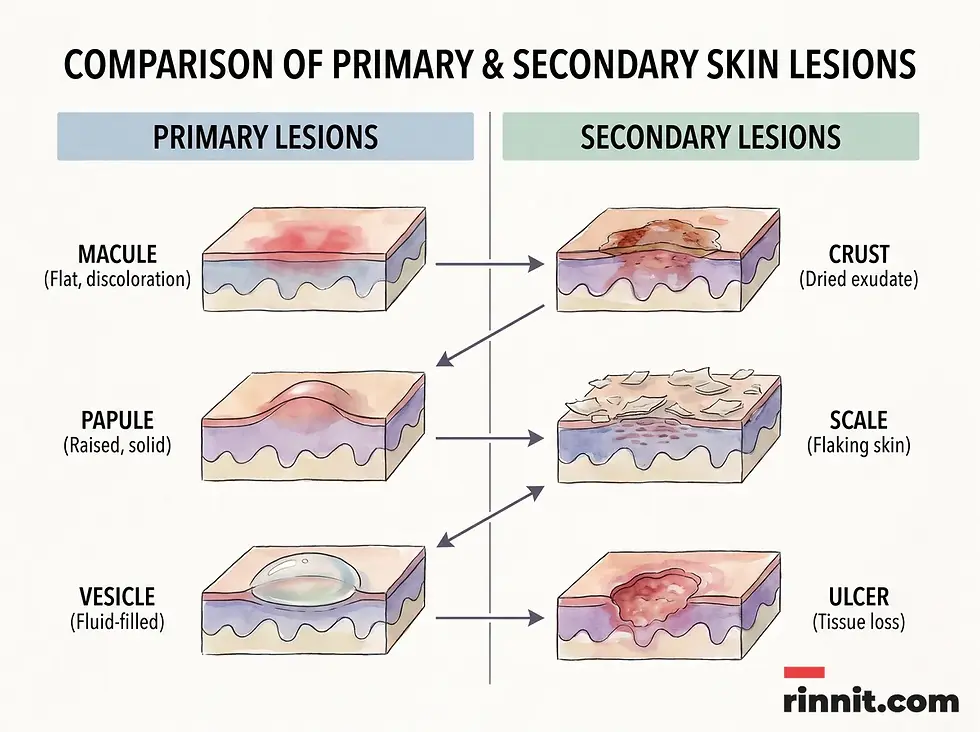
Dermatologists typically categorize skin lesions into two main groups: primary and secondary. Primary lesions are the initial changes in the skin that are not caused by other conditions or injuries. [1] These include flat marks like macules, elevated bumps known as papules or nodules, and fluid-filled blisters called vesicles or bullae. [1] Common examples of primary lesions include acne, birthmarks, insect bites, and sunburn. [1]
Secondary lesions, by contrast, develop as a modification of a primary lesion. [1] This can happen because of external factors like scratching or injury, or as the natural progression of an underlying condition like psoriasis. Examples include crusting (dried fluid), scaling (flaky skin), and fissures (painful breaks in the skin). [1] Recognizing the transition from a primary to a secondary lesion can provide important clues about the severity of a skin condition and the effectiveness of current treatments.
Lesion Category | Common Examples | Physical Characteristics |
|---|---|---|
Primary | Macules, papules, pustules | Flat marks, solid bumps, or pus-filled pimples [1] |
Secondary | Scars, ulcers, scales | Raised tissue, open sores, or peeling skin [1] |
Benign | Freckles, skin tags, moles | Non-cancerous, stable growths |
Malignant | Skin cancer (BCC, SCC) | Non-healing wounds or evolving growths |
What are the common causes and symptoms of skin lesions?
Because skin lesions cover a wide variety of conditions, their causes are equally diverse. Some are congenital, appearing at birth, while others are triggered by viral or bacterial infections, such as herpes or staph. [1] Allergic reactions to triggers like poison ivy or insect bites are also frequent causes. [1] Systemic issues such as poor circulation, autoimmune diseases, and even medication side effects can also show up as visible changes on the skin. [1]
The symptoms depend heavily on the type and cause of the lesion. General signs include abnormal growths, itchiness, swelling, or localized pain. [1] Color changes are also common, with lesions appearing red, brown, black, or even blue. [1]
Red Flags to Watch For
Monitor for warning signs that may point to a more serious condition. Seek medical attention promptly if a lesion:
How are skin lesions diagnosed and treated?
Diagnosis begins with a physical examination, in which a healthcare provider assesses the growth's size, shape, color, and texture. [1] A detailed medical history is also important to identify potential triggers, such as allergies or recent exposures. While many lesions can be identified by sight, some may require further testing, such as a microbial swab for infections, an allergy test, or a biopsy to rule out malignancy. [1]

Treatment is personalized to the diagnosis. Primary lesions are often managed with topical creams, ointments, or oral medications. [1] If a lesion is secondary, the focus shifts to treating the underlying medical condition. [1] For benign growths that are cosmetically bothersome, simple office procedures can often remove them. [1] Malignant lesions, however, typically require surgical removal to ensure all cancerous cells are taken out and to prevent further spread.
What is the outlook for skin lesions, and can they be prevented?
The long-term outlook for people with skin lesions is generally very positive, especially for benign conditions, which pose no threat to overall health. [1] For malignant lesions, early detection is the single most important factor in achieving a successful cure. With approximately 1 in 5 Americans developing skin cancer in their lifetime [1], regular monitoring and professional skin checks are vital parts of preventive healthcare.
Not all skin lesions can be prevented, but certain lifestyle choices can reduce risk. Consistent sun safety, including broad-spectrum sunscreen and seeking shade, helps prevent UV-induced damage. [1] [3] Using skincare products that do not clog pores (non-comedogenic) and being cautious during physical activity to avoid skin injuries can help maintain the skin's protective barrier. [1]

What are the next steps if you have a skin lesion?
If you notice a skin lesion that changes in size, shape, or color, bleeds, causes pain, or does not heal, schedule a visit with a healthcare provider or dermatologist for an evaluation.
Related reading on Rinnit: Acne: Complete Guide to Symptoms, Causes, Diagnosis, and Treatment · Moles: The ABCDE Warning Signs, Risk Factors, and When Removal Is Needed · Psoriasis: Complete Guide to Symptoms, Types, Causes, and Treatment
Frequently Asked Questions
What is the difference between a skin lesion and a sore?
"Lesion" is a broad term for any abnormal skin area, while "sore" typically refers to specific types like ulcers or open wounds.
Is acne considered a skin lesion?
Yes. Acne is a common type of primary skin lesion that can appear as pimples, cysts, or blackheads.
Are most skin lesions dangerous?
No. The majority of skin lesions are benign (non-cancerous) and harmless, though some can be signs of serious conditions.
What are primary skin lesions?
Primary skin lesions are initial skin changes not caused by other factors, such as birthmarks, insect bites, or blisters.
What causes secondary skin lesions?
Secondary skin lesions result from changes to primary lesions, often due to scratching, injury, or the progression of an underlying disease.
Can a skin lesion be a sign of an internal disease?
Yes. Some lesions are linked to underlying issues such as liver disease, kidney disease, or autoimmune disorders.
When should I be concerned about a skin lesion?
Seek medical advice if a lesion changes size or color, bleeds, causes severe pain, or fails to heal.
How do doctors diagnose skin lesions?
Diagnosis usually involves a physical exam, a review of medical history, and sometimes a biopsy or other tests.
Can benign lesions be removed?
Yes. If a benign lesion such as a skin tag is bothersome or you dislike how it looks, a provider can often remove it.
What is a malignant skin lesion?
A malignant lesion is skin cancer, which requires prompt medical treatment and often surgical removal.
Are skin lesions contagious?
Most are not, but those caused by viral or bacterial infections (like herpes or staph) can spread through contact.
Does every skin lesion require a biopsy?
No. Many can be identified through a physical exam, but a biopsy is used when cancer is suspected.
How common is skin cancer?
Skin cancer is the most common cancer in the U.S., affecting an estimated 1 in 5 people during their lifetime.
Can I prevent skin lesions?
Not all can be prevented, but sun safety and good hygiene can significantly reduce the risk of many types.
What is the outlook for benign lesions?
The outlook is excellent, as they are harmless and generally do not affect overall physical health.
References
Cleveland Clinic. Skin lesions. Cleveland Clinic. October 17, 2022. https://my.clevelandclinic.org/health/diseases/24296-skin-lesions
Kittler H, Pehamberger H, Wolff K, et al. Diagnostic accuracy of dermoscopy. Lancet Oncol. 2002;3(3):159-165. PMID 11902502. https://doi.org/10.1016/S1470-2045(02)00679-4
Green AC, Williams GM, Logan V, et al. Reduced melanoma after regular sunscreen use: randomized trial follow-up. J Clin Oncol. 2011;29(3):257-263. PMID 21135266. https://doi.org/10.1200/JCO.2010.28.7078
Guy GP Jr, Machlin SR, Ekwueme DU, et al. Prevalence and costs of skin cancer treatment in the U.S., 2002-2006 and 2007-2011. Am J Prev Med. 2015;48(2):183-187. PMID 25442229. https://doi.org/10.1016/j.amepre.2014.08.036
Medical Disclaimer
This article is for informational purposes only and does not constitute medical advice. Always seek the advice of your physician or other qualified health provider with any questions you may have regarding a medical condition or skin changes.



Comments