Short Sleeper Syndrome: Why Some People Need Less Sleep

Updated: 3 days ago
Medically reviewed by Dr. Baraa Alnahhal, MD · Last reviewed: October 2026
Quick Answer: What is short sleeper syndrome?
Short sleeper syndrome (SSS) is a condition in which a person naturally needs much less sleep than most people, usually six or fewer hours a night. [1] People with it wake feeling refreshed and keep high energy without an alarm clock. [1] The trait is linked to genetic changes, including in the DEC2 and ADRB1 genes, and has no known health risks. [1]
Is it really SSS?
Many people sleep fewer than six hours because they are cutting sleep short, not because they need less. [2] If you feel sleepy during the day, need to catch up on sleep on weekends, or depend on an alarm to wake up, you are probably not a natural short sleeper. Talk to your healthcare provider if you are unsure.

What the research says
A single gene change was linked to naturally short sleep. In 2009, researchers identified a mutation in the DEC2 gene (hDEC2-P385R) associated with a human short sleep trait. Mice carrying the same mutation spent more time alert and slept less than control mice (He et al., Science, 2009) [3].
Short sleep with resistance to sleep loss has been seen in a twin pair. Researchers sequenced the BHLHE41 (DEC2) gene in two cohorts (200 people with acute sleep deprivation and 217 with chronic partial sleep deprivation). In one twin of a dizygotic pair, the Y362H variant was linked to shorter sleep, less recovery sleep after deprivation, and fewer performance lapses than the twin without it (Pellegrino et al., Sleep, 2014) [4].
Natural short sleep appears to be an intrinsic trait without related health concerns. A systematic review of 12 articles on natural short sleepers’ genes found that the short-sleep trait was intrinsic to affected individuals and was not accompanied by related health concerns. The authors noted that few studies exist because the trait is rare (Yook et al., Cureus, 2021) [6].
What is short sleeper syndrome, and who are natural short sleepers?
Short sleeper syndrome, also called short sleep syndrome, is a state in which a person functions well on much less rest than most people. Typical sleep needs vary, but natural short sleepers (NSS) consistently get six or fewer hours on most nights. [1] Healthcare providers do not consider SSS a sleep disorder because it does not cause the symptoms or health risks linked to inadequate sleep. [1]
Most natural short sleepers notice the pattern in childhood or adolescence. [1] [2] It usually stays consistent throughout life, although sleep needs may change with age. [1] Because they wake up energetic and rested, many people with SSS do not think their sleep is unusual until they compare it with other people’s habits.
What genetic causes and inheritance patterns explain short sleeper syndrome?
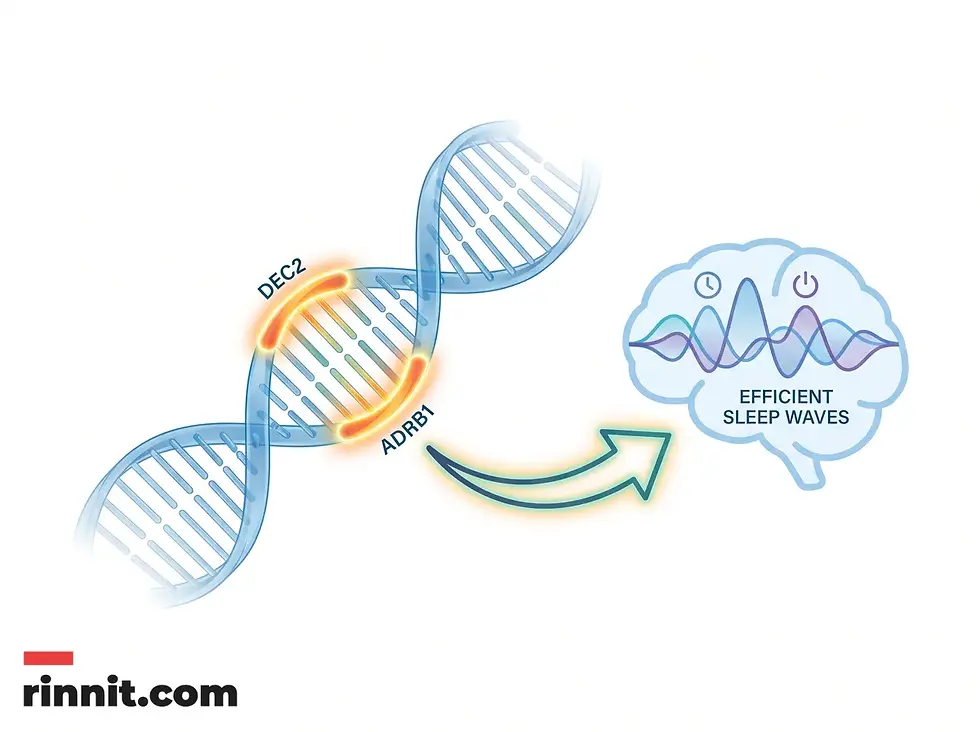
Research suggests that SSS has a biological basis. Scientists have found specific gene changes in natural short sleepers, most notably in the DEC2 and ADRB1 genes. [1] Researchers believe these changes make it possible to feel refreshed and function fully on less sleep than the general population. [1] For example, a rare ADRB1 mutation found in people who need fewer hours of sleep led to short-sleep behavior in mice, and the receptor is highly expressed in a brain region called the dorsal pons (Shi et al., Neuron, 2019). [5]
Because these genetic changes are inherited, the trait often runs in biological families, and parents may pass the changes to their children. [1] The true prevalence is hard to know, but researchers have so far identified about 50 families with genetic mutations linked to the condition. [1] This rarity is what separates true SSS from the much more common sleep deprivation caused by lifestyle.
Feature | Short Sleeper Syndrome (SSS) | Typical Sleep Habits |
Nightly Sleep Duration | 6 hours or fewer (often 4 to 6) [1] | Most adults need 7 or more hours [2] |
Wake-Up Method | Usually wakes naturally, without an alarm | Often needs an alarm |
Daytime Alertness | Consistently high energy | May feel drowsy if sleep is short |
Sleep Quality | Typically good and restorative | Varies by person |
Health Risks | No known health problems [1] | Chronic sleep loss is linked to health risks |
What are the symptoms of short sleeper syndrome?
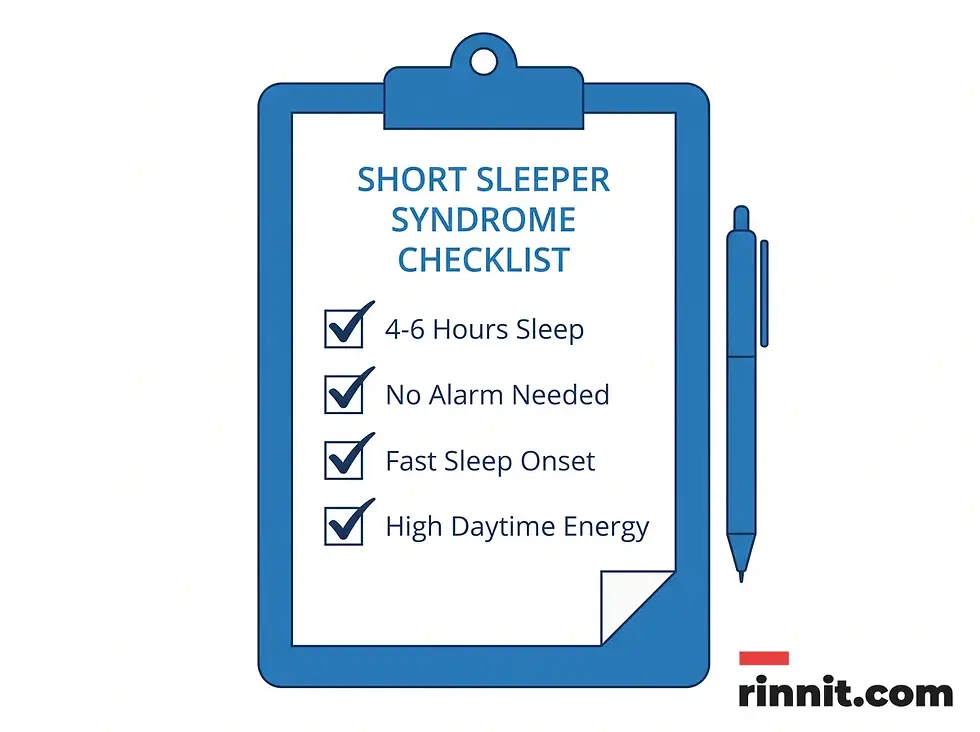
The main sign of short sleeper syndrome (SSS) is sleeping only four to six hours a night without daytime drowsiness, fatigue or thinking problems. [1] Natural short sleepers wake on their own even when they have nothing to get up for, and they typically:
Unlike people with insomnia, people with SSS do not struggle to fall asleep or stay asleep. [2] They simply need less total sleep to feel rested, and they do not have the fatigue or thinking problems that affect people who are sleep-deprived. Their energy stays steady through the day without extra rest or naps.
How is short sleeper syndrome diagnosed?
SSS can be hard to confirm. [1] A healthcare provider reviews your sleep history and daily habits, including bedtime routine, daytime sleepiness, and sleep schedules on weekdays and weekends. [1] They may also do a physical exam and ask about stress, exercise, and alcohol use. [1]
There are no specific tests for SSS. [1] A provider may recommend a sleep study (polysomnography) to rule out other sleep disorders and to tell natural short sleep apart from conditions that cause broken or poor-quality sleep. [1]
Condition | Primary Characteristic | Distinction from SSS |
Insomnia | Difficulty falling or staying asleep [2] | People with SSS sleep easily and well |
Sleep Apnea | Breathing interruptions during sleep | SSS involves continuous, restorative sleep |
Narcolepsy | Excessive daytime sleepiness | People with SSS stay alert all day |
Restless Legs Syndrome | Uncomfortable leg sensations | SSS does not involve limb discomfort |
How is short sleeper syndrome managed, and what is the long-term outlook?
SSS is not a disorder and does not cause known health problems, so treatment is usually not needed. [1] Natural short sleepers do not appear to share the health risks, such as cardiovascular disease, heart attack, or type 2 diabetes, that are linked to not getting enough sleep. [1] Their sleep quality tends to be good, and good-quality sleep helps lower those risks. [1]
For people with SSS, self-care is about protecting sleep quality. Helpful habits include:
Conclusion
Short sleeper syndrome is a natural variation in human biology rather than a medical problem. Most people need more rest to function, but natural short sleepers thrive on much less because of their genetic makeup. As long as you feel refreshed and keep your energy through the day, needing only a few hours of sleep is a normal and healthy trait for people with SSS.
What are the next steps if you think you have short sleeper syndrome?
If you think you may be a natural short sleeper, track your energy levels and sleep patterns to understand your body’s needs. See a healthcare provider if you feel sleepy during the day or your sleep habits change.
Trusted resources: Cleveland Clinic: Short Sleeper Syndrome, American Academy of Sleep Medicine: Short Sleeper.
Frequently Asked Questions
What is short sleeper syndrome?
Short sleeper syndrome is a condition in which a person naturally needs six or fewer hours of sleep per night to feel fully rested and energetic.
Is SSS considered a sleep disorder?
No. Healthcare providers do not consider it a sleep disorder because it does not cause health problems or daytime impairment.
How do I know if I have SSS?
Natural short sleepers wake up refreshed after 4 to 6 hours of sleep and are not drowsy during the day. Talk to a healthcare provider if you are unsure.
Can you develop SSS later in life?
Symptoms usually begin in childhood or adolescence and typically last throughout life.
What causes short sleeper syndrome?
Short sleeper syndrome is linked to genetic changes, including changes in the DEC2 and ADRB1 genes.
Is the condition hereditary?
Yes. These genetic changes can be passed from parents to children within biological families.
Are there health risks associated with SSS?
There are no known health risks. Natural short sleepers do not appear to face the same risks as people who are sleep-deprived.
Do short sleepers need an alarm clock?
Most natural short sleepers wake on their own without an alarm.
Can SSS be prevented?
There is no known way to prevent it, because it is thought to be caused by genetic factors.
How is SSS diagnosed?
Diagnosis involves a review of your sleep habits and history, and sometimes a sleep study to rule out other sleep disorders.
Is there a treatment for SSS?
Treatment is usually not needed because the condition does not cause negative symptoms.
Does SSS affect sleep quality?
Natural short sleepers typically have good-quality, restorative sleep.
What should I do if I only sleep 5 hours a night?
If you feel refreshed and energetic, it may be your natural pattern. If you feel sleepy during the day, or you need to catch up on weekends, you may be short on sleep, so talk to a healthcare provider.
How common is short sleeper syndrome?
It is hard to know exactly, but researchers have identified about 50 families with the linked genetic mutations.
Can short sleepers have insomnia?
Yes, anyone can. But SSS itself is different: people with SSS feel rested, while insomnia involves trouble sleeping and feeling tired.
Related Reading
Understanding Sleep Basics: Functions, Stages, and Requirements explains sleep stages and how much sleep most people need.
Sleep Study (Polysomnography): What It Tests, What to Expect and Results describes the overnight test used to rule out other sleep disorders.
Circadian Rhythm Sleep Disorders: What Your Internal Clock Is, Why It Gets Out of Sync, and How to Fix It explains how body clock problems can shift or shorten sleep.
Paradoxical Insomnia: Symptoms, Causes, and Management describes a condition where people feel they barely sleep at all.
References
Cleveland Clinic. Short Sleeper Syndrome (SSS). Cleveland Clinic Health Library. Last updated December 25, 2023. https://my.clevelandclinic.org/health/diseases/short-sleeper-syndrome-sss
American Academy of Sleep Medicine. Short sleeper. Sleep Education. Reviewed January 2021. https://sleepeducation.org/sleep-disorders/short-sleeper/
He Y, Jones CR, Fujiki N, et al. The transcriptional repressor DEC2 regulates sleep length in mammals. Science. 2009;325(5942):866-870. PMID 19679812. https://doi.org/10.1126/science.1174443
Pellegrino R, Kavakli IH, Goel N, et al. A novel BHLHE41 variant is associated with short sleep and resistance to sleep deprivation in humans. Sleep. 2014;37(8):1327-1336. PMID 25083013. https://doi.org/10.5665/sleep.3924
Shi G, Xing L, Wu D, et al. A rare mutation of β1-adrenergic receptor affects sleep/wake behaviors. Neuron. 2019;103(6):1044-1055.e7. PMID 31473062. https://doi.org/10.1016/j.neuron.2019.07.026
Yook JH, Rizwan M, Shahid NUA, et al. Some twist of molecular circuitry fast forwards overnight sleep hours: a systematic review of natural short sleepers’ genes. Cureus. 2021;13(10):e19045. PMID 34722012. https://doi.org/10.7759/cureus.19045
Medical Disclaimer
This article is for informational purposes only and does not constitute medical advice. Always seek the advice of your physician or other qualified health provider with any questions you may have regarding a medical condition or sleep pattern.



Comments