Circadian Rhythm Sleep Disorders: What Your Internal Clock Is, Why It Gets Out of Sync, and How to Fix It

Updated: 2 days ago
Medically reviewed by Dr. Baraa Alnahhal, MD · Last reviewed: October 17, 2026
Quick Answer
Circadian rhythm sleep disorders are conditions that disrupt the body's natural sleep-wake cycle, changing when and how well you sleep [1]. There are six main types, including jet lag and shift work disorder [1]. Diagnosis uses sleep logs, questionnaires and actigraphy [1]. Treatment includes adjusting light exposure, melatonin or prescription medications and sleep hygiene [1], and many types resolve with simple adjustments.
What the research says
High-quality evidence on sleep-timing disorders is scarce. A Lancet series paper reviewing the existing categories of circadian rhythm sleep-wake disorders noted that very few high-quality epidemiological and intervention studies exist, and that wider recognition and treatment are hindered by a scarcity of accessible, objective tools for measuring sleep and circadian physiology (Meyer et al., Lancet, 2022) [2].
Vision loss sharply raises the risk. In a telephone survey of 157 visually impaired Japanese individuals, 33.1% had a circadian rhythm sleep-wake disorder, most often the non-24-hour or irregular type (26.8%), and the absence of light perception was significantly associated with the disorder (Tamura et al., BMC Public Health, 2021) [3].
Light timing is a core lever. An international expert consensus report recommended specific daytime, evening, and nighttime indoor light levels for healthy adults, based on how sensitively the circadian, neuroendocrine, and alerting systems respond to light reaching the eyes (Brown et al., PLoS Biol, 2022) [4].
What Is a Circadian Rhythm Sleep Disorder?
Your body has a natural, automatic clock called the circadian rhythm. The word "circadian" comes from Latin and means "around the day." This clock tells your body when to sleep and wake, and it involves many systems throughout your body working together. For most people, the rhythm runs automatically with no problems.
A circadian rhythm sleep disorder (also called a circadian rhythm sleep-wake disorder) is a condition that disrupts this cycle. These disruptions change how well you sleep, when you sleep, and how you function while awake [1].
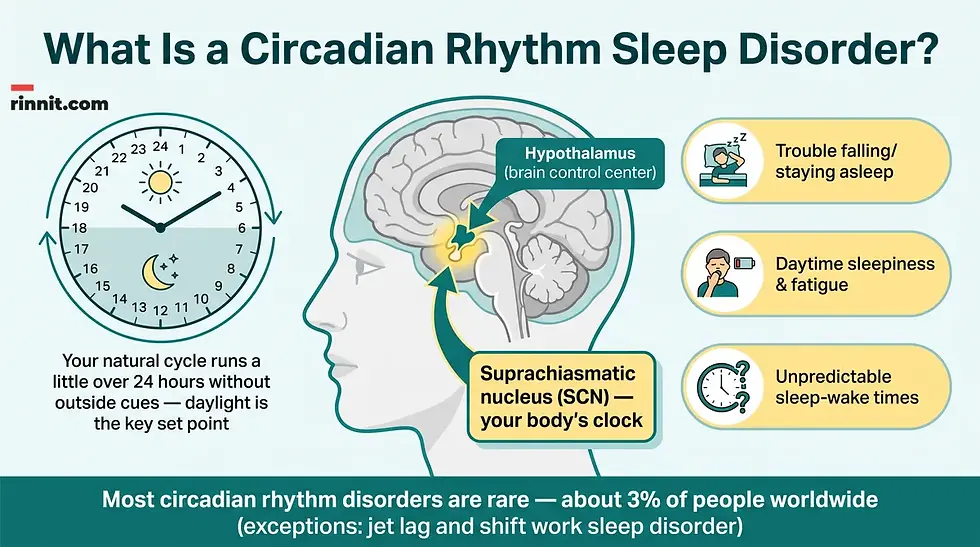
Your internal clock sits in the suprachiasmatic nucleus of the hypothalamus. Daylight is its key set point, and when it drifts out of sync, sleep and daytime alertness suffer.
What Does the Body's Internal Clock Look Like?
The circadian rhythm is anchored in the brain. Inside your brain sits a structure called the hypothalamus, a small control center that manages many automatic body functions. Within the hypothalamus is a cluster of brain cells (neurons) called the suprachiasmatic nucleus (SCN). The SCN is your body's clock.
Without any outside cues from light or routine, the human body naturally runs on a sleep-wake cycle that lasts a little over 24 hours [1]. Daylight and daily habits act as "set points" that keep the clock tuned to a true 24-hour day.
How Common Are Circadian Rhythm Disorders?
Most circadian rhythm disorders are rare. Experts estimate they affect about 3% of people worldwide [1]. Two types are important exceptions:
Type | How common is it? |
Jet lag disorder | Very common; expected for travelers flying to a destination with at least a two-hour time difference |
Shift work sleep disorder (SWSD) | Affects about one-third of people who work shifts during nighttime hours |
What Are the Different Types?
Type | What it means | Who it typically affects |
Jet lag disorder | Recent travel to a different time zone puts you out of sync with your usual day/night schedule | Air travelers crossing time zones |
Shift work sleep disorder (SWSD) | Trouble adjusting the circadian rhythm to a work schedule | People working night shifts |
Delayed sleep-wake phase disorder (DSWPD) | Sleep/wake schedule is much later than average | More common in children and teenagers |
Advanced sleep-wake phase disorder (ASWPD) | Going to bed earlier and waking earlier than average | More common in older adults |
Irregular sleep-wake rhythm disorder (ISWRD) | Sleep and wake times happen at unpredictable, disorganized intervals | Usually people with dementia or other degenerative brain diseases |
Non-24-hour sleep-wake rhythm disorder (N24SWD) | The rhythm is predictable but not 24 hours long, usually longer, sometimes shorter | People whose clock "runs long" |
Disorders that don't fit these categories are classified as "circadian sleep-wake disorder not otherwise specified."

The six main types of circadian rhythm sleep disorders. Types that don't fit are classified as "not otherwise specified."
What Are the Symptoms of Circadian Rhythm Sleep Disorders?
Symptoms of circadian rhythm sleep disorders revolve around sleep and waking, specifically your sleep cycle and how your body anchors itself to day and night. They vary by type, but common symptoms include:
Trouble falling asleep (insomnia)
Difficulty staying asleep
Trouble falling back asleep in the middle of the night or early in the morning
Waking up earlier than you want or plan
Trouble waking up (sleep inertia) or unpredictable sleep-wake times
Sleepiness during the day, which can lead to hypersomnia (excessive daytime sleepiness)
Needing to nap during the daytime
Fatigue
Headaches
Depression, irritability, and other issues caused by lack of sleep
What Causes Circadian Rhythm Sleep Disorders?
People with these disorders often have differences in their body's natural "clock" or related processes, sometimes because of a problem in part of the brain. The SCN sits in the hypothalamus and has a direct connection to your eyes, which is why daylight is a key set point for the clock [1].
Cause | What it involves |
Brain damage or disruptions | Degenerative brain diseases, head injuries, and infections that cause encephalitis (brain inflammation) |
Vision impairments | Damage to the eyes, retinas, or optic nerves, because the SCN connects directly to the eyes |
Travel | Jet lag: modern technology lets us travel faster than our bodies know how to adjust |
Work | Starting overnight shifts disrupts the rhythm |
Unknown | Some people develop these disorders for reasons experts can't explain |
What Are the Risk Factors?
Several factors can make circadian rhythm disorders more likely. Some are manageable; others are not.
Risk factor | How it raises risk |
Age | Children and teens are more likely to develop DSWPD; adults over 60 are more likely to have ASWPD |
Genetics | Sleep traits can be inherited from one or both parents; some genetic mutations are linked to higher risk |
Direction of air travel | Flying east (which advances your sleep cycle) causes more severe jet lag than flying west (which delays it) |
Shift timing changes | Shift workers moving to an earlier shift than they're used to face more problems |
Neurodevelopmental differences | People with ADHD or autism spectrum disorder may be more prone |
What Complications Can Develop?
These disorders range from mild to major disruption. Possible complications include school or work difficulties, other sleep problems (especially chronic insomnia), substance use (over-the-counter sleeping pills, alcohol, or drugs that can lead to alcohol use disorder or substance use disorder), and accidents or injuries caused by daytime sleepiness [1].
How Are Circadian Rhythm Sleep Disorders Diagnosed?
To receive a diagnosis, you must have symptoms for at least three months, with one exception: jet lag disorder has no time requirement [1]. A healthcare provider diagnoses these disorders using a combination of methods.
Test or method | What it looks for |
Questionnaires and medical history | Your symptoms, sleep habits, and changes affecting work or personal life |
Physical and neurological exam | Signs of any condition causing or contributing to rhythm issues |
Lab testing | Saliva, blood, and urine tests that check hormone levels and other markers |
Imaging scans | CT and MRI scans to find conditions that could be causing rhythm problems |
Sleep logs | A diary you keep to track your sleep behaviors |
Actigraphy | A wearable, watch-like, motion-sensitive device worn around the clock for a few days up to two weeks to track activity patterns |
Your provider may recommend other tests depending on your symptoms and what they suspect.
How Are Circadian Rhythm Sleep Disorders Treated?
Treatments vary by disorder and personal circumstances. Your plan may involve one or more of three approaches: adjusting lighting, medications, and sleep behavior changes [1].
Adjusting Your Lighting
Because the SCN connects directly to your retinas, daylight has a strong effect on most people's circadian rhythm [1] [4]. Generally, bright light helps you wake up and dim light helps you wind down. Practical steps include turning on bright lights in the morning and dimming lights as you get ready for bed [1].
Light color matters too. Cooler temperatures of light contain more blue (think sky blue), and your brain is most sensitive to blue light. Use cool (blue) light during the daytime, then switch to warmer, yellow light as evening nears [1]. Since televisions, computer monitors, and smartphones all emit blue light, adjusting screen color settings and limiting screen use before bedtime may help you sleep [1].
Medications
Your body naturally produces melatonin, a hormone that regulates the circadian rhythm and makes you sleepy. Work with your healthcare provider to determine the right dose of melatonin [1]. Supplements are available over the counter, and prescription medications work similarly; examples include tasimelteon and ramelteon, both often prescribed for circadian rhythm disorders.
Sleep Behavior Adjustments (Sleep Hygiene)
"Sleep hygiene" is the term providers use for behaviors that improve sleep quality and quantity. Helpful habits include:
Sleep hygiene habit | What it involves |
Consistent schedule | Set and keep a consistent sleep schedule |
Gradual shifts | Gradually move your bedtime rather than jumping all at once |
Enough time | Make time to get enough sleep |
Routine | Have a bedtime routine |
Light limits | Avoid bright lights and electronic screens close to bedtime |
Substances and meals | Avoid alcohol and meals, and limit fluid intake close to bedtime |
Bedroom purpose | Use your bedroom for sleeping or intimate activities only |

Treatment combines lighting changes, medications such as melatonin, and sleep hygiene habits. Falling asleep while driving or operating machinery can be extremely dangerous.
What Is the Outlook for People With These Disorders?
Outlook depends on the specific disorder. In general, these conditions make you sleepy when you should be awake and alert, and interfere with sleep when you try to rest. Symptoms can often be managed or minimized with sleep behavior changes and treatment.
Circadian rhythm disorders aren't dangerous directly, but they can increase the risk of dangerous situations [1]. Falling asleep while driving or operating heavy machinery can be extremely dangerous. Even without physical danger, these disorders can interfere with work, family relationships, and social activities [1].
How Long Do They Last?
Duration depends on the disorder, how well you manage symptoms with sleep hygiene, and how well you respond to treatment.
Scenario | Typical duration |
Jet lag | Reverses naturally in 2 days to 2 weeks; the greater the time difference, the longer symptoms last |
Shift work sleep disorder | Can resolve with a consistent night shift schedule or by moving to a daytime shift |
Disorders from brain damage (for example, degenerative brain diseases) | Sometimes permanent |
Can Circadian Rhythm Sleep Disorders Be Prevented?
Many circadian rhythm disorders happen unpredictably or for reasons you can't control, though you may reduce your risk for some. Jet lag is considered a normal consequence of traveling across time zones by airplane [1]. But causes tied to brain damage or disruption, genetics, and inherited traits are impossible to prevent [1].
How Can You Take Care of Yourself?
If you suspect a circadian rhythm disorder, it's a good idea to talk to a healthcare provider such as a sleep medicine specialist or a behavioral sleep medicine psychologist, sooner rather than later, to avoid more serious issues like daytime sleepiness-related accidents or problems at work or school.
Once diagnosed, follow your provider's guidance, especially when adjusting sleep-related habits, behaviors, and routines. Sleep hygiene is often critical. Other steps depend on your specific disorder and circumstances.
Questions worth asking your provider include: What circadian rhythm disorder do I have? Is there an identifiable cause? How is it affecting my sleep-wake patterns? What are the treatment options? How long does it usually last? What can I do to manage it? What should I avoid?
What is the bottom line on circadian rhythm sleep disorders?
Your body's internal clock runs on a natural cycle of roughly 24 hours, and when it drifts out of sync, it can make you exhausted by day and wide awake at night [1]. Most circadian rhythm sleep disorders are rare and treatable, often with simple, no-cost changes to light exposure and daily routine. Some types, like jet lag, resolve on their own within days to weeks [1]. If your sleep schedule feels broken for months at a time, a conversation with a sleep specialist can help you get back in rhythm.
Where can you get trusted answers about circadian rhythm sleep disorders?
Get trusted health answers from Rinnit.com. Our health information is clear, practical, and reviewed for accuracy, so when your sleep (or anything else) feels off, you know what's happening, what to expect, and what questions to ask. Visit Rinnit.com
Frequently Asked Questions
What is a circadian rhythm sleep disorder?
It's a condition that disrupts or affects your body's natural sleep-wake cycle. These disruptions change how well you sleep, when you sleep, and how you function while awake.
What does "circadian" mean?
"Circadian" comes from Latin and means "around the day."
Where is the body's internal clock located?
It's a cluster of brain cells (neurons) called the suprachiasmatic nucleus (SCN), located inside the hypothalamus, a structure in your brain.
How long is the natural sleep-wake cycle without outside cues?
A little over 24 hours.
How many types of circadian rhythm sleep disorders are there?
Six main types: jet lag disorder, shift work sleep disorder, delayed sleep-wake phase disorder, advanced sleep-wake phase disorder, irregular sleep-wake rhythm disorder, and non-24-hour sleep-wake rhythm disorder.
How common are circadian rhythm sleep disorders?
Most are rare; experts estimate they affect about 3% of people worldwide. Jet lag and shift work sleep disorder are two common exceptions.
What is the difference between delayed and advanced sleep-wake phase disorder?
In delayed sleep-wake phase disorder, your sleep schedule is much later than average; in advanced sleep-wake phase disorder, you go to bed earlier and wake earlier than average.
Who is most likely to have delayed sleep-wake phase disorder?
Children and teenagers are more likely to develop it.
Who is most likely to have advanced sleep-wake phase disorder?
Older adults, especially those over 60.
What causes jet lag?
Recent travel to a different time zone puts you out of sync with the day/night schedule you're used to. Modern technology lets us travel faster than our bodies know how to adjust.
Why does flying east cause worse jet lag than flying west?
Flying east advances your sleep cycle, which tends to cause more severe jet lag than traveling west, which delays your sleep cycle.
What percentage of night shift workers develop shift work sleep disorder?
About one-third of people who work shifts during nighttime hours.
Is jet lag a circadian rhythm disorder?
Yes. It's classified as a circadian rhythm disorder, and it's the only type with no time requirement for diagnosis.
Why are people with vision impairments at higher risk?
The SCN connects directly to your eyes, so daylight is a key set point; damage to the eyes, retinas, or optic nerves makes circadian rhythm disorders more likely.
What is sleep inertia?
Trouble waking up: difficulty getting going after waking.
How long must symptoms last for a diagnosis?
At least three months for all types except jet lag disorder, which has no time requirement.
What is actigraphy?
A test using a wearable, motion-sensitive device (like a wristwatch) to track and analyze your activity patterns, worn 24 hours a day for a few days up to two weeks.
What medications treat circadian rhythm disorders?
Melatonin supplements (over the counter) and prescription medications that work similarly to melatonin, such as tasimelteon and ramelteon.
Can bright light really help fix my sleep schedule?
Yes. Bright light helps you wake up and dim light helps you wind down. Your brain is most sensitive to blue light, so cool (blue) light is best limited to daytime, with warmer, yellow light in the evening.
Are circadian rhythm disorders dangerous?
Not directly, but they can increase the risk of dangerous situations, such as falling asleep while driving or operating heavy machinery.
Can these disorders be permanent?
Sometimes, yes, especially disorders caused by brain damage from degenerative brain diseases. Others, like jet lag, reverse naturally.
Related Reading
Content reviewed and produced following the Rinnit editorial framework. Last updated: October 13, 2026.
This article is for general information only and is not a substitute for professional medical advice, diagnosis, or treatment. Always seek the advice of a qualified healthcare provider with any questions you may have about a medical condition. Never disregard professional medical advice or delay in seeking it because of something you have read here.
References
Cleveland Clinic. Circadian Rhythm Sleep Disorders. Cleveland Clinic. Last updated January 23, 2024. https://my.clevelandclinic.org/health/diseases/12115-circadian-rhythm-disorders
Meyer N, Harvey AG, Lockley SW, et al. Circadian rhythms and disorders of the timing of sleep. Lancet. 2022;400(10357):1061-1078. PMID 36115370. https://doi.org/10.1016/S0140-6736(22)00877-7
Tamura N, Sasai-Sakuma T, Morita Y, et al. Prevalence and associated factors of circadian rhythm sleep-wake disorders and insomnia among visually impaired Japanese individuals. BMC Public Health. 2021;21(1):31. PMID 33407286. https://doi.org/10.1186/s12889-020-09993-8
Brown TM, Brainard GC, Cajochen C, et al. Recommendations for daytime, evening, and nighttime indoor light exposure to best support physiology, sleep, and wakefulness in healthy adults. PLoS Biol. 2022;20(3):e3001571. PMID 35298459. https://doi.org/10.1371/journal.pbio.3001571



Comments