Jet Lag Disorder: Symptoms, Causes & Treatment Guide

Updated: 2 days ago
Medically reviewed by Dr. Baraa Alnahhal, MD · Last reviewed: September 2026
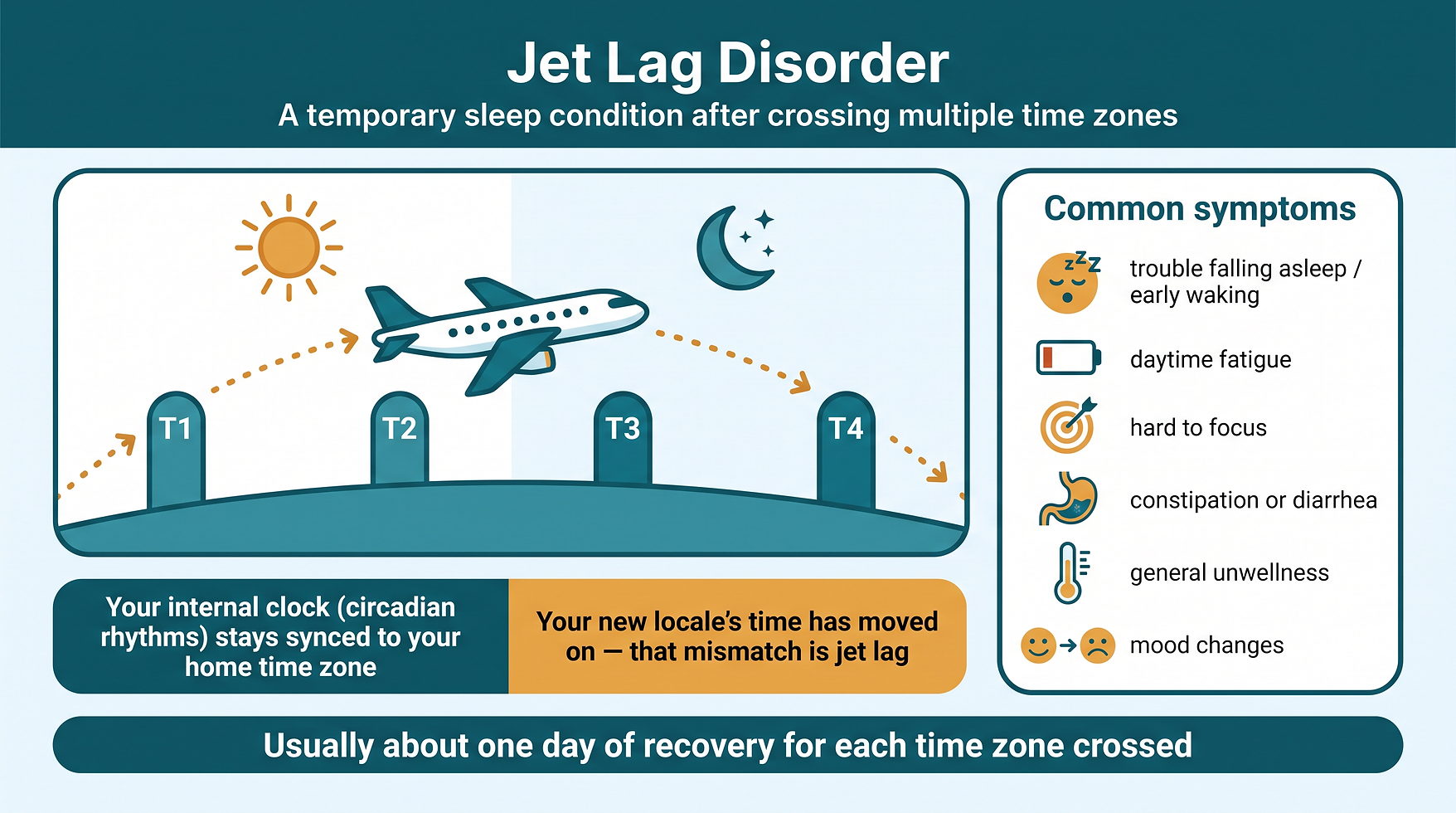
Jet lag is a temporary sleep condition that can affect anyone who quickly travels across several time zones. It happens because your internal clock (circadian rhythms) stays synced to your original time zone while your new locale's time has moved on. The more time zones you cross, the more likely — and usually more severe — the jet lag. Symptoms include sleep problems, daytime fatigue, poor focus, stomach issues, general unwellness, and mood changes, and recovery typically takes about a day for each time zone crossed. Flying east (losing time) is usually harder than flying west (gaining time). Most cases need no treatment, but prevention strategies — sleep, hydration, and carefully timed light exposure — can significantly reduce the effects, and melatonin, light therapy, or short-term sleep medicines can help frequent travelers.
Quick Answer
What is jet lag? A temporary sleep condition that affects anyone who quickly travels across several time zones. It usually starts within a day or two of crossing at least two time zones.
What causes it? Your body's internal clock (circadian rhythms) stays synced to your original time zone. Sunlight-driven melatonin regulation and cabin pressure/dry air also play roles.
What are the symptoms? Sleep problems (can't fall asleep or early waking), daytime fatigue, poor focus, constipation or diarrhea, a general feeling of not being well, and mood changes.
How long does it last? Usually about a day of recovery for each time zone crossed; symptoms are worse or last longer the farther you travel, especially flying east.
Is flying east harder than west? Yes. Flying east, when you “lose” time, is harder than flying west, when you “gain” time.
Does it need treatment? Usually no — jet lag is temporary and often improves within a few days. Frequent travelers can use light therapy, melatonin, or short-term sleep medicines.
What is the fastest way to adjust? Properly timed bright light exposure, staying hydrated, staying on the new schedule, and — for eastward travel — melatonin taken nightly until you adjust.
What Is Jet Lag Disorder?
Jet lag is a temporary sleep condition that can affect anyone who quickly travels across several time zones.
Your body has its own internal clock, called circadian rhythms. These rhythms signal to your body when to stay awake and when to sleep.
Jet lag occurs because your body's internal clock is synced to your original time zone. It has not yet changed to the time zone you've traveled to. The more time zones you cross, the more likely you are to experience jet lag.
Jet lag can cause daytime fatigue, a feeling of not being well, trouble staying alert, and stomach problems. Although symptoms are temporary, they can affect your comfort while on vacation or during a business trip. The good news: you can take steps to help prevent or lessen the effects of jet lag.
What Are the Symptoms of Jet Lag?
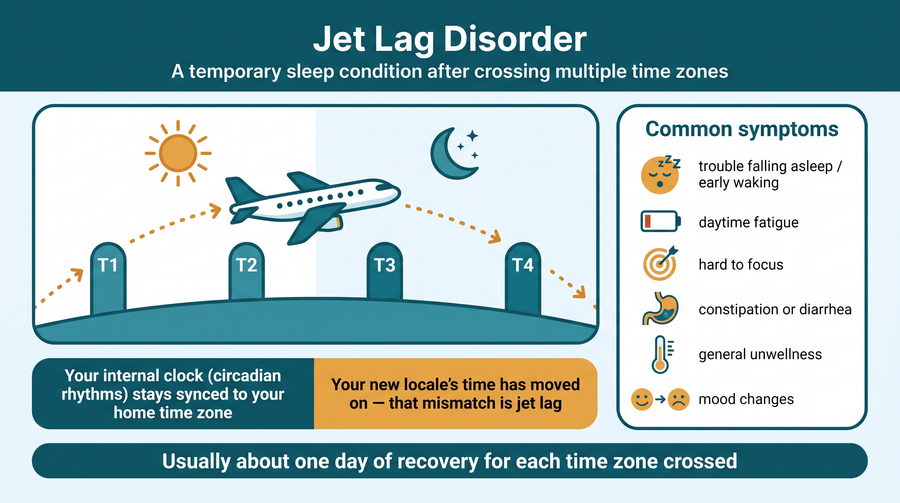
Symptoms of jet lag can vary. You may experience only one symptom or you may have many.
Sleep problems: not being able to fall asleep or waking up early.
Daytime fatigue: feeling exhausted during daylight hours at your destination.
Poor focus: not being able to focus or function at your usual level.
Stomach problems: constipation or diarrhea, as digestion also follows your internal clock.
General unwellness: a general feeling of not being well.
Mood changes: irritability or shifts in mood.
When symptoms start and how long they last: Jet lag symptoms usually occur within a day or two after traveling across at least two time zones. Symptoms are likely to be worse or last longer the farther you travel — and this is especially true if you fly east. It usually takes about a day to recover for each time zone crossed.
When to see a doctor: Jet lag is temporary. But if you travel often and experience jet lag, you may benefit from seeing a sleep specialist — a doctor who focuses on sleep disorders.
What Causes Jet Lag?
A disruption to your circadian rhythms
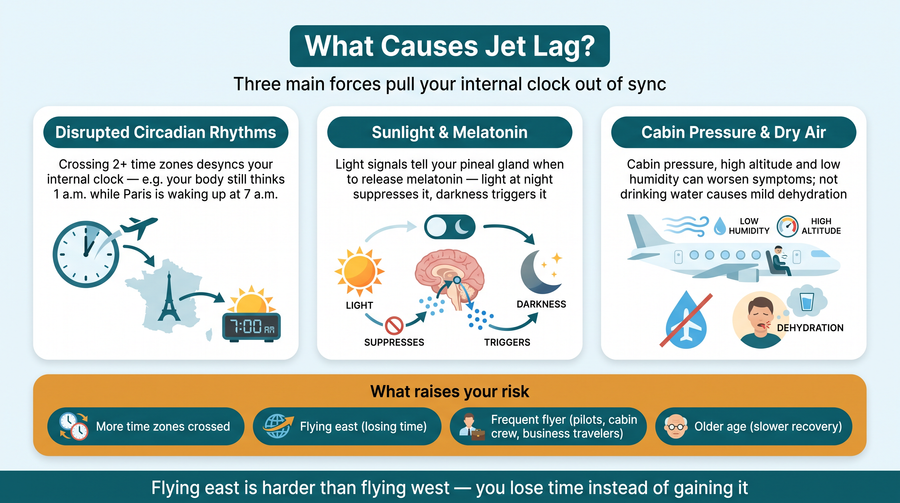
Jet lag can occur anytime you cross two or more time zones. Crossing multiple time zones puts your internal clock out of sync with the time in your new locale. Your internal clock, also called circadian rhythms, regulates your sleep-wake cycle.
Consider a concrete example: if you leave New York on a flight at 4 p.m. on Tuesday and arrive in Paris at 7 a.m. Wednesday, your internal clock still thinks it's 1 a.m. That means you're ready for bed just as Parisians are waking up.
It takes a few days for your body to adjust. In the meantime, your sleep-wake cycle and other body functions such as hunger and bowel habits remain out of step with the rest of Paris.
The effect of sunlight
A key influence on circadian rhythms is sunlight. Light affects the regulation of melatonin — a hormone that helps cells throughout the body work together.
Cells in the tissue at the back of the eye transmit light signals to an area of the brain called the hypothalamus. When the light is low at night, the hypothalamus signals a small organ in the brain called the pineal gland to release melatonin. During daylight hours, the opposite occurs — the pineal gland releases very little melatonin.
Because light is so crucial to your internal clock, you may be able to ease your adjustment to a new time zone by exposing yourself to daylight. However, the timing of light needs to be done properly — getting light at the wrong hour can push your clock in the wrong direction.
Airline cabin pressure and atmosphere
Some research shows that changes in cabin pressure and high altitudes associated with air travel may contribute to some symptoms of jet lag, regardless of travel across time zones.
In addition, humidity levels are low in planes. If you don't drink enough water during your flight, you can get slightly dehydrated — and dehydration may also contribute to some symptoms of jet lag.
What Are the Risk Factors for Jet Lag?
Number of time zones crossed: the more time zones you cross, the more likely you are to feel jet lag.
Flying east: you may find it harder to fly east, when you “lose” time, than to fly west, when you “gain” time.
Being a frequent flyer: pilots, flight attendants, and business travelers are most likely to experience jet lag.
Age: older adults may need more time to recover from jet lag.
Can Jet Lag Cause Complications?
Yes, though the main one is indirect. Auto accidents caused by drowsy driving may be more likely in people who are jet-lagged. If you arrive exhausted, treat the first day or two like a recovery day: avoid long drives when possible, or rest before getting behind the wheel.
How Is Jet Lag Diagnosed?
Jet lag has one of the simplest “diagnoses” in medicine. To diagnose jet lag, your health care professional asks about your symptoms and your travel across time zones. There are no lab tests or scans involved — your recent itinerary and symptom pattern tell the story.
How Is Jet Lag Treated?
Jet lag is temporary and usually doesn't need treatment. Symptoms often improve within a few days, though they sometimes last longer.
If you're a frequent traveler bothered by jet lag, your health care professional may prescribe light therapy or medicines.
Light therapy
Your body's internal clock is influenced by sunlight, among other factors. When you travel across time zones, your body must adjust to a new daylight schedule. This allows you to fall asleep and be awake at the right times.
One way to adjust to a new daylight schedule is through light therapy. This involves exposure to an artificial bright light or lamp that mimics sunlight. You use the light for a specific amount of time when you're meant to be awake. Light therapy comes in a variety of forms, including a light box that sits on a table, a desk lamp, or a light visor that you wear on your head.
Light therapy may be useful if you're a business traveler and are often away from natural sunlight during the day in a new time zone.
Medicines
You can take medicines — sometimes called sleeping pills — during your flight and for several nights afterward as you adjust to a new time zone. These medicines are usually only recommended for people who haven't been helped by other treatments.
Nonbenzodiazepines: zolpidem (Ambien, Edluar), eszopiclone (Lunesta), zaleplon (Sonata).
Benzodiazepines: temazepam (Restoril), midazolam (Nayzilam).
Side effects of these medicines are not common, but may include nausea, vomiting, amnesia, sleepwalking, confusion, and morning sleepiness. Also important to understand: although these medicines appear to help you sleep better and longer, you may still feel jet lag symptoms during the day — they treat the insomnia, not the clock mismatch.
Can Melatonin Help Jet Lag?
The hormone melatonin — and even exercise — may help relieve jet lag symptoms.
As a sleep aid, melatonin has been widely studied and is a common jet lag treatment. The latest research seems to show that melatonin aids sleep during times when you wouldn't typically be resting, making it beneficial for people with jet lag.
Your body treats melatonin as a darkness signal, so melatonin tends to have the opposite effect of bright light.
Timing is everything
The time when you take melatonin is important.
Flew east (resetting to an earlier schedule): take melatonin nightly in the new time zone, until you adjust to local time.
Flew west (resetting to a later schedule): take melatonin in the mornings in the new time zone, until you adjust.
Dosing and side effects
A dose as small as 0.5 milligram seems just as effective as a dose of 5 milligrams or higher, although some studies show that higher doses are better at making you sleep. Take melatonin 30 minutes before you plan to sleep — or ask your health care professional about the proper timing.
Side effects of melatonin are not common, but it can cause dizziness, headaches, daytime sleepiness, and loss of appetite. Melatonin also can cause nausea and disorientation. Don't drink alcohol when taking melatonin.
Other possible remedies
Some people use morning exercise to try to ease the effects of jet lag. If you want to try an alternative therapy, such as an herbal supplement, be sure to check with your health care professional first — some alternative therapies may interact with medicines or cause side effects.
What Are the Best Lifestyle Strategies for Jet Lag?
Sunlight: your most powerful natural tool
Being exposed to sunlight helps reset your internal clock. It's the most powerful natural tool for regulating the sleep-wake cycle. Morning light exposure can help you adjust to an earlier time zone after traveling east; evening light helps you adapt to a later time zone after traveling west.
Plan ahead to determine the best times for light exposure based on your departure and destination points and overall sleep habits.
Before your trip: You can start light therapy up to three days before traveling. Traveling east: wake one hour earlier than usual, get at least one hour of light exposure daily, and move bedtime one hour earlier each night if possible. Traveling west: delay your wake times and bedtimes instead.
At your destination (east, 3–5 zones): Avoid bright daylight first thing in the morning. Get several hours of bright light exposure in mid-morning to late morning.
At your destination (more zones or west): Avoid bright light the morning of arrival, but seek sunshine in the early afternoon. During the day, dark glasses can block light when you need to avoid exposure. At night, draw blinds or drapes, or use a sleep mask. Each day on your trip, gradually shift your light exposure earlier.
Combining light exposure with exercise such as walking or jogging may help you adapt to the new time even faster.
The 8-plus-zone exception: Light exposure has a big influence on your circadian rhythms — but the timing must be done properly. The one exception to the normal light rules is if you've traveled across more than eight time zones. Your body might mistake early-morning light with evening dusk, or vice versa. If you've traveled more than eight time zones to the east, wear sunglasses and avoid bright light in the morning, then expose yourself to as much sunlight as possible in the late afternoon for the first few days. If you've traveled west by more than eight time zones, avoid sunlight a few hours before dark for the first few days.
Caffeine: use it wisely
Beverages with caffeine, such as coffee, espresso, and soft drinks, may help offset daytime sleepiness. Choose drinks with caffeine wisely. Don't have caffeine after midday — it may make it even harder to fall asleep or sleep well.
How Can You Prevent Jet Lag?
A few basic steps may help prevent jet lag or reduce its effects.
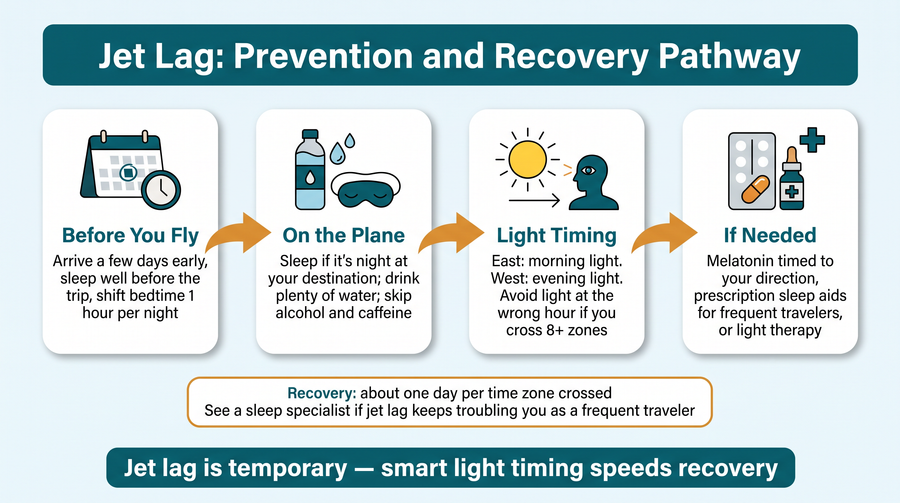
Plan to arrive early: If you have an important meeting or event requiring top form, arrive a few days early so your body can adjust to the new time zone.
Get plenty of rest before your trip: Starting out sleep deprived makes jet lag worse.
Gradually adjust your schedule before you leave: Traveling east: go to bed one hour earlier each night for a few days before your trip. Flying west: go to bed one hour later for several nights. Eat meals closer to the time you'll be eating them during your trip.
Try to sleep on the plane if it's nighttime at your destination: Earplugs, headphones, and eye masks can help block noise and light. If it's daytime where you're going, resist the urge to sleep.
Stay hydrated: Drink plenty of water before, during, and after your flight to counteract dry cabin air. Avoid alcohol and caffeine — they dehydrate you and affect your sleep.
Stay on your new schedule: Set your watch or phone to the new time before you leave. Once you reach your destination, try not to sleep until the local nighttime, no matter how tired you are. Time your meals with local mealtimes too.
Properly time bright light exposure: After traveling west, expose yourself to light in the evening. After traveling east, expose yourself to morning light — with the 8-plus-zone exception noted above.
How Should You Prepare for Your Appointment?
Jet lag symptoms usually resolve after your trip. You can reach out to your health care professional if you're looking for prevention strategies for future travel.
Be sure to bring your travel itinerary to the appointment — your travel history is exactly how jet lag is diagnosed.
Conclusion
Jet lag is one of those conditions where understanding the mechanism is half the cure. Your internal clock is still running on home time; sunlight is the reset button; and timing — of light, melatonin, sleep, and even your caffeine — determines how fast you recover. Most jet lag clears on its own in about a day per time zone crossed. But if you fly often and keep paying for it in exhaustion, prevention habits and, when needed, light therapy, melatonin, or short-term sleep medicines can put your clock back in sync with your passport stamps.
Planning a long flight? Build the sleep shift and light-timing plan into your itinerary before you book — and if jet lag keeps knocking you out trip after trip, bring your travel schedule to a sleep specialist.
Frequently Asked Questions
How do you know if you have jet lag?
Jet lag typically causes symptoms within a day or two after crossing at least two time zones — sleep problems (can't fall asleep or early waking), daytime fatigue, poor focus, constipation or diarrhea, a general feeling of not being well, and mood changes.
Is jet lag a real medical condition?
Yes. Jet lag disorder is a recognized temporary sleep condition caused by a mismatch between your body's internal clock (circadian rhythms) and the time zone you've traveled to. Diagnosis is based on your symptoms and travel across time zones.
How long does jet lag last?
It usually takes about a day to recover for each time zone crossed. Symptoms are likely to be worse or last longer the farther you travel, especially if you fly east.
Why is flying east worse than flying west?
Flying east, when you “lose” time, is harder on your internal clock than flying west, when you “gain” time. Your body finds it easier to extend its day than to shorten it.
Does melatonin really help jet lag?
Melatonin has been widely studied as a jet lag treatment, and research suggests it aids sleep during times you wouldn't typically be resting. For eastward travel, take it nightly in the new time zone; for westward travel, take it in the mornings. A dose as small as 0.5 milligrams may be as effective as 5 milligrams or more.
Do sleeping pills cure jet lag?
No. Sleeping pills (nonbenzodiazepines like zolpidem or benzodiazepines like temazepam) can help you sleep better and longer, but you may still feel jet lag symptoms during the day. They are usually reserved for frequent travelers who haven't been helped by other treatments.
How do I time sunlight after landing?
After traveling east, get morning light. After traveling west, get evening light. If you've crossed more than eight time zones, the rules change: avoid morning light when flying east (wear sunglasses) and get sunlight in the late afternoon; when flying west by 8+ zones, avoid sunlight a few hours before dark.
Can dehydration make jet lag worse?
Yes. Cabin humidity is low, and not drinking enough water on a flight can leave you slightly dehydrated, which may contribute to jet lag symptoms. Drink plenty of water before, during, and after your flight, and avoid alcohol and caffeine.
When should I see a doctor about jet lag?
Jet lag is temporary and usually resolves on its own. But if you travel often and experience jet lag repeatedly, you may benefit from seeing a sleep specialist.
References
Jet lag disorder — Symptoms and causes (Published May 21, 2026)
Jet lag disorder — Diagnosis and treatment (Published May 21, 2026)
Rinnit.com provides general health information for educational purposes. This content does not replace professional medical advice — always consult a qualified healthcare provider for diagnosis and treatment.
Health information, not medical advice. This article is for general education and is not a substitute for professional diagnosis or treatment. Always consult a qualified healthcare provider about your own health, and seek emergency care for urgent symptoms.
Comments