Sand Flea Bites: Symptoms, Causes, and Treatment

Updated: 2 days ago
Medically reviewed by Dr. Baraa Alnahhal, MD · Last reviewed: October 2026
Quick Answer: What are sand flea bites?
Sand flea bites are skin reactions to tiny organisms found in sandy environments. Most sand fleas are harmless crustaceans that cause mild itching, but true chigoe fleas can burrow into the skin and cause painful swelling and infection. Mild bites can be treated at home, while burrowed fleas should be removed by a provider, never dug out yourself. [1]
What the research says
Dimeticone-based products are the best-supported treatment for burrowed fleas. A systematic review of 19 studies (9 clinical trials) found that the 2 trials of dimeticone-based topical products reported lesion reduction and cure with no significant adverse reactions, while the 2 oral drugs tested (niridazole and ivermectin) had discouraging results. Surgical extraction had been studied only in observational studies (Tardin Martins et al., PLoS Negl Trop Dis, 2021). [3]
One targeted treatment cleared nearly all embedded fleas. An evidence review reported that in a randomized controlled trial, 97% of embedded sand fleas had lost all signs of viability 7 days after a targeted application of a dimeticone product, and trials with 106 participants reported no adverse events (Miller et al., Braz J Infect Dis, 2020). [4]
Tungiasis is common where homes have earthen floors. A meta-analysis of 37 studies (29,760 people in 10 African countries) found a pooled prevalence of 36.2%. Living in a house with an earthen floor raised the odds of infestation nearly 5-fold (adjusted odds ratio 4.92), and male sex raised them by about 50% (aOR 1.53) (Girma et al., BMC Infect Dis, 2025). [5]
What are sand flea bites?
People use the term “sand flea bites” for bites from any tiny organism in the sand. Some are harmless and others can be dangerous. [1]
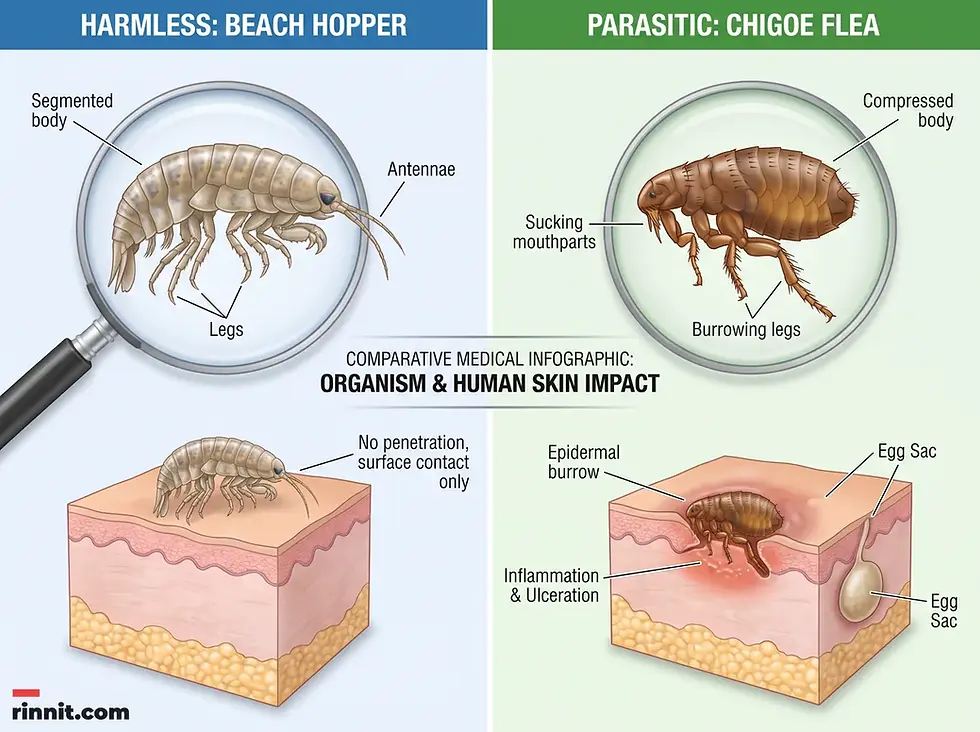
The most common and least dangerous “sand fleas” are actually crustaceans, in the same family as crabs and lobsters. They are not fleas or even insects. People call them fleas only because they hop and jump, and you may also hear them called sand hoppers, beach fleas, or beach hoppers. They might cause red, itchy bumps, but the irritation usually goes away in a few days. [1]
True sand fleas are the chigoe or jigger flea (Tunga penetrans), the smallest known flea. Chigoe fleas are found mainly in tropical climates such as Central America, South America, Africa, and the Caribbean, and they are rare in the United States. Unlike beach hoppers, the female chigoe flea burrows into the skin to feed on blood and lay eggs, which causes a condition called tungiasis (sand flea disease). [1] [2]
Sand fleas, sand flies, and regular fleas
Sand flies: These are different insects that usually cause mosquito-like bites that go away in a few days. One type carries Leishmania parasites, which can cause a serious disease called leishmaniasis. [1]
Regular fleas: Regular fleas do not live on humans, while sand fleas do, and regular flea bites do not usually cause serious skin wounds. Both types can live on animals, including pets and wild animals. [1]
How do you tell apart the organisms called sand fleas?
Sand flea is a common name for different organisms, so it is important to tell apart the common harmless type from the parasitic one. The table compares the common harmless type with the parasitic one.
Feature | Common “Sand Fleas” (Crustaceans) | True Sand Fleas (Chigoe/Jigger Fleas) |
Classification | Crustaceans, not insects (related to crabs and lobsters). | Parasitic insects (the smallest known flea). |
Primary Location | Coastal beaches, in humid sand. | Tropical and rural regions. |
Behavior | Hop around and may cause skin irritation. | The female burrows into the skin. |
Skin Impact | Mild, itchy red bumps. | Swollen white bumps with a black center. |
Duration | Clears in a few days. | The flea lives about 4 to 6 weeks; medical care is recommended. |
Who Is at Risk?
Anyone can get mild bites from common sand fleas, especially when walking barefoot on the beach, playing in the sand, or wading in warm shallow water. Tungiasis is more common in poor, rural regions, and people who spend a lot of time barefoot on beaches, farms, or dirt floors are at the highest risk. Young children, older adults, and people with disabilities are especially susceptible. In some poor, rural communities, tungiasis may affect up to 60% of the general population and up to 80% of children. Travelers can also bring chigoe fleas home from affected areas. [1]
What are the symptoms of sand flea bites, and where do they appear?
Both types of bites most often occur on the ankles and feet, especially in the soft areas between the toes, around the heels, and under the toenails. Irritation can also appear on the hands, thighs, or groin. [1]
Early symptoms of all types of bites include itchy skin, redness, and small raised bumps. Once a chigoe flea has burrowed and laid eggs, the bump swells and turns white, often with a small black dot in the center. The pressure on nearby tissue can be very painful. [1]

Clinical progression of tungiasis
When a parasitic sand flea burrows into the skin, the condition moves through several stages. Recognizing them helps you get treatment on time.
Stage | Clinical Indicators |
Initial Contact | Mild itching and a small red bump. |
Burrowing | The flea enters the skin and inflammation increases. |
Development | The flea swells to about 2,000 times its original size, and a white nodule with a black center forms. |
Lesion Formation | The site may become dark and crusty or break open into an ulcer. |
Secondary Infection | Open wounds are at risk of bacterial complications such as tetanus or gangrene if untreated. |
Severe wounds can also lead to difficulty walking, nail loss, peeling or thickened skin, and scars. Learn more about related infections in our guides to tetanus and cellulitis. [1]
How are sand flea bites diagnosed?
A healthcare provider examines your skin, especially your feet and between your toes, and asks about your recent travel, time outdoors, and exposure to fleas or other insects. There is no blood test for sand flea bites. Mild bites and early chigoe bites can look like contact dermatitis, regular flea bites, hives, or mosquito bites, so describing where you have been helps. See also our guides to ant bites and fire ant bites for other common bites, and our overview of parasites. [1]
How are sand flea bites treated and managed?
Mild sand flea bites from common sand hoppers can usually be managed at home, but a burrowed chigoe flea needs professional medical care. [1]
A burrowed chigoe flea needs professional medical care. A provider may remove the flea surgically with sterile instruments, and may recommend a tetanus shot. Topical dimeticone-based products (a type of silicone oil also used for head lice) are an effective option, and people with open wounds or a high risk of infection may need antibiotics. Never use a sharp object to remove a flea yourself, because it can push bacteria into the wound. [1] [2] [3]

How can you prevent sand flea bites?
Sand flea bites can be prevented by wearing closed-toed shoes and socks, using insect repellent, washing your feet after time in the sand and checking travel risks. [1]
Wearing closed-toed shoes and socks whenever possible, especially on beaches and rural soil. [1]
Using insect repellent on your skin, such as products with DEET or natural products such as coconut oil or certain essential oils. The World Health Organization notes that a coconut oil-based repellent applied twice daily to the feet effectively prevents chigoe fleas from penetrating the skin. [1] [2]
Washing your feet thoroughly after going barefoot or spending time in the sand. [1]
Talking to your doctor or a tropical medicine specialist about the risks in any country you plan to visit. [1]
When to see a doctor
See a doctor if you notice bumps, redness, or irritation on your skin that does not clear in a few days. Open sores, ulcers, or signs of infection need medical attention right away. [1]
Conclusion
Most encounters with sand fleas lead to nothing more than a few days of itching, but it pays to stay alert when traveling to tropical regions. Knowing the difference between common beach hoppers and parasitic chigoe fleas helps you protect your skin. If you notice persistent pain, white nodules, or signs of infection, seek professional medical evaluation promptly.
What are the next steps if you have sand flea bites?
If you recently traveled to a tropical area and notice painful, swollen bumps on your feet that do not go away, consult a healthcare professional or a tropical medicine specialist. Early treatment helps prevent complications and secondary infections. After a beach day, wash your feet and check your skin for unusual bumps.
Trusted resources: Cleveland Clinic: Sand Flea Bites, World Health Organization: Tungiasis.
Frequently Asked Questions
What are sand fleas?
The term covers tiny organisms found in sandy or rural areas. Most are harmless crustaceans, but the true sand flea is a parasitic insect, the chigoe or jigger flea. [1]
Do all sand fleas burrow?
No. Only the female chigoe flea burrows into the skin. Common beach hoppers do not. [1]
Where are chigoe fleas found?
Chigoe fleas are found mainly in tropical climates such as Central and South America, Africa, and the Caribbean. [1]
Are sand flea bites painful?
Common bites are mostly itchy. A burrowed chigoe flea can cause significant pain because of the pressure on nearby tissue. [1]
Can I remove a sand flea myself?
No. Using a sharp object can cause a serious bacterial infection. Have a healthcare provider remove it. [1]
Are sand fleas the same as sand flies?
No. Sand flies are different insects that usually cause mosquito-like bites. One type can carry Leishmania parasites, which cause leishmaniasis. [1]
Can sand fleas live on pets?
Yes. Both regular fleas and sand fleas can live on domestic or wild animals. [1]
Do sand fleas live in the U.S.?
Common sand hoppers are frequent in coastal areas, but chigoe fleas are rare in the United States. [1]
How long do common bites last?
Common sand flea bites usually clear up within a few days. [1]
What should I do after a beach day?
Wash your feet thoroughly and check your skin for unusual bumps or irritation. [1]
Related Reading
Understanding Tungiasis: Causes, Symptoms, and Effective Prevention explains the skin infection caused by burrowing chigoe fleas.
Flea Bites: Identification, Symptoms, and Treatment explains how to recognize and treat bites from common fleas.
What Are Chigger Bites? Symptoms, Causes, Treatment and Prevention explains itchy bites from tiny mites found in grass and brush.
What Are Mosquito Bites? A Plain-Language Guide to the Itch, the Reaction, and How to Prevent Them explains mosquito bite reactions and how to prevent bites outdoors.
References
Cleveland Clinic. Sand Flea Bites. Cleveland Clinic. November 16, 2022. https://my.clevelandclinic.org/health/diseases/24458-sand-flea-bites
World Health Organization. Tungiasis. World Health Organization. April 28, 2023. https://www.who.int/news-room/fact-sheets/detail/tungiasis
Tardin Martins AC, de Brito AR, Kurizky PS, et al. The efficacy of topical, oral and surgical interventions for the treatment of tungiasis: a systematic review of the literature. PLoS Negl Trop Dis. 2021;15(8):e0009722. PMID 34415904. https://doi.org/10.1371/journal.pntd.0009722
Miller H, Trujillo-Trujillo J, Mutebi F, et al. Efficacy and safety of dimeticones in the treatment of epidermal parasitic skin diseases with special emphasis on tungiasis: an evidence-based critical review. Braz J Infect Dis. 2020;24(2):170-177. PMID 32105621. https://doi.org/10.1016/j.bjid.2020.01.004
Girma A, Abdu I, Genet A, et al. Prevalence and risk factors for tungiasis in Africa: a systematic review and meta-analysis. BMC Infect Dis. 2025;25(1):1536. PMID 41214550. https://doi.org/10.1186/s12879-025-11922-2
Medical Disclaimer
This article is for informational purposes only and does not constitute medical advice. Always seek the advice of your physician or other qualified health provider with any questions you may have regarding a medical condition. Never disregard professional medical advice or delay in seeking it because of something you have read in this article.



Comments