Fire Ant Bites: Symptoms, Stages, Causes, Treatment, Outlook and When to Seek Emergency Care — What You Need to Know

Updated: 2 days ago
Medically reviewed by Dr. Baraa Alnahhal, MD · Last reviewed: September 2026
Executive Summary: TL;DR
Fire ant bites occur when aggressive, venomous ants sting the skin, typically in a circular pattern on the feet and legs. These stings cause an immediate burning sensation followed by itchy welts that transform into pus-filled blisters. While most cases are manageable at home with antihistamines, cold compresses, and steroid creams, approximately 2% of reactions are severe or life-threatening. Prevention focuses on wearing protective clothing, using repellent, and avoiding disturbed mounds. If you experience trouble breathing, swelling of the tongue, or dizziness after a sting, seek emergency medical attention immediately.
MEDICAL EMERGENCY: CALL 911 OR GO TO THE NEAREST EMERGENCY ROOM IMMEDIATELY IF YOU EXPERIENCE: Trouble breathing or swallowing. Swelling of the tongue, lips, or throat. Dizziness, fainting, or a sudden drop in blood pressure. Stomach cramps, nausea, vomiting, or diarrhea after a sting. Signs of anaphylaxis or cardiac arrest.
Quick Answer: What Should You Do for a Fire Ant Bite?
For mild fire ant bites, immediately brush the ants off your skin and wash the area with soap and cold water. You can manage itching and swelling at home by applying hydrocortisone cream twice daily, using cold compresses (ice packs), and taking an oral antihistamine like Benadryl®. It is critical not to squeeze or pop the resulting blisters, as this significantly increases the risk of infection and permanent scarring. Most stings resolve within seven to 10 days. However, if you develop systemic symptoms like nausea or breathing difficulties, seek emergency care right away, as you may require epinephrine or corticosteroids.
What Are Fire Ant Bites?
A fire ant bite is a skin injury caused by the sting of a specific type of aggressive, venomous ant. These insects, primarily Solenopsis invicta and S. richteri, were accidentally imported to the United States from South America in the 1930s. They are now common throughout the southeast, living in large colonies or mounds in the ground.
Fire ants are red-tinged insects ranging in size from 1 millimeter to 5 millimeters. They possess six legs, two pinching mandibles, and a venom pouch with a stinger on their rear end. When they attack, they use their mandibles to anchor themselves to the skin before repeatedly injecting venom with their stinger.
Key facts: fire ant profile
Scientific names: Solenopsis invicta and S. richteri
Size range: 1 mm (pencil tip) to 5 mm (pencil eraser)
Appearance: red-tinged body with six legs
Attack tools: pinching mandibles (head) and stinger (rear)
Habitat: large colonies or mounds in the ground
What Happens During a Fire Ant Attack?
Fire ant bites typically occur when a person or animal accidentally disturbs a nest or steps on an area where the ants live. Because they are highly aggressive, contact with a nest prompts a swarm. The ants attack any exposed skin, most commonly the feet, ankles, and legs.
Unlike many other insects, a single fire ant can sting multiple times. After attaching its mandibles to the skin, the ant curves its body and sticks its stinger in. It often moves in a circular direction, delivering seven or eight stings at a time. The ants will continue to sting until they are killed or physically removed from the skin.
Disturbance: accidentally stepping on or touching a nest or mound.
Swarming: large numbers of ants quickly emerge to attack exposed skin.
Anchoring: the ant uses its mandibles (pinchers) to attach to the skin.
Stinging: the ant curves its rear stinger into the skin to inject venom.
Repetition: the ant moves circularly, stinging 7 to 8 times per attack.
The 5 Stages of Fire Ant Bite Healing
The symptoms of a fire ant bite progress through distinct stages over several days. Understanding this timeline helps individuals monitor the healing process and identify potential complications.
Immediate sensation: the first sign is a sharp burning or stinging sensation at the site of the bite.
Initial welts (1 hour): within an hour, itchy bumps or welts develop, often appearing in a circular or semicircular pattern.
Blister formation (several hours): the initial welts transform into blisters, which are typically intensely itchy.
Pus-like fluid (24 hours): about a day later, the blisters fill with a yellow or white fluid that resembles pus.
Resolution (7 to 10 days): the blisters gradually dry up and disappear within a week to 10 days, provided they are not disturbed.
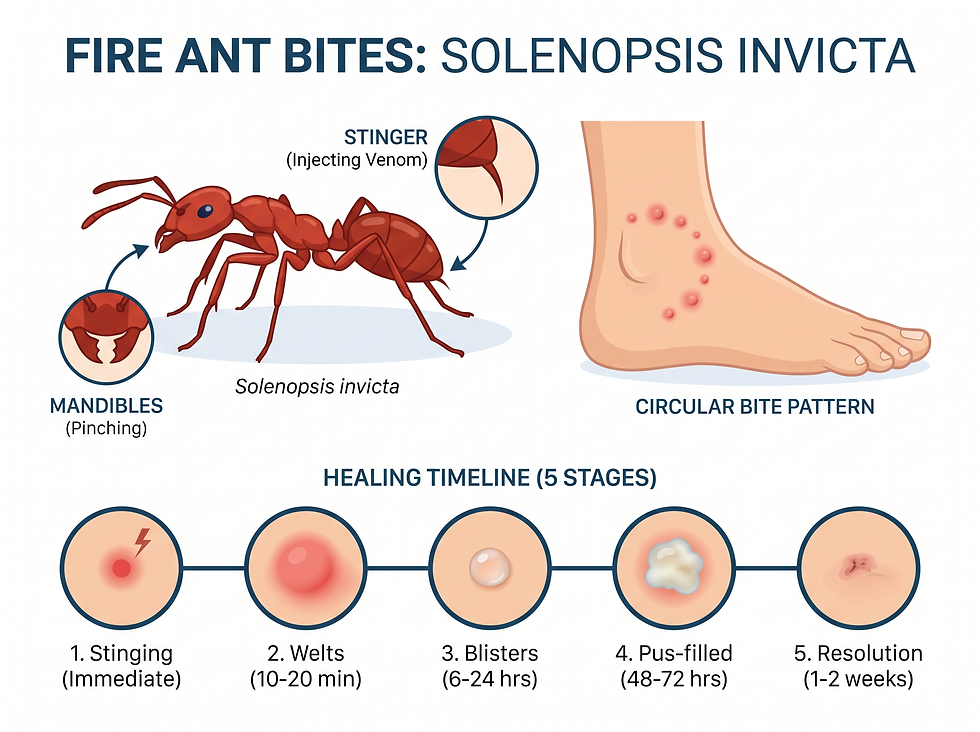
Types of Reactions to Fire Ant Venom
While most people experience only localized discomfort, others may have more widespread or life-threatening reactions. Only about 2% of fire ant stings result in severe systemic issues.
Standard reaction: burning, itching, circular welts and pus-filled blisters localized to the sting sites.
Large local reaction: swelling that extends beyond the bite location. For example, a single sting on the calf might cause the entire lower leg to swell for several days.
Systemic reaction: a whole-body response that may include stomach cramps, diarrhea, nausea, vomiting, or respiratory issues such as trouble breathing or swallowing.
Anaphylaxis: a rare, life-threatening allergic reaction involving a drop in blood pressure, dizziness, loss of consciousness, or cardiac arrest (read more about anaphylaxis and why epinephrine is the emergency treatment)

How Are Fire Ant Bites Diagnosed?
Healthcare providers typically diagnose fire ant bites through a physical examination and a review of the patient's history. Because the symptoms are so characteristic, specialized testing is rarely needed unless an allergy is suspected. Diagnosis is based on three primary factors:
Insect identification: confirming contact with fire ants or their mounds.
Skin appearance: observing the circular pattern of welts or the specific type of blisters.
Symptom review: assessing the level of itchiness, burning, and any signs of a whole-body reaction.
Treatment for Fire Ant Bites
Treatment depends on the severity of the reaction. Most cases can be managed at home, but systemic symptoms require professional medical intervention.
Home care for mild bites
Immediate action: slap or brush the ants off the skin immediately.
Cleaning: wash the affected area with soap and cold water.
Itch relief: take an oral antihistamine (like Benadryl®) and apply hydrocortisone cream twice daily.
Swelling control: use cold compresses or ice packs as needed.
Medical treatment for severe reactions
Corticosteroids: oral medications like prednisone or prescription-strength steroid creams.
Emergency measures: epinephrine injections (EpiPen), IV antihistamines, IV fluids, oxygen, and CPR if necessary.
Infection care: antibiotics may be necessary if blisters break and become infected.
Outlook and Long-Term Management
The outlook for fire ant bites is generally excellent, with most symptoms resolving within 10 days. However, the blisters can leave permanent scars, especially if they are picked, squeezed, or popped.
If you experience a serious reaction, it is recommended to consult with an allergist. They can perform allergy testing and may prescribe an epinephrine injector for future use. This is a vital precaution, as fire ants are aggressive and often difficult to avoid in infested areas.
Healing time: typically 7 to 10 days
Severe reaction rate: approximately 2% of cases
Scarring risk: high if blisters are popped or picked
Follow-up: consult an allergist after any systemic reaction
How to Prevent Fire Ant Bites
Prevention is the most effective way to avoid the pain and potential dangers of fire ant stings. Taking simple precautions when outdoors can significantly reduce your risk.
Wear protective clothing: use long sleeves and pants, and tuck your pants into your socks or shoes to eliminate entry points for ants.
Use repellent: apply insect repellent to both exposed skin and clothing.
Watch your step: wear shoes whenever walking outside and avoid disturbing mounds or nests.
Check objects: be cautious when lifting logs, rocks, or other items off the ground, as ants may live underneath.
Pest control: if fire ant colonies are found on your property, contact a professional pest-control specialist to remove them safely.

Limitation Statement
This article is based on clinical guidance available at the time of writing. While it is known that approximately 2% of fire ant stings result in severe systemic reactions, there are no specific prevalence statistics available for the frequency of standard local versus large local reactions. Additionally, specific data on the number of stings required to trigger anaphylaxis in non-allergic individuals is not available.
When to See a Healthcare Provider
You should contact your healthcare provider or a dermatologist if you have blisters that appear infected or if the pain and itchiness do not improve after several days. Seek immediate medical care if you develop flu-like symptoms, such as fever, chills, or body aches, or if you notice increasing redness or red streaks extending from the bite site.
If you experience any signs of a systemic reaction, such as trouble breathing, nausea, or dizziness, call 911 or visit an emergency room immediately.
"Fire ants are aggressive, venomous insects that sting. They cause painful, intensely itchy welts that turn into blisters. Though rare, fire ant venom can cause a life-threatening reaction. Seek immediate medical attention if you have any systemic symptoms." (Care Team note)
Conclusion
Fire ant bites are common but potentially dangerous injuries that require prompt attention. By understanding the stages of healing and recognizing the signs of a severe reaction, you can manage most stings safely at home. However, the risk of anaphylaxis makes it essential to know when to seek emergency help.
Three steps to protect yourself
Identify and avoid: learn to recognize fire ant mounds and keep a safe distance.
Dress for protection: wear shoes and long clothing when working or playing in infested areas.
Act quickly: if stung, brush off the ants immediately and monitor for whole-body symptoms.
Frequently Asked Questions
What does a fire ant bite look like? A fire ant bite starts as a red bump or welt, often appearing in a circular pattern. Within a few hours, it turns into an itchy blister that later fills with a yellow or white pus-like fluid.
Should I pop fire ant blisters? No. You should never squeeze or pop fire ant blisters. Popping them increases the risk of a bacterial infection and can lead to permanent scarring.
How long do fire ant bites last? Most fire ant bites and their associated blisters heal and disappear within seven to 10 days.
Are fire ant bites dangerous? For most people, they are painful and itchy but not dangerous. However, about 2% of people may experience a severe, life-threatening allergic reaction called anaphylaxis.
Where do fire ants live in the U.S.? Fire ants are most common in the southeastern United States, where they build large mounds or nests in the ground.
How do fire ants sting? Fire ants use their mandibles to pinch and anchor themselves to your skin, then they use a stinger on their rear end to inject venom. They can sting multiple times in a circular motion.
Can fire ant bites cause a fever? A fever after a fire ant bite may be a sign of a systemic reaction or a secondary infection. If you develop a fever or chills, you should contact a healthcare provider.
What is the best home remedy for fire ant stings? Washing the area with soap and cold water, applying hydrocortisone cream, using ice packs, and taking an oral antihistamine are the most effective home treatments.
Can fire ants bite pets? Yes, fire ants are aggressive and will attack animals, including pets, that disturb their nests.
What is in fire ant venom? Fire ant venom contains a mixture of toxins that cause a burning sensation and an immune response, leading to welts and blisters.
How can I tell if a fire ant bite is infected? Signs of infection include increasing redness, red streaks moving away from the bite, increased pain, swelling, and the presence of a fever.
Why do fire ant bites appear in a circle? Fire ants anchor themselves with their pinchers and then pivot their bodies to sting multiple times, resulting in a circular or semicircular pattern of welts.
What is a large local reaction? A large local reaction is when swelling extends far beyond the actual sting site, such as an entire arm or leg swelling after a single sting.
Can fire ant bites cause trouble breathing? Yes. Trouble breathing is a sign of a severe systemic reaction or anaphylaxis and requires immediate emergency medical attention.
Do fire ant bites leave scars? They can leave scars, especially if the blisters are popped, picked at, or become infected.
Are fire ants the same as red ants? Fire ants are a specific type of venomous ant known for their aggression and painful stings. While they are red-tinged, not all red ants are fire ants.
Can I use insect repellent to stop fire ants? Yes, applying insect repellent to your skin and clothing can help reduce the risk of fire ant stings.
What should I do if I step in a fire ant mound? Immediately slap or brush the ants off your skin. Once the ants are removed, wash the area with soap and cold water.
Is there a specific time of year fire ants are most active? Fire ants are active year-round in warm climates but are most aggressive when their nests are disturbed during warm, sunny weather.
Can fire ant stings cause cardiac arrest? In rare cases of severe anaphylaxis, the body's reaction to the venom can lead to cardiac arrest.
How do I know if I'm allergic to fire ants? If you have ever had a whole-body reaction (nausea, trouble breathing, dizziness) after a sting, you likely have an allergy and should see an allergist.
What is an EpiPen used for? An EpiPen (epinephrine injector) is used to treat severe, life-threatening allergic reactions (anaphylaxis) by quickly reversing symptoms like throat swelling and low blood pressure.
Can fire ants live indoors? While they primarily live in outdoor mounds, they can occasionally enter homes in search of food or water, especially during extreme weather.
How do I get rid of fire ants on my property? It is best to contact a professional pest-control specialist who can safely treat the mounds and prevent the colony from spreading.
Can fire ant venom cause diarrhea? Yes, diarrhea and stomach cramps are potential symptoms of a systemic reaction to the venom.
Are fire ant stings more dangerous for children? Children may be at higher risk because of their smaller body size and the potential for multiple stings if they accidentally disturb a nest.
Can I use vinegar on fire ant bites? Vinegar is not a recommended treatment. Recommended treatments include soap and water, cold compresses, hydrocortisone cream, and antihistamines.
Do fire ants have wings? Reproductive fire ants (queens and males) have wings and fly during mating swarms, but the worker ants that sting do not have wings.
What is the scientific name for fire ants? The most common fire ants in the U.S. are Solenopsis invicta (red imported fire ant) and S. richteri (black imported fire ant).
External Authoritative Sources
American Osteopathic College of Dermatology (AOCD) — Fire Ant Bites Overview
Britannica — Biological Characteristics of Fire Ants (Solenopsis)
StatPearls (Kruse B, et al.) — Clinical Management of Fire Ant Bites (updated 08/11/2021)
National Health Service (NHS) — General Guide to Insect Bites and Stings
Medical disclaimer: The information provided in this article is for educational purposes only and is not intended as a substitute for professional medical advice, diagnosis, or treatment. Always seek the advice of your physician or other qualified health provider with any questions you may have regarding a medical condition. Never disregard professional medical advice or delay in seeking it because of something you have read in this article. If you think you may have a medical emergency, call your doctor, go to the emergency department, or call 911 immediately.
Comments