Renal Cortex: Location, Function, Nephrons and Kidney Health

Updated: 2 days ago
Medically reviewed by Dr. Baraa Alnahhal, MD · Last reviewed: October 2026
Quick Answer: What is the renal cortex?
The renal cortex is the kidney’s outer layer and the place where the kidney’s filtering units begin. Nephrons in the cortex contain glomeruli that filter blood and tubules that process waste, fluid, nutrients and minerals. It is also called the kidney cortex, surrounds the inner medulla and is covered by the renal capsule. [1]
Core idea | Plain-language meaning |
Other name | Kidney cortex. |
Location | Outer layer of the kidney, around the inner medulla. |
Covering | Renal capsule. |
Main starting structures | Nephrons, the kidney’s blood-filtering units. |
Filter | The glomerulus, a cluster of tiny blood vessels in a nephron. |
Processing tube | The tubule, which removes waste and returns needed substances. |
Tubule shape | Twisted in the cortex and straighter in the medulla. |
Urine link | Leftover fluid and waste in the tubules become urine. |
Health concern | Several kidney diseases and related disorders may affect the renal cortex or its function. |
What the research says
A thinner kidney cortex on ultrasound goes along with lower kidney function. In 176 people grouped by estimated glomerular filtration rate (eGFR), renal length, cortical thickness and parenchymal thickness all fell stepwise as kidney function declined, while medullary thickness did not change among the three groups with eGFR of 30 or above. Among those three groups, cortical thickness was the strongest associated ultrasound measure, and the authors concluded that left cortical thickness could help detect early changes in kidney function (Takata et al., Nephron, 2016). [2]
Kidney disease is common and often silent. A systematic review and meta-analysis of 100 studies with 6,908,440 participants estimated the global prevalence of chronic kidney disease (stages 1–5) at 13.4% (95% CI 11.7–15.1%) and of stages 3–5 at 10.6% (95% CI 9.2–12.2%). The authors note that chronic kidney disease is usually asymptomatic until later stages (Hill et al., PLoS One, 2016). [3]

What is the renal cortex?
The renal cortex is part of the kidney, which is part of the urinary tract. It is also called the kidney cortex. [1]
The cortex is the outer layer of the kidney. It surrounds the inner medulla and has a covering called the renal capsule. The filtering units of the kidney begin in the cortex. [1]
Where is the renal cortex located?
The renal cortex lies around the kidney’s inner medulla. The renal capsule covers the outside of the kidney. [1]
This layered arrangement helps describe where different parts of the nephron are found. Tubules in the cortex are twisted, while tubules in the medulla are straighter. [1]
What does the renal cortex do?
The renal cortex is involved in kidney functioning because the kidney’s filtering units begin there. Nephrons filter blood so waste can leave the body in urine. [1]
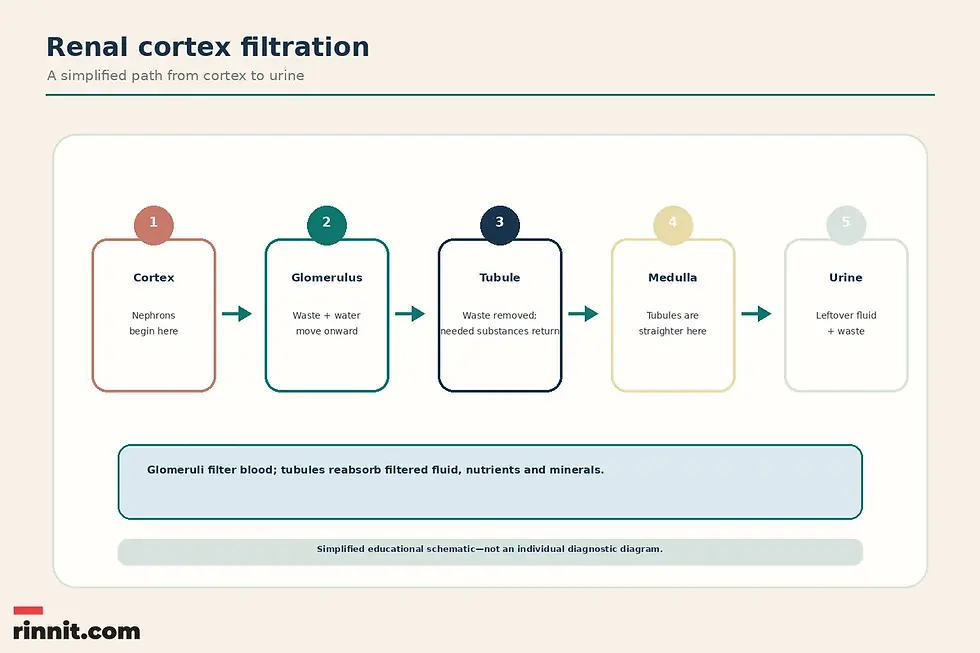
The glomerulus allows waste and water to move into the tubule, while proteins and blood cells stay in the glomerulus. The tubule removes waste and returns needed substances to the body.
The renal cortex is therefore part of a larger kidney pathway rather than a standalone organ. Kidney function also depends on the medulla, blood vessels, tubules, urine flow and the body’s overall health.
What are nephrons?
Nephrons are the blood-filtering units of the kidneys. Each kidney has approximately 1 million nephrons, and they begin in the renal cortex. [1]
Each nephron includes a glomerulus and a tubule. The glomerulus is a cluster of tiny blood vessels that filters part of the blood, and the tubule processes the fluid that moves forward.
What is the glomerulus?
The glomerulus is the filtering unit of a nephron. It allows waste and water to move into the tubule, while proteins and blood cells remain in the glomerulus.
Damage to kidney filters can allow red blood cells to leak into urine, producing dark or bloody urine. Excess protein in urine can make urine look foamy. These findings have several possible causes and need professional interpretation. [1]
What do kidney tubules do?
The tubules remove waste and return needed substances to the body. Blood vessels alongside the tubules reabsorb filtered fluid, nutrients and minerals. Leftover fluid and waste become urine. [1]
In the renal cortex, tubules are twisted. In the medulla, tubules are straighter. This is one of the structural differences between the kidney’s outer and inner regions. [1]
What other jobs do the kidneys perform?
Beyond the renal cortex and waste removal, the kidneys perform several other important jobs in the body. They also help control several body systems and balances:
Kidney job | Role |
Electrolytes | Helps control electrolyte balance. |
Water | Helps control water balance. |
Blood pressure | Helps control the body’s blood pressure. |
Fluid outside cells | Helps regulate the amount of fluid outside cells. |
Red blood cells | Supports red-blood-cell production. |
Acid and base balance | Helps maintain acid-base balance. |
Vitamin D | Contributes to vitamin D production. |
Calcium and phosphorus | Helps balance calcium and phosphorus. |
Glucose | Produces some glucose in addition to what the liver makes. |
These kidney functions are broader than the renal cortex alone. The cortex is an important part of the kidney, but a symptom or laboratory finding cannot be assigned to the cortex without professional evaluation.
What conditions can affect the renal cortex or kidneys?
Many disorders can affect the kidneys, including chronic kidney disease, kidney cancer, kidney failure, kidney infection, kidney stones, kidney cysts and polycystic kidney disease. [1]
Other conditions related to the kidneys include metabolic acidosis, nephritis, diabetes-related nephropathy, glomerular diseases, proteinuria and uremia. [1]
Condition or disorder | Plain-language description |
Chronic kidney disease | A long-term kidney disorder. |
Kidney cancer | A cancer that may affect the kidney. |
Kidney failure | A serious loss of kidney function. |
Kidney infection | An infection involving the kidney. |
Kidney stones | Solid deposits that may affect the urinary system. |
Kidney cysts | Cysts that may develop in a kidney. |
Polycystic kidney disease | An inherited kidney condition in which cysts form in the kidneys. |
Metabolic acidosis | Acid buildup related to the body’s acid-base balance. |
Nephritis | Inflammation involving the kidney. |
Diabetes-related nephropathy | Kidney disease related to diabetes. |
Glomerular disease | Disease involving the kidney’s glomeruli. |
Proteinuria | High levels of protein in urine. |
Uremia | Waste buildup in the blood. |
What are possible signs of kidney problems?
Most kidney problems do not cause symptoms in their early stages. Pain in the lower back is often not kidney pain. [1]
As kidney damage progresses, possible signs may include:
Sign or symptom | Context |
Muscle cramping | Electrolyte imbalances can cause muscles, usually in the calf, to stiffen. |
Dark or bloody urine | Damage to kidney filters can let red blood cells leak into urine. |
Foamy urine | Bubbles in urine can signal excess protein. |
Itchy or dry skin | Mineral and nutrient imbalance in the blood can cause itching. |
More frequent urination | Problems filtering some waste products can lead to more frequent urination. |
Puffy eyes or swollen ankles and feet | Reduced kidney function can cause the body to hold on to sodium and fluid, and protein leaking into the urine can add to swelling. |
Sleep problems, fatigue or loss of appetite | Toxin buildup in the blood can affect sleep, appetite and energy. |
These signs are not a diagnosis of renal-cortex disease. They may result from kidney, urinary, metabolic or other conditions and should be evaluated in context.

What does renal cortical thinning mean?
Imaging can show kidney blockages or issues such as renal cortical thinning. Cortical thinning may mean that the kidney is not working well. [1]
A report mentioning cortical thinning should be discussed with the clinician who ordered or interpreted the imaging. The significance depends on the full report, symptoms, kidney function tests and medical history.
How are renal-cortex or kidney problems evaluated?
Renal-cortex or kidney problems are evaluated with several tests of kidney function, and the right test depends on the concern being evaluated.
Test | What it may show or measure |
Imaging | X-ray, CT scan, MRI, ultrasound or nuclear medicine may show blockages or issues such as renal cortical thinning. |
Kidney biopsy | Removes a small amount of kidney tissue to examine under a microscope. |
Ureteroscopy | Uses a small camera passed through the urethra into the bladder and ureters to look for anything unusual. |
Urinalysis | Measures substances such as protein or blood in urine to detect disease or infection. |
Kidney function tests | Show how well the kidneys clear waste from blood. |
The right test depends on the concern being evaluated. Ask what a recommended test is intended to measure, whether preparation is needed and how the result will guide the next step.
How can you support kidney health?
Kidney health is supported by regular checkups, because a healthcare provider can order blood and urine tests to measure how well the kidneys work. This is especially valuable if you have high blood pressure, obesity or diabetes. General steps that can reduce the risk of a kidney problem include:
Avoiding or quitting smoking.
Cutting out excess salt.
Drinking enough water.
Increasing daily physical activity to help reduce high blood pressure. [1]
Limiting use of nonsteroidal anti-inflammatory drugs. [1]
Maintaining a weight that is healthy for you.
Checking blood pressure regularly.
Watching blood sugar levels to manage diabetes.
If you have kidney disease, ask a healthcare professional or dietitian whether changes involving protein, potassium, sodium, fluids or other nutrients are appropriate. Kidney needs vary by diagnosis and kidney function.
When should you contact a healthcare professional?
Contact a healthcare professional for dark or bloody urine, foamy urine, changes in how often you pee, swelling, muscle cramping, itchy or dry skin, sleep problems, fatigue, poor appetite, stomach pain or vomiting.
Also discuss a report describing renal cortical thinning, an abnormal urine result, reduced kidney function, known kidney disease, high blood pressure or persistent urinary changes. The earlier stages of many kidney problems may have few symptoms, so follow-up of an abnormal result matters.
Very little or no urine, severe swelling, confusion, severe shortness of breath, chest pain, fainting, severe flank pain with fever, blood clots in urine or rapidly worsening symptoms need prompt medical assessment.
What questions should you ask a healthcare professional about the renal cortex?
Question | Why it helps |
Could my urine changes have a kidney or urinary cause? | Dark, bloody or foamy urine can reflect different problems and needs context. |
What does my imaging report mean by renal cortical thinning? | Cortical thinning may indicate reduced kidney function. |
Which kidney-function tests are appropriate? | Kidney-function tests assess how well the kidneys clear waste. |
Do I need a urinalysis? | Urinalysis can measure protein or blood in urine. |
What does the swelling suggest? | Puffy eyes or swollen ankles and feet can have several causes. |
Should my diet change? | Protein, potassium, sodium and fluid advice may depend on kidney function and diagnosis. |
When should I repeat testing? | A clear follow-up plan helps monitor symptoms and results. |
Conclusion: The renal cortex is where kidney filtration begins
The renal cortex is the outer layer of the kidney, surrounding the inner medulla and covered by the renal capsule. It is where the kidney’s nephrons begin. [1]
Each nephron includes a glomerulus and a tubule. The glomerulus filters blood, while the tubule processes waste, fluid, nutrients and minerals as urine forms.
Kidney problems may be silent early. Dark or bloody urine, foamy urine, swelling, urinary changes, muscle cramps, itchy or dry skin, fatigue, sleep problems or appetite loss should be discussed with a healthcare professional. [1]
Imaging, kidney biopsy, ureteroscopy, urinalysis and kidney-function tests are possible evaluation tools. [1]
Use this guide to prepare questions for a qualified healthcare professional. It is an anatomy and symptom-awareness resource—not a diagnosis or a substitute for individualized care. [1]
Frequently Asked Questions
What is the renal cortex?
The renal cortex, or kidney cortex, is the outer layer of the kidney. The renal medulla lies inside it, and the renal capsule covers the kidney.
What is another name for the renal cortex?
The renal cortex is also called the kidney cortex.
Where is the renal cortex located?
The renal cortex surrounds the kidney’s inner medulla and lies beneath the renal capsule.
What happens in the renal cortex?
The kidney’s nephrons begin there. Their glomeruli filter blood, and their tubules process waste and filtered fluid.
How many nephrons are in a kidney?
Each kidney has about 1 million nephrons.
What is a nephron?
A nephron is a blood-filtering unit of the kidney.
What is a glomerulus?
A glomerulus is the filtering unit of a nephron and a cluster of tiny blood vessels. It allows waste and water to move into tubules while proteins and blood cells stay in the glomeruli.
What is a kidney tubule?
A tubule is a small tube attached to the glomerulus. It removes waste and returns needed substances to the body.
Are tubules different in the cortex and medulla?
Yes. Tubules are twisted in the renal cortex and straighter in the medulla.
How does the renal cortex relate to urine?
Nephrons begin filtering in the cortex. As tubules remove waste and reabsorb fluid, nutrients and minerals, leftover fluid and waste become urine.
What else do the kidneys control?
The kidneys help control electrolytes, water, blood pressure, fluid outside cells, red-blood-cell production, acid-base balance, vitamin D, calcium and phosphorus, and some glucose production.
What conditions can affect the renal cortex or kidneys?
Examples include chronic kidney disease, kidney cancer, kidney failure, kidney infection, kidney stones, kidney cysts, polycystic kidney disease, metabolic acidosis, nephritis, diabetes-related nephropathy, glomerular diseases, proteinuria and uremia.
What is renal cortical thinning?
Renal cortical thinning is an imaging finding that may mean the kidney is not working well. Its meaning should be discussed with the clinician who interpreted the imaging.
Does renal cortical thinning always mean kidney failure?
No. Cortical thinning may mean the kidney is not working well, but an imaging finding alone does not establish a diagnosis or severity.
Can kidney problems be silent?
Yes. Most kidney problems do not have symptoms in the early stages.
Is lower-back pain always kidney pain?
No. Pain in the lower back is often not kidney pain.
What does dark or bloody urine mean?
Damage to the kidneys’ filters can let red blood cells leak into urine, but urine color can change for many reasons. Professional evaluation is appropriate.
What does foamy urine mean?
Bubbles in urine can signal excess protein. Foamy urine is not diagnostic and should be discussed if it persists or is concerning.
Can kidney problems cause swelling?
Reduced kidney function can cause the body to hold on to sodium and fluid, and protein leaking into the urine can cause puffy eyes or swollen ankles and feet. Swelling has other possible causes too.
Can kidney problems cause frequent urination?
Problems filtering some waste products can cause more frequent urination.
Can kidney problems cause muscle cramps?
Electrolyte imbalances can cause muscles, usually in the calf, to stiffen.
What imaging tests can show renal-cortex problems?
X-ray, CT scan, MRI, ultrasound and nuclear medicine imaging can show kidney blockages or issues such as renal cortical thinning.
What is a kidney biopsy?
A kidney biopsy removes a small amount of kidney tissue for examination under a microscope.
What is a urinalysis?
A urinalysis measures substances such as protein or blood in urine to detect disease or infection.
What are kidney-function tests?
Kidney-function tests show how well the kidneys clear waste from blood.
Is a renal-cortex problem the same as a renal-artery problem?
No. The renal cortex is kidney tissue, while the renal artery is a blood vessel supplying the kidney. Problems can be related to kidney function but are not the same diagnosis.
Is the renal cortex part of the urinary tract?
Yes. The renal cortex is part of the kidney, and the kidney is part of the urinary tract.
When should urine changes be evaluated?
Discuss dark, bloody or persistently foamy urine, or other new urinary changes, with a healthcare professional.
What should I bring to a kidney appointment?
Bring the imaging report, urine or blood-test results, a list of medicines and supplements, and a record of symptoms and timing.
Can a renal-cortex article diagnose me?
No. Anatomy and symptoms overlap with many conditions. Diagnosis requires a qualified healthcare professional and appropriate evaluation.
Related guides
References
Cleveland Clinic. Renal Cortex: Kidney, Anatomy, Function & Conditions. Cleveland Clinic. Updated February 27, 2026. https://my.clevelandclinic.org/health/body/23127-renal-cortex
Takata T, Koda M, Sugihara T, et al. Left Renal Cortical Thickness Measured by Ultrasound Can Predict Early Progression of Chronic Kidney Disease. Nephron. 2016;132(1):25-32. PMID 26581096. https://doi.org/10.1159/000441957
Hill NR, Fatoba ST, Oke JL, et al. Global Prevalence of Chronic Kidney Disease - A Systematic Review and Meta-Analysis. PLoS One. 2016;11(7):e0158765. PMID 27383068. https://doi.org/10.1371/journal.pone.0158765
Medical disclaimer
This article is for general educational purposes and is not a substitute for professional medical advice, diagnosis or treatment. Always seek the advice of a qualified healthcare professional with any questions about a medical condition or treatment.



Comments