PUPPP Rash: Managing the Itch During Late Pregnancy

Updated: 2 days ago
Medically reviewed by Dr. Baraa Alnahhal, MD · Last reviewed: November 2026
Definition: Pruritic Urticarial Papules and Plaques of Pregnancy (PUPPP) is an intensely itchy, hive-like rash.
Key Sign: The rash typically begins in stretch marks on the belly but spares the area around the navel.
Safety: Harmless to both the mother and the baby; usually resolves shortly after birth.
Relief: Managed with cool baths, moisturizers, and provider-approved medications.
Quick Answer
PUPPP rash, or pruritic urticarial papules and plaques of pregnancy, is a common, intensely itchy skin condition that typically develops in the third trimester. Hive-like bumps form within stretch marks on the abdomen and can spread to the limbs. It is harmless to mother and fetus and usually resolves within weeks of delivery. Treatment focuses on relieving symptoms.
What the research says
PUPPP mostly appears in a first pregnancy, late in the third trimester, and often with twins or more. In a series of 18 cases from the American University of Beirut Medical Center, 72% were first pregnancies, 89% began in the third trimester, and 50% involved multiple gestation. The abdomen and proximal thighs were the most common sites (67%), and skin lesions resolved in an average of three weeks with emollients, topical corticosteroids, and/or oral antihistamines (Ghazeeri et al., Int J Dermatol, 2012).
Unlike some other pregnancy rashes, PUPPP has minimal effect on the baby. A systematic review of 8,490 pregnant cases with dermatologic changes found that intrahepatic cholestasis of pregnancy and pemphigoid gestationis were linked to higher rates of adverse fetal outcomes, including preterm birth and fetal distress, while polymorphic eruption of pregnancy (another name for PUPPP) had minimal effect on fetal health (Alhomieed et al., Clin Pract, 2025).
What is PUPPP Rash?
Pruritic Urticarial Papules and Plaques of Pregnancy, commonly known as PUPPP rash, is a skin condition that causes significant irritation during the later stages of pregnancy. It is recognized as one of the most frequent dermatological issues faced by expectant mothers, occurring in approximately 1 out of every 160 pregnancies. The rash typically manifests as scattered, itchy bumps that eventually form raised patches of skin, primarily localized in the stretch marks on the belly. [1]
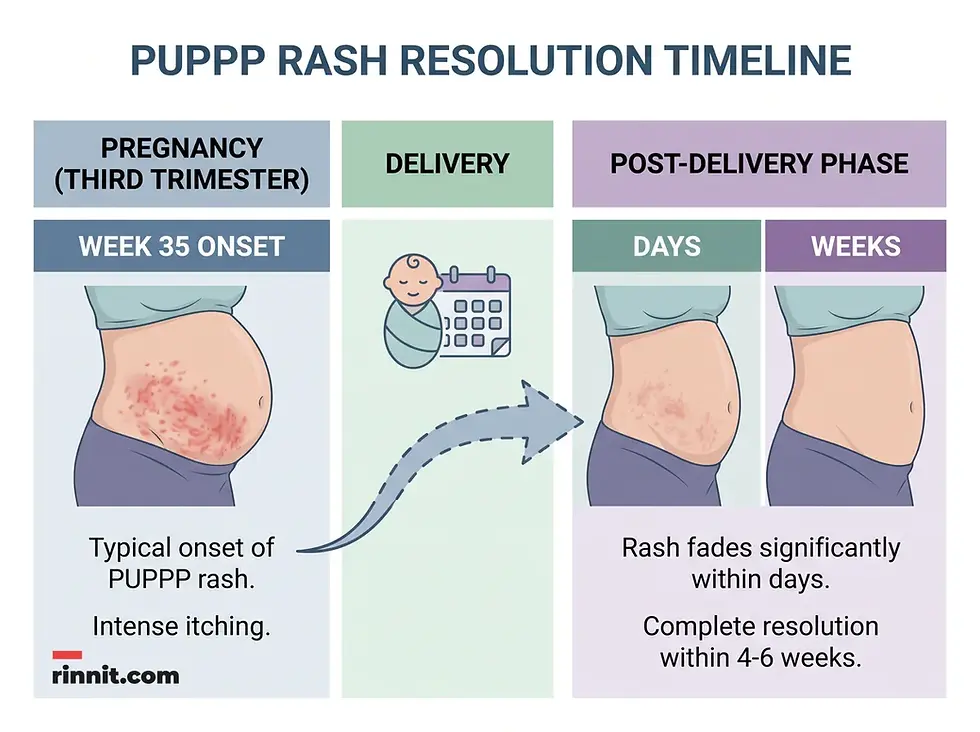
Although the intense itching can be distressing and disrupt sleep, PUPPP is entirely harmless to both the mother and the developing baby. It most often appears around the 35th week of the third trimester, though in rarer cases, it may develop shortly after delivery. A defining characteristic of this condition is that it usually avoids the area immediately surrounding the belly button, a detail that helps healthcare providers distinguish it from other similar skin conditions.
Feature | Description |
Typical Onset | Late third trimester (approx. week 35). |
Primary Location | Abdominal stretch marks (sparing the navel). |
Appearance | Pink/red bumps or skin-colored patches. |
Duration | 4 to 6 weeks, resolving post-delivery. |

What are the symptoms and possible causes of PUPPP rash?
The primary symptom of PUPPP is an overwhelming urge to scratch. The rash starts as hive-like bumps within abdominal stretch marks and can quickly spread to the thighs, buttocks, breasts, and arms. On lighter skin tones, these patches often appear pink or red, while on darker skin, they may match the natural skin tone or appear slightly darker. Because the itching is often worse at night, it can lead to significant exhaustion for the mother. [1]
While the exact cause of PUPPP remains unknown, medical experts have developed several leading theories. The most prominent theory suggests that the rapid stretching of the abdominal skin during the final weeks of pregnancy damages connective tissue, triggering an inflammatory response. Other theories point to the significant hormonal shifts occurring during this period. Certain factors increase the likelihood of developing the rash, such as carrying a male fetus, being in a first pregnancy, or expecting multiples like twins or triplets.
How is PUPPP rash diagnosed and treated?
Healthcare providers typically diagnose PUPPP through a thorough physical examination. However, because other skin conditions like contact dermatitis can mimic these symptoms, additional tests may be ordered to rule out other issues. These can include a complete blood count, liver function tests, or a metabolic panel. Tell your provider right away if itching is severe, especially on the palms and soles or without a rash, because it can be a sign of intrahepatic cholestasis of pregnancy, which needs prompt care. In cases where the diagnosis is unclear, a small skin biopsy may be performed to confirm the presence of PUPPP. [1]
Management focuses entirely on easing the intense itching until the rash naturally resolves after birth. Treatment options include:
Home Care: Taking cool or oatmeal baths, applying fragrance-free moisturizers, and wearing lightweight cotton clothing can provide immediate, temporary relief.
Topical Treatments: Anti-itch creams and cold compresses are often recommended to soothe the affected skin.
Medications: In more severe cases, providers may prescribe antihistamines or corticosteroids. These medications usually begin to reduce the itching within one to two days.
Safety Note: It is essential to get approval from a pregnancy care provider before using any over-the-counter or prescription medications while pregnant.

What are recovery and long-term outlook like after PUPPP rash?
The long-term outlook for those with PUPPP is excellent. The rash is a temporary annoyance that typically vanishes within a few days to a few weeks after the baby is born. One of the most reassuring aspects of the condition is that it rarely leaves behind any permanent scarring. Furthermore, having PUPPP during one pregnancy actually makes it less likely that a mother will experience it again in future pregnancies. [1]
Conclusion and Next Steps
PUPPP rash is a challenging but temporary part of the pregnancy journey for many. While the physical discomfort can be significant, knowing that it poses no risk to the baby provides much-needed peace of mind. If you notice a new, itchy rash developing on your abdomen, contact your healthcare provider to confirm the diagnosis and discuss safe treatment options. With the right management strategies, you can minimize the irritation and focus on the final steps of your pregnancy.
Frequently Asked Questions
Does scratching make the PUPPP rash spread?
No, scratching does not cause the rash to spread to other parts of the body, but it can significantly worsen the irritation and damage the skin.
Can PUPPP rash affect my baby's health?
No, PUPPP is completely harmless to the baby and does not affect the health or development of the fetus.
Why does the rash avoid the belly button area?
The rash avoiding the belly button is a unique clinical characteristic of PUPPP that helps doctors distinguish it from other pregnancy-related skin conditions.
Will the rash go away immediately after I give birth?
Most mothers find that the rash begins to fade within a few days of delivery, though it can take a few weeks to disappear entirely.
Is PUPPP rash contagious?
No, PUPPP is an inflammatory skin reaction related to pregnancy and cannot be passed to other people.
Are there any specific soaps I should avoid?
It is best to avoid harsh, fragranced soaps that can further irritate the skin; stick to mild, fragrance-free options.
Can I get PUPPP in my first trimester?
PUPPP in the first trimester is very rare; PUPPP almost exclusively appears in the third trimester or occasionally right after delivery.
Do I need a biopsy for a diagnosis?
In most cases, a physical exam is enough, but a biopsy may be used if the rash looks unusual or doesn't respond to treatment.
Will I get PUPPP again in my next pregnancy?
Surprisingly, most women who have PUPPP once do not experience it again in subsequent pregnancies.
Can twins increase the risk of PUPPP?
Yes, carrying multiples like twins or triplets is a known risk factor, likely due to the increased stretching of the skin.
Related Reading
Understanding Prurigo of Pregnancy: Symptoms and Care covers another itchy pregnancy rash that can be confused with PUPPP.
Stretch Marks: Symptoms, Causes, Diagnosis, and Treatment Explained explains stretch marks, where the PUPPP rash often first appears.
Itchy Skin (Pruritus): What Causes It, When to See a Doctor, and How to Get Relief outlines common causes of itchy skin and ways to get relief.
Hives and Angioedema: Symptoms, Causes, Treatment & Complete Guide describes raised itchy welts that can look like the PUPPP rash.
References
Cleveland Clinic. PUPPP Rash. Cleveland Clinic Health Library. Accessed October 11, 2026. https://my.clevelandclinic.org/health/diseases/22374-puppp-rash
Ghazeeri G, Kibbi AG, Abbas O. Pruritic urticarial papules and plaques of pregnancy: epidemiological, clinical, and histopathological study of 18 cases from Lebanon. Int J Dermatol. 2012;51(9):1047-1053. PMID: 22909357. DOI: https://doi.org/10.1111/j.1365-4632.2011.05203.x
Alhomieed MF, Al Hartany LO, Alghorab MA, et al. The effect of pregnancy on dermatological disorders: a systematic review. Clin Pract. 2025;15(4):68. PMID: 40310306. DOI: https://doi.org/10.3390/clinpract15040068
Medical disclaimer
This article is for informational purposes only and is not a substitute for professional medical advice, diagnosis, or treatment. Always seek the advice of your physician or other qualified health provider with any questions you may have about a medical condition.



Comments