Pulmonary Contusion: Understanding Lung Bruising and Recovery

Updated: 2 days ago
Medically reviewed by Dr. Baraa Alnahhal, MD · Last reviewed: October 2026
Quick Answer
A pulmonary contusion is a serious bruising of lung tissue after chest trauma, in which blood and fluid collect in the lungs and impair oxygen exchange. [1] [2] Shortness of breath and chest pain may appear immediately or over several days. [1] Because of the risk of respiratory failure or pneumonia, patients typically need close ICU monitoring while the lung heals naturally. [1]
What the research says
Lung bruising is common after blunt chest trauma. A clinical review reports that pulmonary contusion occurs in 25–35% of all blunt chest traumas, that CT is very sensitive for diagnosing it, and that treatment is primarily supportive (PubMed: Ganie et al., Bull Emerg Trauma, 2013) [2].
Moderate-to-severe contusions lengthen ICU care. Over 5 years at one trauma center, 1,176 of 3,836 patients with chest wall injuries (30.6%) also had contusions. Among severely injured patients on mechanical ventilation, those with moderate-to-severe contusions needed longer ventilation (6–7 vs 5 days), ICU stays (10 vs 8 days), and hospital stays (15 vs 13 days); their mortality was lower (17.9% and 17.4% vs 28.9%) than in patients without contusion (PubMed: Zingg et al., Respir Care, 2021) [3].
The more lung that is bruised, the worse the outlook. A systematic review of 20 CT-based studies found that worse in-hospital outcomes were generally associated with a contusion volume above about 18–24% of the lung (PubMed: Van Diepen et al., Eur J Trauma Emerg Surg, 2024) [4].
What Is a Pulmonary Contusion?
A pulmonary contusion is essentially a bruise on the lung that results from a significant impact to the chest. This injury damages the small blood vessels within the lung tissue, causing blood and other fluids to leak into the air sacs. This accumulation of fluid prevents the lungs from functioning correctly, as it blocks the essential exchange of oxygen and carbon dioxide. [1] [2]
While the term "bruise" might sound minor, a pulmonary contusion is a life-threatening condition. It is a common consequence of severe chest trauma and requires immediate medical evaluation. Because the symptoms can be vague or delayed, healthcare providers often monitor patients in an intensive care unit (ICU) to catch any rapid decline in respiratory function. [1] [2]
Feature | Pulmonary contusion details |
Primary cause | Blunt force trauma or penetrating chest injury |
Internal effect | Bleeding and fluid buildup in lung tissues |
Healing time | Approximately one week for initial recovery |
Mortality rate | Estimated between 14% and 40% |
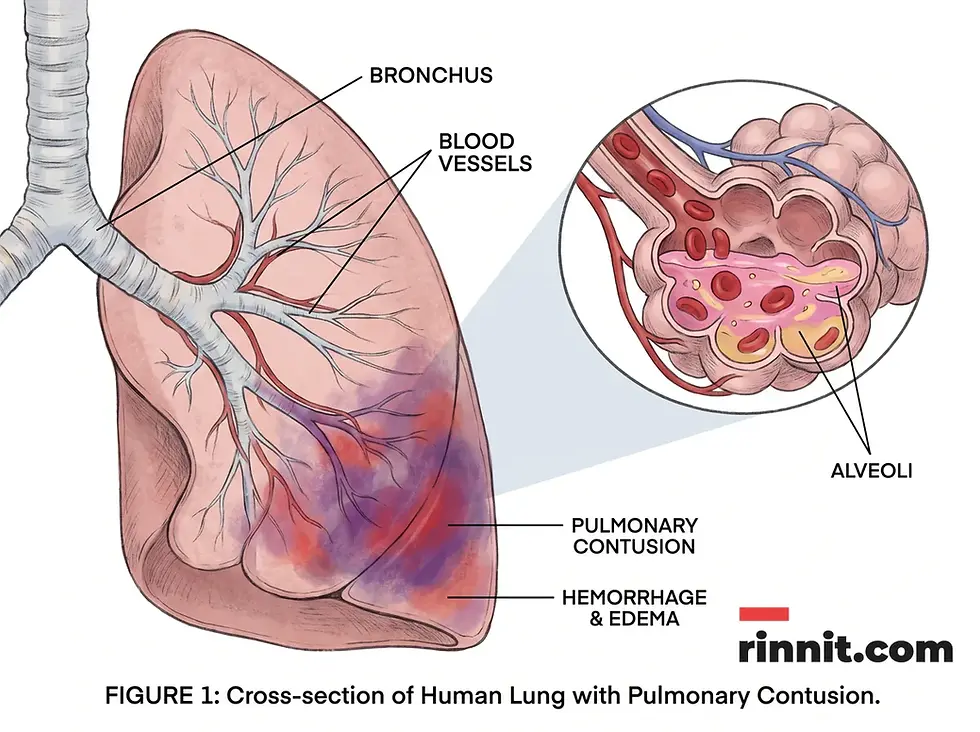
What are the symptoms of a pulmonary contusion?
The signs of a pulmonary contusion can be deceptive. In some cases, a patient may feel relatively fine immediately following an accident, only to develop severe breathing difficulties hours or even days later. This delayed onset makes it critical for anyone who has sustained a chest injury to seek medical attention, regardless of how they feel initially. [1]
Common symptoms of a lung bruise include:
Respiratory distress: Shortness of breath, wheezing, and a persistent cough, which may produce blood. [1]
Cardiovascular signs: A rapid heart rate (tachycardia) and chest pain or pressure. [1]
Physical indicators: Visible bruising or tenderness on the chest wall, dizziness, and cyanosis—a bluish tint to the lips, skin, or fingernails indicating low oxygen levels. [1]
What causes a pulmonary contusion, and who is at risk?
Pulmonary contusions are almost always the result of high-impact trauma. The most frequent cause is a motor vehicle accident, where the chest strikes the steering wheel or dashboard. Other common triggers include falls from significant heights, explosions, or penetrating wounds such as stabbings. The impact force damages the delicate blood vessels surrounding the lungs, leading to the characteristic fluid collection. [1]
While anyone who sustains a chest injury is at risk, certain groups face higher dangers:
Children: Their chest walls are more flexible, which can lead to significant internal lung damage even without visible rib fractures.
High-risk environments: Individuals involved in contact sports, industrial work, or those in areas prone to explosions are at an increased risk of sustaining the blunt force trauma necessary to cause a contusion.

How is a pulmonary contusion managed and treated?
A pulmonary contusion has no specific cure, so treatment supports breathing and prevents complications while the lung tissue heals itself. Instead, medical management focuses on supporting the patient's breathing and preventing secondary complications while the lung tissue heals itself. This process typically takes about a week, though the severity of the injury dictates the length of the hospital stay. [1]
Standard management strategies include:
Respiratory support: This ranges from simple oxygen therapy via a mask to mechanical ventilation in severe cases where the patient cannot breathe independently. [1] [2]
Pulmonary hygiene: A critical part of recovery that involves deep breathing exercises and techniques to help the patient cough up mucus and fluid, reducing the risk of pneumonia. [1]
Surgical intervention: While the bruise itself is not operated on, surgery may be required to repair structural damage to the chest wall or to drain excess fluid from the pleural space. [1]

Conclusion and Next Steps
A pulmonary contusion is a serious, time-sensitive medical emergency that requires professional care. While the initial injury is traumatic, the majority of the danger lies in the potential for respiratory failure and secondary infections like pneumonia. If you or someone you know has sustained a chest injury, immediate evaluation at an emergency department is vital. Consistent use of seatbelts and avoiding high-risk trauma remain the most effective ways to prevent this life-threatening condition.
Frequently Asked Questions
1. Is a pulmonary contusion just a bruise?
While it is technically a bruise, it occurs inside the lung tissue and can be life-threatening by blocking oxygen exchange. [1] [2]
2. How long does it take for a lung bruise to heal?
Most pulmonary contusions take about a week to heal, though recovery from complications may take longer. [1]
3. Can you have a contusion without broken ribs?
Yes, especially in children, the lungs can be severely bruised even if the flexible chest wall does not fracture.
4. What is the biggest risk during recovery?
Pneumonia is a major complication, affecting up to 20% of patients with a pulmonary contusion. [1]
5. Why is "lung hygiene" important?
Lung hygiene helps clear fluid and mucus from the lungs, which is essential for preventing infections and improving breathing. [1]
6. What are the long-term effects?
Some patients may experience reduced lung function or permanent scarring (fibrosis) for years after the injury. [1]
7. What causes the bluish tint in skin or nails?
The bluish tint in skin or nails is called cyanosis, and it happens when the blood does not have enough oxygen due to the lung injury.
8. Should I go to the ER for a minor chest hit?
If you have any trouble breathing or chest pain, you should be evaluated immediately, as symptoms can be delayed. [1]
9. Is surgery always needed for a contusion?
No, surgery is typically reserved for repairing other chest injuries or draining fluid, not the bruise itself.
10. What is the mortality rate for this injury?
Studies estimate the mortality rate to be between 14% and 40%, depending on the severity and complications. [1]
Related Reading
Rib Fracture: Symptoms, Causes, and Recovery Guide explains broken ribs, which often occur with lung bruising.
Flail Chest: Symptoms, Causes, Diagnosis, Treatment and Outlook — What You Need to Know covers a severe rib injury closely linked to pulmonary contusion.
Pneumothorax: Understanding Collapsed Lung Causes and Care explains collapsed lung, another common chest injury.
Hemothorax: What It Is, Why It Happens, and How It's Treated explains blood collecting around the lung after chest trauma.
References
Cleveland Clinic. Pulmonary Contusion. Cleveland Clinic. Last updated Sep. 29, 2023. https://my.clevelandclinic.org/health/diseases/pulmonary-contusion
Ganie FA, Lone H, Lone GN, et al. Lung contusion: a clinico-pathological entity with unpredictable clinical course. Bull Emerg Trauma. 2013;1(1):7-16. PubMed. PMID: 27162815.
Zingg SW, Millar DA, Goodman MD, Pritts TA, Janowak CF. The association between pulmonary contusion severity and respiratory failure. Respir Care. 2021;66(11):1665-1672. doi:10.4187/respcare.09145. PMID: 34584011.
Van Diepen MR, Wijffels MME, Verhofstad MHJ, Van Lieshout EMM. Classification methods of pulmonary contusion based on chest CT and the association with in-hospital outcomes: a systematic review of literature. Eur J Trauma Emerg Surg. 2024;50(6):2727-2740. doi:10.1007/s00068-024-02666-w. PMID: 39251438.
Medical Disclaimer
This article is for informational purposes only and does not constitute medical advice. Always seek the advice of your physician or other qualified health provider with any questions you may have regarding a medical condition. Never disregard professional medical advice or delay in seeking it because of something you have read here.



Comments