Prefrontal Cortex: Location, Functions, Development and Brain Health

Updated: 2 days ago
Medically reviewed by Dr. Baraa Alnahhal, MD · Last reviewed: October 2026
Quick Answer: What is the prefrontal cortex?
The prefrontal cortex is the front part of the brain, behind the forehead, within the frontal lobe. It manages executive functions such as attention, planning, decision-making, emotional regulation and self-control. It keeps developing through adolescence, with myelination usually finishing in the mid-20s. Conditions and injuries can affect focus, judgment and mood, while learning and physical activity support neuroplasticity. [1]
What the research says
Brain regions mature in sequence, and higher-order areas come later. In a study that followed 13 healthy children with MRI scans every 2 years for 8–10 years (ages 4–21), higher-order association cortices matured only after the lower-order sensory and visual areas they integrate (Gogtay et al., Proceedings of the National Academy of Sciences of the United States of America, 2004). A 2022 review adds that neuron differentiation and synapse development in the prefrontal cortex extend into the third decade of life (Kolk & Rakic, Neuropsychopharmacology, 2022). [2] [3]
Aerobic fitness training showed its largest cognitive benefit for executive control. A meta-analysis of 18 intervention studies in healthy but sedentary older adults found robust but selective cognitive benefits, with the largest gains in executive-control processes (Colcombe & Kramer, Psychological Science, 2003). [4]
Mindfulness training had small-to-moderate effects on several attention and executive skills. A meta-analysis of 111 randomized controlled trials (9,538 participants) found small-to-moderate effects on global cognition, executive attention, working memory accuracy, inhibition accuracy and sustained attention versus waitlist or no treatment (effect sizes about 0.26–0.64) (Zainal & Newman, Health Psychology Review, 2024). [5]

What is the prefrontal cortex?
The prefrontal cortex is the front part of the brain located behind the forehead. It helps manage thinking, emotions and behavior by supporting executive functions. [1]
Executive functions are the mental skills used to plan, make decisions, solve problems, stay focused and adjust to new situations. These abilities shape everyday activities, from organizing a task to pausing before reacting. [1]
The prefrontal cortex is part of the frontal lobe and works as one part of a larger brain network. It is important to many aspects of daily life, but a single brain area does not independently explain every thought, emotion, behavior or personal characteristic. [1]
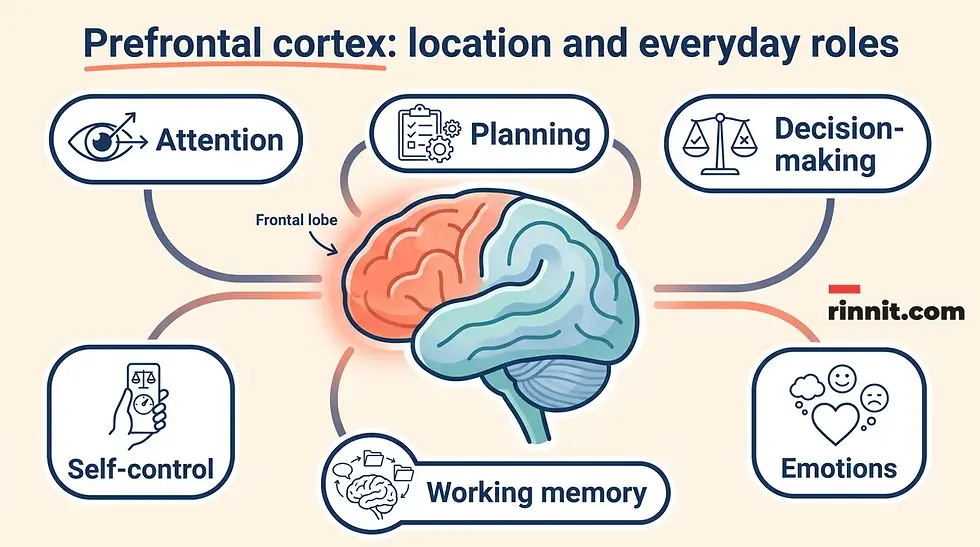
Where is the prefrontal cortex located?
The prefrontal cortex is above and behind the eyebrows and forehead, in the front portion of the brain’s frontal lobe. [1]
Its location helps explain why it is often discussed in relation to planning, attention, judgment, decision-making and behavior. However, its functions depend on connections with other brain regions rather than on the prefrontal cortex acting alone.
Anatomic description | Meaning |
Front part of the brain | Located toward the front of the brain |
Behind the forehead | Positioned above and behind the eyebrows |
Part of the frontal lobe | A region within the brain’s frontal lobe |
Connected system | Works with other brain areas to support complex skills |
What does the prefrontal cortex do?
The prefrontal cortex helps guide many everyday skills. Its functions are often grouped under executive functions because they help a person direct attention, behavior and choices toward a goal. [1]
Function | What it helps with |
Attention | Staying focused and filtering out distractions |
Decision-making | Thinking through choices and directing behavior |
Emotional understanding | Understanding feelings, showing empathy and responding to rewards or consequences |
Goal setting | Using past experiences to manage actions instead of acting only on impulse |
Self-control | Pausing automatic reactions and choosing a response |
Working memory | Holding information briefly so it can be used right away |
Adaptation | Adjusting behavior when situations or rules change |
These skills overlap. For example, completing a long-term goal may involve working memory, attention, planning, self-control and the ability to adapt when circumstances change.
What are the parts of the prefrontal cortex?
The prefrontal cortex has several sections. Each contributes to different skills, and the sections work together rather than operating as completely separate systems. [1]
Section | Functions described in relation to the prefrontal cortex |
Dorsolateral prefrontal cortex | Planning, problem-solving, working memory and filtering distractions |
Anterior cingulate cortex | Emotional regulation, choices, task switching and autonomic functions such as heart rate and blood pressure |
Medial prefrontal cortex | Adjusting behavior when rules change |
Ventromedial prefrontal cortex | Judging experiences as good or bad |
Orbitofrontal cortex | Decision-making, impulse control and linking visual cues with outcomes or rewards |
The boundaries and functions of these regions are complex. A table can introduce the broad roles, but it cannot determine what an individual symptom or scan means.
How does the prefrontal cortex develop?
The basic structure of the prefrontal cortex forms during childhood, but the region continues changing through the teen years and into early adulthood. [1]
During development, the brain strengthens connections it uses frequently and lets go of some connections it does not need. It also adds myelin, a protective covering around some nerve fibers. Myelination helps signals travel faster and more smoothly from one part of the brain to another. [1]
The prefrontal cortex is one of the last parts of the brain to finish myelination. This usually happens in the mid-20s, although fine-tuning may continue longer. This is an approximate developmental pattern, not a fixed deadline that applies identically to every person. [1]
Developmental process | How it relates to the prefrontal cortex |
Childhood structure | The basic structure forms during childhood |
Teen years and early adulthood | Connections continue to change and mature |
Connection strengthening | Frequently used pathways become stronger |
Connection refinement | Some less-used pathways are reduced |
Myelination | Protective insulation helps signals travel more efficiently |
Functional development | Judgment, self-control and long-term planning improve over time |
What conditions can affect the prefrontal cortex?
The prefrontal cortex may be involved in many neurological and mental-health conditions. Examples include attention-deficit/hyperactivity disorder, bipolar disorder, brain tumor, depression, epilepsy, obsessive-compulsive disorder, Parkinson’s disease, schizophrenia, stroke, substance use disorders and traumatic brain injury.
These conditions have different causes, patterns and treatments. Mentioning a condition in relation to the prefrontal cortex does not mean that every person with that condition has the same brain changes or symptoms.
Condition category | Examples |
Attention and mood-related | ADHD, bipolar disorder and depression |
Neurological | Epilepsy and Parkinson’s disease |
Brain and blood-flow conditions | Brain tumor, stroke and traumatic brain injury |
Compulsive or psychotic disorders | OCD and schizophrenia |
Substance-related | Substance use disorders |
What can happen if the prefrontal cortex is damaged?
Damage to the prefrontal cortex can affect how a person thinks, feels and acts. It may change personality, judgment, emotional control or behavior. [1]
A person may have more difficulty planning, making decisions, adapting when circumstances change, staying focused, remembering information or managing impulses. Speech and intelligence can remain intact even when everyday tasks become more challenging. [1]
The effects depend on the nature and extent of the injury and on the brain networks involved. An article cannot identify whether a particular change is due to prefrontal-cortex damage, another neurological condition, a mental-health condition, medication, sleep, stress or another factor.
What are possible signs that prefrontal-cortex skills are affected?
Possible changes include difficulty setting long-term goals, impulsiveness, loss of motivation, mood swings, poor judgment, trouble staying focused and trouble with planning or memory. [1]
These changes have many possible explanations. Tell a healthcare professional if they affect daily life, work, relationships or safety. A clinician can help look for the cause and discuss options that fit the person’s needs.
Possible change | Why professional context matters |
Difficulty with long-term goals | Can have different neurological, emotional or situational causes |
Impulsiveness | Does not by itself identify a brain injury or a specific diagnosis |
Loss of motivation | May occur with many health or life circumstances |
Mood swings | Need context, timing and other symptoms for proper evaluation |
Poor judgment | May reflect several possible changes in health or environment |
Trouble focusing | Can have many causes beyond the prefrontal cortex |
Planning or memory difficulty | Requires consideration of the person’s history and daily function |
Sudden, severe or rapidly changing neurological or behavioral symptoms, especially after a head injury, need prompt medical attention. Seek emergency help for signs such as sudden weakness, a seizure, loss of consciousness, severe confusion or difficulty breathing.

What is neuroplasticity?
Neuroplasticity is the brain’s ability to build new pathways and strengthen existing ones when a person learns, practices or repeats activities. [1]
The prefrontal cortex can continue to change and adapt after it has fully developed. This does not mean that every brain problem can be reversed or that a particular activity will treat a condition. It means that the brain retains some capacity to adjust throughout life.
How can someone support prefrontal-cortex skills?
General activities described as supporting neuroplasticity and prefrontal-cortex-related skills include learning a new skill, managing stress, practicing mindfulness or meditation and staying physically active.
These activities are not a substitute for evaluation or treatment when changes in focus, mood, behavior or memory affect daily life. A healthcare professional can help an individual choose appropriate activities, particularly after a brain injury or when another condition is present.
General activity | Connection to ongoing brain adaptation |
Learning a new skill | Provides repeated practice that can engage new pathways |
Managing stress | Supports the ability to respond deliberately rather than automatically |
Mindfulness or meditation | Offers structured practice in attention and awareness |
Physical activity | Supports general brain and body health when appropriate for the individual |
What questions should you ask a professional about prefrontal cortex health?
Could my changes in focus, mood, motivation, judgment or behavior have more than one possible cause?
What information about timing, injury, medicines, sleep or daily function would help with evaluation?
Do I need an assessment for attention, memory, mood or executive functions?
Could a head injury or another neurological condition contribute to these changes?
Which activities are appropriate for my current health and abilities?
Would learning, stress management, mindfulness or physical activity be safe for me?
Which sudden or severe changes should prompt emergency care?
What follow-up would help track changes over time?
Conclusion
The prefrontal cortex is the front part of the brain behind the forehead. It helps coordinate executive functions such as attention, planning, decision-making, problem-solving, emotional regulation, self-control, goal setting and working memory. [1]
It develops over many years, with myelination usually finishing in the mid-20s, and it can continue adapting through neuroplasticity. Conditions and injuries may affect focus, judgment, motivation, mood or impulse control, but no single symptom identifies a specific cause. [1]
Learning new skills, managing stress, practicing mindfulness or meditation and staying physically active may support ongoing brain adaptation. If changes affect daily life or appear suddenly and severely, professional evaluation is the safest next step. [1]
Want a clearer next step for brain-health questions? Read more health articles before speaking with a healthcare professional. [1]
Frequently Asked Questions
What is the prefrontal cortex?
The prefrontal cortex is the front part of the brain behind the forehead. It helps manage thinking, emotions and behavior through executive functions.
Where is the prefrontal cortex located?
The prefrontal cortex is above and behind the eyebrows and forehead, in the front part of the brain’s frontal lobe.
What does the prefrontal cortex control?
The prefrontal cortex helps with attention, decision-making, planning, problem-solving, emotional understanding, self-control, goal setting, working memory and adapting to changing situations. It works with other brain areas rather than controlling every function alone.
Is the prefrontal cortex fully developed at 18?
The prefrontal cortex continues changing through adolescence and early adulthood. Myelination usually finishes in the mid-20s, and fine-tuning may continue longer. Development varies from person to person.
What are the main parts of the prefrontal cortex?
The sections described include the dorsolateral prefrontal cortex, anterior cingulate cortex, medial prefrontal cortex, ventromedial prefrontal cortex and orbitofrontal cortex. Each contributes to overlapping functions.
What can affect the prefrontal cortex?
Conditions and injuries that may involve it include ADHD, bipolar disorder, brain tumor, depression, epilepsy, OCD, Parkinson’s disease, schizophrenia, stroke, substance use disorders and traumatic brain injury.
What are possible signs of prefrontal-cortex changes?
Possible changes include impulsiveness, poor judgment, loss of motivation, mood swings, trouble focusing, difficulty with planning or memory and difficulty setting long-term goals. These signs have many possible causes and do not prove damage to one brain region.
Can the prefrontal cortex change after adulthood?
Yes. Neuroplasticity allows the brain to build new pathways and strengthen existing ones through learning, practice and repetition.
How can someone support neuroplasticity?
General activities described for supporting neuroplasticity include learning a new skill, managing stress, practicing mindfulness or meditation and staying physically active when appropriate.
When should someone seek urgent help?
Sudden, severe or rapidly changing neurological or behavioral symptoms, especially after a head injury, need prompt medical attention. Emergency signs can include sudden weakness, seizure, loss of consciousness, severe confusion or difficulty breathing.
Related Reading
The Frontal Lobe: The Command Center of the Human Brain covers the brain lobe that contains the prefrontal cortex.
ADHD: Complete Guide to Symptoms, Causes, Diagnosis & Treatment explains attention and planning problems linked to frontal brain networks.
Traumatic Brain Injury: Symptoms, Emergency Signs, Diagnosis and Recovery describes head injuries that can affect thinking and behavior.
The Human Brain: Understanding the Master Control Center of Life maps the brain's lobes and what each part does.
References
Cleveland Clinic. Prefrontal Cortex: What It Is, Function, Location & Damage. Cleveland Clinic. Last updated September 29, 2025. https://my.clevelandclinic.org/health/body/prefrontal-cortex
Gogtay N, Giedd JN, Lusk L, et al. Dynamic mapping of human cortical development during childhood through early adulthood. Proc Natl Acad Sci U S A. 2004;101(21):8174-8179. PMID 15148381. https://doi.org/10.1073/pnas.0402680101
Kolk SM, Rakic P. Development of prefrontal cortex. Neuropsychopharmacology. 2022;47(1):41-57. PMID 34645980. https://doi.org/10.1038/s41386-021-01137-9
Colcombe S, Kramer AF. Fitness effects on the cognitive function of older adults: a meta-analytic study. Psychol Sci. 2003;14(2):125-130. PMID 12661673. https://doi.org/10.1111/1467-9280.t01-1-01430
Zainal NH, Newman MG. Mindfulness enhances cognitive functioning: a meta-analysis of 111 randomized controlled trials. Health Psychol Rev. 2024;18(2):369-395. PMID 37578065. https://doi.org/10.1080/17437199.2023.2248222
National Institute on Aging. Brain health. National Institute on Aging. Accessed October 30, 2026. https://www.nia.nih.gov/health/brain-health
National Institute of Neurological Disorders and Stroke. Traumatic Brain Injury (TBI). NINDS. Last reviewed March 13, 2026. https://www.ninds.nih.gov/health-information/disorders/traumatic-brain-injury-tbi
Disclaimer
This article is for general educational purposes and is not a substitute for professional medical advice, diagnosis or treatment. Always seek the advice of a qualified health provider with any questions you may have regarding a medical condition.
It explains prefrontal-cortex location, executive functions, subregions, development, myelination, conditions that may involve it, possible effects of damage and general neuroplasticity-supporting activities. It does not diagnose a neurological or mental-health condition, interpret an individual scan or reduce personality, morality or intelligence to one brain region.



Comments