The Human Brain: Understanding the Master Control Center of Life

Updated: 3 days ago
Medically reviewed by Dr. Baraa Alnahhal, MD · Last reviewed: October 2026
The brain is the body's most complex organ, regulating everything from breathing and heart rate to memory, emotion and decision-making. It has three main parts, the cerebrum, cerebellum and brainstem, and contains about 86 billion neurons plus a roughly equal number of glial cells [1] [2]. The skull, cerebrospinal fluid and three membranes called the meninges protect it. Regular exercise, nutritious meals, enough sleep and staying mentally and socially active help keep it healthy [1].
Quick Answer: What is the brain?
The brain is a major organ that regulates movement, memory, emotion and automatic processes such as breathing and heart rate [1]. Its three main parts are the cerebrum for conscious thought, the cerebellum for balance and the brainstem for survival functions [1]. It keeps maturing until the mid to late 20s [1], and staying healthy takes activity, engagement and enough sleep.
What the research says
The human brain has about 86 billion neurons. Counting cells in adult male brains, researchers found an average of 86.1 billion neurons and 84.6 billion non-neuronal cells, so the two types are roughly equal in number, and only 19% of all neurons sit in the cerebral cortex (Azevedo et al., J Comp Neurol, 2009) [2].
Physical activity is linked to a lower risk of dementia. A systematic review and meta-analysis of 58 prospective studies found that physical activity was associated with a 20% lower risk of all-cause dementia (relative risk 0.80, 95% CI 0.77 to 0.84; 257,983 participants), including in follow-ups of 20 years or more (Iso-Markku et al., Br J Sports Med, 2022) [3].
The Essential Functions of the Human Brain
The brain serves as the central processing unit of the body, managing a wide range of life-sustaining and cognitive functions. It interprets signals from the five senses (sight, smell, sound, touch and taste) and turns them into meaningful experiences [1]. It also regulates automatic behaviors that occur without conscious effort, such as heart rate, sleep cycles and body temperature [1].
The brain is also the seat of individuality, housing memories, emotions and decision-making [1]. It coordinates movement, balance and coordination, and it handles speech and language [1]. The prefrontal cortex, one of the last areas to mature, helps you make decisions, prioritize tasks and regulate emotions, and this development continues into a person's mid to late 20s [1].
Function Category | Examples of Brain Regulation |
Automatic Processes | Breathing, heart rate, sleep and temperature control [1]. |
Cognitive Abilities | Thought, decision-making, reasoning and memory [1]. |
Motor and Coordination | Voluntary movement, balance and fine motor skills [1]. |
Sensory Processing | Interpreting vision, hearing, smell, taste and touch [1]. |
Speech and Emotion | Speech and language, emotions and the fight-or-flight (stress) response [1]. |
Anatomical Structure and Protective Layers
The brain has three main parts, each with its own responsibilities.
Cerebrum: The largest part. It handles higher-level functions such as speech, memory, reasoning and judgment, and it is split into left and right hemispheres joined by the corpus callosum [1].
Cerebellum: Located at the back of the brain around the brainstem, it maintains balance, posture, coordination and fine motor skills [1].
Brainstem: It connects the brain to the spinal cord and regulates automatic functions such as heart rate, breathing, sleep and wake cycles, and swallowing [1].

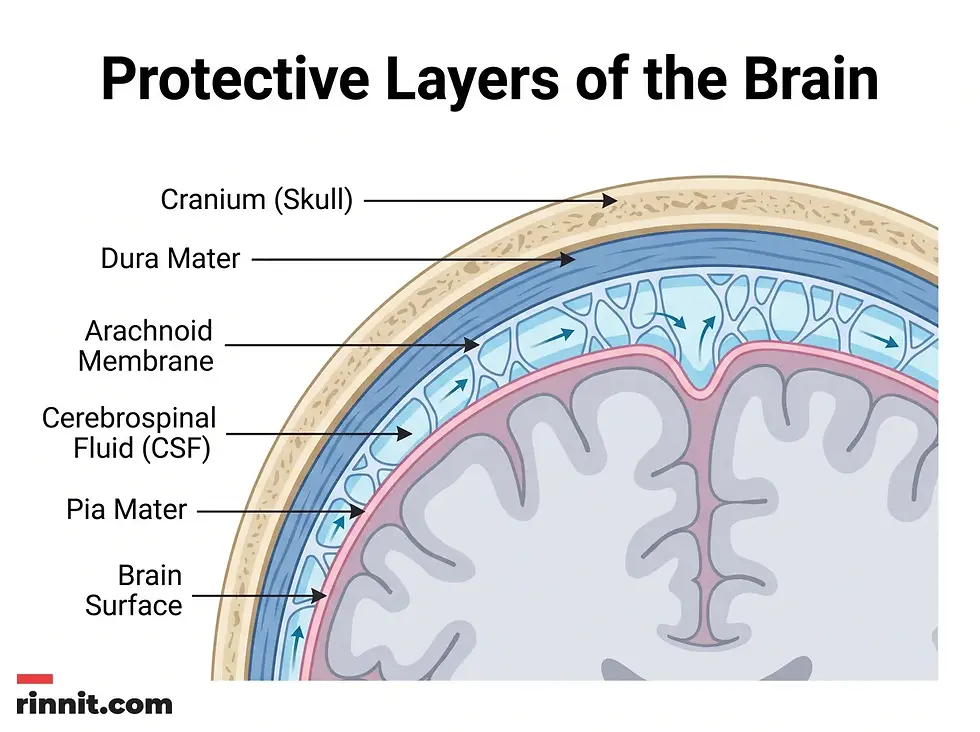
To protect its delicate tissue, the brain is surrounded by the cranium (part of the skull) and floats in cerebrospinal fluid (CSF) [1]. Between the brain and the skull are three layers of tissue called the meninges: the dura mater, the outermost layer that lines the cranial vault; the arachnoid membrane, the middle layer that covers the entire brain; and the pia mater, the innermost layer, which contains blood vessels that run into the brain's surface [1].
The Four Lobes of the Cerebrum
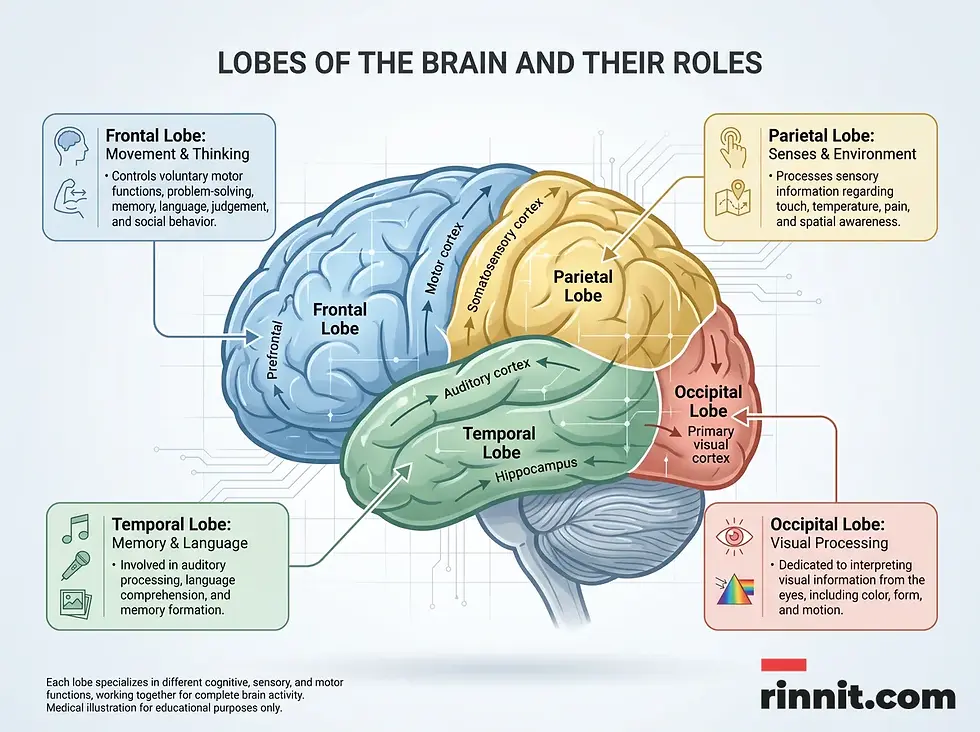
On each side of the cerebrum there are four lobes, each with different functions [1].
Frontal lobe: The largest lobe, behind the forehead. It controls voluntary movement, thinking, learning and social understanding [1].
Occipital lobe: At the back of the brain, it processes and interprets visual information from the eyes [1].
Parietal lobe: Near the upper back of the brain, it receives and interprets signals so you can understand your environment and the state of your body [1].
Temporal lobe: On the side of the head near the ears, it helps you retrieve memories and understand language and emotions [1].
Cellular Composition and Tissue Types
The human brain contains close to 86 billion neurons, specialized nerve cells that send and receive electrical and chemical signals [1] [2]. It also contains about an equal number of glial cells [1] [2], which help maintain the brain, provide nutrition and form myelin, the fatty protective substance found in white matter [1].
These cells are organized into two kinds of tissue. Gray matter, the darker outer layer known as the cerebral cortex, helps with day-to-day functioning such as muscle control, using your senses, remembering, experiencing emotions and speech [1]. White matter, the lighter tissue beneath it, sends signals between different parts of the central nervous system [1].
Tissue or Cell Type | Primary Role |
Gray matter | Everyday processing such as muscle control, senses, memory and speech; often compared to a computer [1]. |
White matter | Sends signals between brain regions; often compared to a computer's cables [1]. |
Neurons | Nerve cells that send and receive electrical and chemical signals [1]. |
Glial cells | Support cells that maintain the brain, form myelin and provide nutrition [1]. |
Common Conditions and Proactive Brain Care
Because the brain is involved in nearly everything the body does, brain conditions are common and vary widely in severity. Examples include neurodegenerative diseases such as Alzheimer's disease and Parkinson's disease, as well as stroke, brain bleeds, concussion and traumatic brain injury [1]. Epilepsy, brain tumors and multiple sclerosis are other examples; sudden face drooping, arm or leg weakness, trouble speaking, vision loss or a severe headache can signal a stroke, so call 911 right away [1].
Looking after your brain involves both lifestyle and safety. Meeting up with friends, doing puzzles or meditating to reduce stress, eating nutritious meals, exercising regularly and getting enough sleep are all helpful [1] [3]. Wearing protective gear such as helmets and seat belts can help prevent head injuries.
Conclusion
The brain is an extraordinary organ, the control center behind our thoughts, movements and very sense of self. Its parts and billions of specialized cells work together to regulate both conscious actions and life-sustaining automatic processes. Understanding its structure and taking proactive steps to protect it can support long-term health and quality of life.
Next step: If you have concerns about your neurological health or notice symptoms such as persistent headaches or memory loss, consult a healthcare professional for a comprehensive evaluation.
Frequently Asked Questions
What are the three main parts of the brain?
The three main parts are the cerebrum, the cerebellum and the brainstem.
What does the cerebrum do?
The cerebrum interprets the five senses and regulates conscious actions such as speech, memory, reasoning, judgment and voluntary movement.
How much does an adult brain weigh?
An adult human brain weighs about 3 pounds on average. The weight varies with sex and body size.
When does the brain stop developing?
Most development happens between birth and the teenage years, but the brain keeps maturing through the mid to late 20s.
What is the difference between gray and white matter?
Gray matter is the darker outer tissue that handles everyday processing, while white matter sends signals between different regions of the nervous system.
How many neurons are in the human brain?
There are close to 86 billion neurons, along with about an equal number of glial cells.
What are the meninges?
The meninges are three layers of tissue between the brain and the skull: the dura mater, the arachnoid membrane and the pia mater.
Which lobe is responsible for vision?
The occipital lobe, at the back of the brain, processes and interprets visual information.
What is the role of the brainstem?
The brainstem regulates automatic functions such as heart rate, breathing, sleep and wake cycles, and swallowing, and it connects the brain to the spinal cord.
How can I protect my brain health?
Stay socially and mentally active, manage stress, eat nutritious meals, exercise regularly, get enough sleep, and use protective gear such as helmets and seat belts.
Related Reading
The Frontal Lobe: The Command Center of the Human Brain explains how the frontal lobe controls planning, behavior and movement.
Stroke: Symptoms, Causes, Diagnosis, and Treatment — A Complete Guide explains stroke warning signs and why fast emergency care matters.
Epilepsy: Seizures, Symptoms, Causes, and Treatment covers seizure types, epilepsy causes and current treatment options.
Alzheimer's Disease: Symptoms, Causes, Treatment & Complete Guide explains Alzheimer's symptoms, stages and available treatments.
References
Cleveland Clinic. Brain. Cleveland Clinic. Last updated January 25, 2025. https://my.clevelandclinic.org/health/body/22638-brain
Azevedo FAC, Carvalho LRB, Grinberg LT, et al. Equal numbers of neuronal and nonneuronal cells make the human brain an isometrically scaled-up primate brain. J Comp Neurol. 2009;513(5):532-541. PMID 19226510. https://doi.org/10.1002/cne.21974
Iso-Markku P, Kujala UM, Knittle K, et al. Physical activity as a protective factor for dementia and Alzheimer's disease: systematic review, meta-analysis and quality assessment of cohort and case-control studies. Br J Sports Med. 2022;56(12):701-709. PMID 35301183. https://doi.org/10.1136/bjsports-2021-104981
Medical disclaimer
The information provided in this article is for educational purposes only and should not be used as a substitute for professional medical advice, diagnosis, or treatment. Always seek the advice of your physician or other qualified health provider with any questions you may have regarding a medical condition.



Comments