Postural Drainage: Techniques for Airway Clearance

Updated: 3 days ago
Medically reviewed by Dr. Baraa Alnahhal, MD · Last reviewed: October 2026
Quick Answer: What Is Postural Drainage?
Postural drainage is a form of chest physiotherapy that uses specific body positions and gravity to clear mucus from the lungs. Tilting lung segments toward the central airways helps trapped secretions move so they can be coughed out. It is often combined with percussion and vibration and can ease breathing for people with conditions like cystic fibrosis or COPD. [1]
What the research says
Airway clearance techniques appear safe in stable bronchiectasis, but the evidence is limited. A Cochrane review of 7 randomized trials (105 participants) found that airway clearance techniques appear safe in adults and children with stable bronchiectasis and may improve sputum expectoration, selected lung function measures, symptoms, and quality of life. The evidence was low quality, and their role during flare-ups was unknown (Lee et al., Cochrane Database Syst Rev, 2015).
No single airway clearance technique has been shown to be best in cystic fibrosis. A Cochrane review of 21 studies (778 participants) found no difference in lung function (FEV1 and FVC) between conventional chest physiotherapy and alternative techniques. All evidence was of very low certainty, and participants tended to report preferring techniques they could do themselves (Main & Rand, Cochrane Database Syst Rev, 2023).
During bronchiectasis flare-ups, all techniques studied appeared safe for adults. A systematic review of 6 studies (120 participants) reported no adverse reactions, and suggested the active cycle of breathing technique may be more effective than postural drainage and percussion at improving gas exchange, sputum volume, and quality of life (Phillips et al., Physiother Theory Pract, 2020).
Research summaries are based on article abstracts retrieved from PubMed.
Which conditions are managed with postural drainage?
Many respiratory and neuromuscular conditions make it hard to clear mucus, so postural drainage is often part of daily management. The table below lists the main conditions where healthcare providers may recommend it. [1]
Condition | Respiratory Impact | Role of Postural Drainage |
Cystic Fibrosis | Production of thick, sticky mucus | Facilitates removal of dense secretions |
COPD | Chronic inflammation and mucus buildup | Clears obstructed airways to improve airflow |
Bronchiectasis | Permanently widened and damaged airways | Prevents mucus pooling in damaged segments |
Pneumonia | Infection causing fluid and mucus in lungs | Assists in clearing inflammatory debris |
Atelectasis | Partial or complete collapse of the lung | Helps re-expand lung tissue by clearing blockages |

How is postural drainage done?
Performing postural drainage effectively requires preparation and a systematic approach to positioning. It is typically carried out under the guidance of a respiratory therapist or healthcare provider who can demonstrate the safest and most effective positions for your needs.
Preparation and Timing
To maximize safety and comfort, postural drainage is best done on an empty stomach, ideally at least 90 minutes after a meal. This timing helps prevent nausea or vomiting during the procedure. Your healthcare provider may also suggest a bronchodilator medication 15 to 30 minutes beforehand to help open the airways and loosen secretions. Tell your provider about any health conditions, especially bleeding or blood pressure problems, before you start. [1]
Positioning and Techniques
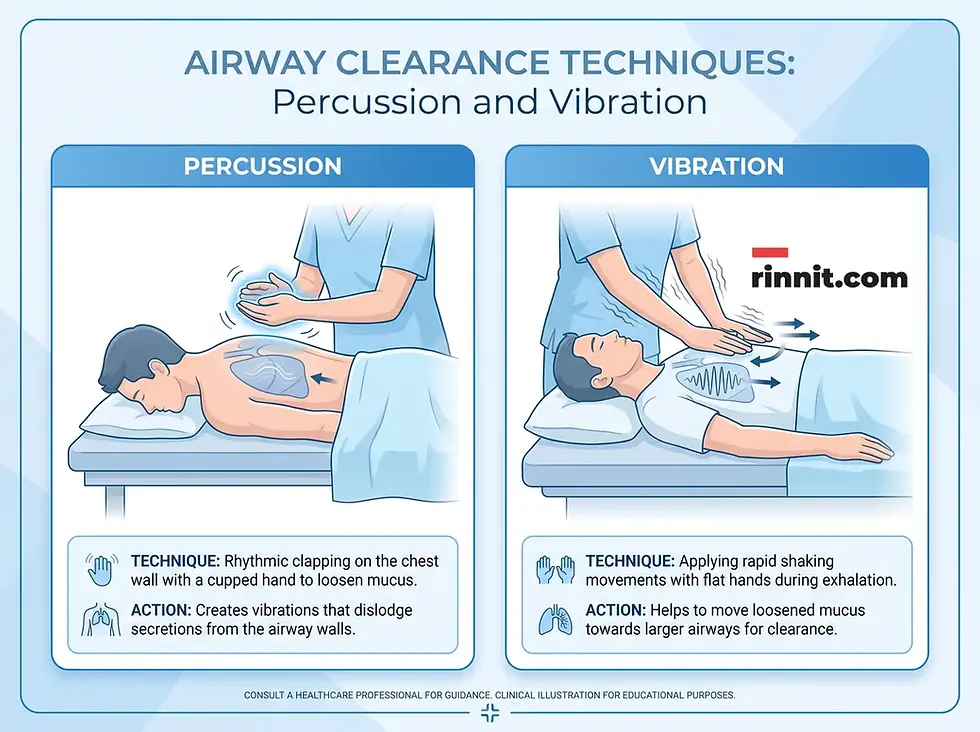
During a session, you are placed in various positions, such as lying on your side, back, or stomach, or sitting upright, depending on which lung segment needs clearing. Pillows or wedges are often used for support. While you are in position, a provider may perform percussion (clapping) or vibration on the chest wall to loosen mucus. You then cough to clear the mucus that has been mobilized. The provider may have you change position and repeat the process to clear other parts of the lungs. [1]
Technique | Description | Primary Function |
Positioning | Using gravity-favorable body angles | Moves mucus toward central airways |
Percussion | Rhythmic clapping on the chest wall | Loosens thick mucus from airway walls |
Vibration | Rapid shaking during exhalation | Helps move loosened mucus upward |
Coughing | Controlled, deep-breathing maneuvers | Clears the mobilized mucus |
What are the risks and safety considerations of postural drainage?
Postural drainage is a standard therapy, but it carries risks, particularly if it is not done correctly or if you have an underlying condition that makes it unsafe. Possible complications include shortness of breath, vomiting, aspiration, low oxygen levels, low blood pressure, bleeding in the lungs, increased pressure inside the head, bronchospasm, abnormal heart rhythm, and rib, spine, or muscle injury. [1]
High-Risk Groups
Some people are at higher risk of complications and should only do postural drainage under close medical supervision. This includes people with a recent rib or spine injury, severe osteoporosis, bleeding in the lungs or a high risk of bleeding, or conditions that affect blood pressure. Using only head-up positions, rather than head-down (Trendelenburg) positions, lowers the risk of many of these complications. [1]

Conclusion
Postural drainage is a gravity-assisted tool for helping clear mucus in people with chronic lung conditions. Used with percussion, vibration, and controlled coughing, it can make breathing easier for many people. Research has not shown that any one airway clearance technique is best for everyone, so the right approach depends on your condition, your comfort, and what you can keep doing consistently. Work with your respiratory therapist or healthcare provider to find the technique that suits you.
Frequently Asked Questions
What is the main goal of postural drainage?
The primary goal is to use gravity to help move mucus from the smaller, peripheral airways to the larger, central airways so it can be coughed out.
How often should postural drainage be performed?
It depends on the underlying condition and how much mucus you produce. Your healthcare provider will set the schedule that fits you.
Is it necessary to have a professional perform it?
Initial sessions should be guided by a respiratory therapist or other healthcare provider. For some conditions, a therapist may recommend positions you can do yourself, sometimes with a percussion vest or an airway clearance (PEP) device, but only after they have shown you how to do it safely.
Why must it be done on an empty stomach?
Performing the techniques shortly after eating can lead to nausea, vomiting, or aspiration, where stomach contents enter the lungs.
What is the difference between percussion and vibration?
Percussion involves rhythmic clapping to loosen mucus, while vibration uses rapid shaking during exhalation to help move the loosened mucus upward.
Can postural drainage be painful?
Postural drainage can feel uncomfortable for some people. If you feel discomfort, tell your healthcare provider so the position or technique can be adjusted. Severe headache, chest pain, or difficulty breathing needs urgent medical attention.
What are head-up drainage positions?
Head-up drainage positions are positions in which your head is not tilted toward the ground. Using only head-up positions lowers the risk of complications such as shortness of breath, low blood pressure, and increased pressure inside the head.
How long does a typical session last?
The length of a typical session varies with the condition and with how many positions are needed to clear the affected parts of the lungs. Your respiratory therapist will tell you how long each position and the whole session should last.
What should I do if I cough up blood?
If you cough up blood during or after postural drainage, stop the procedure immediately and contact your healthcare provider or emergency services.
Can children use postural drainage?
Yes. It is used for children with conditions such as cystic fibrosis, and a specialist adapts the techniques to the child's size and age.
Related Reading
Chest Physiotherapy (Chest PT): Techniques, Uses and Benefits explains chest physiotherapy for clearing mucus.
References
Cleveland Clinic. Postural drainage. Cleveland Clinic. Last updated April 13, 2026. https://my.clevelandclinic.org/health/treatments/postural-drainage
Lee AL, Burge AT, Holland AE. Airway clearance techniques for bronchiectasis. Cochrane Database Syst Rev. 2015;2015(11):CD008351. PMID: 26591003. DOI: https://doi.org/10.1002/14651858.CD008351.pub3
Main E, Rand S. Conventional chest physiotherapy compared to other airway clearance techniques for cystic fibrosis. Cochrane Database Syst Rev. 2023;5(5):CD002011. PMID: 37144842. DOI: https://doi.org/10.1002/14651858.CD002011.pub3
Phillips J, Lee A, Pope R, et al. Effect of airway clearance techniques in patients experiencing an acute exacerbation of bronchiectasis: a systematic review. Physiother Theory Pract. 2020;36(12):1300-1315. PMID: 30776932. DOI: https://doi.org/10.1080/09593985.2019.1579286
Medical disclaimer
This article is for informational purposes only and is not a substitute for professional medical advice, diagnosis, or treatment. Always seek the advice of your physician or other qualified health provider with any questions you may have about a medical condition.



Comments