Plasmacytoma: Understanding This Rare Blood Cancer

Updated: 2 days ago
Medically reviewed by Dr. Baraa Alnahhal, MD · Last reviewed: October 2026
Plasmacytoma is a rare blood cancer involving a single tumor of abnormal plasma cells. While it is highly treatable and often curable with radiation, it requires lifelong monitoring due to the risk of progressing to multiple myeloma.
Quick Answer
Plasmacytoma is a rare form of blood cancer in which antibody-producing plasma cells become cancerous and form a single tumor, either in bone or in soft tissue. Unlike multiple myeloma, which involves multiple sites throughout the body, a plasmacytoma is a localized condition that is often curable with targeted radiation therapy. [1]
What the research says
Clonal plasma cells in the marrow sharply shorten the time without relapse. A single-center study of 147 patients plus a meta-analysis of 62 studies (3,487 patients) found median disease-free survival of 15.7 months in patients with up to 10% clonal marrow plasma cells versus 79 months in true solitary plasmacytoma. Pooled disease-free survival was 66.9% at 3 years, 55% at 5 years, and 42.1% at 10 years, and extramedullary tumors fared better than bone tumors (Charalampous et al., Blood Adv, 2025).
Combining radiation with surgery was linked to the longest survival in a large U.S. registry. Among 9,427 patients (73% bone, 27% extramedullary), median overall survival was 106 months for bone and 146 months for extramedullary tumors. Radiation plus surgery (181 months) was associated with longer survival than surgery alone (137 months) or radiation alone (116 months), and survival rose with higher radiation doses. This was a retrospective analysis, so it shows association rather than proof (Saba et al., Am J Clin Oncol, 2026).
Certain features flag a higher chance of progressing to myeloma. A narrative review found that high-risk cytogenetic abnormalities, tumor size, age, and persistent M-protein after treatment predict progression to multiple myeloma, and called for standardized risk stratification to guide monitoring (Purow et al., Cureus, 2025).
Research summaries are based on article abstracts retrieved from PubMed.
What Is Plasmacytoma?
Plasmacytoma is closely related to multiple myeloma but is considered a less advanced stage of plasma cell malignancy. In this condition, abnormal plasma cells multiply and produce a specific protein called M protein, eventually clumping together to form a tumor. Because these cells are part of the immune system, their malfunction can impact the body's ability to fight infections. [1]
The condition is rare and typically diagnosed in individuals in their 50s or 60s, with a higher prevalence among males. While many cases are successfully treated, the primary clinical concern is the potential for the disease to return or evolve into multiple myeloma, a more systemic and serious form of blood cancer. [1]
Type | Primary Location | Progression Risk to Myeloma |
Solitary Plasmacytoma of Bone (SPB) | Spine, pelvis, ribs, or other bones | Over 50% |
Extramedullary Plasmacytoma (EMP) | Soft tissue (90% in head/neck) | Approximately 30% |
Symptoms and Clinical Presentation
Symptoms of a plasmacytoma depend largely on the tumor's location and whether it is pressing on surrounding structures. [1]
Bone Involvement (SPB)
Tumors in the bone often lead to localized bone pain or unexplained fractures. The spine, pelvis, and ribs are the most frequent sites for these solitary lesions.
Soft Tissue Involvement (EMP)
Extramedullary tumors most commonly occur in the upper respiratory tract, including the sinuses, nasal cavity, and throat. Symptoms may include:
Persistent nasal congestion or discharge.
Frequent nosebleeds and sore throat.
Difficulty swallowing or hoarseness in the voice.
Back pain or weakness if a tumor presses on the spinal cord. [1]

Diagnosis and Classification
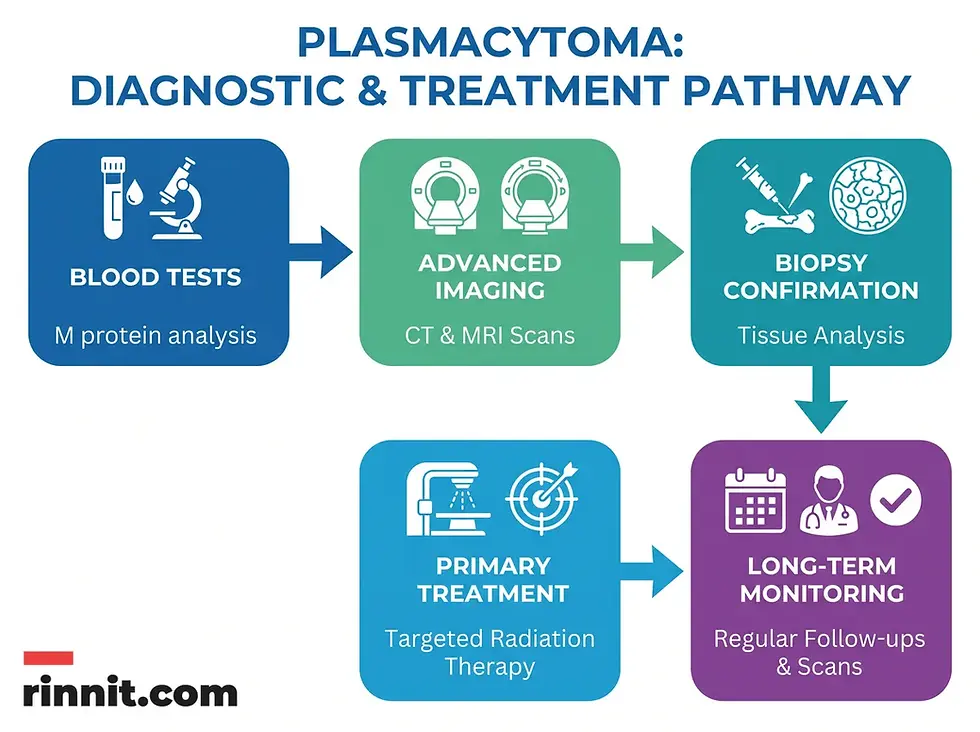
Differentiating a plasmacytoma from multiple myeloma is critical for determining the correct treatment path. A plasmacytoma diagnosis is confirmed when there is only one localized tumor and fewer than 10% abnormal plasma cells in the bone marrow. [1]
Diagnostic Tools
Healthcare providers utilize a combination of laboratory and imaging tests to confirm the diagnosis:
Lab Tests: Blood and urine tests are used to measure levels of M protein and check for abnormal blood cell counts.
Imaging: CT scans are typically used for bone tumors, while MRIs are preferred for soft tissue involvement. Whole-body PET/CT or MRI scans may be performed to ensure no other tumors are present.
Biopsy: A tissue sample from the tumor and a bone marrow aspiration are essential to confirm the presence of cancerous plasma cells. [1]
Treatment and Management
The primary goal of treatment is to eliminate the solitary tumor and prevent progression to systemic disease. Radiation therapy is the gold standard and is highly effective, often resulting in a cure for many patients. [1]
Primary Interventions
Radiation Therapy: Usually delivered over several weeks, this targeted treatment is often the only intervention needed for solitary bone lesions.
Surgery: In cases where a tumor causes bone instability or obstructs vital organs, surgical removal may be necessary, typically followed by radiation.
Systemic Therapy: For patients at high risk of developing multiple myeloma, providers may recommend chemotherapy or immunotherapy to target potential cancer cells throughout the body. [1]
Long-Term Outlook and Monitoring
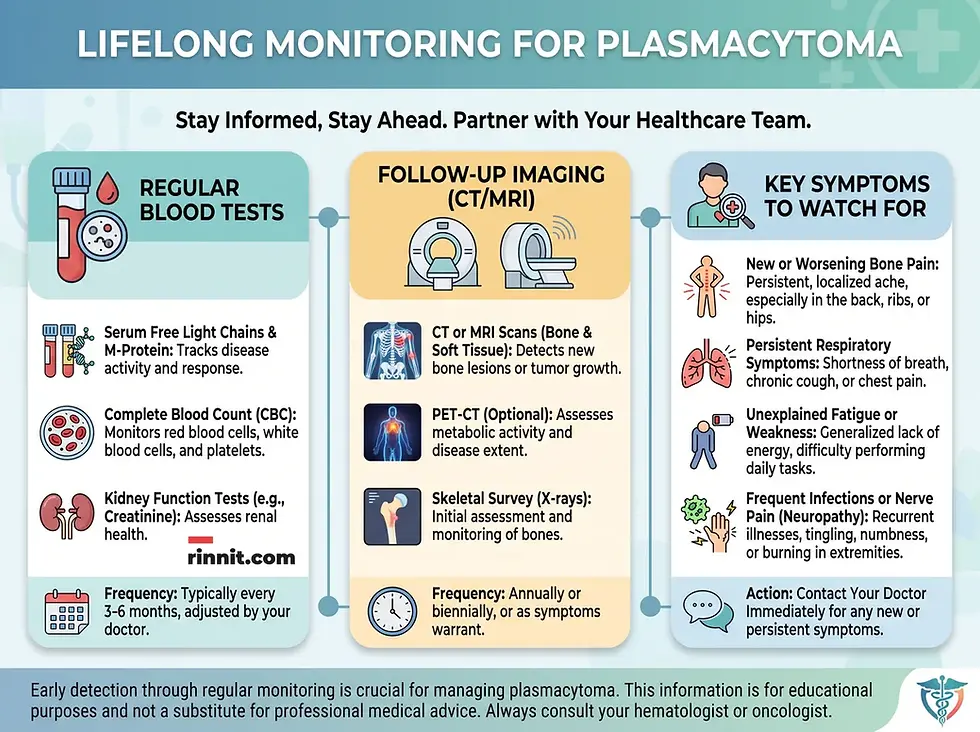
The prognosis for plasmacytoma is generally positive, with five-year survival rates around 77% for bone tumors and 81% for soft tissue tumors. However, because of the significant risk of progression to multiple myeloma, lifelong follow-up care is mandatory. [1]
Monitoring typically involves regular blood work and imaging tests, which are more frequent in the first year following treatment. Early detection of any recurrence or progression is key to managing the condition effectively over the long term. [1]
Conclusion
Plasmacytoma is a rare but highly treatable form of blood cancer. While a diagnosis requires a commitment to lifelong medical surveillance, modern radiation and systemic therapies offer excellent outcomes for most individuals. Early diagnosis and a proactive management plan are essential for maintaining health and preventing the transition to multiple myeloma.
If you experience persistent bone pain or unexplained respiratory symptoms, consult a healthcare professional for evaluation.
Frequently Asked Questions
Is plasmacytoma the same as multiple myeloma?
No, while they involve the same type of cancerous cells, plasmacytoma is a single localized tumor, whereas multiple myeloma is a systemic disease affecting multiple areas.
Can plasmacytoma be cured?
Yes, many solitary plasmacytomas are cured with targeted radiation therapy, although patients require lifelong monitoring.
What is the most common symptom of a bone plasmacytoma?
Localized bone pain is the most frequent symptom, sometimes accompanied by a fracture in the affected area.
Where do extramedullary plasmacytomas usually form?
Approximately 90% of these soft tissue tumors form in the head and neck area, particularly the sinuses and nasal cavity.
What are M proteins?
M proteins are abnormal antibodies produced by cancerous plasma cells; measuring their levels is a key part of diagnosing and monitoring the disease.
Is plasmacytoma contagious?
No, it is a form of cancer and cannot be spread from person to person.
Why is lifelong follow-up necessary?
Lifelong monitoring is required because plasmacytoma has a significant risk of returning or progressing into multiple myeloma.
What is "minimal bone marrow involvement"?
Minimal bone marrow involvement refers to a plasmacytoma diagnosis where less than 10% of the bone marrow cells are abnormal plasma cells. It does not mean multiple myeloma, but it carries a higher risk of developing it.
Does surgery always require radiation?
Radiation therapy is often recommended after surgery to help eliminate any remaining cancerous cells in the localized area. Your care team will decide based on your situation.
Who is most at risk for plasmacytoma?
The condition most commonly affects males and individuals in their 50s and 60s.
Can immunotherapy be used for plasmacytoma?
Yes, immunotherapy is sometimes used for patients at high risk of progression, treating the condition similarly to multiple myeloma.
Related Reading
What Is Multiple Myeloma? A Plain-Language Guide to Symptoms, Causes, and Treatment explains the related plasma cell cancer that affects many sites.
Smoldering Multiple Myeloma (SMM): What It Is, How It's Diagnosed, and What Comes Next — Complete Guide describes this early, symptom-free stage of myeloma and how it is watched.
What Is MGUS? A Plain-Language Guide to This Common, Usually Quiet Blood Condition explains this common plasma cell condition and why it is monitored.
Bone Marrow Biopsy: Why It's Done, What to Expect, Pain and Recovery describes how bone marrow samples are taken and what they show.
References
Cleveland Clinic. Plasmacytoma. Cleveland Clinic Health Library. Last updated April 9, 2026. https://my.clevelandclinic.org/health/diseases/22826-plasmacytoma
Charalampous C, Claveau JS, Kapoor P, et al. Solitary plasmacytoma: single-institution experience, and systematic review and meta-analysis of clinical outcomes. Blood Adv. 2025;9(7):1559-1570. PMID: 39883947. https://doi.org/10.1182/bloodadvances.2024013355
Saba L, Haddad GC, Greskovich J, et al. Clinical features, treatment patterns, and outcomes of solitary plasmacytoma in the United States: a National Cancer Database (NCDB) analysis of years 2004 to 2020. Am J Clin Oncol. Published online March 25, 2026. PMID: 41879814. https://doi.org/10.1097/COC.0000000000001321
Purow JI, Viera A, Crist SM, et al. The prognostic indicators of progression from solitary plasmacytoma to multiple myeloma: a narrative review. Cureus. 2025;17(9):e92844. PMID: 41127777. https://doi.org/10.7759/cureus.92844
Medical disclaimer
This article is for informational purposes only and is not a substitute for professional medical advice, diagnosis, or treatment. Always seek the advice of your physician or other qualified health provider with any questions you may have about a medical condition.



Comments